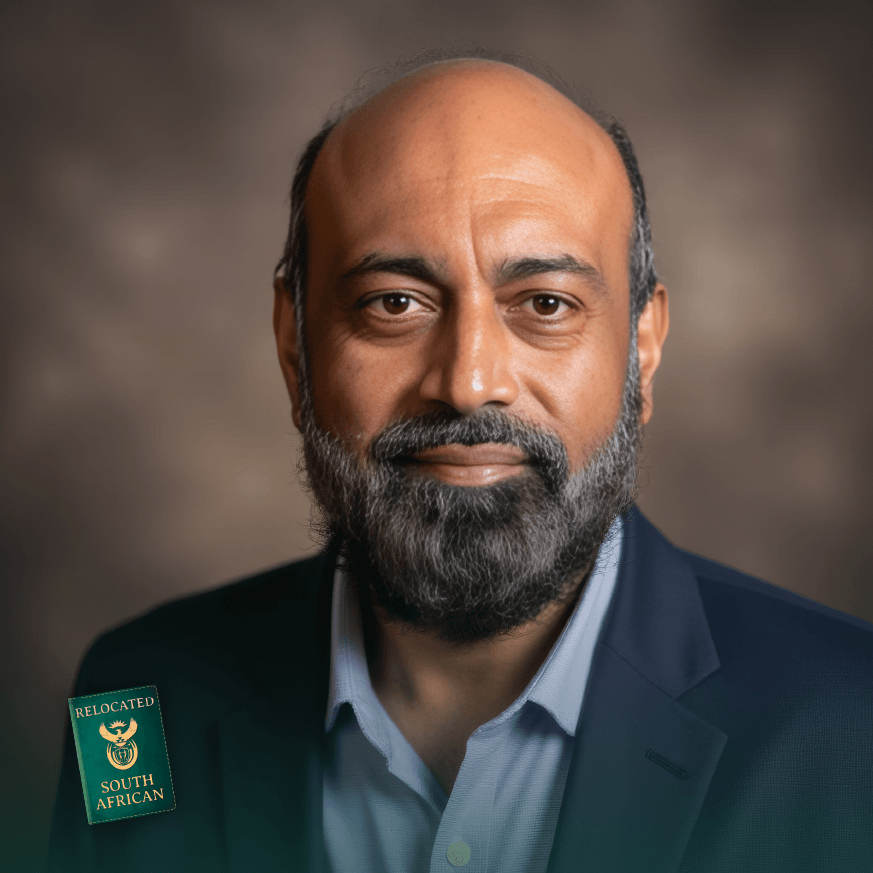
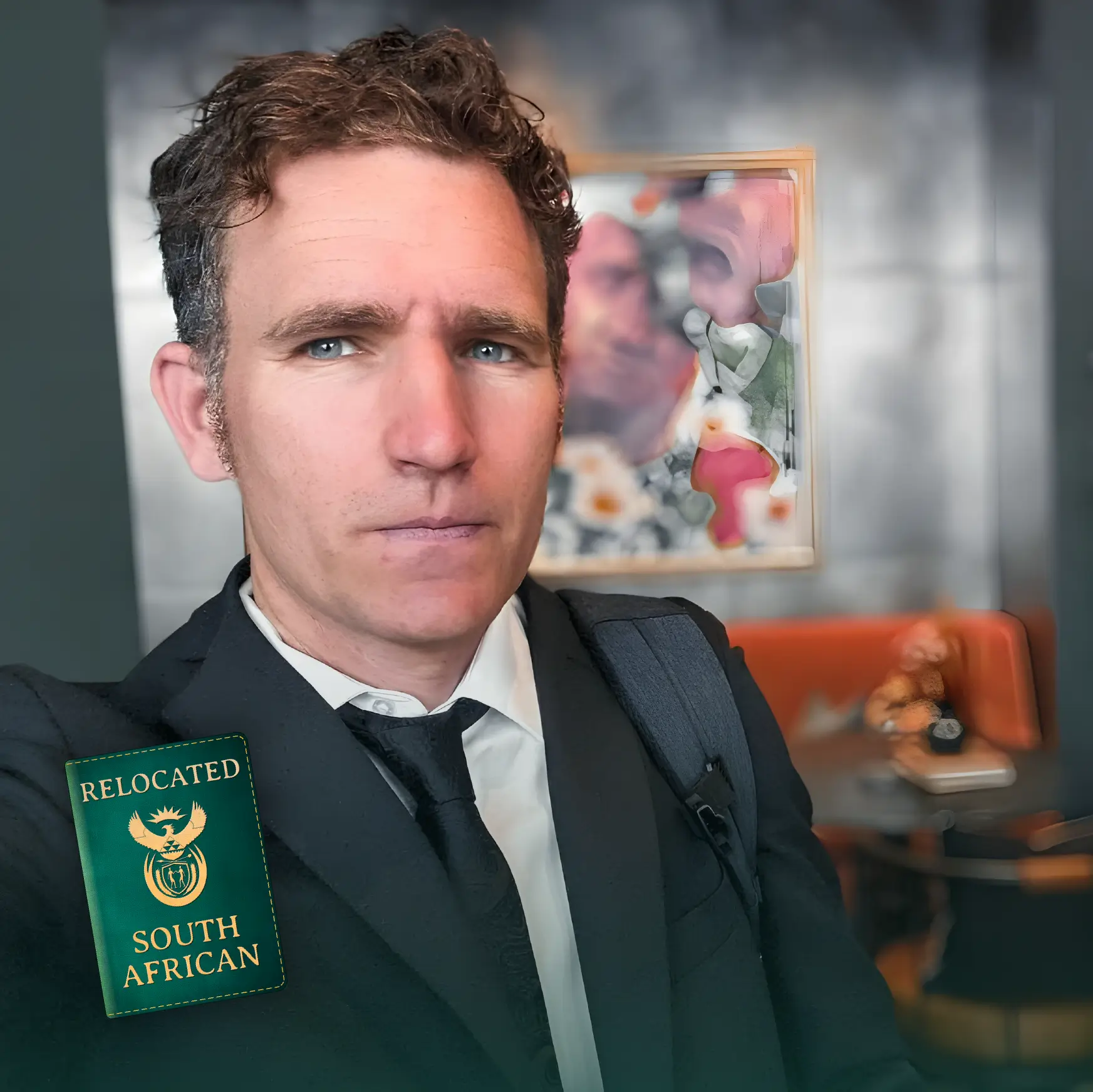
Jan Hugo: Welcome back to The Relocated South African. As always, I am in Lagos, Portugal. Today’s guest spent fifteen years living and working in Johannesburg. In the 1990s, he built a career in transport, IT consulting, outsourcing and business development before taking those experiences onto a global stage.
Today, he coaches professionals, entrepreneurs and business leaders around the world, helping them build better careers, stronger leadership skills and lasting success. He’s also joining us on his birthday today. So, happy birthday, Dr Deepak Bhootra, and great to have you on the show.
Dr Deepak Bhootra: Happy birthday to me. My pleasure. Thanks for the warm welcome, I really enjoyed that. Just to clarify: it’s fifteen years in Johannesburg.
Jan Hugo: Fifteen, okay. That’s excellent, even better. So, Deepak, where are you joining us from today?
Dr Deepak Bhootra: I’m in Houston, Texas: concrete jungle of note. When it rains, nothing gets absorbed, so we learn how to swim in hurricanes.
Jan Hugo: That’s very true. I know Houston a little bit, it’s an interesting city. I’ve been through the tunnels in downtown, that’s also quite interesting.
Dr Deepak Bhootra: In the tunnels, there’s a little pole on the side, a yellow pole. It says fifteen feet, twenty feet, twenty-one feet. That’s when I freaked out, because I asked someone if that was the height of the underpass. The guy said, no, no, no: this is for the water, for when it floods, so that drivers don’t try to be too smart. They look at it and think it can’t be that bad, because the road slants down and then comes back up in an underpass.
And you misjudge that: twenty-one feet of water can accumulate under the underpass. Can you imagine the threat? That’s when I realised the sheer volume of water that can fall in this part of the world. So let me put it this way, sir: I do not go downtown anymore.
Jan Hugo: That is the way. So, Deepak, obviously this is a show for South Africans, let’s go back to South Africa. You went there as a young guy, can you take us back? How did you end up in Johannesburg?
Dr Deepak Bhootra: This is one of the most amazing stories, Jan, that I love sharing. It’s a standard at any party, and when I share it, I usually get invited back again, so it’s not a bad story.
I was born and raised in India, but I travelled the world thanks to my dad’s job. And my dad’s job, unfortunately, only starts once you’ve died: he’s a forensic pathologist. All my friends used to tell me, “Hey Deepak, my throat hurts, can uncle check it for me now?” Sorry, you’ll have to be dead before uncle will check you. Uncle is a forensic pathologist.
I worked with my dad across the world, and he had what I’d call an eclectic taste in death. Some of his projects were quite something: sudden infant death syndrome, for instance, when a baby, parents wake up in the morning to realise the baby has passed in the cradle. He took an interest in that, and I still remember, he used to dictate to me, and I’d type it up on an old Remington Clackety Clack typewriter. At the age of ten or twelve, I’d started typing out his research papers and first drafts. So I’d argue I was traumatised thanks to his work. But how do we get to South Africa? The man is what I’d call a forensic pathologist, nomad of note.
In 1989, he got approached, and he ended up telling us, “Guys, I’ve had this really interesting outreach from the Transkei region: Transkei, Bophuthatswana, Venda, the TBVC states.” They wanted his help setting up mortuaries, and dealing with muti murders and necklace murders, which were a big thing at the time. My dad’s approach to it was purely scientific: for him, if someone had been stabbed, his first question was how big the knife was, not the ethics of it, it was beyond that for him. So he comes to South Africa and calls us, and the first thing he says is, “It’s glorious here, the weather is amazing.” Then he said the people were very friendly, there was a lot of work to do, not enough budget, and so on. He finished his project in six months, and his goal was not to come back.
But what happened is that he’d built a little network in the Northern Transvaal, in old Pietersburg, now Polokwane. They said to him, “Hey, now we’ve got some work, are you interested in coming to work for us?” So my pa was very confused, but he really liked it there. He was concerned about his work status, but he got the right support and applied for permanent residency. Those were the days when even the kids under twenty-one were included, and I was just under twenty-one at the time. So my father put in my paperwork, and voila, we all got approved: the entire family, me and my sister included.
I was going to go to the States to do my MBA straight from India, and dad said, “Come visit us first, come spend some time here.” And I must tell you, Jan, I went, and I absolutely fell in love with the now Polokwane of today, then Pietersburg. Because, having travelled the world, I have a lens that’s very different from other people’s. One is that I don’t do what I call developmental couchonomics: “Did you go to that part of town? What a shit part of town.” You know, those conversations. I went to that part of town, looked at it, and I remembered I’d seen this part of town all over the world, even in America. So I never do that judgment check.
But that’s my story, in simple terms: a nomad father who bred a nomadic corporate nomad, because I’ve lived in Singapore, South Africa, all over the world. When I finished my MBA, and this is a pivotal moment for a lot of people, typically my entire class of Indian extraction stayed on in the US. I was one of the few who said, “No, I’m going to go back.” And when someone asked me where I was going back to, I said, “Going back home.” And home at that point was South Africa for me, because once you’ve become a nomad and travelled the world, you ask, “Where can I get that adventure? Where can I learn?”
And I lived in South Africa. Was it easy? No, it was not easy. I couldn’t speak a lick of Afrikaans, not a single word. Basic stuff, yes, but to really speak it, you need to be able to stop someone on the street and have a two-minute conversation to make sure you don’t die of hunger or thirst. That much I can do now. The sense of humour, I enjoyed. But yeah, that’s the story. Back to you, sir, before I finish an entire hour on this.
Jan Hugo: No, I love hearing that. I mean, you worked in South Africa, what was your experience like, working with South Africans and experiencing the country as a foreigner?
Dr Deepak Bhootra: It’s what you give back. I’ve always said to people, when you walk in with all these notions, that South Africa is a pariah state, apartheid, and so on, fine, I see that lens. But I also saw the human lens. There’s a raw sense of humour that South Africans bring to the table that I assure you I have not seen anywhere else on the planet. I will take that bet, please prove me wrong. South Africans will say the crassest of things, but they’ll say it in such a way that you have to smile at it, even though you’ve been massively insulted.
I still remember one insult, and I’m honestly a bit ashamed of it, but I’ll share it anyway. I’m sitting in a meeting room, Sybrand van Dyk looks across at me and says, “I’m so proud of you, you’re saying a lot, but I don’t understand a single word, because I don’t know what you’re talking about.” Then he says, “But then I look at you and realise you’re like fifty meals ahead and a hundred… behind. So it makes a lot of sense the way you talk.” And he smiles at me as if it’s a compliment. To this day, thirty years later, I’m still telling you: Sybrand van Dyk, wherever you are, shame on you, man, shame on you.
Jan Hugo: That’s brilliant, but so true. Every South African around the world will have the same kind of story. We have a unique sense of humour, we laugh at stuff other people just don’t appreciate. Here in Portugal, we have a lot of expats, and they just cannot laugh at the same stuff. They think we’re mad, but that’s just the way we were brought up.
Dr Deepak Bhootra: That water you drink, and I drank it for fifteen years of my life, gives you a work ethic and a perspective on the world that’s unique. I don’t want to speak on behalf of South Africa or South Africans, or an Indian in South Africa, but all I can tell you is you get out of the system whatever you put into it. I learned so much about South Africa because I was willing to experiment. There were certain foods I tried and certain foods I said I’d never eat again. I cannot do more mopane worms, I’m sorry, ladies and gentlemen, I just cannot do more mopane worms.
Jan Hugo: I don’t do them either.
Dr Deepak Bhootra: But on the other side, my wife makes one heck of a potjiekos, and it’s all vegan vegetarian. Everyone sits there licking their fingers, she’s that good. We make a dish with sugar beans, and she’s brilliant with it, then she adds Indian spices into it. If you saw the queue at my house when she cooks.
So there’s something you learn along the way. My wife, if you ask her, is someone who got bored in Singapore within five months, just so you know. But she still has a fond heart for South Africa. She’s strictly religious, I have never once heard her swear.
Jan Hugo: (laughs)
Dr Deepak Bhootra: When you talk to her about her years in South Africa, she did ten years there, both our boys were born there. Every day she’s on the phone speaking to her people back home. The saddest day for her was hearing that our neighbour had passed, she fondly remembered how he used to hold our kids in his hands. To this day, every year on the anniversary of his passing, she does a little Hindu prayer for him. I think that’s the respect we bring to the table ultimately: we may all believe in a different God, in a different form, with cultural nuances, but “lekker, come to my table, let me share with you.” That’s something we really found powerful.
Especially when you’re new, settling into a country, how welcoming that country is matters. The US is a very cold place, honestly. I still don’t know the names of my neighbour’s kids, and I’ve been living here eight years now. Yes, they have their braais and barbecues, and I go sometimes, but I’ve decided to rather focus on two or three close relationships and go deep with them, than try to spread myself thin.
Jan Hugo: That’s amazing.
Dr Deepak Bhootra: Sorry, I don’t have a clean answer for that one. Back to you.
Jan Hugo: Just one question I have to ask, it’s maybe negative, but as a foreigner coming from India into South Africa, with everything that was going on there, I’m talking as an older South African, we were so indoctrinated. How was that for you before the changes happened? Did you experience any negativity?
Dr Deepak Bhootra: Yes, I did, yes, I did. But here’s the fun part, and I want to be candid in how I answer this, Jan. This isn’t a Truth and Reconciliation Commission discussion, nor do I want to make it that heavy.
When I first moved to South Africa, I moved for the warmth of the people, but very quickly the system also gets to you. Interestingly, the system worked in my dad’s favour, because he was a senior person in a part of government that the government was supportive of. So even in those days, with Bophuthatswana and everything else going on, he still had some power, enough to get the paperwork done properly and get settled properly. He even had a government property to live in. Both me and my dad are cut from a different cloth: when you meet us, you realise there’s intelligence, there’s a worldview, and to this day I can tell you I did not face the pettiness I was told could happen. I’m not saying others didn’t suffer it, they did, I’m just saying I didn’t, maybe because of the position I was in.
I also found it very straightforward. There’s this joke in the Indian community about Afrikaner shopkeepers: as long as you’re buying, everything is fine, you never feel different, it’s a business relationship. The same thing happens in India, by the way. My grandfather, a staunch Hindu, used to ask me a very simple question: “Can you identify, in the plate of food you’re eating, which is the Muslim money, which is the Christian money, which is the Hindu money? And if you can’t, then you shouldn’t be pretentious about taking people’s money for the work you do.”
That was a big learning for me: the economics of taking money and working with people remain the same, but then come the cultural nuances. One of the biggest things I noticed was how candid people could be. As an example, I interviewed with a recruitment consultancy in those days, this was around 1993. The recruiter said to me, “Deepak, I have a problem: I already have two Indians in my office, I won’t be able to hire a third because there’s an invisible quota. However, there are two opportunities I want to direct you to, one in Kenya, one in our Durban office.” I asked about the Kenya option, and he said, “I want to mention it because I think you’re an awesome candidate.” And that’s the fun part: when you get rejected due to apartheid, but the explanation is so clear that you can’t argue with it, at least I knew he was giving me a clear rationale, and telling me how he could help me within the rules.
The second thing I realised was watching the Truth and Reconciliation Commission hearings, the TRC. To this day, if there’s one thing people have to learn from South Africans, it’s the process of cleansing. Of course, there was upheaval, people storming parliament and so on, but the point is, what a brilliant way to ask a group of people to come together, by first admitting to what went wrong. I don’t think any other country has deployed that the way South Africa did.
Jan Hugo: No, that answers it perfectly, it’s fascinating. So, Deepak, then you left South Africa?
Dr Deepak Bhootra: Yes. I first came to South Africa in 1990, spent six months there with my dad, loved the place, then went to do my master’s in the US. In June 1993, I came back to South Africa. There’s a story to that too: your typical ambitious, hustle-dynamic guy asking himself, “I’m growing, but I want to grow faster, I want to grow bigger.” I had a conversation with my leadership, and they told me, “The problem, Deepak, is that when you’re in-country, you’ll find yourself pegged to a certain role, a certain position. Unless you pick up a regional role, it’s not going to work.” In those days, regional roles were run out of Dubai or elsewhere. I was a bit frustrated, but at least I was having a great conversation. Then, in April 2007, I finally snagged a role in Singapore of all places.
The goal wasn’t really to go to Singapore, it was: go for three to five years and come back. But once there, I was working for Sun Microsystems, which then got acquired by Oracle. Before that, I was with Sun Microsystems in South Africa, based in Midrand’s Waterfall Park, not sure if it’s still there. From Singapore, I was covering the Asia-Pacific region, got a nice fat promotion, and life was good. Weather in Singapore isn’t great, but otherwise it’s a beautiful city.
Then an opening came up in India, of all places. And here’s something that’ll make you smile, Jan, and I think it applies to South Africa too: expats like me, when we’re in India, we complain about how bad it is there, but when we’re outside India, we cry about how much we miss it. It’s a real Jekyll-and-Hyde situation. From Singapore, I got the opportunity to move to India. Think of it this way: a Jew born anywhere on the planet always feels he has the right to go to Israel. I had the same notion, even though I’d never worked in India. But I’d been cautioned that if I wanted to work there, I should go in at a senior level. So I took the role of sales operations director for the India subcontinent and supply chain. I ended up staying nine years in India, growing steadily, because from there they gave me a lot of Asia-Pacific roles to run.
Then the same question came up again: now what? Meanwhile, my boys were growing up, and because they’re cultural nomads too, they weren’t quite sure what was going on. Both wanted to study in the States. Once the first boy got there, I said to my boss, “There’s no fun earning in rupees and paying in dollars.” It took about nine months to a year and a half of candid conversation, but I eventually got a role in Houston, and that’s how I ended up here. The truth is, as an expat, even if I tried to build a bridge back to South Africa, it’s now nearly impossible for me to find roles there that would fulfil me.
I may end up having to go backwards, and sometimes you don’t want to go backwards once you’ve always been on the front foot. I’m fifty-five years old. If I had to come back to South Africa, I’d most likely come in to do something unique or different: pile on with a couple of buddies and open a beach bar in Knysna, something like that. At fifty-five, I’ve actually exited the corporate world. I’m on my own now, doing B2B consulting, sales training, sales coaching, and building my own startup. RiseUp is my startup, working on that, raising funding.
A lot of people ask me where I got this intense work ethic from. South Africa. I learned to stay honest, to tell people what I can and cannot do, dry sense of humour, and I can get very serious when required, and very detail-oriented. People think of South Africans as quick-witted, but no, when you see them putting documents together, there’s massively awesome detail in there, because they know their stuff. And when you know your stuff, you’re able to summarise, be brief and concise, because there’s no need for fluff anymore.
When a South African gets their teeth into something, they typically go in pretty deep to understand it. Hands-on. There’s always that joke: “‘n boer maak ‘n plan.” And I shouldn’t say the bad word, but it’s about the plan and the execution. Basically, when your proverbs and your sayings operate like that, you understand the culture. It’s not about a racial thing, I read it very differently: planning and execution. Most cultures have a philosophy of thinking big, having a vision, and believing things will just happen. The problem is, to get there you need to do the work. And that’s where South Africans excel: sleeves coming up, get stuck in, that’s the culture.
Jan Hugo: And, Deepak, that’s a very interesting comment, because I think in the current environment, post-2007, things have developed, and there’s all kinds of rules and regulations that make it difficult to do business there, but there are still plenty of people who make a success of it. It’s that thing where people can see their way through tough times. I think when South Africans go overseas, and this is part of what the Lekker Network is about, they just freaking work, and they make it work.
Dr Deepak Bhootra: I think you’ve got to understand that some diasporas are just uniquely inclined that way, and I’m lucky that Indians are like that too. Indians will stick with the plan to the point of cutting their expenses until they make it. There’s an old joke in Indian circles: if you want to start a business, you’d better be able to starve for a thousand days. That’s it, and if you do the maths, that’s nearly three years, which lines up with the fact that the first three years of any business are typically the hardest, while you build your network and make your mistakes. You need a different work ethic for that.
Indians tend to try everything and see how it works, which sometimes leads to too much innovation and too many ethical dilemmas. South African-trained people do things a little differently: how do I keep my nose clean but still get the work done? And we’re also expressive, if we have an emotion or a reaction, we get it out of our system rather than keeping it in. Other people are too politically correct.
For example, my passport has been messed up three times. I sat without a passport for five months, couldn’t travel internationally. What do you want me to do, stand up and say Home Affairs is the best thing that ever happened to humanity? That wouldn’t be right, I’d be lying. So I’m making it clear: when a system or process fails you, and the communication is vague, we have the right to say it doesn’t make sense. It’s not that I didn’t pay for the passport, in fact they made me fly in for fingerprints because after three sets they couldn’t figure out what was going on. Who’s going to pay me back those twelve hundred dollars? So it’s not a complaint about the government, it’s a complaint about bad service, and I think we’ve got into a habit of not separating the two.
There’s a message I want to give everyone. I was at a bank in South Africa, this was the late 1990s, and there was a cultural shift happening. I was standing there while the teller asked the lady in front of me some clarifying questions, and the lady responded, “What’s your problem? Why are you being racist against me?” The person being served was Indian, the person serving was white, and this is very relevant to how I was raised and what I’ve learned. The teller shrank back, apologised, and fixed everything. As the lady turned to walk away, I stopped her and said, “I don’t think that was necessary, she spoke to you very nicely.” She said, “Who cares, I got my work done.” And I said something to her that I want to repeat here.
When you jump to insults, when you pressure someone by calling them a racist, when in fact you just wanted your job done, that person is going to go home thinking, “I wasn’t a racist, but I just got called one.” And the next thing they’ll think is, “These guys are pulling my race into something unnecessary.” I told her, “What you just did is give her a reason to go home and wonder why you said what you said, despite not being racist.” Her expression changed, the light hit her. Can you imagine how many thousands of people have had to go home and question their behaviour because of that kind of thing? People forget the point, they’re doing what gets their stuff done in the moment, but the impact on the other person is something you really need to consider.
Sometimes I feel people think it’s okay to behave that way because of what someone’s ancestor did three hundred, two hundred, a hundred years ago. If you’re devout and you believe in your faith, you’ve got to work with the person in front of you, end of story. I tell people: come to the table with genuine grievances, not inherited ones, inherited grievances just make you sound wrong. Focus on the individual. If someone makes a mistake, call them out on it, that’s fine, but it’s a mindset thing.
There’s a habit of holding the government responsible, complaining about government apathy, and I get that South Africans living all over the world do it a lot. But even having experienced the system myself, I can tell you: I have an Overseas Citizen of India card, and getting it was also a pain, but the process worked crystal clear as long as you did the paperwork. In the case of South Africa, even when the paperwork was perfect, there were still too many gaps. In India, if the paperwork is spot on, there’s no way your work won’t happen. That unpredictability is what’s costing us as a nation. The Indians made the process painful upfront: you do your blood test, hand over your documentation, and once you comply, you’re in, and then the process works. I’ve gone through those complexities myself, but I feel we take on unnecessary hardship because of something that keeps going on and on.
Jan Hugo: Deepak, you’ve travelled all over the world, as you say, you’re a nomad. Every time you move, and that’s obviously what a lot of my listeners do, they move, do you think you have to reinvent yourself each time you land in a new country, or do you apply the same principles wherever you go?
Dr Deepak Bhootra: Here’s how I’d answer that. If I were to take the Ten Commandments and apply them anywhere on the planet, I assure you no one’s going to find fault with them. I always tell people, if you live your life simply, there are certain cultural differences, sure, some countries eat rats, and I’d never be caught eating one, but that’s not me judging rat-eaters as bad people. Look at my wife: she’s lived across the world, and she’s a strict Hindu vegetarian who doesn’t even eat egg. Can you imagine how many loaves of bread she has to sniff to make sure there’s no egg white in them?
At the end of the day, you have a choice: complain that the supermarkets don’t have vegetarian food, or do the research, find what’s there, and just be happy with it. I get this question often: what you bring to the table matters. If you bring a win-at-all-costs mindset, you’re going to disrupt any culture you enter. But if you bring a win-win mindset, where both parties get something out of it, that works globally, I promise you, that works globally. There’s no culture where people would rather have win-loss or lose-lose over win-win. You’ll get out of any system what you put into it.
If you visit India and decide to stay only in five-star hotels, shuttled around, after two weeks you haven’t understood India at all, you’ve spent two weeks in an air-conditioned bubble. I also get asked, “Which is the best country you’ve lived in, Deepak?” All of them. Can you imagine asking a mother with five sons which one is the best? I’ve been to villages in India where they still don’t have running toilets, and they’ll literally hand you a piece of cloth and a bucket of water and say, “figure it out.” You have a choice: if you feel that’s too much, then don’t go there.
If you go on a Soweto trip, and they invite you into a local shebeen for a beer and a meal, and you’re sitting there worried about whether the person washed their hands, you’re not going to have a great experience. I’m not saying be naive, I’m saying, what you put in is what you get out. The more you insulate and protect yourself, the more the world holds back what could have been an amazing experience. Every country has given me joy. Would I go back to visit some countries? No, not because I hate them, but because there are better options elsewhere, and ultimately it’s my money to spend.
Jan Hugo: That’s very clear. It’s fascinating listening to you, given how your career has expanded to where you are today, coaching, speaking, helping people around sales and so on. Something that comes up a lot in these conversations is trust. Is that a big thing for you?
Dr Deepak Bhootra: In enterprise sales, for every dollar you make from a customer, you could potentially make five dollars from that same customer over the next ten years. I learned this from shopkeepers in Polokwane and in India: their thought process isn’t “I’m selling to this one guy,” it’s “I’m selling to seven generations, him, his kids, and his family.” Those days are largely gone now, the big chain stores wiped out the small shops, and I respect that, Walmart is in the US too, but the mindset we need to think about is that one.
In sales, trust is so important. Trust is never given, trust is earned. In the same way you put money into a bank account to earn interest, to earn trust you’ve got to put something out in goodwill. That’s where a win-win mindset really helps: focus on the customer’s pain, solve it, and trust follows. There’s a story I’ll share, and I know you might not love this one, involving Valli Moosa, the former minister of parliament. Someone asked him, “What’s the difference between doing business in the Northern Transvaal versus in Kaapstad?” He said, “When I do business in the Northern Transvaal, I know exactly where I stand. When I do business in Cape Town, I don’t know whether I can trust the guy or not.” That was a strange statement, but I think his point was that in the harder regions of the country, the salt of the earth, the older generation, people tend to keep their word, because trust runs deeper there. In a more mixed, political environment like Cape Town, politicians aren’t always trustworthy, and you need to keep your guard up higher.
I’m old school, my grandfather used to tell me: if you’ve spat and shaken hands on an agreement, and you’re now looking to relitigate it, that relationship is already dead, you might as well cremate it. But trust is critical, and from a business point of view, you cannot build a relationship if you don’t trust the person’s actions. I always tell salespeople one simple truth: stop selling, solve problems, the sale will happen. When you walk into a meeting only thinking about your quota, you’ll say the wrong things. This has been my mantra for thirty-four years: focus on what’s at hand, the outcome will follow if you do the thing correctly. My sales teeth were cut in South Africa.
Salespeople often don’t understand equal stature the way South Africans do. I’ve never seen a South African being subservient, they might sound polite, but they walk into a room with a very clear understanding of how they want the conversation to go. It’s not thumping the table, it’s saying, “Let me explain, and let’s discuss.” That’s very powerful. So I always tell people: figure out how to gain trust, adopt a win-win mindset, mind your language, and show patience, because trust takes time to build.
Jan Hugo: And you also do leadership coaching. It sounds like those same lessons apply to leadership too. What would you say is the biggest lesson there?
Dr Deepak Bhootra: Absolutely. Jan, balance. If I look at everything I did wrong, it was when I let balance slip out of the picture. I know work-life balance sounds like a massive cliché, but here’s something I learned in South Africa: a country with sunshine will always have more smiling faces, I’ve just kept to that simple conclusion.
South Africans tend to be outdoorsy people, they spend a lot of time on that, and I think that’s great for balance. I’d say the highest concentration of people who spend time outside of work on active pursuits are Australians and South Africans. Every South African boss I’ve worked for has had at least one hobby they poured serious time into, not a pastime, real, deep investment in one or two things outside of work. Many cultures fail on that front. South Africans aren’t really “foodie” people either, that’s not the culture. I’d tell you, if you go through the Lekker Network and look back through this show, you’ll find that most likely twenty-five to thirty percent of the guests you’ve had on have some kind of solid, athletic, outdoorsy vibe going on, regular hikers, runners, golfers, or just people chasing the sunshine. I was even looking at a list of the top five books written by surfers in the world, two of them were South African.
Jan Hugo: True story.
Dr Deepak Bhootra: Yes. When they write, they write deep from the heart, there’s some kind of abandon that comes from being out there in the ocean, just you, your board and that sheet of water. What you feel in that moment is what really intrigued me when I read about it.
Jan Hugo: That’s very interesting, because as one gets older, and I’m a little older than you, I’m sixty-eight already, you start thinking about what defines success. Now that you’ve been in a corporate career and you’re doing your own thing, has your view on success changed?
Dr Deepak Bhootra: Yes, I have, this may blow your mind, but ten years ago, success for me was how big my 401(k) would be, my retirement package, how many properties I’d own. During COVID, I lost my brother-in-law, back in South Africa. He passed at Olivedale Clinic, he was one of the first people to get COVID, in the days when nobody quite knew what was going on. He was intubated for five weeks. At the end of the day, he became a statistic, because many people did, but for me it wasn’t a statistic, it was something deeply personal. Watching my sister become a widow made me step back and ask myself a simple question: even if you’re winning the corporate rat race, how would you like to be remembered?
It’s not that I changed my mind entirely, but my message now is very different. Focus on your assets, focus on being a leader, but ask yourself: when your moment of passing comes, and people talk about you, what will they say? Will they say, “This was a guy who worked from six to eight”? Or will they say, “This was a guy who uplifted more than eight hundred people through his mentoring and coaching, I remember him because he taught me how to sell, I remember him because his sense of humour got me through a dark time”? If people can’t say that kind of thing about you, you’ve failed.
So the test is pretty simple. My definition of success now is about purpose, or calling, whatever you want to call it. For me it’s a journey, not a destination. I don’t fully understand it myself, but the journey is more important than the destination. My journey now is about how many lives I can touch, and letting people see that I made them a better person in the process. That’s the metric I use now, not money. Money was a big driver before, but I’ve always said, money never buys happiness, money buys you options that make you think you’re happy.
Because now you’re standing there asking, do I buy an eighty-foot yacht or a hundred-and-twenty-foot yacht, or do I just get the eighty-footer and build a deck on top? What are we even doing? The same satisfaction can be found elsewhere, there are kids from Kailash and other places racing down the street in a hundred-rand wooden car that actually steers, and the joy on their faces racing down that street is the same joy. That’s what’s missing sometimes.
Honestly, I sometimes ask myself what possessed me, at around fifty-five, to build a startup, because asking other people for money is one of the most humbling things you can do, it strips away all your degrees and passion, and forces you to manage your emotions. That was the biggest thing for me. Luckily, it’s this destination, or journey, of wanting to make an impact on people’s lives, that sustains me.
So that’s my definition of success: if I passed away tomorrow, what would people say? And if anyone listening really wants to change their life, here’s a little exercise: write down the three things you want to be remembered for, and ask yourself honestly, are you doing the things on a daily basis that live up to those three? Every decision should be guided by that. You’ll probably realise that fifty to eighty percent of the time, you’re doing the wrong things.
And once you know that, you start to focus, and you know where you spend your money, and on what. There are always options and choices, whether God gives them to you or other human beings do. I could choose to buy a big bottle of vodka, or I could choose to buy meat for ten orphans and sit there watching the kids eat while I have a shot of vodka. I’m just being visual here.
I always tell people: think about your obituary. What would you want to see written there? What would you want people to say if you were standing to the side, watching your own life? If people are going to talk about six residences around the world, you’ve failed miserably.
Jan, let me tell you something that will blow your mind. I’ve been to Hong Kong, Bombay, Miami, all waterfront properties are always expensive. In Miami, you ask someone where they live, and they’ll say something like, “I have that view, that part of the ocean view,” which is basically their way of hinting, “I’m in a million-dollar apartment.” I was genuinely amazed by that. We went through Miami, and they took us through the waterways to show us all the houses, it blew my mind, it seemed like every celebrity owned a piece of that land. So the question is, where’s the rest of humanity in all that?
Someone once asked me if I’m a big Elon Musk fan, and I’ll be cautious about what I say here. I don’t know of anything he’s done that’s changed the world from a philanthropy point of view. For a man that wealthy, I’d love to see six hospitals with his name on them, or a big university called Elon Musk International University. Where is it? He’s crossed fifty, like me. When you cross fifty, you really need to ask yourself how long you’re going to live, and whether you want to be remembered simply as the richest person on the planet.
I’m not picking on him, he’s one of the great South Africans on the planet, we’re proud of him, but I’d be extremely proud if I could see his name attached to things that really make people stop and think. I’m not saying solve world hunger, but hey, can you help with cancer research, as an example? With his resources, one phone call could raise a hundred billion dollars in a day, enough to build one of the world’s most exciting networks for kids with cancer or something similar. But every conversation seems to be about selling more cars or going to Mars.
There’s a saying where I come from in India: if the paint inside your own house is peeling, but you’re busy painting other people’s houses so they shine, you need to ask yourself why you’re not painting your own house first. It’s one of those things I find hard to explain, but I feel a bit despondent sometimes looking at the world. I do believe there’s massive disparity, and I do believe in capitalism at the same time, it’s not a good culture where everyone relies purely on money, but there’s a different kind of reliance I’m talking about, not monetary. I’d like people to rely on me for a rational reason.
Jan Hugo: I read somewhere that your personal philosophy is “grow together, rejoice together.” Is that true?
Dr Deepak Bhootra: Yes, yes. Here’s the fun part about where that came from. It was over Easter, and there was something on TV, a group of people standing under a baobab tree, forming a little church gathering. There was a hymn being sung, and I couldn’t understand a single word, it was Zulu. I went online out of curiosity and found the word “Jabulani.” And of course, the Soccer World Cup ball was also called Jabulani: it means “rejoice, be happy.”
When the World Cup was over, I got a dog, and I named him Jabulani. He was a runt when I found him, and the vet teased me, saying, “He’s not your therapy dog, you’re his therapy human.” That dog is the most chilled little thing. When I was naming my company, people assumed I named it after my dog, and I let them think that. Actually, I named it after that Zulu word for rejoice, sung at Easter to mark the joy of the resurrection.
Someone once told me that was cultural appropriation, and I said, well, actually it’s religious appropriation, not cultural, because I’m Hindu, and I’m borrowing from another religion’s scripture. I said, that’s another downfall of the world today, if you’re a devout Christian, it should be a source of pride that someone finds the Ten Commandments a simple, powerful way to look at life, or finds joy in what the resurrection represents.
That’s how “grow together” came about: I want to rejoice with you, but I want to rejoice because you grew with me, I grew by helping you, and you grew because of my help. That symbiotic relationship, maybe with a little Ubuntu thrown in, though I can’t fully claim that. It took me about a minute to land on that. When you sit back and distil an entire life of thinking, you get these profound little shocks. My son calls it a forced metaphor. I told him, I don’t care, I like it.
Jan Hugo: I think it’s wonderful. Deepak, we could talk for hours, but maybe a last question, given everything we’ve discussed, and thinking about our South African audience around the world, Lekker Network members, people who’ll be listening to this. What message do you have for people who are sitting abroad, missing home, missing family, missing South Africa, but making it work?
Dr Deepak Bhootra: We live in a world of technology. Here’s my request: instead of making caricatures of yourself on the latest AI app, Deepak on a flying banana, rather create a WhatsApp group with family and friends, take a funny photo, and say, “Hey guys, thinking of you.” The joy that brings is worth so much.
Secondly, I like what The Lekker Network did when I joined: they asked a simple question, “How can I help you?” That turns the focus outward, and I think that’s very powerful.
To South Africa, my request is: stop complaining so much. I know that sounds strange, and I’m sorry to say it, but here’s an example. I’m on a call and someone says, “South Africa is going this way, South Africa is going that way, I’m going to get my entire family out fast.” There’s a limit. Yes, you’re entitled to be honest, but we don’t always think about the impact of the words we say, and it can become a self-fulfilling prophecy the more we talk that way.
Even sitting from outside the country, you can still do a lot of graceful things for your country of birth. I may have divided allegiances, born in India, carrying a US green card, holding a South African passport, but you can always do something. That’s why I typically don’t disparage South Africa, that’s my commitment: I won’t speak ill of it. Not because it’s my motherland, but because the value I got as a young, dynamic learner at the age of twenty-one, that school of hard knocks, that education, that culture, is something I remain grateful for, for the rest of my life. I don’t know which part of me grew from good South African meat and all of that, but those braais brought something out in me too.
Build up your nation, we’ll critique where it goes wrong, of course, but I think sometimes it’s like sitting down to a meal, and my dad always does this, he hasn’t even tasted the food and he’s already reaching for the salt. I think sometimes South Africans do that: in a lekker situation, everyone’s sitting down, and for no reason, someone throws in a comment about getting the family out of South Africa. That’s negative, this is negative, don’t do that. And the reason I don’t do that is because I genuinely want people to keep going to South Africa and spending their money there, it’s good for everyone, especially if you’ve still got family living there. So the message to everyone is: be proud of who you are.
Just as an aside, my son finished off the last of our droëwors yesterday, and I went to a small store in North Houston called Biltong. I walked in and nearly cried, they had Hunter’s Gold, Savanna Dry, I told the owner I’d stopped drinking but I’d still keep coming back for the good stuff, and he laughed and laughed. I picked up biltong bites, some dust for the dog, he loves it sprinkled on his meals, and about half a kilo of droëwors, because they do a killer droëwors straight from the fridge. What I couldn’t find was pie. The South African pie is such an amazing export, I’m honestly shocked no one’s taken it global. Nando’s, though, thank goodness, is here. My nephew, visiting from South Africa while doing his master’s in New York, insists on Nando’s every time he’s in Houston, full stop.
One time, the staff realised I wasn’t with them when they were leaving at midnight, right at closing. And here’s another thing about South African culture: that restaurant wouldn’t just throw the leftover food away, they asked, “We’ve got some food left, can we send some home with you?” I’ve never experienced that anywhere else, in the US, the culture is to just throw out whatever’s left at closing. They sent home three chicken breasts, mango and lime sauce, just like that. So at two in the morning, I was sitting there eating chicken breast Nando’s, because you’ve got to eat Nando’s at any given time.
Jan Hugo: That’s amazing. Deepak, what can I say, what an incredible conversation. I’m so chuffed you made time to chat to us, there’s just so much wisdom in what you’ve shared. I really hope a lot of people get to listen to this. Thank you so much.
Dr Deepak Bhootra: No, my pleasure, absolutely, my pleasure. Thank you, Jan Hugo. Until next time, everyone, bye bye.
Jan Hugo: If people want to connect with you, best is on LinkedIn, you’ve also got a website.
Dr Deepak Bhootra: Just scream my name and I’ll be there. I live on LinkedIn, my wife calls it my mistress, I’m there three or four hours a day, minimum. Reach out to me, especially if you’re a TLN member, you’ll find me in the member diary, and I’m in some of the groups too. Just reach out to the concierge and they’ll connect you, they’ve been very helpful connecting me with people.
Jan Hugo: (laughs)
Dr Deepak Bhootra: LinkedIn is where you’ll find me: Deepak Bhootra. I’m the only Deepak Bhootra, the others all have handles like Deepak Bhootra 666 or Deepak Bhootra 029. I was lucky enough to have captured “Deepak Bhootra” itself.
Jan Hugo: Excellent, well, we’ll also put it in the show notes. Again, thank you so much, I really appreciate it.
Dr Deepak Bhootra: My pleasure, thanks, I’ll speak to you later.
Jan Hugo: And to our listeners, if this conversation resonated with you, please share it with other South Africans all over the world. You can find a lot more episodes on your favourite podcast platform, or on therelocatedsouthafrican.com. Stay proud, stay connected, and remember, wherever you are in the world, you’re not far from home. Until next time.
This transcript was generated with the assistance of AI and checked for accuracy.