Jan Hugo:
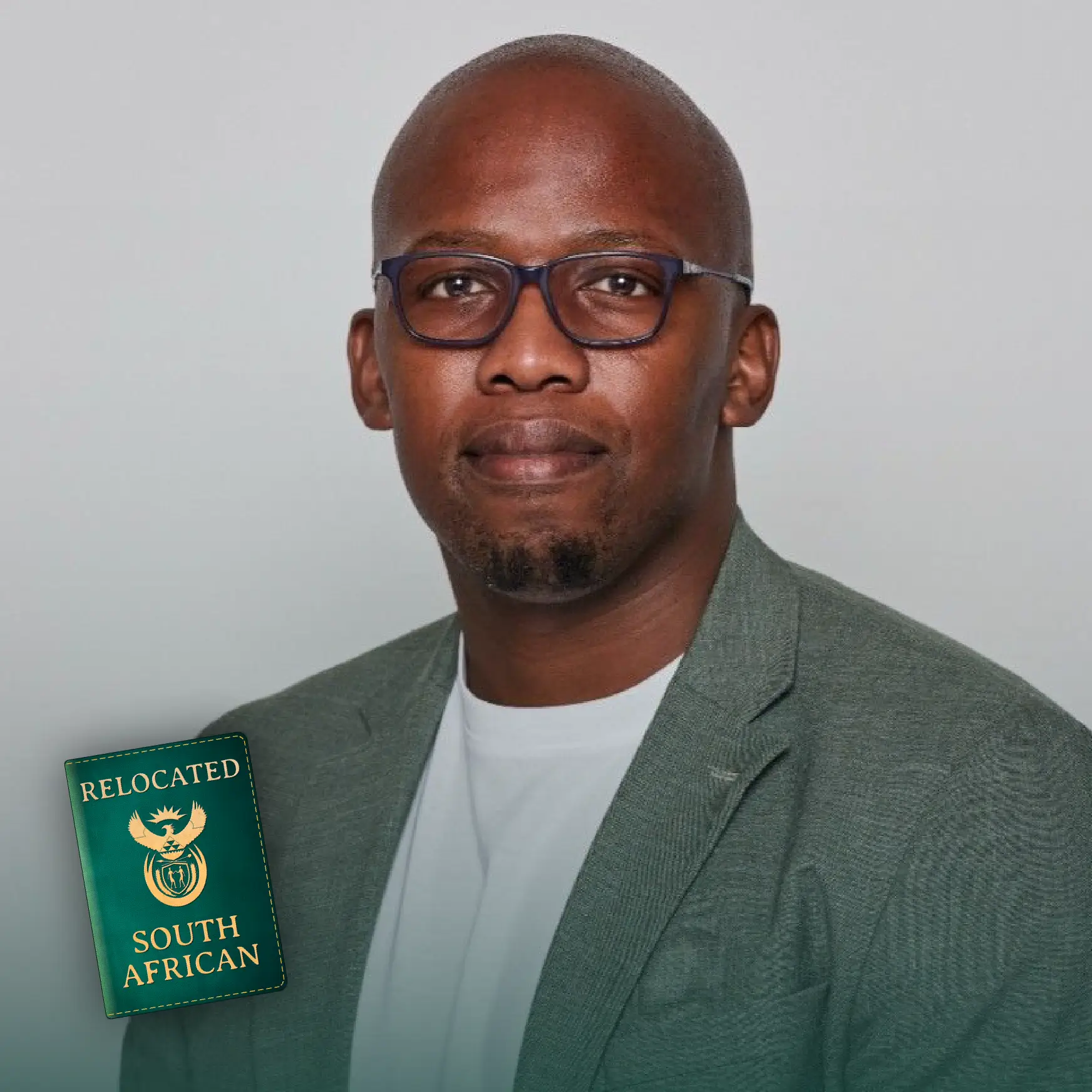
Today on The Relocated South African podcast, I am joined by Lazola Tutani, all the way from Sumter in South Carolina. He describes himself as driven by a deep belief in people and potential. He is a passionate leader in manufacturing, who thrives on building high-performance teams and solving complex challenges with clarity and purpose. Welcome, Lazola.
Lazola Tutani:
Thank you, Jan. Thank you for having me on your podcast.
Jan Hugo:
Lucky to have you. Before we get into the interview, just explain to the listeners where exactly Sumter is and how big the town is.
Lazola Tutani:
Sumter is in South Carolina and it is close to two big cities, Columbia and Charlotte. The city itself, I think, has close to 100,000 or 50,000 people. I cannot remember the exact number. It is like a dorp, if I can use South African language. I compare it to Uitenhage or Despatch, where I am from. So it is a small town, but it has a lot of industry, much like Uitenhage in South Africa, with automotive suppliers and so forth. It is a central, very industrial town here in the US.
Jan Hugo:
Awesome. Really lucky to have you. So we always start at the beginning, and you have already answered part of that. Just tell us where you are from, and a little bit about your schooling and early life.
Lazola Tutani:
I was born in East London in a township called Mdantsane. That is where I was born and spent my formative years. Then my mother is a teacher, so we moved around a lot. I spent most of my primary school years in Somerset East, and then we moved to a small town called Addo. That is where I did my full primary school at a school called Sondagsrivier, and we played a lot of rugby there. Afterwards I moved to Daniël Pienaar Technical High School, which is also a very big rugby school in the town of Uitenhage. I did Grade 8 through to Matric there, and then afterwards I moved to Nelson Mandela University (NMU), where I studied mechanical engineering. After that I joined Continental as an intern, worked my way up through multiple positions, and yes, that is where I come from.
Jan Hugo:
Excellent. Well, you skipped over the school story. You mentioned it is an Afrikaans school and that it brought out your Afrikaans. Tell us more about the schooling in Uitenhage.
Lazola Tutani:
Yes, it really brought out my Afrikaans. The schooling was great. I remember it started with primary school at Sondagsrivier. It was a small farming community, so I went to school with the children of farmers, and we played a great deal of rugby. It was a wonderful time. Then we all moved to Daniël Pienaar Technical High School. My rugby coach, Lokkie Strydom, instilled a lot of values in me, pushing me and telling me that in life nothing is given to you. You need to be disciplined and you need to work hard. In the town of Uitenhage, they had something called “tiere maniere”, because whenever we were moving around the town, we had to conduct ourselves in a specific type of way. I think the discipline I got from Lokkie Strydom and the rugby carried me through life and distinguished me from other people at university and when I started working, because I had this resilience and this hardkoppige attitude towards life where I did not want to give up and always wanted to push. Those were the people who made me who I am.
Jan Hugo:
That is an unbelievable and beautiful story. And I think, having done research and reading about you, one of the things that stood out for me is that in 2012 you were a petrol attendant while studying. Tell us a bit more about that.
Lazola Tutani:
Yes, indeed. When I was at university, my mom was a single mother and I wanted to have some extra money to supplement my funds, because she paid for half of my fees and I also had a bursary. So I had to find a way. A friend of mine suggested that we apply for jobs at a filling station. We were lucky enough to get a job at an Engen garage in PE, and on Friday, Saturday, and Sunday we did the night shifts, because the regular employees did not want to work at night. My buddy and I would come from university and do the night shift, and it was tough, Jan. I can imagine pumping fuel for other students coming back from a jol. There they were, and I needed to try and hide, because you were seeing people who would laugh at you on Monday. But it was enjoyable, because I learnt a lot. I learnt how to work with people. I learnt how to deal with customers. I would do it again if I had to, because it was fun. The tough part was seeing your friends coming from a jol at night, asking you to pour petrol for them, but yes, that was a tough part.
Jan Hugo:
Wow. And one of my questions was: was it lonely? It must have been, because all the others were out, as you say, and here you were on a weekend with a bigger goal. From what you are telling me, the discipline that was instilled in you kept you going?
Lazola Tutani:
Definitely. For me, I have always understood that if you want life to be easy, you will be like everybody else. But if you want a good, sustainable future, you need to do the things that other people do not want to do. For me it was tough at the time, but in the back of my mind I knew why I was doing it and that it had a purpose. That is why I kept doing it, regardless of what other people were saying.
Jan Hugo:
That is unbelievable. So you then finished your studies. I know you went to Germany before you got to the US. Tell us about that journey.
Lazola Tutani:
Within Continental, as I said, I was very fortunate to be developed quite heavily within Conti in South Africa. The company funded a portion of my studies and I completed a Post Graduate Diploma in Business Administration (PDBA) through Conti. That was great for exposing me to business. Then in 2022 and 2023 I received an offer from Germany to join our headquarters in research and development. I took the opportunity, but it meant relocating with my wife and my two kids. We all moved from South Africa in April 2023 to Germany. Germany was an interesting experience in the beginning, because everything was in German. It is similar to Afrikaans in some ways, so tapping into my slightly rusty Afrikaans helped a little, because I was able to navigate some of the words and the accent. The kids were young at the time, so they adapted quickly. We enjoyed it. It was a wonderful two years that we spent in Hannover, Germany.
Jan Hugo:
Did you have to learn German?
Lazola Tutani:
I wanted to learn it. It was not required, but much like I learnt earlier in my life that language is a way to connect with people, from learning Afrikaans as a young child, speaking Afrikaans helped me connect with people at work. So I said, if I can speak a little German, maybe I will connect with people more easily. I did a language course while I was there. Now I can introduce myself in German and I understand certain conversations because I know the key words. I am not fluent, but I can speak broken German and people understand what I am trying to say.
Jan Hugo:
It just adds to your life, absolutely. And Lazola, when that opportunity arose, you mentioned that someone also looked after you, a mentor. When you looked at that opportunity, was there an option of staying in South Africa and becoming a senior executive within Continental South Africa, or did you not compare those two things?
Lazola Tutani:
My mentor at the time, who has since left Continental, was not initially supportive of the idea, because he believed I had immense potential within the local entity in South Africa. But I explained to him that I was still young at the time, and in the end he understood and acknowledged that going to Europe would accelerate my career development. He gave me his blessing, though he was initially a little reluctant, because he was losing a highly talented person and the pipeline at the plant at the time was not that deep. I did have to push a little against his advice, but we are still close. He is working for a different company now and we still keep in touch.
Jan Hugo:
Awesome. And those two years with your family, we always ask how tough it is, because it is not always moonshine and roses. From a family perspective, how difficult was it, especially in the first six months?
Lazola Tutani:
It was rough. I am not going to lie to you. It was extremely rough, because my wife could not speak the language. My daughter at the time was four and had already started Grade R in South Africa, which meant she had begun learning in English. The first few months were frustrating for her, because she was not getting the German at all. My son was one, so everything was smooth sailing for him, because all of his classmates could not speak either; they were all mumbling together. It took us about four months to adapt. The kids adapted first. My daughter picked up the language quite quickly and became our translator. My wife then enjoyed it once we found the South African community. We found a very large South African community. They even had a Facebook page and a WhatsApp group. We joined, and she met a lot of South Africans. That is how she got introduced to the German community, through those people who were either married to Germans or connected through kindergarten. Once she was happy and the kids were happy, my life was a lot easier.
Jan Hugo:
Happy wife, happy life. In terms of South Africans welcoming each other abroad, it is just incredible. There are so many groups, and you always talk about a soft landing and being able to get assimilated into a community. I do not know Germany that well, but I assume the Germans themselves, partly because of the language, are not that immediately welcoming. They are not going to invite you into their home just because you speak differently.
Lazola Tutani:
Definitely. The Germans take a while to open up. But once they open up, you are tied for life. They are not like the Americans, who are very friendly at first to the point where you think, you cannot be this friendly when you have only just met me. The Germans take their time, but the South Africans we met gave us the gateway to build those German connections. They helped us a great deal.
Jan Hugo:
Yes. And from a work point of view, what was it like working in Germany? It was the same company, but the atmosphere is probably not the same as in South Africa.
Lazola Tutani:
The German working culture is very different. Things take time. You could be working on a project due in eight months and there is no rush. I found that in South Africa, everything was urgent, you know: let us make a plan and do something now. But there, people are very structured and organised, and it is always about what we are trying to achieve in the next few months. The people also do not have a scarcity mindset. Everybody wants to share. They trust you 100% from the first meeting. They do not doubt who you are or what you are capable of. If you are there, you must be good, so you can do whatever you need to do. It took a while for me to adapt. The starting times at work also surprised me. I would arrive at seven and there would be no one. I would ask what time people started, and they would start coming in around quarter to nine. Then around two or three in the afternoon they would pack their bags and leave. I had to adjust my thinking and I learnt how to work with a long-term view rather than always seeking instant gratification.
Jan Hugo:
That is interesting. And in terms of the arrangement, I thought it was a two-year contract. Was that always the plan?
Lazola Tutani:
No, it was supposed to be a permanent relocation. Moving here to the US took a lot of people by surprise, because when I moved to Germany it was an indefinite assignment. But then the opportunity in the US came up and I could not say no to it. The Germans understood, and things worked out.
Jan Hugo:
I did not realise that. I thought it was just a two-year contract. That is amazing. So you went straight from Germany to the US.
Lazola Tutani:
Yes. After Germany, I did not even go back to South Africa. I completed all the US visa applications while in Germany, and my wife and kids flew straight from Munich to Charlotte. So we have not been home in three years now. It has been quite an experience.
Jan Hugo:
That is just amazing. It is hard enough to move once, but it is really tough to move twice and into a completely different culture and country, just when you have settled in Germany. I assume that moving with the company makes it easier than for someone going alone.
Lazola Tutani:
Definitely. The company does a lot of the legwork. You essentially just need to show up and everything else is taken care of. When we left South Africa, the company gave us options: move our furniture or sell everything and receive a lump sum to buy new furniture. They paid for the flights, the legal fees, everything. I did not have to do anything myself. The company took care of all the costs, so we were quite fortunate that we could move without any personal financial loss.
Jan Hugo:
That is interesting. So many people talk about furniture. What did you choose?
Lazola Tutani:
We took nothing. We gave everything to my mom back home, because most of it had sentimental value. In Germany, that was the hard part. Unlike in South Africa, you cannot easily sell second-hand items there. So we had to throw away a lot of things we could not sell, and that was by far the hardest part. You might have spent two thousand euros on a couch, but then you have to hire a truck and take it to the dump. That is a hard thing to do.
Jan Hugo:
That is true. South African furniture is often so big that it does not fit into European homes, and there is not much of a second-hand market. I think you made a wise choice. So Lazola, you arrive in the US after two years in Germany. Your wife found the first four months in Germany very hard. Language is obviously much easier in the US. How hard was the first six months there?
Lazola Tutani:
It was not hard at all. To give you an indication: when we arrived at Charlotte at around 1 pm on the 9th of June, some random person at the airport said, “Welcome home, brother.” My wife and I looked at each other wondering if he thought we were American. But since that day, the people here have been, unlike what you see on television, extremely welcoming, regardless of who they are. The culture is very similar to South Africa. We used to go to church a lot back home, and we found a church here. We are part of the church community, and life is almost identical to back home. My wife has actually told me we are not moving again, which shows how happy she is. Obviously at some point I want to go back to South Africa, but I will leave that up to my wife to decide when. The kids are great too. My daughter found a school, my son found a school, and it is amazing how quickly they have integrated. The English is now changing, which is a concern for us. We are trying to hold our ground, but we are not that successful, if I am honest.
Jan Hugo:
The twang. Once they start saying “y’all”, you know they are completely converted.
Lazola Tutani:
Then it is curtains for us. But overall, the transition here has been a lot smoother for the whole family.
Jan Hugo:
I have spoken to a lot of people in America. One of the difficulties is that there are so many types of visas. Does your visa allow your wife to work?
Lazola Tutani:
Yes, we are very fortunate, because I am here on an L1A manager-executive visa, which allows her to work almost immediately. She is actually in the process of being hired. She accepted an offer two weeks ago and her start date will be the 1st of May. If I am honest, this was part of the reason we wanted the US. When we compared Germany and the US, she was really struggling to find work opportunities in Germany because of the language barrier. When we weighed the two options, we felt the US would enable her to restart her career after having had to pause it to support my move. I also have to be fair to her as my partner, so that she can drive her own personal ambitions.
Jan Hugo:
And what is her background, Lazola?
Lazola Tutani:
My wife is a chemist, a compound chemist. She studied rubber technology back home in South Africa and was also working for Continental in the laboratory, doing rubber evaluations and tests. So she is in the science field and I am in the engineering and business field. I would say she is a lot smarter than I am.
Jan Hugo:
That is just amazing. It is so great to hear that you are all so happy. In terms of your visa, how long are you able to stay, or does it keep renewing?
Lazola Tutani:
My visa is for three years and then renewable for another two. What the company allows us to do is to start the green card process after a year. We will start that around June, and after a few months we should receive permanent residency, which will allow us to stay for a significant period. Then after five to six years, I believe, we would be eligible for citizenship. I am not entirely sure about that yet, because I love the Green Mamba a great deal, and I do not think I will be exploring that option anytime soon. I love South Africa.
Jan Hugo:
Yes. It is very interesting. My children moved there in 2016 and now have US passports. Their kids are in high school and they live in Dallas. It gets more and more difficult to think about going back. I think that is something you will encounter too. From a timing perspective, once your kids are in high school, can you take them back to South Africa and put them in a school there? There is a lot to consider. But as you say, you have to do what is right for you right now, and I think you are doing that. Well done. Before we get to life in the US, tell us about the Ironman.
Lazola Tutani:
I completed a full Ironman in 2017. I also did the half in 2016 and 2017, and my last half was in 2018. It was a fantastic time of my life. I was younger, no kids, and I was hungry for challenges. I only did it because a rugby mate of mine said I could run but bet I could not do an Ironman. I said, “Excuse me, what did you say?” I signed up for the race, found a group to train with, and just locked into that mentality from high school, the one I learnt from playing rugby, and went for it. I built a lot of great friendships through it, but it is the hardest thing I have ever done.
Jan Hugo:
I can just imagine. I did the Comrades, but the Ironman strikes me as a really tough challenge. Well done. I mentioned Flip earlier. He has done it too. I do not know how you big rugby players manage it.
Lazola Tutani:
John Smit, actually, was about five minutes ahead of me. In 2017 we did the same full Ironman in PE, and I was doing it under the Ironman for Kids at the time. Seeing John Smit running right in front of me was a genuine celebrity moment. I was thinking, this is a Rugby World Cup-winning hooker running right in front of me.
Jan Hugo:
Awesome, that is absolutely amazing. Let us get to life where you are now. One thing that people often talk about is the American healthcare system. You have little kids, so what has been your experience?
Lazola Tutani:
It is expensive, that is what I can say. Compared to Germany, the healthcare system in Europe is world class. You go in, you hardly pay anything. Here I went to the doctor, I was not feeling well, they gave me medication, and we walked out with a $200.00 bill. I was not dying. It is very capitalistic and very business-oriented. I think you just need to find a way of exercising, eating well, and making sure you avoid going to the doctor, because otherwise you will be working to pay your medical bills.
Jan Hugo:
And you have probably got corporate cover of some sort. Imagine those who do not have that. You talked about eating healthily. We know that is not something Americans are famous for. Comparing Germany and the US in terms of food, what is that like for you?
Lazola Tutani:
In Germany, the food quality was a lot better. There was not much processed food and the quality was even better than food back home in South Africa. Here, my wife makes the majority of our meals and we cook everything ourselves. We hardly eat out, and we do not allow the kids to have much sugar, because everything is sweet here. The same Coke with sugar tastes a lot sweeter here than it did in Europe. So we try to navigate the food landscape and cook most things at home to avoid the fast food that is on offer.
Jan Hugo:
Very true. And are you still able to get some exercise?
Lazola Tutani:
I would never give that up. We are very fortunate in that Continental has a gym right above my office. I wake up quite early and I am always in the gym at about ten past five in the morning for a strenuous strength workout, drawing on what I learnt from rugby. My wife runs a lot; she does a lot of mid-distance running. The kids: my son is playing soccer and my daughter is into gymnastics and track. The first thing we did when we arrived was put them into sports programmes, because we did not want them spending most of their time at home. The whole family has a full schedule. My son has soccer on Monday, Wednesday, and Friday, and my daughter has gymnastics on Tuesday and Thursday. My wife, now that she has not yet started working, runs almost every morning after dropping the kids off. Sport is a core value in my family.
Jan Hugo:
Fantastic, and that will keep you healthy. You mentioned the kids’ school. What is your impression of the school system?
Lazola Tutani:
The school system is very similar to what I experienced in South Africa when I was young. The teachers, especially for primary school, remind me of the dedicated teachers back home. What I found, compared to Germany, is that there is more academic structure here from a young age. They focus on teaching maths from early on. My son is being taught maths at age four, whereas in Germany, when we arrived, my daughter was four and they only touch reading and writing when children are in Grade 1. In daycare in Germany, children simply play. That was a big shock for us, because in the US, even in daycare and in pre-K, as they call it, children are required to learn and be able to recognise letters. In Germany, the philosophy is the opposite: they want the child to play and only start formal schooling when they reach school age. Our daughter was in a private bilingual school in Germany, so it was not the true German experience; she was being taught in both German and English.
Jan Hugo:
One thing I also found in the American school system, at least in certain states, is that from a very young age children are introduced to cultural subjects. My grandson learnt to play the violin and is now in the school orchestra. He also taught himself the guitar. It is great that they introduce children to different skills. Lazola, you talked about the South African community in Germany. Do you have the same welcome from South Africans in South Carolina?
Lazola Tutani:
There are not many South African community groups here outside of work. There are colleagues at Continental who are South African. My boss’s boss is South African, and it is his family and one other colleague we have connected with, but that is pretty much it. There is not a big community in this part of the US. Most of the South African groups seem to be in bigger cities, like Florida, and also up in Virginia and those areas. Here in the South, particularly in South Carolina, we have not found many South Africans.
Jan Hugo:
But through school and church, that is an ideal place to make friends and build a community.
Lazola Tutani:
Yes, and it is allowing us to connect with Americans and see a different side of American culture. We are appreciating it. They are teaching us a lot about how to behave in society here. I am told I need to get a gun. My American friends say I need one, not just one. I am not sure how that is going to work.
Jan Hugo:
That is so funny, absolutely. And what do you find most difficult about living in the States?
Lazola Tutani:
The main challenge for me is the time zone. It sounds like an odd thing to say, but I enjoyed Germany because I could just pick up the phone and call my mother. Here, by the time I knock off, it is almost 10 or 11 pm in South Africa, and my mother is there with my younger brother. When I try to call her, the timing does not always work out. Other than that, the country itself is great. I am also still adjusting to the faster-paced American corporate working style, where it is all about results today, not tomorrow.
Jan Hugo:
You touched on family, and I was going to ask what you miss most about South Africa. From what you are telling me, it is that family interaction, because that comes up in every single conversation I have. That is the biggest sacrifice of immigration. Do you agree?
Lazola Tutani:
Definitely. Losing proximity to family is hard. In 2024 we lost my grandmother and I could not get back for the funeral. That was a very hard part. If you have a young family, you cannot just go alone, and going back to South Africa is not cheap, so it requires a great deal of financial planning. People grow old and you think about depriving your mother of the opportunity to see your kids grow up. That is tough.
Jan Hugo:
Very difficult. Have you considered bringing your mother across to visit or even to live with you?
Lazola Tutani:
A visit, yes. Her coming to live here permanently will probably not work well at this stage. What we are considering is planning a visit to South Africa in our winter, which is the South African June, just to see her. She is retiring next year, and we are thinking that once she retires, we could have her come for 90 days every few months, so that as she gets older she can have breaks spending time with us and then returning home, rather than moving full time.
Jan Hugo:
It is so tough. Just missing the kids growing up, as a grandparent myself, I know exactly what she must be going through. Somebody said this week that there is a cost and there is a price to immigration. The cost is the actual financial outlay of moving and getting there, but the price you pay is that lack of daily interaction with family. Especially when you move to the US across time zones, you cannot just hop on a plane when something goes wrong. So yes, it is very difficult. But you did say you see yourself going back. Is that the big plan?
Lazola Tutani:
Definitely. That is the ultimate plan for me. My mentor, who is based in Johannesburg and is a former CEO of a JSE-listed company, including a stint leading Altron, is now in the public sector at Eskom. He and I have regular monthly calls, and one of the things we discuss is the game plan for when I go back to South Africa. We have both agreed that at some point everything the country has invested in me needs to be given back. I want to be part of the solution in terms of building the country. There is a lot of talent there, but sometimes I feel guilty for not being part of the group trying to make the country better. At some point I want to return and take on a leading business role in the Johannesburg area, contributing all the international experience I have gained back into the South African economy. That is why the citizenship route, while it might be good for my kids, is not something I am pursuing for myself. As a millennial, I really want to help make things better back home.
Jan Hugo:
And you have stayed out of politics, because so many people are negative about what is happening in South Africa. But you see a different path: contributing through business and through helping people that way.
Lazola Tutani:
Yes, I think that is the best way I can contribute. I have never been a political person. Politics is for politicians. But there are a lot of great companies in South Africa that are changing the country through business, and I think that is the best way I can help. If I can lead a business ethically, turn it around, and create employment, that means more South Africans have jobs, and the international experience I carry comes back into the local economy. I can only hope that things improve politically, but from a business side, I want to be part of the solution at some point in the future.
Jan Hugo:
And I know you have a YouTube channel. Is the idea behind that to give something back? Is it a way of mentoring young people?
Lazola Tutani:
Yes, the YouTube channel is something I created but have not explored much in the last two years or so. For me, mentorship comes primarily through the connections I build on LinkedIn. A lot of people reach out to me, we have calls, and I give them advice. That is the best way I can contribute right now: giving my time and sharing best practices. One person has recently moved to the US, and two others moved to Germany after I did, people I knew who were curious about the experience. I gave them everything I had and that helped set them up to make their own moves. That is why I love LinkedIn as a platform. It is a powerful tool for sharing insights, staying connected with people back home, and contributing knowledge.
Jan Hugo:
Absolutely fantastic. We are getting towards the end, although I could talk to you all night. My last question: if a young person from Mdantsane is watching or listening and thinking that could never be me, what is your message to them?
Lazola Tutani:
Anything is possible. Have a vision for the life you want and be stubborn and hardworking in pursuing it. If you set a vision, it always works. I know that sounds corny, but I have a vision board in my office that I made in 2017. That vision board has somehow come to fruition, because everything I put on it became my North star. I wanted to work internationally: I have worked internationally. I wanted an MBA: I have an MBA. The Ironman, everything I set out, I wrote it down, I wanted it, and then I asked myself how to get it. That is where it starts happening, because once you ask yourself how to get something, the stars align and everything conspires in your favour. Have a plan for your life, know what you want to be, and then be stubborn about pursuing it until it becomes a reality.
Jan Hugo:
I am getting goosebumps listening to you. Lazola, I cannot thank you enough. Thank you for connecting with me and for sharing your journey, your perspective on living and working abroad, and your love for South Africa. That is just awesome. Thank you so much, man. I will put your LinkedIn contact details in the show notes for anyone who wants to reach out. I really, really appreciate you coming on the show.
Lazola Tutani:
No, thank you very much.
Jan Hugo:
To all our listeners: if this episode resonated with you, please consider sharing it with someone who might enjoy the conversation. You can find more episodes of The Relocated South African on your favourite platform or visit our website at therelocatedsouthafrican.com. Thank you for listening, and I will see you next time.
This transcript was generated with the assistance of AI and checked for accuracy.