Jan Hugo:
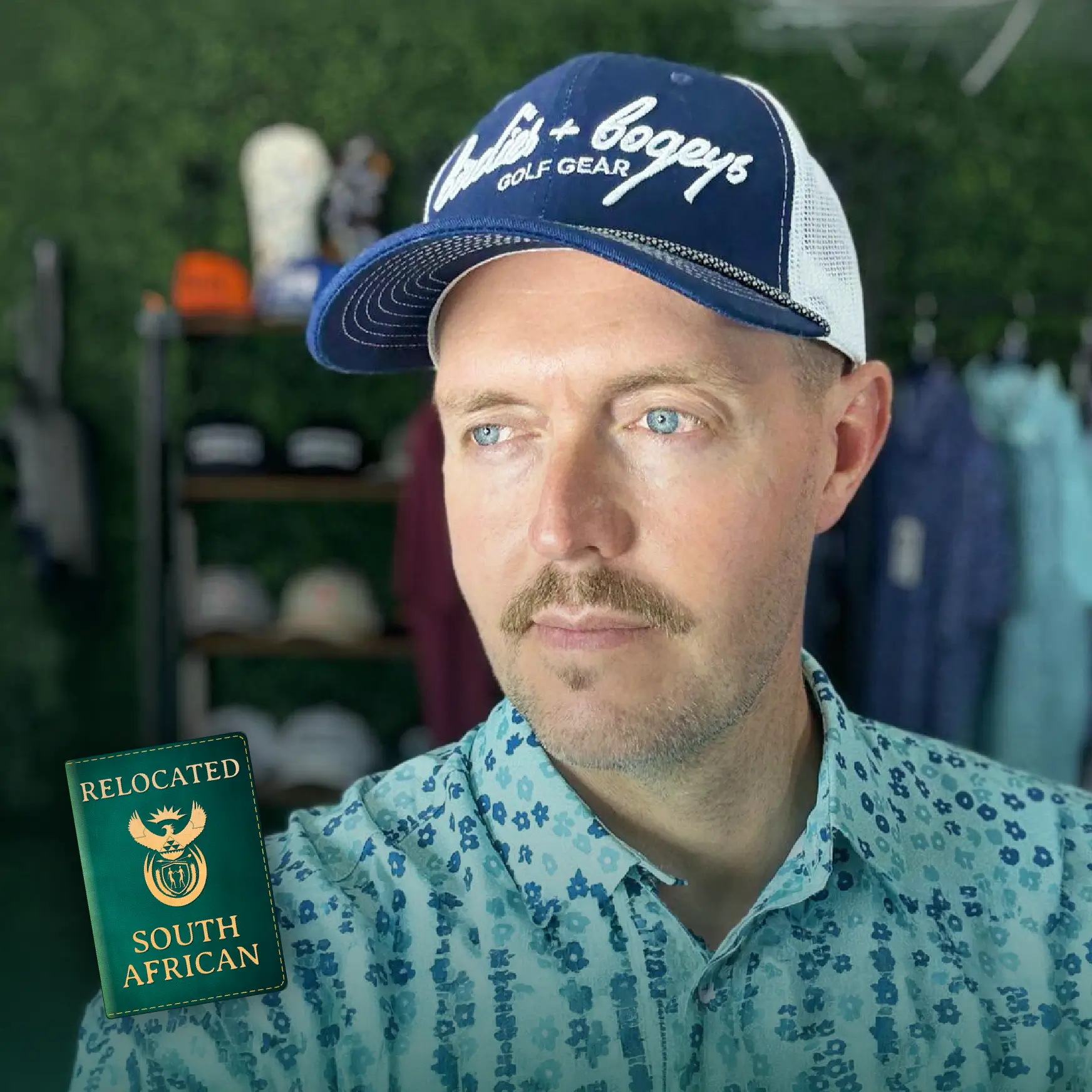
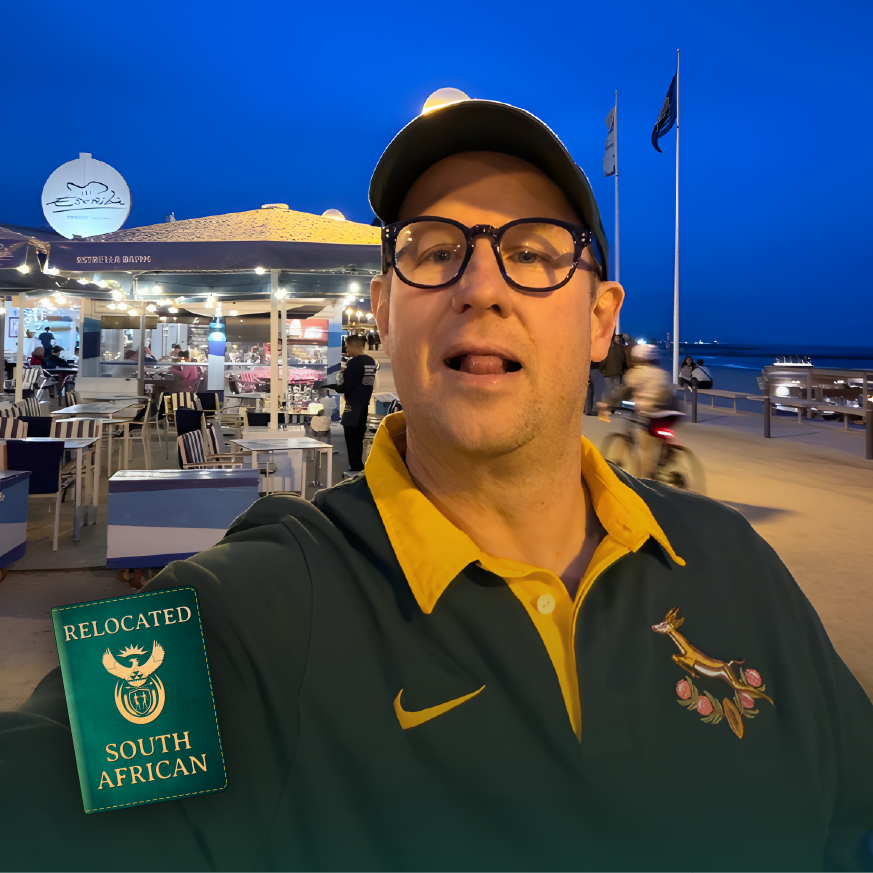
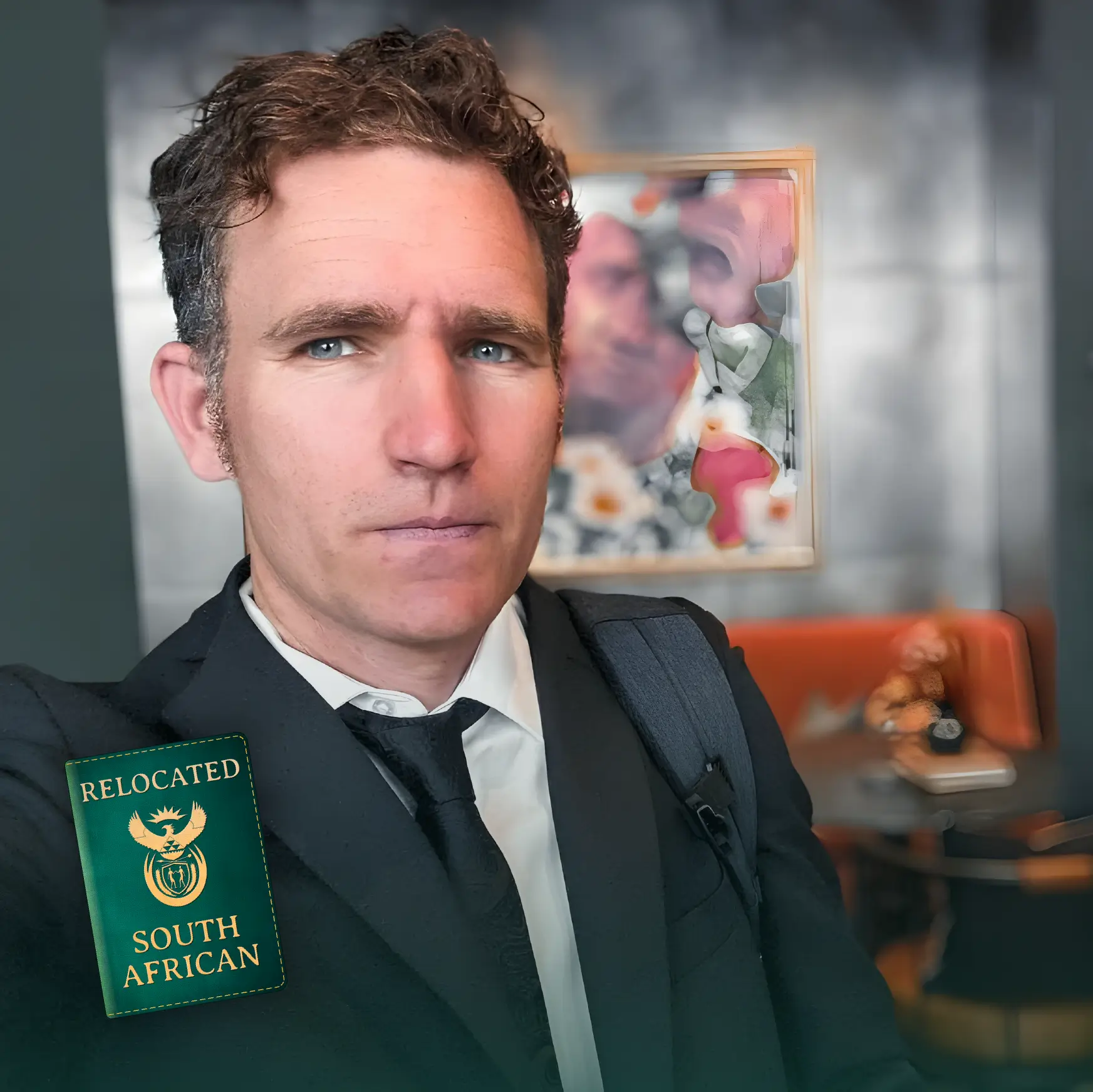
Welcome back to The Relocated South African. My guest today grew up in Pretoria, played rugby, turned pro golfer, competed in 47 countries, and has called Oklahoma home for many years. Martin Maritz, welcome, lekker to have you.
Martin Maritz:
Yeah, very lekker to be here too, and appreciate the time. Looking forward to the chat.
Jan Hugo:
Me too. So Martin, obviously from Pretoria, which school did you attend?
Martin Maritz:
Afrikaanse Hoër Seunskool. Finished my high school there and then relocated to America on a golf scholarship. I grew up in Pretoria, you know, big Blue Bulls fan, and grew up right across the street from Loftus. I went to many, many rugby games there and actually sold some peanuts and biltong as a kid, and did some parking so I could go to the games. Yeah, I miss Pretoria a lot.
Jan Hugo:
And I mean, it’s just an interesting story. You played good rugby. Did you actually play for Blue Bulls Schools?
Martin Maritz:
No, I wish I did. My final rugby game that I ever played was on Loftus, the main field, but it was in school, seventh or eighth grade. It was our Northern Transvaal finals and we lost in overtime. So my final game I did play there, but not for the Blue Bulls. Naas Botha, Johan Heunis, Uli Schmidt, those guys were my heroes growing up. So I always wanted to be a Blue Bull rugby player, but I think I was too scared of the tackles and getting hurt.
Jan Hugo:
Very tall fly half, is that right?
Martin Maritz:
Yeah, I was a fly half and fullback. I went back and forth, and I did all the kicking. That was fun for me. I scored a lot of points, just not a lot of tries.
Jan Hugo:
Okay, and then what I read is that you caddied for your dad at Pretoria Country Club and became a scratch golfer at 13.
Martin Maritz:
Yeah, I started doing that around seven, eight years old. At that time, my dad was a good golfer. It’s actually his birthday today, so shout out to my dad, happy birthday. I would go to the course with him. He was a single digit handicap. I think he got down to a two or three, something like that, back in the day.
And so I would kind of walk with him the front nine and push the little trolley. Then when they finished the back nine, I would just be around the putting green, the chipping green. I’d go hit some balls on the driving range. I’d do that for a couple of hours. They’d come back and head up to the pub for a couple of beers, and I would just keep putting, sometimes even in the evening under the lights. That’s how I got introduced to the game, and I was hooked from the beginning. I couldn’t get enough.
Jan Hugo:
You know, this weekend when Aaron Rai won the PGA and you listen to the practice routines and what people have to go through, I think a lot of people don’t understand what it takes to be a professional golfer.
Martin Maritz:
No, definitely. It’s a full-time job. Just like anything else, if you want to get really good at it, you’ve got to spend the time.
Jan Hugo:
And Martin, so when you finished school, the opportunity to go to the University of Tulsa on a golf scholarship, did they approach you, or did you start looking around?
Martin Maritz:
So when I was in high school, we had a very good junior programme in South Africa, the golf foundation. I would play in every tournament I could, all over the country. I was very lucky to win the national junior championships. I think it was at Roodepoort, and I was 16 years old.
The first prize for that event, and that was the first time they ever did that, was a trip to America to play in six tournaments all over the country. They ended up picking Trevor Immelman as well to join me on the trip. So it was me and him, his dad came along, and my parents, and we travelled all over the US: started in Buffalo, New York, went up to Wisconsin, did Florida, ended up in Arizona, and then also San Diego for the Junior World Championship. College coaches would travel to these events and watch the kids play, and that’s how they recruited the top players.
I did reasonably well in those events. I ended up winning the International Junior Masters in Buffalo, New York. Gary Player actually sponsored the trophy. A week or so later, the phone rang back home and my mom picked up the phone, and it was Gary Player calling to congratulate my parents on my victory. For a second, my mom was like, why would Gary Player be calling our house? And she almost said, yeah, and I’m the Queen of England.
That was a funny story, and it just shows you what kind of person Gary Player is to take the time to do that. But yeah, that’s how I got recruited. I did that for two or three years in high school. I played in Japan a couple of times in the World Junior Cup. You just get exposure that way. And I ended up getting a scholarship to the University of Tulsa.
Jan Hugo:
And then you turned pro in 2000. Maybe just a step back: people always hear about kids going on these golf scholarships. I mean, it’s not just moonshine and roses, is my impression. You really work hard at academics and playing golf.
Martin Maritz:
No, it’s, you know, just a quick backstory. My dad was a college professor, dean of construction engineering at Tukkies in Pretoria. So I could have gone to university for free over there as well. But I always wanted to come to America, because of the exposure to American college golf, the golf courses, the tournaments, and playing against some of the best players in the world. So there was always a goal.
My dad said, if you want to go to America, you better get a full scholarship. And I was just lucky enough to get one, because it’s very expensive. I went to a private university. Tulsa is a private university, so it’s two or three times more expensive than what’s called a public or state university. I think in dollar terms it’s somewhere in the $60,000 to $70,000 a year to go to the university, and that’s including room and board, books, tuition, and all that. So it is not cheap. There’s no way I could have done that paying for it.
But yeah, it’s basically them paying you $60,000 to $70,000 to be there and play. So you have workouts at six o’clock in the morning, breakfast, then school, probably three or four classes, lunch, and then you go and practise from one to five. So it’s basically from six o’clock in the morning till five in the afternoon. And then you have to travel: in the fall season probably four or five events, and in the spring about nine events. So you’re gone all the time, missing a lot of lectures, and you just have to make up the time.
And you have to maintain what’s called a 2.0 grade point average, which is basically C’s. Otherwise, you cannot play. So yeah, it’s pretty demanding, but a lot of fun. I wish I could go back to college now. A lot less worries and stress.
Jan Hugo:
I can’t imagine. And you probably made some amazing friends during that time.
Martin Maritz:
Yeah, we had such an international group. My roommate was a tennis player from South Africa. We had Gareth Williams, who was a very good tennis player from Affies as well. We went to high school together. He was at Tulsa. It was nice to have some South Africans around. But we had players from Sweden, Finland, and all over the place, a lot of athletes from all over the world.
Jan Hugo:
Is that where John Daly’s kid is? Is he a Razorback?
Martin Maritz:
He’s at Arkansas, so he’s not too far away. It’s about a 90-minute drive, so it’s in the area.
Jan Hugo:
OK, and then you turned pro in 2000, but you went back to South Africa to do that on the Sunshine Tour.
Martin Maritz:
Yeah, I started in the US. The only way you can get into tournaments is to do Monday qualifying. So the first event, I Monday qualified, I got in, and I was like, this is pretty easy. I ended up missing the cut. And then I went six weeks in a row, travelling in my car all over the country, just wherever there was a Monday qualifier. I missed the next five.
I soon realised that this is not easy, because they only have three or four spots and you have 150 guys playing. If you don’t shoot a 65, you’re not going to get in. So then I went down to South Africa to go and play on the Sunshine Tour. I was very lucky at the time: they had a deal where if you make the cut in the event, you get into the following week. So I qualified for my first tournament, got in, made the cut, and I made the next eight or nine cuts. I won enough money to get my Sunshine Tour card. I was very, very fortunate, and then it just kind of took off from there. I played very well in South Africa starting out, and that opened up some doors in Europe. I ended up playing in Europe for a few years. But the Sunshine Tour was the springboard for me.
Jan Hugo:
And we have to talk about the Dunhill, because you said you gave that one away. Tell us the story.
Martin Maritz:
Yeah, that was I think 2001, the Dunhill Championship at Houghton in Johannesburg. I was leading after three days. I think I was up by two or three strokes going into Sunday, first time ever playing in the final group. On the front nine I shot a 41, I believe. But luckily on the back nine I had two eagles and a birdie. So I think I finished eagle, birdie, eagle. And then on the 18th, which is a par five, I went for it in two, and I had to get an eagle again to tie Justin Rose. Unfortunately I hit it on the fringe of the green. The pin was all the way at the back and I ended up three-putting to finish second.
So I lost by two to Justin, and that was his first ever professional victory. Now he’s won I think 20 times worldwide. He’s an Olympic medal winner, he’s won numerous Ryder Cups, I think he’s won two majors. So all because of me, I kind of opened up the door for him. He needs to send me a thank you note.
Jan Hugo:
Well done. That’s amazing. And then on the European Tour your highest ranking was 52nd. I mean, you have to be able to play to be 52nd on that tour. I think people do not appreciate that.
Martin Maritz:
Yes, that was in 2004. Very, very proud of that season. I played really, really well, very consistent. I made pretty much every cut I played in and had a number of top tens. And then my biggest finish was fifth in the Scottish Open. That’s another story.
I was tied for the lead with three holes to go, playing out of my mind for three days, like an out-of-body experience. The first round I think I shot a 73, I was 145th, and then each day just got better and better. I think I shot 73, 63, 67, and then I was nine under through 15 holes on Sunday. Tied for the lead, all of a sudden. I had no idea what my score was. I was just, like I said, in an out-of-body experience.
Then for the first time in three days I got nervous. I don’t know where this came from. Felt like a decent swing, but it went 20 yards right into thick rough on 16. The course was Loch Lomond in Scotland, my favourite golf course in the world. It’s spectacular. I found the ball in thick rough, had to hack it out sideways. I hit it too far, went across the fairway into more rough, had to hack it out again. And then all of a sudden I realised what I was doing, and my heart started pounding out of my chest. I somehow made a double bogey on 16, and I do not know how I finished 17 and 18 because I was shaking like a leaf. I realised I had just thrown away the tournament.
Luckily I made par, par. Ernie Els finished second that week, I remember, and then Thomas Levet ended up winning. So even if I had finished par, par, par, I would have finished second because Thomas birdied the 18th. But that result would have gotten me into the British Open the following week. It would have gotten me into world championship events, and I probably would have finished maybe top 30 on the money list. So yeah, even though it was my best week ever on tour, it was still a big disappointment because of what could have been.
Jan Hugo:
Can you put that out of your mind, or does it stay with you?
Martin Maritz:
Every now and then I still think about it. That’s 22 years ago now. But it’s golf, you know. I had a couple of close calls. I was just never able to really win a big one.
Jan Hugo:
Yeah. And we’ll move on to the journey, but just one last golf-related question: in 2011, you qualified for the Open. I think you called that the greatest week of your career.
Martin Maritz:
Yes. Growing up as a young kid, you always want to play in a major. The Masters was always kind of, oh, I’d love to play at Augusta, and I still haven’t had the opportunity. I always thought maybe playing in the Masters would be my opportunity to play at Augusta. But the British Open is a big deal for South Africans as well, because we’ve had so many great players win British Opens: Ernie, and Gary Player, and Bobby Locke, and Louis Oosthuizen.
So it was a treat for me to be able to qualify for it. I had played in the British Amateur before. I went out there a week before and played six practice rounds. I played with some great players: Francesco Molinari, Ernie Els, Justin Leonard, Bo Van Pelt, Charles Howell III. Every day I just went to the tee sheet and looked at some names. I’d think, oh, I’d like to play with that player, so I’d put my name next to them and go play a practice round. I thought that would really prepare me for the event, and I ended up playing very mediocre. I think I shot a 73, 74. I missed the cut by three.
I really didn’t have my game. I think if I was on, I could have made the cut pretty easily.
Jan Hugo:
Still, what a privilege to do that. And maybe this leads to the next question and getting into the journey. I know in pro golf, they talk about the boot slappers when you miss the cut. And I don’t think, you know, we love watching golf and we always see the top guys. You never see the guys in the parking lot having to go home with nothing. How tough is that?
Martin Maritz:
It’s demoralising, especially if you start missing numerous cuts in a row. I remember at the end of my career the sponsorship dried up, so I was doing it on my own for the most part. You would just kind of swipe a credit card and be like, OK, where’s the next tournament? And sometimes it’s in New Zealand or Australia or Hong Kong. Let’s go and try to make a paycheck there. And especially if you miss five or six in a row, the expenses really stack up. And especially if you have kids at home, a mortgage, a car payment, it’s not as easy as it seems. Sure, you’re playing golf for a job, it must be fun. And it is, but it’s stressful, especially if you don’t have big financial backing behind you.
Jan Hugo:
I’ll never forget, I watched, years and years ago, still in South Africa, a tournament where Seve was playing and there was a British pro who was very close to the top of the leaderboard and his wife was pulling a trolley with his bag on it. The commentators were saying, the poor guy needs it, he’s staying in a combi and he needs the hotel money, but Seve gets everything and he doesn’t need it. I always thought that puts it in perspective.
But you, I mean, just amazing. You played in over 300 events in 47 countries. That is just phenomenal. Is there a standout country that you would say was an amazing experience?
Martin Maritz:
You know, I really loved playing on the Asian Tour. I loved going to Hong Kong. Macau was amazing. Philippines, Thailand, Malaysia, that whole area, just very tropical. I really liked the food and the golf courses. I enjoyed my time in Asia in 2007.
But some of the most unique places I’ve played: I’ve played the Kazakhstan Open twice, the Russian Open twice. Morocco, Kenya, the Zambian Open, some really interesting places. But in Europe, you’ve got to love the links golf: Scotland, Ireland. I love going to Scandinavia, Sweden, Norway, Denmark. So it’s very hard to pick a favourite spot. Dubai, Qatar, I always loved going there, loved the golf courses. And New Zealand is beautiful. Yeah, I can come up with a top ten list, but a single favourite is difficult.
Jan Hugo:
Yeah. And just to put it in perspective again, if you have a sponsor, it’s relatively easy I guess, but you still have massive expenses. We always read a guy’s won 100 or 200,000 euros or dollars. But my sense is always that it’s a really expensive lifestyle: hotels, a caddy, there’s just a lot of expenses. And as you say, if you don’t make the cut, it gets demoralising, but also financially incredibly stressful.
Martin Maritz:
Yeah, you’ve got to think about it. Each week I would say on average three to $4,000 in expenses, especially in Europe and Asia, because you’re travelling internationally every week to get to the next location. And then yeah, you either have family travelling with you, you pay for your caddy. Very, very expensive. In America it’s obviously a little bit cheaper to travel around, but most of the time they have official hotels and they usually pick the nice ones. They’re not cheap. You can stay somewhere cheaper if you want, but then you don’t have the luxury of the courtesy car or the bus that takes you to the course. So you have to plan really well if you want to save some money.
Jan Hugo:
And were you doing all of that yourself, in terms of the planning and scheduling tournaments?
Martin Maritz:
Towards the end of my career, I did. But in the beginning, I did have an agent and a management company that took care of most of that. But then again, if you don’t play well, if you don’t make the good money, the management groups don’t really want to keep you around for too long because you’re not making them money. So I had an agent for maybe three or four years. I didn’t really see the value because they didn’t bring in a whole lot of sponsorship for me, and I just kept paying them percentages of my winnings. So towards the end, I tried to do it on my own.
Jan Hugo:
Yeah. And all that travel, 47 countries, a different country every week almost. You said you sometimes were able to travel with family, but as kids grow, it gets more and more difficult and more and more expensive. That must have been pretty hard on family life.
Martin Maritz:
Yes. I remember around 2007 and 2008, I lost my card in Europe and went and played in Asia for a year. My wife at the time and our two little kids decided to stay back in America. And so I would just travel all over the world. I think there was a stretch of six, seven, eight months where I didn’t come home. I was travelling, trying to make money. She went back to school to try and get a better job. Two young kids at home and I was on the road all the time. Yeah, it definitely takes a toll.
Jan Hugo:
Yeah, I can just imagine. And now let’s get back to today. All of that golfing experience, and maybe the boot slapping, was that what’s behind your business now, Birdies and Bogeys?
Martin Maritz:
Yeah, that’s kind of a passion project, a bit of a side hustle at the moment. I’d love to potentially turn that into something where I can spend all my time on it. When I retired from golf, I call it retirement but it’s more of a forced retirement, in 2012 I came back to Tulsa and I was looking for what they call a big-boy job, you know, out of sport, maybe get into the corporate world. I had a couple of interviews, and at the time the economy wasn’t great. Not a lot of big companies were hiring. They’d look at my resume and say, OK, you’ve got a degree from the University of Tulsa, which is a good degree, private university, good university. But you have no work experience for 12 years. You travelled the world chasing a golf ball. A lot of those interviews, I finished second, third, fourth, didn’t get that kind of entry-level position.
So I ended up taking a job at Meadowbrook Country Club as an assistant pro. I didn’t really want to go back into golf, I was kind of burnt out with the struggles towards the end of my playing career, but I really enjoyed working at a golf course. The money wasn’t great though. The schedule, opening up the pro shop at six o’clock in the morning and in the summertime closing it down at nine thirty in the evening, and we had some young kids at home, so that was stressful as well. And that’s where I met the owners of a recruiting firm here in Tulsa and ended up getting into recruitment that way.
I’ve been doing that for 12 or 13 years now. The majority of the time is spent on IT positions: software engineers, network engineers, roles like that. It’s been rewarding to help people find jobs and kind of move up the ranks. But yeah, I’ve got that Birdies and Bogeys little golf company that I started during COVID. We were stuck at home for about nine months, and so I had a lot of time on my hands to start designing things and reaching out to factories overseas and getting some samples made. In the beginning I was terrible at it, but it was fun, trying to figure out how to make a nice golf shirt or a hat, come up with the logo and things like that. I’ve learned a lot, gotten a lot better. The company is growing nicely. We’re starting to do a lot of events and corporate apparel. Yeah, I can really see a future with it.
Jan Hugo:
Excellent. Looking at the website, do you ship worldwide or only in America?
Martin Maritz:
Not at the moment, it’s in the US only for right now. But the plan is to eventually maybe get it into South Africa. I’d love that. So if you have some contacts, let me know. Also, my brother is over in England, he lives in London. I’d love to eventually maybe get it into the UK or the European market.
Jan Hugo:
It’s golf apparel, mainly?
Martin Maritz:
Yeah, apparel. We do some accessories too: head covers, gloves, hats, golf towels, things like that. So whatever you would need for a golf event, we could do that. But yeah, the main focus is on the apparel side.
Jan Hugo:
Okay. And did I read right that there is a bit of a charitable angle to Birdies and Bogeys?
Martin Maritz:
Yeah, so that was the whole idea for me when I started it, because golf has given me a lot. It gave me a full scholarship to America. It created a life for me in the US. So the idea behind it is to give back to the next generation. A percentage of what we make goes back to sponsoring some local young golf pros. I’ve paid for some entry fees for them. I try and create some playing opportunities. We didn’t have the tournament this year, but we plan on having a big one next year where we create playing opportunities and a little bit of prize money. It’s not big yet, but you’ve got to start somewhere.
I sponsor some local kids with some apparel and equipment if the need is there, and so that’s fun, to give back to the game that’s given me a lot.
Jan Hugo:
And the whole idea around a name on a golf bag, is that part of the logo idea?
Martin Maritz:
Yeah, so that’s how I came up with the golf bag logo. Like I mentioned, when I was seven or eight I was kind of obsessed with the game, and my parents took me to Swartkops Golf Course where they had the ICL International. Nick Price was playing, Nick Faldo, Corey Pavin, Vijay Singh, John Daly, they were all there.
I was there by the putting green and I saw all these pros with the golf bags with their names on them. I thought it was the coolest thing. I was like, I want my name on a bag one day. And that’s always kind of stuck with me. I was able to do that. Now everybody can put their name on a bag. Back in the day, you had to be a pro golfer to do that. That is the whole idea around the logo: the pinnacle of the golf game is to have a pro staff bag with your name on it. And that’s what I aspire to with my little clothing company, to reach the pinnacle, to be the best that we can be.
And just the name Birdies and Bogeys: you cannot have the one without the other. It’s just like life, the ups and downs and the struggles. If you make a bogey and then a birdie on the next hole, you appreciate the birdie a lot more because of all the bogeys you made before.
Jan Hugo:
Absolutely. I have to just tell this little story. A friend of ours is a really good golfer, but he always says, when we’re playing golf, there’s a very good reason why his name is not on his golf bag but on the door of his bakkie. And I often feel like that. I should paint my name on the door of my bakkie.
Awesome. And just living in Oklahoma, I mean, you’ve been there for so many years. You’ve become a stalwart there. What’s it like, the weather, just life in general in Oklahoma?
Martin Maritz:
Yeah, you know, Oklahoma is right in the middle of the US. Funny story, before I came over for college, there was a musical called Oklahoma! that they had at the Pretoria Theatre that my parents took me to. We went and watched it and it was pretty good. But it’s from the older days in Oklahoma, almost the cowboy era. And I wouldn’t say there are lots of cowboys in Oklahoma, but once you get out of Tulsa, out of the city, there’s a lot of farmland. Kind of similar to the area I grew up, Pretoria, with my family having a history in the farming industry: my uncles, my grandpa, my mom and dad even farmed for a little bit. In that sense, very similar.
But the weather, I still cannot get used to it. I hate the cold. In January and February it can get very cold, but only for a couple of days. It’ll snow and we get ice and then it’ll melt. We get maybe two weeks out of the year that are really, really bad. And then in the summertime it can get up to 105 Fahrenheit, which is around 43 to 45 degrees Celsius, for about two or three weeks in August.
When I showed up in Tulsa as an 18-year-old ready for college, it was the middle of August and I flew in on a propeller plane. There was no jet bridge straight into the airport, so we were on the tarmac. We got off the plane and I kid you not, it felt like 50, 60 degrees Celsius because of the heat from the tarmac and the wind was blowing. It was like a hairdryer in your face. I was like, what place did I show up at? Kind of soon got used to the heat, but it’s kind of like Leopard Creek in the summertime. Nelspruit, you know: very humid, just heavy. Yeah, very humid.
I’ve been here 30 years now, still not used to the heat and the cold. But Tulsa has taken me in like one of their own. I love the people, a lot of like-minded people in Oklahoma. Yeah, it’s home, even though I miss Pretoria every day.
Jan Hugo:
Is it humid as well? I was going to say. But do you have a big South African community there, or not really?
Martin Maritz:
I wouldn’t say big, but there’s a nice community. We have a Facebook group, South Africans in Oklahoma. There are about 40 or 50 families pretty active on that group. There’s a South African coffee shop called Bryce’s that I go to every now and then: proper cappuccino, and they’ve got milk tart, they’ve got a chicken mayo sandwich. Every time I’m homesick, I just go there.
Jan Hugo:
Awesome. And I always ask people, it’s quite a question, just cost of living. We talk about the McDonald’s index, but what would a cappuccino cost at that coffee shop?
Martin Maritz:
I think he’s pretty good on his pricing. Somewhere in the region of $4.00 to $4.50, something like that. If you go to a Starbucks, you can pay $6.50 for a coffee, which is insane. But Oklahoma is actually one of the states in America with the cheapest cost of living in the entire nation.
Our gas prices are usually in the cheapest five states in the nation, even though the gas prices are very, very high right now. I saw this morning $4.11 a gallon, where normally it’s around $2.00 a gallon. And I think in California it’s like over $10.00 or something, something crazy.
Jan Hugo:
And what would that be? We’re paying just over two euro a litre now. I don’t know what that converts to in dollars.
Martin Maritz:
Yeah, I’m so used to gallons now, I wouldn’t even know how to work that out. I’m just a dumb golf pro. I can count to about five, sometimes six. Maybe seven.
Jan Hugo:
Awesome. And Martin, you talk about missing South Africa. I assume your parents are still alive and you still have siblings. Are you able to visit regularly? Have they been across?
Martin Maritz:
Yeah, Mum and Dad still live in Pretoria. I used to go back a lot because I played the Sunshine Tour, so I would go every year. Then since 2012, I went back for my high school reunion in 2015, that was my 20-year reunion. And then I went back two years ago with a group of American friends. I think we were seven in total, and we went to Cape Town, Stellenbosch, did the wine tours, and then went up to Kruger Park for five days. It was the trip of a lifetime. That’s what really makes me miss South Africa: the food, the weather, the people, the safaris. You don’t have that in America. They were all blown away and they want to go back at some point. They said it was just wonderful.
Jan Hugo:
Yeah. And could you see yourself going back? Or is that unlikely?
Martin Maritz:
That’s a tough, tough question. I don’t know what the future holds. I could live in the Stellenbosch area. I love that area. My parents’ set-up is great, right there by Pretoria Country Club, where my dad can walk to the golf course every day. I could see myself living like that, and I think I would really enjoy it. But I just don’t know if it’s the right move, especially with having kids over here and my youngest being 10. Yeah, a lot of things will have to change for me to ever really consider that.
Jan Hugo:
I can imagine. I was going to ask you: in your recruitment business, does the golf help? Do you still get to play quite a bit?
Martin Maritz:
Yeah, that’s basically the only time I play golf now, when I go out with clients. And the pity is, a lot of the IT folks don’t really play golf. I deal with CIOs, IT directors, IT managers, and a lot of them are so busy that it’s hard for them to break free. They’re always putting out a fire. There must be a lot of fires in IT, because that’s always the excuse.
They also only play once or twice a year. So it’s a little difficult to get them out. But that’s where you build your best relationships, on the golf course, because you get to spend five hours with somebody. They get to know you, your family, what you’re about. And most of the time when we’re done playing golf, we become good friends. Some of my best clients are some of my best friends, and it all started on the golf course.
Jan Hugo:
I’ve got so many questions, but just back to the golfing career: is there anything that one could do differently as a golf pro to make life easier? I assume winning is the easiest, but I mean, it’s not easy to win. Is there a way to make that life easier?
Martin Maritz:
That’s a good question. I think about it a lot. If I could do things differently, what would I have done? Because I had all the potential in the world to be very, very good, and I just didn’t quite live up to the expectation, from other people and from myself. That’s a question I ask myself a lot: what should I have done differently? Because I felt like I did all the right things.
I think I could have worked a lot harder. I always had a very natural talent, and I probably relied on that too much. I tried working on my swing, went and saw sports psychologists, spent a fortune on that. In some cases it helped a little bit. I started working with a fitness trainer for a little bit. So I tried, I dabbled, I tried all these things and nothing just seemed to get me to the next level. But I think at the end of the day, maybe it was the work ethic. I could have worked a lot harder looking back, just spent more time working and grinding.
If you look at guys like Aaron Rai: I was in Houston the other day and I saw Patrick Reed on the driving range. I went and played a golf course where he’s a member and they were telling me that he’s there from sun-up till sundown, just hitting thousands and thousands of golf balls. Then he’ll spend three hours on the putting green and three hours on the chipping green. He’s got one of the best short games in the world, and it’s like, OK, now I can see why. And it’s funny, Houston is very hot and he wears all black on the driving range in the sun and he’s there for 10 hours. Just crazy. And then he must go for a cheeseburger after.
Jan Hugo:
And he’s still quite porky. My son used to live in Houston. I played a few times there. He’s now in Dallas, it’s a lot better. But yeah, it’s amazing. Just thinking about all these young golf guys, the kids who play there. I look at Portugal, they’ve got an academy at our club and these youngsters are there on the putting green. They’ve got all the image, and I’m sure a lot of them have got the game. But what would you advise a young kid who’s really good, but maybe not the best?
Martin Maritz:
I would just say play in as many tournaments as you can. It’s one thing to practise on the putting green, the chipping green, the driving range, and have a beautiful swing, but you’ve got to figure it out on the golf course under tournament conditions. That’s the only way you learn and get better, because it’s easy to hit ten seven-irons in a row or make five five-footers in a row, but when you have to make it when it really counts, that’s when it’s a little bit different. That’s where I was fortunate: my parents drove me all over the country in South Africa when I was a kid to play in whatever tournament we could find. And I think that’s where I got great experience.
Jan Hugo:
Awesome. It’s a tough, tough, tough old life. Last question: what do you think of LIV Golf and this whole situation where they find themselves now?
Martin Maritz:
You know, I’m a big fan of LIV. I know a lot of people give it a hard time on social media, especially here in America, they cannot stand LIV because it’s so against the PGA Tour. But I have some good friends on LIV: Louis Oosthuizen, Charl Schwartzel, Branden Grace, Dean Burmester. They’re a bunch of awesome guys, and so I support them. I follow them.
I even volunteered when LIV was in Tulsa, two or three years ago, and it was great to see the guys come through. I’m good friends with those guys, I’m big fans of a lot of those players. I played against them a lot. So it’s fun for me to watch it. It’s fun for me to see them go to Australia. That tournament looked amazing. And the one in South Africa was so popular because people are craving professional golf.
Overseas, maybe not in America because you’ve got the PGA Tour, but I think maybe LIV should just focus on the international scene. I hope they make it through. I don’t want them to go away. Who knows what’s going to happen. I don’t know if big sponsors will step up, but they did show $600 million in revenue a year ago. So it’s growing, I think, and it’ll be interesting to see. But it would be a big, big pity if that tour goes away.
Jan Hugo:
No, I agree. I must say we were sitting there watching the PGA and Jon Rahm and Cam Smith, and you feel a bit rude to all those guys because they’re part of that world.
Martin Maritz:
I wanted Cam Smith to win because he’s been struggling. That would have been nice, because everybody said, oh, it’s because you went to LIV, now you’re a nobody and you’ve lost your game. Well, he showed, and Rahm showed, that they can still compete with the best in the world.
Jan Hugo:
There were a bunch of them: Joaquín Niemann and others were on the leaderboard. He’s very good. Martin, wow, this has been such a privilege. Thank you so much for reacting to that little post and connecting. I’m indeed very glad.
Martin Maritz:
Yeah, he’s an exceptional player, for sure. Glad I stumbled upon it. I saw that and thought it was very interesting. Yeah, it’s always nice to hear everybody’s stories from all over the world. And I see that you’re part of the Lekker Network. I’m looking into that as well.
Us South Africans always kind of stick together and we try and help each other out as much as possible. So if there’s anybody here in America that wants to connect, needs a good golf polo, or wants to talk golf, they know where to find me. They can find me on LinkedIn. And yeah, I’d love to have a chat.
Jan Hugo:
And your website for your clothing company is birdiesandbogeysgolfgear.com. We’ll put it in the show notes as well. Go and check it out. That kit looks great. It is actually priced in euros when I checked this afternoon.
Martin Maritz:
Yeah, awesome. Maybe wherever you are in the world, it does the exchange. Not at the moment, but hopefully very soon. And so if there’s anybody listening who is very good with logistics and supply chain overseas, they can reach out to me and we can maybe work something out.
Jan Hugo:
I can put Birdies and Bogeys on my golf bag. Not on the bakkie. Martin, thank you so much. I think your story is exactly why I do this: South Africans who go out into the world, give everything, carry the flag with pride. Thank you, man.
Martin Maritz:
Yeah, definitely. It’s been a pleasure, and thank you for inviting me to do this. It’s been fun chatting.
Jan Hugo:
And if you know a South African living anywhere in the world with a story worth telling, please reach out to me. And to the listeners: if you enjoyed this episode, share it, like it, and go and look at our website, therelocatedsouthafrican.com. Stay proud, stay connected, and remember: wherever you are in the world, you’re not far from home. Until next time.
This transcript was generated with the assistance of AI and checked for accuracy.