Jan Hugo: Welcome to the Relocated South African, a show for navigating immigration from South Africa for a better future. I’m your host, Jan Hugo, from Lagos in Portugal. Check out our website www.therelocatedsouthafrican.com. It contains a whole lot of useful information and details of all episodes to date. If you want to interact with us or comment on our discussions or participate in an interview, please contact me on jan@therelocatedsouthafrican.com, and if you like our content, why not subscribe on your favourite platform.
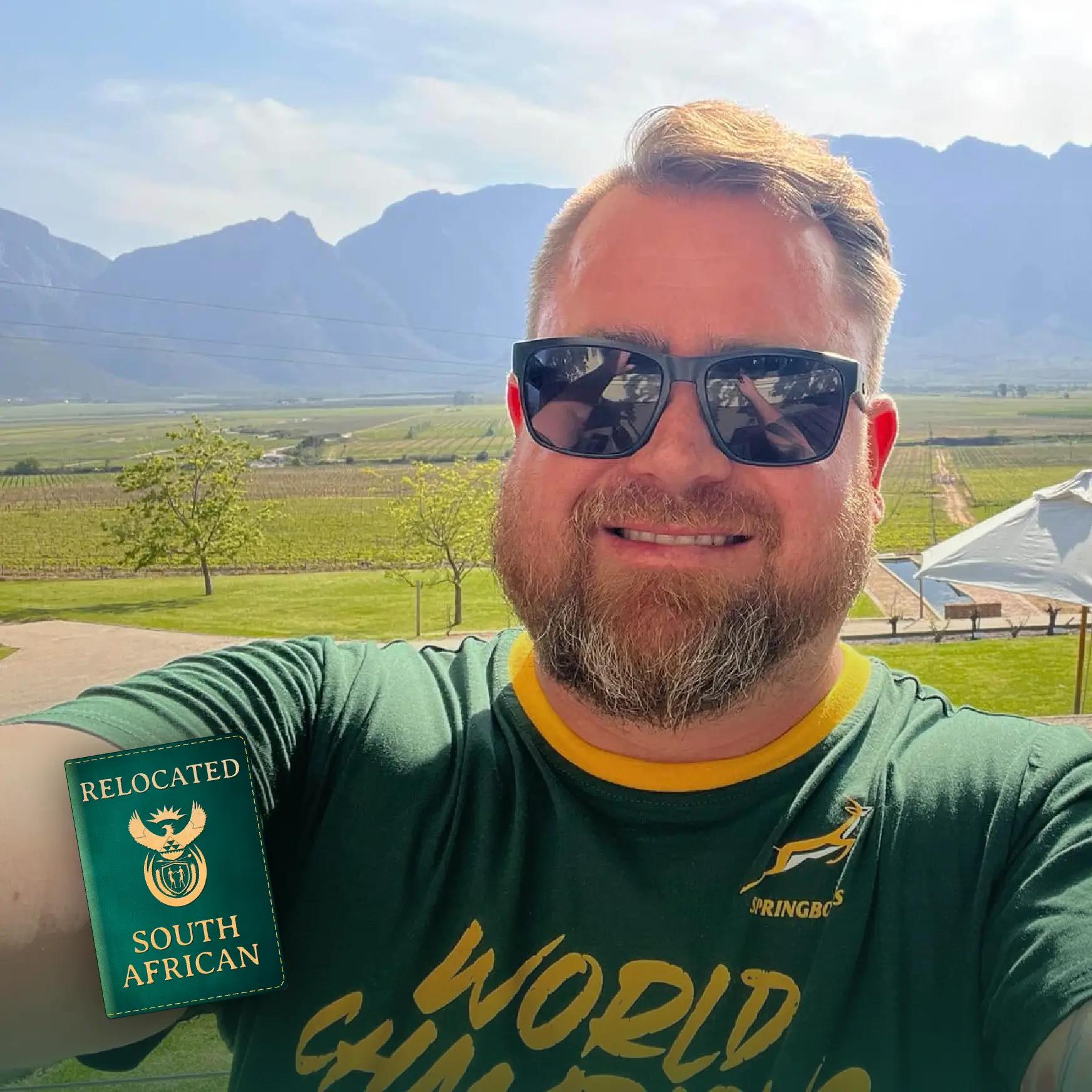
Today I welcome from Cape Town Nic Latouf. Welcome, Nic.
Nic Latouf: Appreciate it, thank you so much. Really excited to be talking to you.
Jan Hugo: Delighted to have you. So what I’ve read about Nic is a South African entrepreneur, storyteller, community builder who’s turned his love for the narrative into a powerhouse for global Saffers and their success. His recent work is as co-founder of the Lekker Network, but more about that a little later. So, like with all my guests, I normally start off by asking them a bit of background. So I know that Nic went to Pretoria Boys High, like Elon. I don’t know, maybe Elon says Nic went to Pretoria Boys High, but that’s where he started off. Give us a bit of your history and your background and how you got to a point to work with Saffas worldwide.
Nic Latouf: Sure. So yes, did finish at Pretoria Boys High. You know, I had an incredible time there. You know, with a school like that, you end up, you know, staying connected to so many of the people that you went to school with. And what I was going to say to you earlier is, you know, regarding Elon, it’s funny, I’m on a WhatsApp group with a couple of others that I was at school with the year that we finished. And somebody on the group the other day found a photo of Elon from school days. And we weren’t there at the same time, but one of their brothers, one of their older brothers were, and had found this photo of Elon back at Pretoria Boys. And I thought it was, and I still got it somewhere, and I thought it was quite fascinating to see this, you know, the richest man in the world and how he was back then.
You know, Pretoria Boys played a big role in how I’m doing what I’m doing today, right? Many, many years ago when I moved from, so I moved from Pretoria to Joburg, Joburg to Cape Town. And when I moved to Cape Town, two friends of mine, a little over 10 years ago, got hold of me from Pretoria Boys High and said to me that they’ve got this idea for this shoe, right? It’s called the Veldskoen. And can I come and help them build this company? And long story short, we ended up taking their shoe brand into 33 countries around the world in a very short space of time.
But how we did that was we connected with South Africans in all of those countries, and we formed partnerships with them and distribution partnerships with them. So we only had South African partners all around the world. And it was through that experience where I got to meet incredible South Africans everywhere. I got to meet incredible South Africans in Uruguay, in Costa Rica, in Mexico, you know, in all the countries that you don’t think that you’d find opportunities or incredible South Africans. And I always had it in the back of my head that these South Africans…
And I remember at the time there was this Facebook group that was popping up and it was super popular. It was called I’m Staying. And everybody was pledging on this group to stay in South Africa. And as much as everybody’s hearts were in the right place, I was looking at the diaspora very differently and looking at all these South Africans moving abroad and thinking that this is our greatest asset, right? This is our biggest opportunity: the fact that you’ll find South Africans everywhere around the globe, because there’s something different about South Africans. We carry our South Africanness with us and we don’t lose it. No matter how long, you know, South Africans have been abroad, you know, we’ve spoken to South Africans, we have members in the Lekker Network that have been abroad for 30 years. Their accents are still very connected to the country and to South Africanness. So there’s something really special in that.
I always had it in the back of my head that, you know, this is almost our 10th province. But I saw opportunity that if we could find a way to connect all of us globally, we could create something really powerful for South Africans locally and for each other around the world. So at the beginning of last year, I posted on LinkedIn a post that said South Africans are South Africa’s best export. And that post blew up. I was getting 60 to 70 messages every single day on LinkedIn, people from all around the world messaging me saying things to me like, “Nic, we’ve been in Australia for 20 years, we know all the retailers here, send us products so we’ll help.” Guys saying the same thing in Dubai: “We have money, we have finance, we have distribution, we know everybody in Dubai, send us stuff, send us opportunities, how can we help?”
Caribbean, a whole bunch of people message me and they say to me they know all the cruise ships, right? They have incredible relationships with all the cruise ships. Are there any products we can get onto the cruise ships? And this was just non-stop. And it became extremely overwhelming where you have so many messages, and I’m not exaggerating when I say 60 to 70 every day from all over the globe. And it became so overwhelming when you see all of these opportunities, right? And you see all of these people that want to help and want to connect and want to do business. And I’m looking at them and I’m going, this is a gateway into Dubai. This is a gateway into, you know, cruise ships in the Caribbean. This is a gateway into Australia. This is a gateway into the US.
I know what it’s like to build businesses and how hard it can be to be able to take something from somewhere and get it into a new market. And I just saw this is such a beautiful way to accelerate all of that. And so I kept on talking about it on LinkedIn. And then what we did was we created a landing page and we said, you know what, if you really want us to build this, right, sign up to this landing page and we’ll keep you and we’ll do a survey.
So we sent out a survey and we said to everybody, “Okay, so you want us to build something around this? We know that there’s something there. What it is, we actually don’t know. But the idea is to build a network connecting South Africans globally with the vision of becoming the most powerful incubator of South African potential.” And everybody was like, we love it, we love it, we love it. And then we said, “Okay, cool, but will you pay for it?” Right? Like this can’t be a charity. This needs to, if it’s going to be successful, it needs to be a business because we need to be able to hire the right people, we need to be able to travel, we need to be able to create experiences, we need to have technology, we need to do everything right in order to make it work. We’re not the first people that have tried to build a South African network globally.
And everybody was like, we understand, we’ll pay, we’ll pay, we’ll pay. So we said, “Okay, cool.” So we send out invoices and everybody starts paying. And within a short space of time, we had 200 members, we actually stopped it at 200 members that paid for a year’s membership upfront. And we said to everybody, “You realise we don’t know what you’re 100% going to get. But what we do know is that you’re going to help us build this and you’re going to help us figure it out.” And everybody was 100% on board with that, right? “How can I help you? How can I create opportunities for somebody else?” mentality. And that was the start of the Lekker Network.
And that happened, you know, from the first post early last year to where we signed our first 200 members, which was around about September last year. And we stopped at 200 members and we had enough capital to be able to build a platform, to be able to study every network around the world from YPO to EO to Chief, to understand what makes them powerful, what makes them work, what makes them sticky, what makes them valuable, and started creating our own core experiences and our own framework. And we spent a lot of time doing that, spent a lot of time creating a team and building a beautiful brand and getting our vision right, getting our mission right.
We then launched in March this year in person in Cape Town where we had about 450 to 500 people flying from all over the world, coming to launch the Lekker Network with us. And it was one of the most incredible evenings that I’ve ever experienced when you felt this energy in the room where everybody wants to help each other. The mentality is not what can I get. The mentality is, you know, let’s connect and let’s do great things together globally. We had guys flying in from, really flying. We had so many flying in just for that event and then flying out the next morning from all over the planet.
Jan Hugo: That’s incredible.
Nic Latouf: No, it was an unbelievable evening. And then the next day we opened it up, right? We had this huge wait list of people that wanted to be in the network and we started working through it one by one, where myself and my partner, Renier, we interview everybody that comes into the network. And the reason we do that is because we want to make sure that everybody is aligned with our core values, which is “How can I help you?” Not “What can I get?” but “How can I help you?” And so there’s not a single person that comes into the network that hasn’t been met by myself or my partner.
So we also begin to understand really a lot more about what people, what South Africans need, from locally building a business or being a professional, to globally. We now have members from Cambodia. We had our first member from Cambodia the other day. We got members in Vietnam. We got members across the US. We got members in Portugal. We’ve got members all over. And it’s growing and we are nine months in and we’re just meeting the most incredible South Africans that I’ve never heard of. Like you just introduced me to somebody now a couple of minutes before we started recording that I’m going to look into, but there are just so many of these incredible South Africans.
And what’s interesting about the diaspora conversation is that, look, we’re not the first to ever recognise the power of a country’s diaspora. The ones that did it really well were the Irish. The Irish had 10 million people leave the country. Seven of them went on to become presidents around the world. And the government saw the opportunity in being able to build relationships with all of these people that had left. And they did it very successfully. And that’s played a really big role in, you know, why and how Ireland became so successful.
So, you know, we’re looking at it in a little bit of a different way and going, you know, we’re in a position now where there’s this incredible technology. You know, we have, we have things like this, right? Where we can, you know, record a podcast with two South Africans on the opposite side of the globe. We have, you know, the ability to be able to connect better than ever before in history. And we want to be able to go back to our original vision and create the most impactful incubator of South African potential where it’s about access, right? Everything is access. Everything is meeting the right person who can open the right doors at the right time.
And it used to be six degrees of separation, but it’s three degrees of separation now. And what I mean by that is, I’ll tell you a story around this. There was a guy who joined the network, right? And he was based out of Liechtenstein and he was telling me he had built this incredible fund in Liechtenstein, been living abroad for many, many years and wanted to come home and bought a house in Knysna and said to me, you know, he hasn’t been back for so long, so he doesn’t really have a lot of people that he knows back in South Africa. And he sees the Lekker Network as a bit of a soft landing where, you know, he can instantly connect with very like-minded people with the same values.
And he said to me, like, “Tell me a little bit more about the network.” So I said to him, “Johan, I said, think of it like this. I said, you’ve got a product, right? And you want to get that product into Walgreens, right?” And why I say Walgreens, I’m not 100% sure, because I usually say Walmart. And I said to him, “If you got a product and you want to get it into Walgreens, somebody in the network, a South African will know somebody who’ll know the right person, right?”
And he looks at me, and I promise you this happened. He looks at me and he goes, “Yeah, Nic, that’s me.” He’s like, “What do you mean?” He goes, “The founder of Walgreens’s son was my intern for many, many, many years. I know the family really well.” What are the chances? So it just goes to prove that we are three degrees of separation away from, you know, the big opportunities out there. And also it doesn’t need to be big opportunities. Meeting one right person can change everything.
I got a message earlier from somebody who was really interesting, and I won’t mention names, but you know, he called me from the network about two, three weeks ago, telling me about one of his business ventures, which is an incredible, incredible business and needing some advice, et cetera. And I said, “You know what? You need to speak to X person because they’ve done, they built a lot of incredible things. They moved back to Stellenbosch. I think that’ll be a wonderful conversation, right?” I connect them and I completely forget about it, you know, because I’m, you know, building the network and I’m connecting hundreds of people all the time.
And I get a message from him today saying that how crazy it was that when they met up, the guy absolutely fell in love with the business idea and is investing in it. And I just, you know, one right connection can change everything and it’s completely changed the trajectory of him, his entire team and his partners. And I know the business and it’s going to be a very impactful, powerful business that’s probably going to become a unicorn. So, and that came off, you know, just connecting two of the right people.
So now how do we do that at scale, right? We’re also the byproduct of that is that there’s a lot of opportunity that flows back into South Africa. A lot of jobs that flow back into South Africa, a lot of capital. And that is a byproduct of what we’re doing because we’re seeing it, you know, we’re having so, there’s so many companies reaching out to us, so many South Africans reaching out to us, setting up companies around the world and building their teams back in South Africa and doing that very successfully and all over. Gosh, I was with somebody yesterday who’s doing that from Tanzania and building and has built a team of 20 in Observatory down the road from me in Cape Town.
So I believe that the next decade belongs to South Africans, not necessarily to South Africa, but South Africans. And again, a byproduct of that will mean that the next decade belongs to South Africa. But, you know, as we grow and as we connect more South Africans, we’ve got really clever technology that we’ve built of our own. We’ll be able to spark opportunities between everybody globally, you know, doing your book that you’re about to publish. Let’s keep in touch. There’s opportunities there, right, to do some really interesting things. And that’s how we’re looking at it.
Jan Hugo: Nic, I mean, it’s absolutely fascinating just the process. And as you’re talking, it’s just connecting, connecting, connecting. Obviously, that’s going to require a massive database of opportunities and actually making sure that these connections happen, that it’s not just talk. And you’ve just given us an idea of what happens. But have you got other kind of recent sort of successes? Because I think, you know, you talk about storytelling and I know you were in storytelling and film and so on, that those stories will also feed what you’re doing, I would imagine, because, you know, it’s in those stories that people find a home.
Nic Latouf: Listen, absolutely. And there are probably too many for me to… What we decided to do is, so we’re having a summit in March on the 11th to the 13th of March in Franschhoek, which you are more than welcome to join us at. If you do find yourself in Cape Town, please come and join us. And so what we’ve decided to do is actually publish a book of our 2025 impact, right? How many opportunities were created, how many lives were changed, how many jobs were created, et cetera. And we’re compiling all of that because there’s so many that we don’t even know about.
We had this thing called, we’ve got this thing internally called Lekker Learnings as an example. And it’s run by a half team member, half a member, right? He’s a member who we brought over into helping us with this Lekker Learnings. And it’s really just about sharing knowledge. And we were the first ones as the founders to talk about networking. And as the season of Lekker Learnings is coming to an end, we had another session with him two, three days ago. And it was in the session that he was telling us about his experience in the Lekker Network. And again, I had zero idea that this happened.
His experience was that he saw somebody that needed something on one of the WhatsApps and he connected them with a friend of his in the UK. And they’ve ended up building an incredible business together. And we had zero idea that that’s happened. So there’s so much of that, right? That’s constantly happening because how we’ve structured the entire network is to foster that.
So you come into the network and there’s a beautiful onboarding that we’ve created. We make sure that you go through this process where you fully understand how to use the network, how to network, how to be confident, et cetera, et cetera. And then you sign up and we’ve got a platform and the platform’s great and you fill out all of your profile with all of your data, which is important because then our tools can really kick in and understand how you can help, right? What you can offer, but also what you need, right? Like what are your goals? Like what is it that you’re building, right?
And then when we understand that, we were able to, you know, be really smart and intentional about our connections. But then there’s all the WhatsApp groups, which we’ve structured into different channels. One of the channels, which is probably the most powerful one, is Leads and Needs channels. So that’s where, you know, you need an introduction to somebody, or you need a tool, or you need help with something, or some advice, et cetera, or a designer, or whatever it is, whatever your challenge is that day, you pop it on that group and you’ll have hundreds of other South Africans on the group as members jumping in and helping you.
So with just that group alone, right, just with that channel, the amount of impact that’s happening on a daily basis is off the charts. Then we have, so we have many of these WhatsApp channels, et cetera. And we’ve done a lot of really smart things with the WhatsApp channels because when you’ve got a couple of hundred members, those WhatsApps can become extremely noisy. So what we’ve done is we built a tool. And what the tool does is it sends everybody a summary every single day via email of anything that they may have missed, which is really powerful. So nobody misses anything. And also if it’s too noisy, they don’t have to be on those channels. They can just keep an eye on the WhatsApps.
Then we have sessions that we’ve created like Micro-Meet sessions. A Micro-Meet session is where we curate, our team. So we’ve got a team of about 14 people now. Our team will take, we’ll invite 10 to 15 members from all around the world, put them on a Zoom call, and everybody goes around the room talking about where in the world they are and what it is that they do. And just a session like that, and we run those, sometimes we have about three of those running a day, where, again, we have hundreds of members in the network, and not everybody knows each other, not everybody’s met each other, right?
And when you, on a call and you hear, you know, that somebody was a helicopter pilot, and you’re able to then connect the dots inside your head when you know where somebody is and what it is that they do, that’s where the magic actually happens and it’s so simple, so simple. The moment I hear that somebody else does something that actually starts ringing bells in my head that I need to talk to them, that’s when opportunities arise. So we have those sessions constantly moving and they’re really powerful.
And we have Boost sessions. That’s also where you have a challenge and you really need help. And it’s a 30-minute session. It’s also with about 10 other members and everybody comes on to the session and it’s like, “Guys, I really need somebody to help me with a visa,” or “I have this issue that I need help with.” And everybody else in the room tries to help you and you try and help everybody else. Very, very, very powerful.
We have a concierge service. So you’re travelling from Portugal to London and you WhatsApp the concierge service and you say to them, “I’d love to meet a couple of members.” They’ll set up lunches for you, they’ll set up dinners for you, they’ll set up coffees for you, anywhere around the world where you’re travelling. So we’ve designed everything for connection and to be able to build relationships. And that’s what a network is about, right? And everything in business and everything in life that comes to you comes through people. So it’s all about, you know the saying, it’s all about who you know.
And we’re going like, let’s double down on that and look at the diaspora and look at every single South African that has moved abroad as an absolute asset, right? An absolute asset. So that’s our vision. And going back to, you know, stories that we may have of things that have happened with members, et cetera, there are so, so, so, so many. Gosh, off the top of my head, let me try and think of a couple quickly.
Jan Hugo: I’m going to… Yes, sorry, go for it.
Nic Latouf: No, no, I was going to ask you a question, but if you think about it and you’re ready to talk about a story.
Jan Hugo: I’ve got a lot of other funny stories that I’ll tell you just now, just like members that I’ve met that you just wouldn’t believe existed, right?
Nic Latouf: Because that was kind of my question. In the podcast, we’ve done 40 episodes and we’ve met people all over the world in so many countries, people from just such diverse backgrounds. But a lot of people go overseas with a profession, you know, they go there to be a doctor or they go there to be an accountant, engineer. A lot of people go to Amsterdam, lots of them, Ireland, where my daughter lives. And my sense is that if I listen to you, the Lekker Network is more for entrepreneurs and businessmen. Is that an incorrect perception?
Nic Latouf: It is, and it’s accurate in the sense that that’s what the world looked like and that’s what it’ll sound like. But something that we realised a couple of months ago is how powerful our professionals are and how connected our professionals are. So you don’t need to be a business person or a business owner or entrepreneur to join the network and you don’t need to be a business owner to be very connected and very successful. And I’ll give you an example of that.
We have a lot of engineers, South African engineers from all over the world that are heading up incredible projects, right? Incredible. The biggest airports in the world being built, massive, massive, massive construction across the US and saying to us, you know, that there’s massive opportunity because they’re heading up a lot of these projects and they’re not business owners. They’re just really brilliant at what they do.
So we look at the network and go, what makes sense is a combination to make it really impactful and successful of professionals and business people and freelancers and sports people and expats people. So South Africans, right, that want to soar, that have the right mentality and want to soar, no matter where in the world you are and no matter what it is that you do. Everybody’s different and everybody has a different path and somebody will be able to open the right doors for you and you’ll be able to open the right doors for somebody else.
So initially what did happen was I’d say 90% of the people that joined right off the bat were business owners, very mature businesses that had been around for a very long time. And when we look back now, we understand why: risk takers, happy to take a risk with us, happy to help us build, happy to share experience, happy to help us shape it. And that was incredible. We would never be where we are if it wasn’t for them and for the risks that they took, you know. And we were always very transparent in saying, we don’t know what this is going to look like.
What the Lekker Network is going to look like a year from now, I don’t 100% know. I just know it’s going to be even more incredible than it is today. We’ve learned a lot and it’s been a very powerful year and we’ve taken the mistakes that we’ve made and we’ve fixed them and we’ve taken all of our learnings and we’ve gone, “Vision 2026, this is what 2026 looks like,” and we’re going to be opening up more chapters. We’re going to be visiting more countries. We’re going to be meeting more South Africans.
I mean, right now, as we’re talking, there are meetups happening across Texas. Then in a few days’ time, there are meetups happening all the way across Florida and there are meetups happening in Amsterdam and there are meetups happening in South Africa. And it’s amazing to watch all of this, you know, taking shape and then having the ability to cross-pollinate all of that, right?
I mean, I was on a call today with two members just kind of touching base and seeing how they were doing. They joined very early on. They’d never met each other, but now they’ve got a business together. And it was just…
Jan Hugo: Yeah, absolutely, right.
Nic Latouf: And the one lives in South Africa and the other lives in the UK. And they met each other on one of those Micro-Meet sessions that I told you about earlier, and they started a business together. And I actually made a couple of notes because in that session, I was kind of in the meeting or just like having a touch base with them. I was saying to them, it just sounds like this business that you guys are building has the ability to be like incredibly successful, right? And like do very well. And they were telling me like, yes. And again, like, I wonder if they’ve actually met in person. Maybe they have by now. But so those things are happening all the time.
Jan Hugo: That’s so fascinating. I had a question. I said, how do you see the Lekker Network in five years? But maybe I can ask it a little bit differently. Do you see the Lekker Network ever becoming an actual partner in this? Or do you see yourselves living off the members’ contributions? Because if these businesses become successful, the businessman in you would say, well, maybe we should participate in that. Is that an option or will you give away your independence by doing that?
Nic Latouf: So we are very aware, like what you’ve mentioned as well, around our independence. And that’s very important to us. We’ve had many people wanting to invest huge amounts of money into what we’re doing. We had some very influential people last week messaging us saying that they’d love to invest, right? We feel like we know where we want this to go. We feel like our hearts are in the right place and that we should for now be the custodians of building this art. And that nothing should get in the way of that. And because there’s no negativity, the energy is all about building. The energy is all about positive. The energy is all about sharing knowledge.
And we need to maintain that, right? Because if it becomes something else and the wrong elements creep in, it’s not going to work. Or the wrong energy or the wrong mentality creeps in, it’s not going to work. We have been looking at building a fund on the side because it does make sense for us when we see all of these opportunities for us to be able to invest in those opportunities. That is something that we are looking at. And we do, you know, it’s a network of opportunities. So we do have incredible businesses reaching out to us all the time through the network going, “Would you like to be part of this?”
We don’t 100% know what that investment fund looks like just yet, but it is being shaped by people way smarter than me. So it’s going to be done correctly. And as for us taking, you know, part of deals that we put together, et cetera, right now, that’s not the model. Right now, the model is it’s a healthy business with membership fees. And as we grow, it means we can do more. As we get more members in, it means we can do more. We can hire more people. We don’t have volunteers in the network. We pay all of our chapter heads, as an example. We’re running it as a very, very, very solid business so that it works for everybody. And that’s really important to us.
So right now, that’s not part of our model as tempting as it is, right? It’s not something that we are looking at currently.
Jan Hugo: I really like what you’re saying about the positivity of the network because I think that is so incredible, especially for the diaspora in terms of South Africa and some of the negative stuff around South Africa. So as long as you can keep positive, you can keep building. And because the other question is, why aren’t these people doing it in South Africa? I think what I heard you say is, eventually it will benefit South Africa. The fact that the guys are living overseas, that’s not going to change. They’re not heading back to South Africa. But ultimately, there will be a benefit. But it’s incredibly important to stay positive, I think.
Nic Latouf: I really like that idea. And it’s something that we’re very protective over. And again, when you want to join the network, it’s something that we reiterate and we set the tone for that. We set the tone for that at every event that we do. We’re drowning in negativity in the world, right? And we don’t want to play a part in that at all. And again, I think that’s also one of the reasons why the network is so successful is because people understand it and they’re finding it so refreshing. And so it’s just compounding, right? They just want more of it and everybody starts taking part in the… And listen, I mean, you know, it’s not all toxic positivity because that’s a new concept where, you know, you can be kind of fake positive for the sake of being positive, et cetera. It’s not that at all.
I mean, there are businesses that I’ve spoken to recently that, you know, have worked so hard that they’re super burnt out at the moment and finding it tough to do business in different countries around the world, being a South African somewhere else and growing a business. And it’s hard. It’s not easy, right? We’re just trying to make it easier. So what that says to us is that, okay, cool, when we start understanding that in the last couple of days, we’ve been thinking, okay, so is there a space then in what we do for wellness, right? People are burning out. People do have digital fatigue. People are overwhelmed, right?
There’s a lot of chaos in what we do, and that’s powerful, but we’re also not naive to how difficult it is to build something abroad and how difficult it is to take your family abroad. And we’re very, very, very aware of that. And that’s something that we are tapping into a lot in a very clever, positive, healthy way. And we’re looking at ways to incorporate wellness and having the ability, if you are battling or struggling with something, that you have many others to lean on and to talk to and to tap into for advice and experience share, et cetera. So as we understand more around, again, owning the business ourselves, we’re able to implement, as we learn, things that will be super beneficial to everybody.
Jan Hugo: Well, just on that note, it’s very interesting. One of the discussions we’ve had on the podcast is about parents that stay behind. So a lot of your network people are overseas, but their parents stay behind. And I never realised, I met through actually this lady I met on one of Emigrate to USA, Dr Sulette Ferreira. She’s also on LinkedIn. So I met this lady, saw on her site, and she’s got a practice dealing with parents that stay behind. She’s a psychologist who only deals with parents who stay behind. And you never think about that. But the kids have their own stuff, the family to work on. But then the parents stay behind and it’s becoming very difficult for those parents and they don’t want to let their kids suffer.
So it links in maybe to what you were saying is there’s a, you know, immigration is not for sissies. And when you live overseas and you leave family behind, it’s a very tough, tough thing. So I can imagine if you’ve been working very hard and South Africans, you know, are really industrious and they want to work hard and they want to succeed and they go overseas. And that’s why this is successful, but it takes a toll because often when people leave, they go and start afresh. They cashed in their pensions. They have to start from scratch again, you know. And it really is hard and it can burn out.
And I think I had an interview with Paul Harris early on in the podcast and he talked about going back to South Africa and he said, immigration takes five years out of your life. So if you go and you go back, it’s going to cost you five years and maybe even more. So it is critically important, I think. I think that’s a great idea to focus on wellness because people, people absolutely…
Nic Latouf: Absolutely. And again, it’s not something that I saw early on. It’s something that I started to realise over time in building this network. When you start to get to know many people and you actually realise how unbelievably tough it is to make that move. And like you say, it must take a toll and it does take a toll. And we can play a role in alleviating some of that and softening the… You know, if Paul Harris says it’s five years and with what we’re building, can it be one, right? Because again, it’s five years because you have to start all over again because you don’t know the right people, et cetera. Well, now you can.
So from that perspective, absolutely. But from the emotional and the mental perspective, there’s so much there to tap into that we’re constantly looking into in really smart ways to be able to play a role in that and a very, very, very effective role.
Jan Hugo: I think that’s excellent. A question: is it open to non-Saffas or is it only Saffas?
Nic Latouf: And that’s a great question. Last week, Thursday, we had somebody from Scotland who has built a product for cars that is everywhere around the world except South Africa and Africa. And she said to me, “Please, Nic, you know, it’s so hard because digital doesn’t work anymore, right? It’s like running ads on digital, you know, because of AI and digital fatigue, et cetera. The trust on digital is not what it used to be. So people are starting to look for different avenues in being able to build their businesses.”
And she had this incredible conversation with me going, “I’m not South African. I’m Scottish, but I want to build a business in South Africa. And it would make so much sense for me to join the network to be able to tap into the right people.” And we said, “With the greatest of pleasure.” We had somebody from Texas joining who’s not South African, buying property in South Africa, wanting to come spend a couple of months a year here, wanting to meet like-minded entrepreneurs and professionals, and he joined.
So we have about, I’d say, 30 members that are not South African but do have a link to South Africa. So, you know, there’s a very long answer to your question. You do not need to be South African. The majority are obviously going to be South African. But if there is a link or a tie to South Africa and it makes sense, absolutely, right? We can’t be, and we don’t want to be super exclusive that, you know, we keep everybody else out. That’s not what we’re building. In fact, we’re building the opposite. We’re building something very inclusive.
You want to do business with South Africans? And people are waking up and realising how amazing it is to do business with South Africans, how amazing it is to hire South Africans. So we’re saying, also, great, join the network then. You’ll have access. We’ve got a guy, okay, he is South African, Singapore, and they do this event once a year in Singapore that is extremely successful. They get hundreds of thousands of people coming to this event, and now they’re taking this event around the world. And their first stop is going to be Cape Town. And he joined the network specifically so he could accelerate and just have one place where he could get all his service providers to be able to do the event successfully.
And that’s what we’re saying to people. So if we have non-South Africans around the world that want to join because it makes sense to tap into South Africanness, with the greatest of pleasure. We do not want to be exclusive. We want to be inclusive and that makes a lot of sense to us.
Jan Hugo: That’s amazing. Also busy producing a book, Winning the Away Game, and are you personally involved in that? It looks like a really interesting project. Do you want to maybe share a little bit about that and maybe a story from that?
Nic Latouf: Sure. Winning the Away Game. So how the story came about was actually the name was coined by Bob Skinstad, where he met one of the members and they were talking about the project and Bob said to him, you know, it needs to be called Winning the Away Game, right? You know, it ties into sports. We’re a sport-loving nation. And ultimately the book is, we’re taking it around the world and we started in the UK and we’re putting some together in the US, where we are looking at the South Africans that are winning the away game in business, in sports, in academics, in culture around the world. And we are putting them into one book for the UK, into one book for Dubai, into one book for the US and publishing that, right?
And we think that that’s going to be something really, really, really beautiful. And so we’ve got quite a couple of those types of projects going on in the background where, you know, as we uncover all of these stories around the world, you know, we’re able to have ways to share those stories with others because the more… You know, the thing with South Africans is, as I’m sure you know, we’re incredibly humble. And I don’t know if that’s always a good thing. Of course it is, right? But not to the point where we’re not sharing our stories and we’re not telling of our successes. And we need to be doing that. We need to be doing that a lot more because there’s so many other South Africans that need to hear how well we’re doing out in the world, right? And also in South Africa. And we don’t do that often enough.
So we want to play a big role in changing that. And not from a point of arrogance, but from a point of showing what’s possible. Because when you see that somebody who lived down the road from you, you know, went and became the richest man in the world, right? Like anything’s possible. And, you know, Elon’s one, but there are so many examples. So many examples. We constantly meet people that we just cannot believe are South African.
And I mean, I’ll tell you one story. I have many. So if you know the world of networks, the two most powerful networks in the world are YPO and EO. The guy who was so instrumental in building YPO and playing a huge role in shaping EO and then going on to build Tiger 21, were playing a big role in building Tiger 21, which is a high net worth network where I think you have to have a net worth of $140 million and above just to join. The guy who shaped those, right? And still continues to be the leading person in the space in the world is South African and been living abroad for 30 years, still got an accent and tells us the funniest story when we meet him a couple of weeks ago.
And he says to us, “Hey guys, you know what I’m making, everybody that’s coming to my house for Thanksgiving?” And we’re like, “What?” He goes, “Durban Curry.” You know, so brilliant that somebody that’s been abroad for so long, so incredibly successful, is still making Durban Curry on Thanksgiving. So there’s a lot of those stories.
In Australia, we met some incredible people who are so successful and then what they’re building back in South Africa, without anybody knowing, just quietly what they’re building back in South Africa. And again, I don’t have all the details on the story, but the one family incredibly successful, again, moved to Australia, but building a centre of sports excellence, which is going to be in Johannesburg, but it’s going to be one of the top centres of sports excellence in the world, right? And apparently the story goes that they funded 80% of the entire project out of their own pockets.
Jan Hugo: That’s incredible.
Nic Latouf: So my biggest takeaway from the last couple of months is this: more good than bad, 100% more good than bad.
Jan Hugo: I think we spoke about Justinus and living in Canada and having that coding business where they teach people to code. I think that’s just incredible. Now I asked him a question in our interview. I said, “Do you think you’d be able to do it better in South Africa?” And the answer is yes and no, because I see different people. I meet people who can help us fund it back into South Africa, which I wouldn’t have access to in South Africa. And that’s quite an interesting thing.
I will tell you about the movie just now, but I spoke to this filmmaker’s father who lives in Stellenbosch. He’s a very well-known psychologist. And I will interview him in January. And we just talked about the concept of immigration and kids leaving. And he takes a very holistic view of it. He says, “Sometimes there’s not enough oxygen for the kids in South Africa. And they have to go elsewhere where there’s more oxygen and they can breathe and live and build something. That doesn’t mean you’ve lost them. It’s just right now the oxygen in South Africa is maybe not enough.”
And I think that’s what happens with a lot of guys because we have such talent and you made the point about the biggest export. And so getting back to this film, this person, his name is Desmond Denton and he made a movie that, probably the most famous movie is called The Journey Home. And if you can watch it, it’s on Amazon Prime. And they literally went and interviewed children who had emigrated and their parents in America. So it’s kids talking. And it was just absolutely fascinating because they as an Afrikaans family emigrated to America and his kids are in there.
And one of the comments in the movie, and I saw it the other day on the internet, on LinkedIn as well, was one of the people in the movie said, “I feel more South African now than I ever did in South Africa.” And I mean, that for me is just fascinating because, and I’m not sure, I’ve asked people about that, you know, what do you think? Why is it that maybe we do feel more South African? Maybe we’re very supportive. Like Justinus said, when they go to the rugby, there’s a gazillion South Africans in green jerseys. But maybe this missing home makes us feel more South African because we’ll always be South African. We’ll always miss home. I think that’s just how it is.
Nic Latouf: Somebody was saying to me yesterday, and I mean I need to think through it a little bit more, but they were saying to me we’re one of the only people that still call ourselves ex-South Africans, you know? Somebody doesn’t move somewhere else and say that they’re ex-Italian or that they’re ex-Chinese or they’re there, you know. We still do carry that with us. And, but you know, I do have to say though that there is something interesting that I’ve witnessed over the last couple of months and that is when we started this journey, I’d say about 5% of our conversations were with South Africans coming home. Now it’s up to about 30% of our conversations. We have these periods where it’s a lot of South Africans having conversations with us about coming home.
And then South Africans that have been home for a little while after having lived many, many years abroad. And I love those conversations as well to really understand why. And when you mentioned Stellenbosch, it just reminded me of a member that joined recently whose family lived in the UK for a very long time. And I think they’ve been back about four years now and absolutely thriving. So it’s complex, right? It’s complex, where there are people coming home and there are many moving abroad.
There’s a stat that Sable International, they’re partners of ours. And they were saying to me a couple of weeks ago that for the first time since 1980, more people are moving from the UK to South Africa than South Africa to the UK.
Jan Hugo: That’s fascinating. Yeah. I had Andy on the podcast a few weeks ago as well.
Nic Latouf: Okay.
Jan Hugo: Yeah, so we had a really good chat about what they do. Yeah, it is fascinating. You know, the one thing that I’ve learned in this podcast is there’s not a rule, one rule that applies to everybody. And you cannot judge a person. When you decide to go, it’s your decision. And you’ve got to live with your decision. It’s a massive decision. I can’t say you’re wrong for whatever reason you’ve decided there’s a better opportunity. And the same thing for going back, you know, I’ve spoken to people who have gone back, people who lived for nine years in Ireland, and they said they want to raise their kids in South Africa. So they got Irish passports, everything. They’re back in Bellville, I think, in Cape Town.
So I think it’s such an individual thing, you know, and you cannot judge. And that kind of leads me to the next question. I had a young entrepreneur come to you now and he says, “Okay, Nic, what should I do? Should I stay? Should I go and try and make it overseas? I have an interesting bunch of ideas. What do you think I should do?”
Nic Latouf: Yeah, that’s a good one. I mean, I think it’ll be industry-dependent, you know, with regards to what it is that you want to build. But I’m of the mind that this is how I see the world, right? And this is a very personal thing. I love the idea of being able to work from anywhere. And I think that that is possible with pretty much whatever you want to build these days, right? Unless it’s a restaurant or… But access is really important. And again, that’s why the world is a very exciting place. And we want to play a big role in shaping the mentality of people or the perception, not mentality, the perception of people to not be in a bubble in South Africa and to realise that there’s a very big and exciting world out there.
But even more so than thinking of the world as just America and just Europe and the obvious players, which are very exciting, right? I love, you know, the opportunities in the US and everywhere else. But there are also opportunities in Mexico, there are opportunities in India, there are opportunities in Uruguay, there are opportunities everywhere. I got off a call with somebody who I said earlier has joined from Cambodia and I’m doing a deep dive into what’s happening in Cambodia and they’re happy. And they go every weekend to Ubuntu Cafe, which is a South African cafe in Cambodia. And they’re saying that the region is thriving. China is exciting. China is super exciting and super interesting. And we’re building an incredible gateway into China through South Africans.
Vietnam, we have some members who lived for a very long time in the Netherlands and have just moved the entire family to Vietnam. And they’re telling me that, you know, we have constant calls because I want to be able to knowledge-share everything that they’re experiencing with everybody else. And they’re just telling me it’s just so incredible. They feel super safe and just everybody’s building, right? And the government’s behind everybody and everybody’s building there. So there’s this incredible energy.
So my answer to, you know, what I would say to an entrepreneur is don’t think small in terms of the world is a big place. You can find customers anywhere. You have the ability, through being South African, to access whatever it is that you want to access. If you want to build a piece of software, we know incredible South Africans throughout Silicon Valley that will open up massive doors, depending what industry you’re in. Nuclear energy: I’ve got friends that are nuclear engineers building small modular reactors. And so many of the successful people in the nuclear industry around the world are South African.
There’s not an industry that you wouldn’t be able to tap into that doesn’t have South Africans somewhere near the top. So I would say use your South Africanness to, you know, to get ahead and to open doors, but do the same for others, right? That humility is a superpower as well, being South African and having all these South Africans around the world, you know, the world is a big place and tap into that.
Jan Hugo: Absolutely. That’s fascinating. Beginning towards the end, I have to ask you this. I mean, it sounds like you have an amazing job now and you’ve had an amazing career to date. Is there anything you know now that you wish you knew when you started out?
Nic Latouf: I was asked that question. To say that again, anything now when I started…
Jan Hugo: When you started out as a…
Nic Latouf: When I started out, oh yeah, absolutely. Gosh, I mean, so many. Do we have enough time? You know what? I think the biggest thing is focus. Being able to focus on one thing, being very, very, very successful at it, knowing when the right time then to move on to the next thing. I think that’ll be it. I think for many, many, many years, I’ve tried to do too many things, too many things at once. And it’s extremely hard now because there’s so many shiny objects. There’s so much opportunity everywhere. When has there ever been this much opportunity in the history of the world?
So if I could go back and do things differently, it would really be focus and learning how to focus better and not jumping between too many different things and just becoming really good at building that, exiting. And I have been fortunate enough to build a few things and exit, but there were many, many, many years of way too much split focus, which was super unnecessary. Split focus is not a good thing at all. And it’s harder now than ever, right? Because there’s just so much trying to draw our attention to their platforms and their content and so if I could go back and do things differently, I’d say, “Nic, when I was 21, just focus, dammit.”
Jan Hugo: Very good, very good advice. And obviously one maybe last question: you are so busy and you’re dealing with there’s just so much stuff coming at you. How do you maintain good family life? Because that’s critical as well to avoid burnout.
Nic Latouf: Yeah, absolutely, absolutely. And I mean, how do I do it? I think through awareness. I’m very aware of how time flies, right? And I’m very aware that I do not want to wake up one day having missed any opportunities with my kids. And I’ll make sure that, and that’s in the back of my head all the time, right? And then, you know, you’ll go through phases as an entrepreneur where like with the Lekker Network, where things are going so well and you get sucked up in, you know, the success of all of it and you can easily forget what’s happening at home. And then you have to find ways to just bring yourself back down to earth, right? And go, that is nice. It’s great. But this is the reason we’re here, right? This is the meaning of life, right? Kids, family, all of that.
So it’s just constantly, I personally, I don’t drink alcohol, very little sugar. And the reason I do that is for the focus. I don’t want to have to deal with all of that as well, right? Deal with, you know, those habits, which is just something extra because there’s so much to deal with. So I make sure that I go watch my son play rugby and I love it and being as involved as I can. And then, you know, my family’s very accepting then when I do need to travel, et cetera. And I know it’s okay also because I put the time in and I’ve been very aware and I’ve been very present.
I think that’s also the thing is constantly teaching myself how to be present. And I haven’t got it 100% right because being present is, you know, when you’re with your family and you’re with your kids, you don’t have work in your head the whole time. And you have to be brave enough to say, like, those are two different worlds and I can let go and I must let go, right? Because happiness is important and family is important. And I’m sorry to say, but it is way more important than business and it is way more important than being successful. And I think for a long time, I probably had the opposite idea as well, where I was caught up in wanting to make huge amounts of money and wanting to be super successful, et cetera. And then you realise that, you know, again, when you have kids, that’s not where it’s at.
And then sports, right? Exercise. So I play a lot of padel and I’ve just taken up golf. And if I feel tired, I go exercise. And that grounds me very quickly. And I also watch my diet, but I think it’s just being very present and aware that all of this goes so quickly and you do not want to be that person that wakes up one day going, “I wish I had.”
Jan Hugo: Fascinating. Nic, that’s unbelievable. If anyone wants to read about the Lekker Network, the website is thelekkernetwork.com. Is that right?
Nic Latouf: Correct. Correct. And anyone’s more than welcome to reach out to me on LinkedIn. I’m very active on LinkedIn. I keep very active specifically so I can have conversations with anybody that wants to have a conversation.
Jan Hugo: Excellent. So if you want to get hold of Nic on LinkedIn or look at the Lekker Network’s website, we’ll also put it in the show notes. And Nic, I can just say, thank you, man. It was unbelievable. I’ve learned so much tonight.
Nic Latouf: It’s an absolute pleasure. And listen, and vice versa, thank you for what you’re doing. I didn’t realise that you had actually done 40 episodes. I’m going to go back and I’m going to listen to the Paul Harris one. And I’m sure there’s a bunch of really other interesting guests that you had that I’m very interested to listen to. So yeah, thank you as well.
Jan Hugo: Thank you, Nic. So if you’ve just enjoyed my discussion with Nic and would like to hear more about experiences of South Africans who have left South Africa, why not subscribe on your favourite platform. If you’d like to share your story, contact me on jan@therelocatedsouthafrican.com. Until next time.