Jan Hugo: Welcome to the Relocated South African, the show for navigating emigration from South Africa for a better future. I’m your host Jan Hugo from Lagos in Portugal. Check out our website, www.therelocatedsouthafrican.com. It contains a lot of useful information and details of all episodes to date. If you want to interact with us or comment on our discussion or participate in an interview, please contact me on jan@therelocatedsouthafrican.com. Also, if you like our content, why not subscribe on your favourite platform.
Today, I welcome from Washington, D.C., Desmond Denton. Welcome Desmond.
Desmond Denton: Thanks so much for having me.
Jan Hugo: Awesome. I think before we start to get into Desmond’s resume, his email signature ends with this quote: “Beauty and grace are performed, whether or not we sense them. The least we can do is try to be there, so that creation need not play to an empty house.” Really beautiful quote and I think if we get into Desmond’s career and his life you’ll understand why that is so appropriate.
So Desmond is from Cape Town where his love for stories and a video recorder started him on his career as a filmmaker. He graduated from the AFDA Film University, master in fine arts and holds postgraduate degrees in communication science and psychology from UNISA. He was chosen for master’s programmes at Berlinale Talents, Big Fish Producers, NFVF writing course, Mo-film Commercial Director. He’s worked with celebrities like Jamie Oliver, Greg Kriek and Desmond Tutu. His work has won numerous awards including Best Produced Feature Film at the Monaco International Film Festival, Best Actress at the Monaco International Film Festival and Best Director at the Apollo International Film Festival.
Recent awards include Best Sci-Fi at the Miami Sci-Fi Film Festival, awarded the African Oscars for Spelonk the Film, Best Director, Best Sci-Fi Film and Best Experimental. He is also a judge for various festivals including SAFTA’s, been an Oscar judge and is involved in various master classes. On top of that he is a published author and has also written various short films and TV series. For over 20 years he has created original content that entertains and connects viewers. He brings creative vision, smart producing and passion to every project.
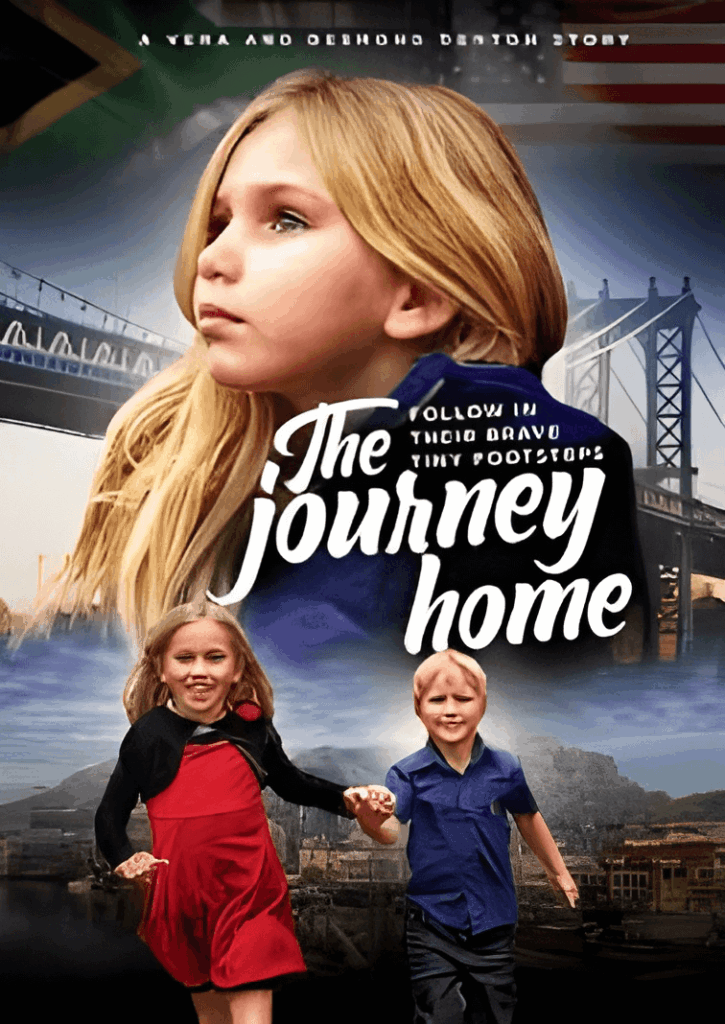
His recent work, The Journey Home, is an emotional journey of South African families with young kids making their move to the US, following the journey of hope, challenges and triumphs through the eyes of the children as they find a new home. So that’s a mouthful. And maybe Desmond, before we dive into the immigration part, please tell us about your recent films, your project that you’re busy with. I mean, I don’t know how many people in South Africa and across the world know about some of these projects. And I think it will be wonderful to hear a bit about it.
Desmond Denton: Yeah, I mean, you know in Afrikaans sê ons “een in die pan, een in die kan”, you kind of always have a few things. So there’s always something that’s coming out to cinema, to TV whilst you’re already busy. I’m heading out Wednesday, where I’m busy shooting a new series that we’re busy with called 24, where I’m featuring artists all around the world from sculptors to various interesting forms of art, animators. I’ve been to Norway, Colombia, parts of Texas, so heading to Ireland next.
And then the one you mentioned, Spelonk, it’s been a fun passion project that we’ve been involved with for quite a bit of time before I relocated to the States. So it’s exciting to see it’s finally out on Amazon and a few other TV stations as we’ve just had it doing its festival run across the world for the last year.
Jan Hugo: Well, I’ve watched the trailer and I look forward to watching the full film. I mean, it’s amazing to see almost a sci-fi movie, a Cape Town backdrop. I mean, that’s never been done before.
Desmond Denton: Yeah, I mean, it’s always exciting just because that was my home for so long and it’s always part of me, just to do a story where we’ve all worked in the South African film industry on a lot of big, and as you can see now with a lot of the new ones, One Piece, all these things coming out. Some people I worked with who worked on films like Mad Max, the South African crew and talent cast, we’re fortunate that we get to work on a lot of amazing international stories. So it’s fun to maybe now and then do something that you feel like this is not just us being involved with, but actually creating our own stories. So Spelonk was one of those. We’re myself and a lot of really talented cast and crew came together and said, well, let’s do something different that is our own. And that’s our own story, our own property, our own unique flavour.
Jan Hugo: Awesome. So obviously you live in DC now. And maybe just I normally do this with my guests. If you just give us a short background where you went to school, university, and how did you get to immigrate to the US?
Desmond Denton: Yeah, it’s always, there’s a lot of different ways you can tell the same story. But I grew up in Welgemoed, Cape Town. My father was a professor at Stellenbosch University Business School. So I come from a background of, I don’t want to say intellectuals, but incredible people. I always say it’s big shoes to fill. I said, Dr. Mario Denton’s my father. My mother’s been in the doctor’s department in the medical scene. So art was pretty far from, if I can put it this way, “die appel val ver van die boom” in that way.
But my dad has always, since I was very young, always told us stories before he puts us to bed. And I think my love for theatre and arts and stories came from that. Just a fascination for how you can take a blank canvas or a black box and bring it to life with stories. So whether it was for Xhosa that we had to do, stand in front of class and tell stories, we always ended up using our VHS and recording Macbeth and Xhosa and just always telling stories. So that’s always been my love is kind of bringing stories and nowadays it’s a lot of time stories either going into the past just because I love sets, love designing, love when you can do interesting hairstyles and both buildings or the future.
So yeah, that’s a very big part. I went to study it after film school, and I could always continue to do theatre and film, continued. But from when I studied, I’d always been involved on film sets. Even before, whilst I was in school, I already started working on film sets. I continued my studies with writing, with psychology, just because I think if you want to be a writer, you need to understand the psyche and the craziness that’s going on inside the human mind to best portray it.
Yeah, and communication science because film, what is interesting about it, it’s one thing to be an artist. It’s another thing to be able to sell your art. So I thought it’s a good thing to understand a little bit more about the business side and the communication side, which helped me a lot, especially with stories like The Journey Home to have a little bit more of a journalistic background.
Jan Hugo: Yeah, yeah. That is fascinating. And the decision to emigrate with you being, I mean, almost finally when I left South Africa, I was living in Stellenbosch, but with the family there, when Stellenbosch is like a little bit of a haven in South Africa, what led to the decision to emigrate?
Desmond Denton: I think it came like myself and Vera. We’ve travelled quite a lot of the world. I’ve travelled a lot of Europe, a lot of other countries, parts of Africa, America, quite a lot. And the opportunity came where we didn’t ever think we’re going to move to America. It wasn’t on our chart. We thought maybe Canada because there’s a lot of South African-Canadian co-productions. And in one time that I came here for a big film festival that I was in New York, travelling and exploring, my mother-in-law moved to the States at that stage, and we came to explore it.
And we’re like, wow, Maryland DC, this area is so green. It’s so beautiful. And then we thought, well, two ticks is done. Number one, we’ve got a really good base. It’s safe. It’s interesting. Very big art section. Plus we have a nanny, a babysitter. So it kind of came as a very good at the right stage. We were ready for a next adventure.
But I never imagined that. I’m African, so I loved working with kykNET with all these stories. That’s been my horizon, although I’ve always been involved with internationals. And in that time, I did more and more productions for American TV stations. My immigration, the person who represents my work in the States also said, like, would you consider it? Just because a lot of your clients easier. So it came at the right time.
And we thought it’s a great adventure. So we started the long, expensive, interesting process of the EB-1, the green card, based on extraordinary abilities. When you think about it originally, you’re like, wow, I’m not Einstein. How am I going to be? I’m not Steven Spielberg. But then you start going through it. And it was very exciting when we realised we ticked a lot of the boxes and was accepted.
Jan Hugo: Awesome. That’s fantastic. And your kids, were they born in the States or were they born in South Africa?
Desmond Denton: No, so the first two, Caitlin and Logan, was the first. And that’s why a big part of The Journey Home also shows that they came here really young. And that was a very interesting process, just so for us, I always say, and that’s why I think The Journey Home represents something of that. It was our choice to come. It was never the kids’ choice. So they were young, they spoke Afrikaans, they came into a school, they came to a new culture and pretty much letting go of everything they knew.
For us, it was an adventure. It was, yes, you’re letting go of your church, of your family, of your network of people, even work-wise. You really have to restart. And I always believe moving across the ocean, travelling is great. But once you need to replant that tree that’s been standing for a while, that’s why so many people move back to South Africa, I believe. It just takes a lot to restart. I always say it’s Disney for this season. It’s not an easy thing.
Jan Hugo: And just briefly, you mentioned that you lived in Moscow.
Desmond Denton: Yeah, I’ve travelled, so my wife Vera is originally from Russia. So I’ve been there, I’ve learned, I tend to speak fluent Russian, but I speak Russian and I love the culture, the language, the history. It’s a country that has so much. We’ve been there now for two months, this year also travelled back to Moscow, which was just like, it’s the same as for Africa, years, stories. So whether it’s about what’s going on currently politically, but the same as America. A lot of times get friends from South Africa, seeing what happens with protests and saying, hey, are you okay? And I’m like, no man, it’s a little protest in DC or the world is so much bigger than what I would say media wrongfully represent.
So I’ve always had a fascination with history and just the ability to travel into Russia and to see it for myself and especially study the history, the arts. You go there to ballet and to just to see what they’ve accomplished over these years. It is like I have to take my hat off when I see the systems, the metros, how they deal with so many people. And just I would say the level of art. A lot of times I watch Russian films and I’m like, wow, these people are, if they say they study art, they really become masters. So there’s a lot to learn. I think from every culture, but in Russia, I’ve learned a lot just about the understanding of art. Most people there has a master’s. Most people are pretty literate. I want you to get into that sphere.
Jan Hugo: That’s interesting because I think that Tucker Carlson, whether you agree with him or not, he went to Russia and he got blasted for it. But he came back with the same feeling that the news that we see is so different from what is going on.
Desmond Denton: The same as South Africa, when you see how people are South African, I’m the strongest defender for that. You need to number one, the same as South Africa. If you want to understand South Africa, study the complexities, the history, just to see it bigger than just the one per cent that’s shown on the news. And then if you really want to see any place, you have to experience it. Like you can’t have a, you can throw your comments and throw things. But if you want to have a real opinion, go and see it.
The same as South Africa, I speak to people and they’re like, oh, it’s so unsafe. And I’m like, listen, I’ve been there more than 30 years. Like, yes, there’s always things that’s true to stereotypes, but come walk with me. Let’s go. Let me go show you some of these places, some of these things. And you’re like, wow. And then people fall in love with things they don’t know, just that they get to experience by themselves.
Jan Hugo: Excellent. And I saw this on your profile where you say you are outspoken as a Christian. Is it difficult to live out your religious beliefs in the world of filmmaking?
Desmond Denton: I think it depends what you’re trying to do. So I have a few years already ago made a decision, so you can make every film you do has a different approach and a different reason. So some films you make it’s really about it’s a popcorn film, you’re making a film to make money and those are great. We are involved with quite a few productions like that.
But my personal thing has always been that stories are something more. And I think over the last few years, I’ve really seen how media influence and shapes the world. It got to a space where you couldn’t really be, I don’t want to use the term left or right, because in America it has a very different understanding. But it’s like the middle ground has kind of became, you can’t really be that any more. I’ve always been Christian, I’ve always strived to live out that.
Even the 24 series we’re doing, it’s all about incredible Christian artists, whether they’re involved with building massive Viking ships in Norway, working on films like How to Train Your Dragon. So it’s been, for me, just a very exciting journey of, and I don’t want to say it’s coming out. It’s always been there, but being unashamedly in what I believe. And it does mean that some people don’t want to work with you just because of that. But I think you can work with people.
It’s not a thing that you have to create an exclusive little circle that you work in. I don’t by any means work only with Christians, work with people from various walks of culture and of life and of beliefs. But this is something that is very strong in my heart and in my family’s heart. And that’s why, yeah, the same is what I will share with you about South Africa, about Russia, about films or just about the world being so much more than what you can put into a sentence or on the news. So yeah, I’m very excited to share about that and all the stories that I do.
Jan Hugo: I think that’s fantastic. A lot of people hide the fact that they are believers today and I think it’s fantastic that you’re prepared to do that. Not hide, talk about it openly. And as a filmmaker in the US, what would you say was the biggest challenge in establishing yourself in a country where everyone knows about filmmakers and Hollywood and everything?
Desmond Denton: I think it’s, you have to, when you move to a new place, I left my circle of friends and you kind of, you knew the who’s who in South Africa. You work with incredible actors. When I worked with amazing producers like Kobus van den Bergh, Tim Theron, you work with these people. It’s legends in the industry, producing films with amazing writers like Deon Meyer.
Then you come here and you, although you know people, it’s a very, very big lake that you’re swimming in. So it was very exciting then to choose, well, there’s so many little groups, whether you want to do commercials, whether you want to do faith-based films, whatever you, sci-fi films. So I think before we came, we had a really exciting thing where we travelled for about four months living in Thailand, living in Vietnam before we came to the US on purpose and it was a good time just to reflect: who are we, what is our story, how do we tell about South Africa, why we left, where we’re going and also what we want to do.
So I think it was really good to come with a very strong focus of this type of stories we want to make the type of life and that helped because I think it’s for a lot of people. If you just come over and say, hey, looking for work, I need to, it’s very easy to get lost and kind of try and get things started because we had a very clear focus that was very good. Kind of knowing where we’re going, who we wanted to connect with, what we wanted to grow. And we came literally just before COVID. So we had six months to get things going before the world literally shut down.
Jan Hugo: We left it on the first non-repatriation flight out of South Africa in 2020 in October. Is Vera also involved in the filmmaking with you?
Desmond Denton: Yeah, she’s very involved. She got involved early on already. She’s involved with a book that we wrote called “Die Aarde Skeur” or Tulbagh Earthquake, which is a new series that we’re developing. She got involved early on. She comes from a background of master’s in literature, so she understands stories really well. And that’s a really great help. It’s really good just to have that person who can look at your work, talk about it, share about it, honestly. And yeah, she’s got a very strong understanding of stories.
Jan Hugo: Awesome. So let’s get into talk about The Journey Home because obviously that affects our podcast. It captures the voices of parents. But for me, it’s the voices of the kids. I mean, you know, sometimes I think we forget that kids maybe suffer more in the process of immigration that we imagine. Is that what you found in making the film?
Desmond Denton: I’m not really always coming back from just to kind of how that came to be, a background of documentary filmmaking. I love inventing stuff and bringing it to life. And during COVID, I shared a little message because we were here. We were missing home. We were here for a few months and literally my parents couldn’t come over. We couldn’t go back. We were literally stuck here.
And I just shared with it on Facebook and it got a lot of attention from celebrities and people who moved to the States and people saying, you need to do a story about this. And I’m like, no, I’m just a little homesick, but we’ll get better. And then more and more people started interacting. And what was interesting is we couldn’t even fly out and film the interview because we were literally on stay-at-home orders by government.
And what I think it was a strength to it just before I get to your question is that people had to self-do interviews. I had to self do the interviews with my kids. So like I spoke to them and kind of most people filmed on phones or cameras and send us, which brought about a very, very beautiful intimacy, which I don’t think I would have had if I had a crew there filming, because it’s like you’re talking to yourself almost like a mirror.
And I got a lot of really beautiful answers from many people. We had over 70 people getting involved, sending their stories. We had to cut down. It’s like, okay, that’s enough. We have to stop. But with kids, I think the strength of it came even for my daughter when I asked her, how was it to leave? And you’ll see that in the film, just saying like she left everything. It was even difficult for her to let go of toothbrushes as crazy as it sounds, because she felt like she could hold on to this now.
So I think for kids, it is, and she was young. I mean, four years old, you just starting to see and understand the world. And then it’s literally taken away from you. So I think for kids, the impact is very, very different. And as parents, it’s you need to guide your kids and kind of sit with them, talk with them. But nothing can prepare even, even older people, nothing can prepare them for once you settle down. And that goes through all of it. You go through all the emotions, from the excitement to the reality of, whoa, this is now home, to where do I find a church? Where do I find my favourite peanut butter? And you would hear that. And it’s the threads are common. Doesn’t matter if you’re from South Africa or you’re from Russia. Whenever you move to another country, you’re dealing with the same things about how do you make home away from home?
Jan Hugo: Absolutely. It was the short background. The reason why I started writing down, because I’ve also written a book, and I like to write down stuff. And I wrote down our experiences when we left. We went to France and stayed there for a period. Lots of stories. But I just felt that Facebook is not a medium to give the truth. It’s a good news medium. It’s a good news newspaper. And I’ve just found in this podcast in hearing people’s voices. And that’s why when I watched the movie on the weekend, it just so resonated with me because every single thing that I’ve now seen in, as I said, 39 plus more than 40 episodes is the same that comes out of there and the biggest thing for everyone is family and it runs through every conversation you know there’s this hankering and I don’t know. How do you think people can deal with that? Is there a way to deal with it?
Desmond Denton: I mean, it’s, it can be for a lot of people, very traumatic. I mean, my parents were still, my brother is just here in America for a few months. He’s leaving now on Wednesday again back. So there is a thing like you grew up with these people you love the same, whether it’s for me, the family or your mum and dad. And you see like my parents are ageing. So you’re going through these things. And there is a lot of hardship through that. It’s not an easy thing.
Someone goes in for operation and you physically can’t be there to hold their hands or Christmas happens and you just can’t, you know, sit around and pray together or have a meal of a braai on Sunday. It’s very different. I think then that way. It is, it’s definitely not for everybody, but I think the families that’s able to keep it alive with Zoom calls, with WhatsApps, with messages, you do as much as you can, but there’s nothing like an in-person get together.
And yeah, the moment, one word, family of five. So the moment you fly to South Africa, quickly it’s up. It’s not like I can fly every weekend. It’s a lot of time just to get over. You need to look Wednesday school schedule when it’s my parents’ work schedule. So it’s, it’s not just you can fly in the car and quickly go 10 minutes and visit. So there is definitely a big restraint on the quality of time you can spend.
But what I’ve learned, and this is definitely some advice I would say to people, is when you do get together, when this is something we do a lot with my parents that’s not from South Africa, when I see my father-in-laws from Russia, is we travel. We go to new places, whether we go on a cruise throughout the Caribbean or like my son just returned from Puerto Rico with in-laws, like you get to see places and those, for me it feels like time travels slower, like it literally goes, some of the best moments I had in my life is when I travelled with my father to places, to Singapore or with my family to different places. It feels, and I feel when you get those shared memories, it’s incredible.
That two weeks could be like significantly longer regarding how it impacts you and your heart because you’re not in your home, where you’re cleaning, where you’re doing the every day, you all are in a different place. That’s something I definitely advise for people is when you do get together as a family, when you can travel, see places, even if it’s middle grounds, you get together in between country, go see Namibia. As a family, you’re spending time together, quality time. You’re not just sitting in the same house and one person needs to work, another person’s busy. But yeah, that’s definitely recommendation from my side.
Jan Hugo: Now, we had the same last week. I haven’t seen my kids from the U.S. in two years and my daughter from Ireland, they were all together. We just had a blast getting together. And, you know, that’s the positive side. The downside is you realise how much you miss, you know, with teenagers growing up, miss two years of their lives and Christmases and birthdays and those kind of things. But yeah, it is, it is, it’s a difficult process that you’ve got to manage. If you think back to The Journey Home, what would you say was the main driver of people wanting to leave South Africa?
Desmond Denton: It’s very different and I had to carefully select when I started doing this project because you can very easily make it very political, make it very one-sided, make it very stereotypical. If you look at stories about South Africa and the news currently or before, you can very easily, and that’s why we clearly decided to touch on it, but it’s not a carte blanche show. It’s not let’s expose the whole truth and show people all the bad.
I felt like The Journey Home for me was a love story to a place that’s been, that’s blessed me with so much. Storytelling is in my blood because of coming from Africa. And so I wanted to not lash out and say like, things are always better and greener on the other side, but to show the whole truth. And that’s why I’m not in the story myself. I decided I’m not talking. I’m not sharing. I’ll let people talk and let the story, and it’s not, what was exciting. It’s not like our typical films where it’s a lot of fun action, crazy scenes jumping around. This is really a slow moving.
Jan Hugo: It’s like watching ballet, but it touches you in a way.
Desmond Denton: And exactly, I was gonna say, it’s kind of deep because, you know, you have this longing for family, but I mean, a lot of the characters talked about the beauty, the quietness, the, you know, running on Sea Point and, you know, the mountains. It’s just, there’s, and the one person talked about thunderstorms, you have thunderstorms, and we all remember living on the Highveld. But I think so there’s that part of it. And I guess the balance must be missing that, but also making sure that you make a new life where you are.
Jan Hugo: Because you can, yeah, otherwise you’re torn into two. That’s why a lot of people, even families, so the husband goes, husband and wife, and you’ll see like then the husband can only work, wife can’t work. There’s so many things you deal with when you come. So it’s very important as a family to deal with it, to deal with the fact that you’re missing your South African food, your braai, your meat, your church, your culture, your dancing, your family.
Honestly, look at it. I think that’s what The Journey Home does. It looks at these things. It says these sorts of things like that has been part of your life and will always be. It’s part of you, part of your story. But in the same way, you can’t have it any more. You’ll see whether people come for different reasons. People still come to America for economic reasons, for safety reasons, and it’s from everywhere. That’s not just from South Africa. For new opportunities. For me, it was a new adventure. I was like, wow, this is the country that really does stories and a lot of it. So it was a great new adventure, and I thought about it like that.
But that’s why I say I think we decided actively not to steer into any of those typical directions. It does touch on it. It does showcase some of the things that’s currently in the news without it becoming like a news topic trying to grab people’s attention.
Desmond Denton: Absolutely and it’s so easy to do that because I find that a lot of people almost feel like they must justify why they’ve left. It’s your decision and that’s another thing that I found that you cannot criticise and you cannot judge because every person has his own reason and he must make his reason. The other question that came up in my mind was in talking to these people when almost gets the sense that some of them have doubts, but I found that again in these discussions when you have doubts it’s a very bad place to be especially if a couple cannot agree because in the initial phases of moving you only have each other.
Jan Hugo: Yeah, I think the doubt is inevitable. It’s with many things when you do like such a big thing. It’s the same as when you get married. There’s a few big decisions you make in life. My dad always says the three M’s: your mission, your mate and your master. And I almost want to add a fourth one, which is like the setting because the thing is like, if you know what your purpose, like your mission in life, like this is the thing that’s really important that you wanted to do. You found the right mate. You could have those. You know, as your master, you follow God, it’s part of your life, part of why you stand.
But then you take everything like you’re sitting where you’re from out from underneath you, it rattles everything. You can even be saying, hey, but God, where are you? What is this? Why is this so difficult with work or with things, why, between myself, my partner, there’s some doubt regarding why we’re here. And I think it’s important to have these honest conversations. And I think it takes a while.
I think that you have stages where you just come over. It’s exciting. You see Disney, you see the big things. And then you get to a stage where it slows down and you’re like, wow, now it hits home. It hits that feeling of being alone over Christmas and there’s not so many people at your house. So I think as a family, it was great for us to have very strong thinking about this even before we left. And then when we came, we could deal with it.
And COVID was very good for us in that way. It’s because we couldn’t go home. I think it was a blessing in disguise. I couldn’t go home and continue at any Afrikaans or South African TV stories now to say, so who am I, Desmond, without South Africa as such a big part of my story?
Desmond Denton: Yeah, fantastic. One of the people mentioned guilt and it goes hand in hand with leaving family and parents behind. So I’ve recently, two episodes ago, I spoke to a migration counsellor and she lives in South Africa in Stellenbosch, and she specialises in working with people who stay behind when their children emigrate. One doesn’t realise how big a problem it is. I didn’t realise until I started speaking to people. And she talks about ambiguous loss. She says that when you mourn somebody who’s still alive. And it’s actually a huge thing. So, you know, leaving parents behind, in your case, she said your parents are still there, still relatively healthy and so on. And they were supportive of you going because of your career and so on. Yeah. But on the other hand, they must miss the grandkids.
Jan Hugo: Yeah. No, it is a big thing. It is for my brother is gonna, my older brother is also in New York. He’s going to South Africa the first time in eight years now. And for him just to see some family and for it’s a big thing. I really honestly feel like that being not being with your family, not being, but I mean, many years ago, that’s how it was. People, the Voortrekkers, all these people, you left. You climbed on a boat, you know, whether you were the Huguenots or wherever you were.
But it wasn’t for all people. It wasn’t typical. Most people stayed in their small town in their small setting most of their life. But there was these brave pioneers who set over the waters and started their life anew. And I think nowadays it’s very typical. It’s not strange, even in America, to find someone who moves to Japan and starts a new life there, moves to Norway.
I think there is a lot to say about the age we’re living in, like that the world has become so small, interconnected. But yeah, I do agree with that, that parents bear the brunt. I think much different because it’s not, even my dad, he’s travelled the world being a lecturer a lot. And he would never move here just because it’s, you know, you’re older, you’ve got your friends, you’ve got your family, you’ve got these things that to resettle on. People don’t say water, they say water. People speak different, people’s humour is so different. So I think it’s, that is complicated.
So I know there are some people bringing their family over and it stays with them, but then all they have is you. So whatever you do, I think as a family, you need to figure out what is the best solution. But I think it’s not a, that’s a very difficult topic. I think you can do a story just about the perspective from parents missing kids.
Desmond Denton: Absolutely. Again, I speak from personal experience. We followed our kids, you know, we stay not with them, but near them. It’s easier to fly to Dublin from Lisbon, you know, to the end of our flight and we can see them. And that’s one thing that I find as a grandparent is just touch, you know, just being able to touch your grandkids and hug them. But yeah, that’s that’s a difficult part.
Jan Hugo: But I think it’s true. And I think it’s great that you can share it. And I think in the podcast you guys do it’s the personal stories. Because the topics you can read about immigration, you can read about how difficult it is and how to make life better and what you can do. But it’s those personal stories of people saying, hey, you know, I wasn’t there as you will see in the documentary. And my father, I couldn’t fly back. I couldn’t be there for his funeral. I couldn’t be. And those are the things that you I think almost feel like people who want to immigrate should watch this and decide if it’s for them. Absolutely. Because it is a lot. Just to really think about it before you do it.
Desmond Denton: And no, there are people that shouldn’t emigrate. It’s not for everybody. This counsellor said one of the things you must realise is that if you didn’t have a good relationship with your children, emigration is not going to make that better. And as a couple, if you didn’t have a good relationship, it’s also not going to make it better.
Jan Hugo: It shakes things up a little. And yeah. No, I think so. It’s and I think that’s a good analogy is the kind of thing that you do your work. It’s the same as like you do your work for your visa, for your paperwork, for your things being shipped. But the internal work, I think most people don’t do. And then you come and you’re sitting with a mess. You’ve got like things that you didn’t deal with in your relationships or back home or with your family or with whatever it might be. And then when you are sitting alone, there’s a lot, a lot of things that you need to deal with.
Desmond Denton: Absolutely. Absolutely. The one other thing that I mean this Afrikaans issue, it’s very interesting how kids are adaptable and we see it here with people that live nearby with young kids who come from Germany and England and their kids learn Portuguese and they go to Portuguese school. So kids are quite adaptable, but I’m sure for the Afrikaans kids like yourself it’s quite tough to learn the language and go to school in a different language. I think with maths and things like that.
Jan Hugo: I think it’s the that’s the fun part of it in some ways because you come over there at some stage said you could stand, pronounced English right, and they said no no no listen we speak British English, you guys speak English wrongly. So if you want to teach them the American way you’re welcome but I’m not gonna say water and things like that. It’s just different.
And I think it’s exciting, like my kids can swap accents between three different languages because they speak English, Afrikaans and Russian. So it’s great that you get that. And I think when you learn a new language, it’s almost like travelling to a new place. You really open up your world. So when our kids came, they were Afrikaans speaking, went to Afrikaans school, they came here, and it wasn’t just English, it was American English. So yeah, they’ve definitely learned, let’s call it a new accent.
Desmond Denton: That’s awesome. Now my kids as well, I mean, my granddaughter, she’s 10 now. She can hardly speak Afrikaans. They still speak Afrikaans at home, but all the friends are English, they’re American and they go to school in English.
Jan Hugo: It takes a lot of work. If you want to keep a culture or a language or anything like that alive, the same with the relationships that’s back at home. It takes work. It means like you have to speak the language. You have to show them all those stories and so for those who don’t want to do the effort, it’s so easy to become American or whichever culture you move into to just become part of that. It’s like mixing a little bit of colour into water. It’s very quickly thought to dissolve and it’s just not visible. And so if you want to keep that essence, you have to keep the work and the effort.
Desmond Denton: The one thing that was also quite interesting, somebody I think made the comment that they feel more South African living abroad than they did in South Africa.
Jan Hugo: I think a beautiful comment. It’s the same as like here, when we come together and the Springboks are playing, the South African jerseys are on and you feel it’s almost the sad reality that you face. Like when you’re in South Africa, there’s so much potential for unity, but also at the same time, so much pulling us apart. And when you’re away from that, you see the story different. You love like where you came from. You kind of stand out as a South African because you’re definitely not American.
Whenever you open your mouth and you speak and you get together for sport or someone is doing a potjie and it’s kind of like you, those elements that’s part of you become stronger. Yeah, I think that’s a very true thing. The music you listen to, the stories you watch.
Desmond Denton: That’s fascinating. You know that there’s a guy that was on the show last week. He teaches Afrikaans at the University of Wisconsin. He’s a fascinating guy. He’s been there since the ’80s. I did a little clip from our discussion. I put it on TikTok. I think we’ve had 355,000 views already, where he was talking about going to a meeting in Holland and faking a Dutch accent. I mean, just so many comments. It’s fascinating when you talk to a guy like that, he lives in Wisconsin, he teaches Afrikaans, he’s got websites and so on and he’s got an Afrikaans programme but he’s still, I mean he’s Afrikaans music and he really keeps the culture going which I think is fantastic, even living in Wisconsin.
Jan Hugo: I think it takes work. Like I said, you have to like that’s why I stay involved the show. I’m a SAFTA judge again just to stay in touch and see who’s the actors, which stories is resonating and happening in South Africa and watching some of those like the audience plays and all this South African, African stories and what my friends are still making. It’s great because I feel you. Although I’m not there all the time, I still do some productions, but 99 per cent of the time I’m not. I think it keeps you in touch with the rhythm, with the stories, with what’s going on for me as a filmmaker.
But I think for other people the same, I think to keep that, you have to. If you feel like that culture, because I’ve seen too many people, I’ve met someone in a small town here in America who came over 30 years ago and she’s Afrikaans, but you can’t even know that she’s Afrikaans when she speaks, that she sounds like someone who’s learning it, the accent is gone, the words, it’s not practised. So yeah, I think you have to just honestly decide to yourself, is this something you want to spend the time on? And if you do, do it and enjoy it. Like, I love listening to my South African music of my fellow South African friends, whether it is Arno King, people I grew up with in Welgemoed and these incredible artists.
Desmond Denton: Yeah, you all fantasise, all those people. It’s interesting. There’s another guy you want. I don’t know if you remember him. He was the SABC man in Holland. He still lives in Holland. And he’s got a very big podcast. He was on this show as well. But he goes weekly with his camera and he cycles around Amsterdam. He does a little clip for LitNet called Pareltjes uit Amsterdam. He goes to art museums and art galleries and museums and he does it just a little clip because that keeps him.
Jan Hugo: That’s amazing. Isn’t it lovely? I think it’s great to stay in touch, to just keep that going. Yeah, as far as possible.
Desmond Denton: Excellent. I mean, a few more questions. If you have to do this journey to where you are today again, would you do it differently? And is there something you wish you knew then when you left that you know now?
Jan Hugo: I think there’s a film I watch called Mr. Nobody which shows like all the different ways life can go that I’ve watched recently again. And it’s kind of like, I think every time you have to do the road, it can go in so many different ways, different directions. So to answer the question is, I don’t know if there’s anything I would change. I just think is that when you realise that this time you’ve got whether it’s now that I’m like you never know how long I will be in America, how long you are where you are in Cape Town in South Africa? How long you have your parents? How long you have? Like your kids. We just said the other day two-thirds of before my daughter leaves school that section of life is done. I have one third left. How do you capture that time?
I think the best the biggest lesson I’ve learned is really really using your time wisely, wherever you are. So if it is that you have your parents, I had my grandmother passed away at the age of 96 this year, my wife’s grandmother. And it’s just like with these people, I’m so glad I was able to fly back to spend time talking with her whilst she was still of a sound mind. And hearing the story she shared about being in Jan van Riebeeck High School and the planes flying over and covering the windows, just being able to sit there and listen to these stories of her experience through the Second World War and things like that.
And I think that’s the biggest lesson I would say to people is just value the moment, the present, because that’s the one thing you, the past, it’s not much you can do, you can deal with it, you can look at it, you can rethink about it. The future we don’t know, but this moment right now, when you are sitting with your parents before you, like I’m really happy that before we came, we had a month that we packed up our house, we were renting out our space, and we stayed with my mum and dad for a month, and every day was a braai en Savanna, and it was just the most, it was like, it was like having Christmas for a whole month. And I’m so thankful for that, just because I really, and they took the time to just talk to us, to spend time with us.
And I think for people to whatever stage you are of leaving South Africa or of being away, just having that present moment, capturing it and saying, I want to really be present and make the most of this.
Desmond Denton: Well, awesome. That’s an incredible way to look at it. And again, from a personal perspective, you know, as you get older, I’ve done two-thirds probably more than two-thirds of my life and I start realising what’s life about. And I’m really enjoying this because I’m hoping to add value to somebody’s life because that’s ultimately what it’s about, what you can’t take it to the grave anyway. So it’s about memories and family and that’s very true. And in that same breath you would say you don’t recreate anything and I think that’s absolutely true.
If you had to advise a young guy like yourself who is still at Stellenbosch University coming to you and saying, what do you think I should do? All the career in South Africa should I look to go overseas? What would your advice be?
Jan Hugo: I think it’s very personal. Like I said, I never thought I would leave South Africa. Honestly, if you asked me as an 18-year-old, even as a 24-year-old, I would say to you, there’s no way. There’s just no way. So I think for different people, it’s a different answer. You have to honestly look at yourself and say, like, is this something? And go and explore it. Like, we travelled to America first. We came here for two months, saw it, experienced it. Enough to a degree, you can never know it to the full, but to a stage that I said to myself, yes, this is something I can and want to do.
Some people come over and they work at ski resorts, other people, and it might be for a season. You might come over and work on the farms in America or in other countries around the world and see, wow, this is great for a season. For other people, it’s a longer-term thing. I mean, the doors to South Africa is always open. You can always go back. But it’s a big process. So I think it’s really good to sit and talk to those closest to you or family saying, hey, we did that when we started the process before we, we didn’t just say, hey, book the flights, we’re leaving in a month. We had this conversation at this, you’ll definitely get setback, you’ll definitely get people who push against what you do.
But to honestly look at it saying like, why are you coming? Sometimes it’s a really big pro for some people, for example, America offers opportunities work-wise that is just like, for example, being a rocket scientist. Like you can study and become it at a very young age. And the same I found in Russia, there’s developments there in sciences that I’m like, wow, I’ve never even seen or heard about these fields when I was in South Africa. Dubai, I speak to some of my friends who stay there, the world is so incredible. And it’s just, I think it’s for people like myself who love travelling.
Now, if I have to say I have to be stuck in South Africa, I would say like, I don’t think you could contain my sense of adventure, but it’s difficult. So I would say to that young person, just see like, number one, why, where you want it to go? Because the world is so big. Is it for career advancement? For what is it? What is the purpose behind that? And then to go explore it, go see it yourself before you jump on the plane and sit there. And then you’re like, wow, this is not because I hear a lot of stories, people living in London saying after six years, after 10 years, the rain, that all these things is not for us and they come back. So I think you need to, and maybe it was good for a season for them, but I think consistently continually ask yourself, why am I here? What am I doing? Where am I going?
Desmond Denton: In small steps. I think that’s, that’s also advice, absolutely. One last question, this Afrikaners thing that’s people going to America, do you see any of that? Are you aware of that?
Jan Hugo: I mean, you’re aware of it. If you read the news, I try not to read too much of the news. I’ve been in the White House press room and see what, how does news go out and how does it gets changed and how little of the truth a lot of times is spread. I think it is always. There’s reasons why people want to leave. There’s what reasons why people want to stay in South Africa. I can resonate with both. I think that like just coming to America, there’s so much opportunities.
I think it’s good that the media sometimes stirs things a little bit, just to say, hey guys, let’s look at what’s going on there. Let’s reinvestigate. But also to know that media, media is fear-driven. It loves getting people to run with it, to buy petrol or peanut butter. It’s the way the world is now. And I speak about this a lot when I do master classes. It’s made to drive action. And to, for example, 1994, ’95, with Mandela, with Invictus, with these big movement. People brought about dreams, and it’s very strong, but it takes a long time to get people to buy into a dream. Where fear, it’s very quick to make people run.
So things like this, I think for Afrikaans people, for people thinking to emigrate, there is an opportunity, there is great opportunities around the world. So definitely to look at that, but also to know, do your research. I always say, like I said earlier on about any country, definitely do your proper research, speak to people and get to know for yourself. I think it’s, it’s, you don’t want to come here and be stuck as asylum and realise that you have to work. You have to find new ways. You have to, it’s not, it’s not just all moonshine and roses. It’s, it’s a harsh new reality you have to face being away from the people in the country you love. But I do take my hat off for anyone who goes anywhere in the world saying, hey, I’m, I’m taking the boat and I’m starting a life anew.
Desmond Denton: Excellent. Well, Desmond, thank you so much. It was such a fascinating conversation. I really, really appreciate you joining us on the show tonight. And yeah, if people want to find out more about you and your work, I guess the best place is www.desmonddenton.com.
Jan Hugo: Yeah, it’s easy. They can follow my personal director this on Instagram. A lot of our films, previous films are out on Amazon out in South Africa. The Journey Home is slowly starting to get released across the world, but it’s out in America. So get in touch. I’d love to talk if you know about any interesting Christian artists, master artists, we are busy with the series, literally travelling from Hong Kong to Norway, showcasing incredible artists, their music, their skills for art. So get in touch, love to hear your stories and maybe soon knock on your door.
Desmond Denton: Absolutely. That sounds fantastic. And your books are on the Amazon Kindle Store.
Jan Hugo: Yeah, a lot of different places. We have a few books. There’s like I said, there’s always a few stories. Spelonk has got a book. We’ve got a new book. It’s coming out soon called End of a Rainbow. Tulbagh Earthquake Story is out. A lot of it comes just from love of film. So we write these stories towards film. And then we’re like, wow, we could have just as well do the book and then learn a whole new set of skills because writing a book is a lot more words than writing a script.
Desmond Denton: I can imagine. I will certainly put all these contact details on the show notes so people want to know more about you. Again, thank you. Thank you so much. I really appreciate it.
Jan Hugo: Thanks for opening up your show and sharing my little bit of advice and insight about the world. Thank you.
Desmond Denton: If you enjoyed my discussion with Desmond and would like to hear more about experiences of South Africans who have left South Africa, why not subscribe on your favourite platform. If you would like to share your own story, contact me on jan@therelocatedsouthafrican.com. Until next time.