Jan Hugo: Welcome to The Relocated South African, the show for navigating immigration from South Africa for a better future. I’m your host, Jan Hugo, from Lagos in Portugal. Check out our website www.therelocatedsouthafrican.com. It contains a lot of useful information and details of all episodes to date.
If you want to interact with us, comment on our discussions, or even participate in an interview, please contact me at jan@therelocatedsouthafrican.com. You can also subscribe to our newsletter. If you like our content, why not subscribe on your favourite platform?
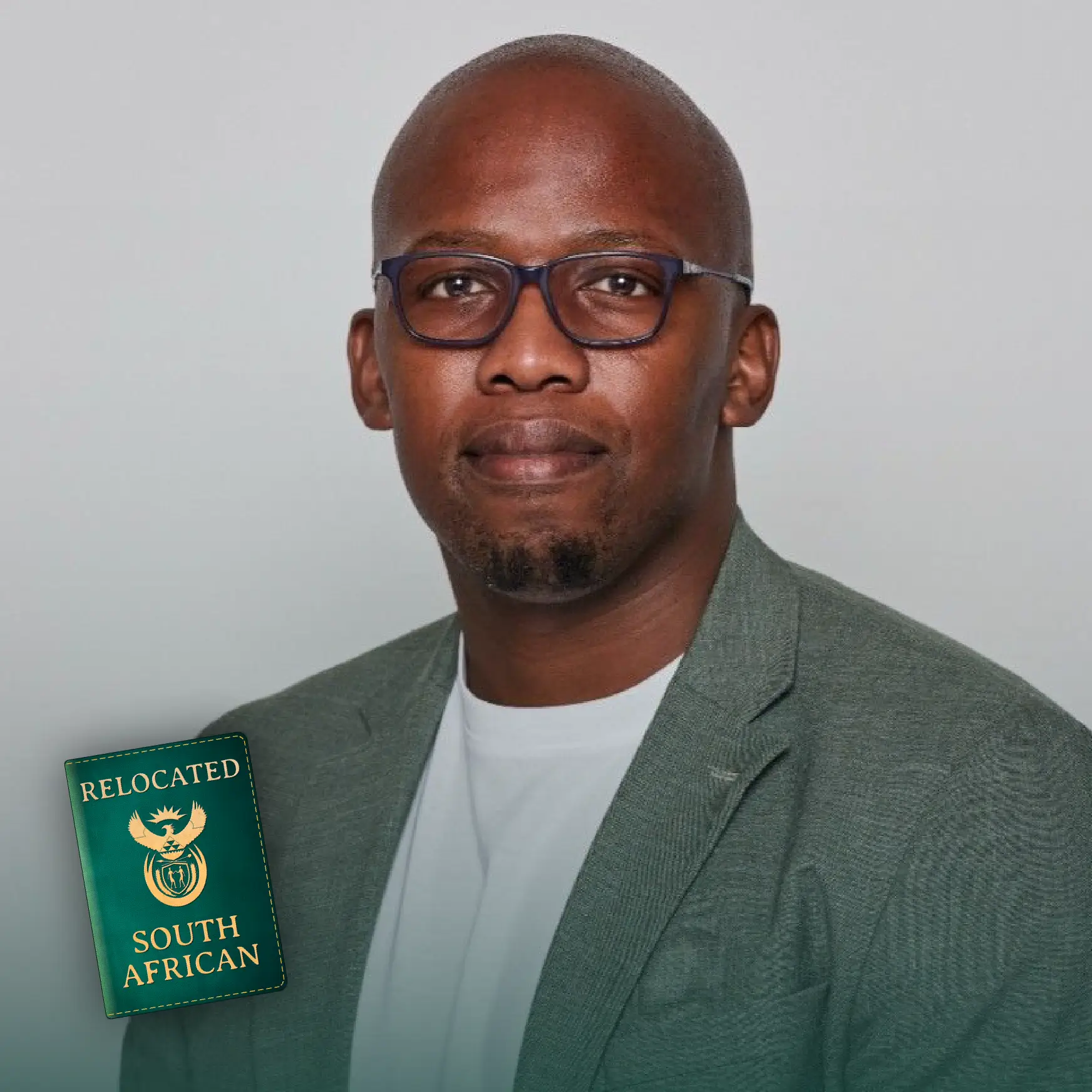
Today, I welcome all the way from the US, currently in Las Vegas (and I’m a little bit jealous), but normally living in Milwaukee, Wisconsin, Professor Jacques du Plessis. Welcome, Jacques.
Jacques, tell us about your journey: how you got to Wisconsin, when you left, where you grew up, and how you got to America.
Jacques du Plessis: I was born on the Rand, and shortly after I was born, my dad relocated to Pretoria as an attorney. So I grew up in Pretoria my whole life. I regard Pretoria as home.
Well, I was bound to go to Affies. I was in Pretoria boys’ school, and I was going to go to Affies. But then we moved. My dad found a fun little home on top of a hill in the Riviera, so I went to Hoërskool Hendrik Verwoerd, which doesn’t exist today anymore. It’s now called Rietondale High.
So I grew up in Pretoria, loved it, and then went to the Navy. I did some volunteer, two-year volunteer work as a missionary. And I found out that you could study overseas and work part-time. Legally, you could work part-time, and that money would be adequate to support myself because I had no funds and I had no one who was interested in sponsoring me to go overseas. I just thought this would be a great, exciting experience. So it wasn’t that there was something specific that drew me; it was rather impulsive.
In 1984, I relocated to the States. When I started, actually, I’d studied at UNISA and at Tukkies before, so I really, as a transfer student, relocated to the States, and a whole new life opened up.
Jan Hugo: Jacques, do you miss South Africa? Do you often go back?
Jacques du Plessis: You know, I’ve been back twice this year, and I go back at least once a year. So I don’t regard myself really as having immigrated. Sometimes somebody works in a different city than where they grew up and they often go back and so forth. I move back and forth so much that I don’t feel out of touch. I often pick up conversations where they left off when I go back to South Africa.
Initially, in the early days, I did not go back a lot. That was hard on me. Those were the days before the internet, and a phone call to South Africa would easily run over $100. As a poor student, that wasn’t an option. I felt isolated back then.
Today, I speak Afrikaans every day. I can engage with South Africans frequently and also with South Africans in the diaspora. I find myself very comfortably situated, and I do not really feel that I’m permanently abroad.
Jan Hugo: That’s quite interesting. I mean, it’s a long distance to travel. So when you go back, is it primarily for work purposes?
Jacques du Plessis: This year I went back for a wedding early in the year in late April, and then in early September, both for work and seeing family. But I’m a member of the South African Academy of Arts and Science, and I did a paper in Stellenbosch. So I went back for that paper, but then also had some time with family and spent my mum’s 97th birthday with her.
Jan Hugo: That is absolutely amazing. This is the interesting part. I was telling Jacques that I listened to a podcast that he was on, where he was talking about his work in America and the website afrikaans.us. I don’t think there are a lot of people who know that you run an Afrikaans programme in America.
Jacques du Plessis: Yeah, it kind of happened by chance. Just when I got here back in 1984, I had students approach me, and I was an undergrad student. Students approached me and said, “Would you like to teach an Afrikaans course? A bunch of us would like to learn the language.”
So I approached the German department, or rather the Department of Germanic and Slavic Languages. The chair and myself were friends to this day, and he said to me, “Sure, Afrikaans is a Germanic language. Why not? If you want to give it a shot and see if it works, let’s put it on the books and see what happens.”
I started teaching Afrikaans way back then. In the process, I wrote two grammar books. Think of it: back in 1984, that’s just when the PC as a concept happened, the first IBM PCs and the Mac. I was so happy that computers were around, and I started way back then and loved it. Laser printers were also coming out and so forth, so I had really the tools around me to develop textbooks. I really got into this, and it profoundly shaped my career.
I did my PhD in Instructional Technology, loved this field to this day, and I’ve been involved in teaching Afrikaans ever since. When I moved to the University of Wisconsin, I was in the School of Information Studies, so kind of a different field. I took all my stuff and I said, “I’ve developed so much, and I don’t want to just leave that behind.”
So that’s when open courseware became a big thing, and I thought, “This is my moment.” So I developed afrikaans.us and ported all my material into this website. That’s been a really interesting experience.
After I did it, I had some interesting experiences teaching Afrikaans. For example, an employee of USAID (now USAID is defunct under the Trump administration) was based in Kabul, Afghanistan. He said to me, “Would you be willing to teach me Afrikaans?” I’m like, “What an interesting situation.” I said, “So tell me about yourself.”
He said, “I’m an engineer in Kabul, but I’ve got to do a language, or you cannot stay employed at USAID. And you’ve got to pass it at level three, so you’ve got to get serious about it.”
I said, “So why Afrikaans?”
He said, “Let me be honest with you. I tried Spanish and failed at it. And everybody said, ‘Do Afrikaans. It’s the easiest and closest language to English.’ So can you help me?”
I said, “Absolutely.” So we worked online twice a week, and I used my website. It worked really well. My website’s design is a bit different from most. It’s really an open resource environment rather than a textbook where you start with A and work your way through to the end. You’ve got different domains: pronunciation and a whole area there, vocabulary and grammar and culture and communication and so forth.
So it was really comfortable to work with him, and he progressed really well. He passed at level three in Afrikaans. Then I had a second student in USAID that did the same thing. So then I’ve had grad students like at Yale. I had two grad students who needed Afrikaans for their research. I’ve had a student at the University of Chicago and so on.
So I get these interesting situations where I teach them, primarily now online. I’m now trying to develop a model that will work for Afrikaans but also for other less commonly taught languages. The problem with the less commonly taught languages is it’s not financially viable to teach it at the university. If you’ve got a class of two or three students, the university will say, “Sorry, no chance. We’re not going to pay a professor to teach two students. Think again.”
So I’m developing a model to form a consortium where universities will (let’s use Afrikaans as the example) put Afrikaans on their books. Whether they have one student or no students, it doesn’t matter because all the students would come to me to be taught. So they don’t have to hire anybody. It’s a synchronous online experience. If they get students, great, because then they can fully regard Afrikaans as part of their permanent programme. It fits into African studies or international business or whatever they want to fit it into. They’re never nervous about “Do we have enough students?”
So I’m working on this model right now to make less commonly taught languages sustainable.
Jan Hugo: I think something that I understand, if I’m correct, is that afrikaans.us is a completely free resource. There’s no cost, you don’t charge?
Jacques du Plessis: Correct. Yes. No money. It’s open. As I mentioned, it’s based on this open courseware concept. It’s my gift to the world for anybody who wants to learn the language.
I get the most interesting people contacting me that have studied on the site. One was a Chinese Jew. I said, “What, a Chinese Jew? Tell me about this.”
He said, “Well, way back in the early to mid-1800s, many Jews in Russia moved into China for business reasons and whatever, and these communities… In some communities, they really integrated with the Chinese, and they’re still Jewish, but they look Chinese. In other communities, they really remained separate, so they were clearly a minority community in the city where they were, and they did not really integrate.”
So I’ve had one person who grew up in China as a Jew, and his dad worked at Sasol in Sasolburg in the 1970s. So then he learned Afrikaans as a kid and then discovered my website and wanted to keep up with his language. That’s how we became friends.
I’ve had an Indian lady who travelled to South Africa, stayed with Afrikaans people, and just loved the language and the culture and experience and wanted to keep up. She got in touch with me.
I’ve had… Oh, this is a funny one. I had a guy from Vladivostok. He was born Korean, but they lived on the island of Sakhalin before the Second World War. So that was Japanese, so they learned Japanese and spoke both. Then during the Second World War, his parents were both executed in his presence. From that moment on, he was a young boy, and he was taken to Vladivostok as an orphan. So he spoke Russian, Korean, and Japanese.
He became a lawyer and somehow became really interested in Afrikaans. Then he contacted me, and we became good friends. He wanted to have some Afrikaans music, so I went to South Africa, bought a few CDs, and brought them back for him. He said to me, “I will have someone contact you to get the CDs from you, so you don’t have to mail them to Russia.”
Then I had this very Russian experience. I got this phone call: “Good morning. This is Igor. Are you the man with the CDs?”
I said, “Yes.”
He says, “I will send you money by Western Union” (that’s the name of the transfer company). “If you go down there, you’ll get the money, and then send me the CDs.”
It sounded like I’m selling drugs to some drug lord! It was such a funny experience, the bluntness of his voice. “This is a serious transaction.” But yeah, in any case, lots of interesting experiences with people all over the world that have picked up on Afrikaans.
In the future, I plan to… My site right now is assuming English as the common language, but I’d like to develop it to make it so that it could be Russian to Afrikaans, Korean to Afrikaans and so forth, so that it’s not only assuming you need to know English before you can learn Afrikaans.
Jan Hugo: I mean, obviously you’ve got these people from USAID who would need to use it, and the people that come to university wanting to study Afrikaans. Where does the interest come from? Because I mean, it’s such a tiny language compared to other languages.
Jacques du Plessis: You know, yes, it is a tiny language, but the same is true for Bulgarian, Danish and so forth. Even Hindi is regarded as a tiny language in America. You think, “Wait a minute, we’re talking a billion speakers,” and it’s a tiny language. So the number of speakers somehow is not as impactful as you would think.
The fact is, I was president of the National Council of Less Commonly Taught Languages, or we fondly call ourselves NCOLCTL, the abbreviation. We gathered all these smaller languages because we all face similar problems. Often it is with developing materials to teach, and the most common problem is stability at universities.
I often have a programme… Afrikaans even recently had that experience. We were a stable programme at UCLA in Los Angeles, and when the professor retired, that’s it, end of the programme. So there’s not a continuity planning for these smaller languages. It’s often attached to someone, and quite often it is someone teaching something else but also does Afrikaans. So it’s not someone who was hired as the Afrikaans teacher. So the stability of these programmes is really a concern. That’s why I’m working on this consortium idea to solve this problem that you don’t have a flourishing programme, and then when the professor retires or transfers or whatever, it’s done.
Jan Hugo: From a technical perspective, if you say someone passes it at level three, for instance, I know with French and Portuguese and so on, they require a certain proficiency if you’re going to get a passport and so on. How do you determine, or do you set the exams to determine the level?
Jacques du Plessis: So I did not have to test those people I taught in Afrikaans, but I do test people in Afrikaans. In America, the organisation that really dominates this space is called ACTFL, the American Council for the Teaching of Foreign Languages. ACTFL has developed a standard that goes up to level five.
Interestingly, I really enjoy their system. You could be a native speaker at level two, but you would be what I would call a rather uneducated native speaker. In other words, it’s maybe like the janitorial staff at a hotel. They’ve never finished high school and so forth. They could speak fine. You can joke with them, have conversations and so forth. But where they lack is if you start asking them abstract questions, then they suddenly start to struggle with the conversation. They lack the background to know the awareness and so forth, and they’re not able to engage at that level.
So level three would be you could operate at a basic abstract level. So I could ask you some relatively straightforward stuff about, “So now with the peace being established between Israel and the Palestinians, how do you foresee the near future in maintaining this peace initiative?” That would be a rather abstract question. You find people that are native speakers but are not educated, and they say, “Yeah, it’s a difficult one, isn’t it?” See, that’s fluent. That’s fluent when you say, “Yes, it’s a difficult thing, isn’t it?” But they cannot engage, they cannot dissect the situation, compare and contrast ideas, juxtapose thoughts, and say there are some that feel this way and expand on that, and some will feel another way and expand, and then bring it together and present your own reflection. They struggle with those abstract thinking challenges.
So level three is basic abstract, and that’s what they want. Level four is really solid abstract, and level five is impeccable. You can throw any topic, anything at this person, and this person is fully polished in the language.
Jan Hugo: Okay. Because at university, if they pass, say, third year or whatever in Afrikaans, would they be equal to that level five?
Jacques du Plessis: You know, level five is not easy to attain, and most employment environments do not require level five. Most places require level three, and in exceptional cases, they would ask for a level four.
Someone said once (and I like this description): they said a level three is the visa officer at the consulate. Level four is the ambassador. There’s a definite difference between the levels of engagement of a visa officer versus the ambassador. So if I was interested in you operating as a country’s ambassador in South Africa, and we would require you to speak Afrikaans, I would go for a level four. You don’t want just basic stuff. You want someone who’s polished, and that’s what you get.
They’ve changed the system. They used to say you have to be an undetectable native speaker to be level five, and if you detect the slightest evidence of non-nativeness, you cannot be level five. So theoretically, in that example, Henry Kissinger could never be a level five in English because he had a hint of German in his accent. They’ve abandoned that now.
Jan Hugo: So yeah, interesting how we are shaped by our experience. Getting towards the end, but just something you mentioned on the other podcast that I thought… It’s not really controversial, but some people may frown upon it. If I’m correct, you said that if you would advise Black people with small kids in South Africa, you’d advise them to go to Afrikaans schools. Is that correct?
Jacques du Plessis: Absolutely. And I put it simply like this: some might find this political, and some not. I find often in the English community a monolingual mindset. If you’ve learned English, you’ve arrived, and the heck with the rest. “We’re it. Hey, join us, we’re it. We’re the winning party. You’re on board.” So in other words, your culture is not worth much. “Leave it behind. If we all just do English, we’re all good.”
I find that regrettable and sad. Whereas if I go to an Afrikaans school, I will learn English just like you, and I will be able to operate and function in an English-speaking world just fine. But I will have more than you culturally. I will be richer. And that’s the benefit of going to an Afrikaans school. You’re not going to lose your English, but you’re going to gain more culturally than that.
So yes, I do find there’s a great benefit to going to… Look at you. You live in Portugal now. Look at a country like Belgium: an average Belgian speaks Flemish and French and German because the eastern part of the country is German, and then of course they learn English. So they, by default, are quadrilingual comfortably. Because of that, they can reach so many more people. They’re so much more aware than someone who grows up in England and knows a few words in French and is proud of it.
But that concept… As I mentioned, when I was in the Navy in South Africa, we knew all the ranks in the Navy, Air Force, and Army. Now, Navy was 2%, Air Force about 10%, and the rest was Army. So we knew them all. Then I met a guy in the Air Force. He knew the Air Force and the Army, but he knew nothing about the Navy. “We’re supposed to know all three.” And then I met the guy in the Army, and as you can guess, he knew the Army. “The Air Force and Navy, they’re small, they don’t matter.”
Think of it: if you use the South African context, if you live in Johannesburg, you know Johannesburg. If you live in Rustenburg, you know Rustenburg, Pretoria, and Johannesburg. If you live in Pretoria, you know Pretoria and Johannesburg, but you don’t know Rustenburg. So if you live in a small place, you know that and bigger. But if you live in the big place, you only know that. English is the big one, so it’s only that.
So I always say it’s counterintuitive to want to go to the small thing to learn the small language, but there’s a wonderful blessing for you in that because you’re going to acquire the big one in any case. But going with the big one first, you deny yourself all the richness of the rest.
I wish South Africa had been more multilingual from the word go. In my time, learning a Black language was not a thing. I wish I really had that richness that I could fluently speak fellow African languages. When you see people do that, there’s a very beautiful thing that happens between people because of the respect and the understanding and the connection that immediately forms because you connect with each other.
Jan Hugo: When you think about France with 68 million people, roughly the same as South Africa, they all speak French. I always feel sorry for Afrikaans artists because there’s such beautiful music in Afrikaans, but there’s only a small number of Afrikaans-speaking people who will buy Afrikaans music. In a way, it’s a bit sad because they are such great artists, and they play all over. My daughter lives in Dublin, and she said the other day they went to a Bok van Blerk concert, and there were like a thousand Afrikaans speakers all with their K-Way jackets, having an unbelievable time listening to Bok van Blerk. These guys can go all over the world because there are so many South African people living abroad. It’s absolutely interesting.
A few more questions. The whole political situation in America with Afrikaans and refugees and that… Do you stay away from the politics, or have they approached you or spoken to you about that?
Jacques du Plessis: No one’s really approached me about politics. Well, I have a tangential comment back to you that doesn’t relate directly to American politics, but to my identity as a South African. I’m going to surprise you with something.
When I left South Africa and came to America, I would describe my identity as follows: first of all, I’m a du Plessis, then I’m an Afrikaner, then I’m a South African, and then a world citizen. That changed for me by living in the States and associating with many other Africans in the diaspora. I found that I’m a du Plessis, I’m an Afrikaner, and then I’m an African, and then a South African.
My African sense of identity was stronger with me than my South African identity, and that surprised even me. In other words, when I hang with people from Malawi or Nigeria or whatever else, I feel extremely comfortable with them, and we celebrate our Africanness. I would obviously, under apartheid, you would never have had that concept. That was just not known, the isolation and so forth. But having that association in the States…
And then the South African Consul (she is a Tswana lady, and she was Consul in Chicago), I spoke to her about this, and she says, “You know, I had exactly the same experience because I studied in the States like you did. I found that my Africanness became really stronger than my South Africanness.”
She said, “And then I went back, and my fellow South Africans did not care for my connection and my affinity with other Africans because of the migration of Africa into South Africa and that whole political thing.” So suddenly, she thought, “My experience and their experience is very different, and how it shaped me puts me at odds with sentiment in South Africa.”
So yeah, it’s interesting how we are shaped by our experience.
Jan Hugo: I have to ask you about the poetry because that really interests me. I mean, you’ve got so many poems. Tell me, where did that come from, and how often do you write poetry?
Jacques du Plessis: It happened by chance. I was 11 years old. My four brothers and I cleaned our own house. My mum divided the house up into four, and you’d rotate it every week. This one week, I had to do all the porches and the outside mainly, and I was one morning early sweeping the porch. I started saying a little poem about General de Wet. Why? I don’t know.
I wrote this little poem about de Wet. Now, it was pure rhyme. It wasn’t really a cool, really artistic piece, but to me, it was a wonderful accomplishment to have written my own poem. It just spontaneously happened. From then on, I got more and more into poetry.
Late 1970s, I’ve been writing poetry, and it was on pieces of paper and so forth. Then eventually, it got some traction. Now, if you go to my site and you look at my poetry and look at the table of contents, you’ll see a little number behind each, and that’s the year that it was written. So there are some gaps. The late 1980s, I did not write much. Through the 1990s, there’s not much. Then it started a little bit to pick up, and now it’s going well again.
I love poetry. I tried (I remember back when I just finished high school) to publish my poetry, and I went to Van Schaik’s. I remember speaking to someone at Van Schaik’s, and he said to me, “I don’t even want to look at your poetry.”
I said, “Why not?”
He says, “It’s the wrong time. We just passed the season of people publishing a collection of poems. That doesn’t sell anymore, so we don’t do collections of poems anymore. It’s really passé. There’s not money in it for us, so we’re not going to go there. I’m so sorry.”
That does not deter me. Eventually, I thought, “I’m just going to put up my own poetry on my own site,” and I’ve gone with that. I’ve enjoyed it. Whether others enjoy it or not, maybe down the road after I’ve passed away, somebody will discover some of the poems, and it will be meaningful to them. Great. But yeah, I do enjoy it. It’s part of me. It’s a wonderful way I love expressing myself.
Jan Hugo: In a very small way, but every time something happens or a kid’s born or something, I tend to write a little story and send it to them, and they forget about it. One day they’ll maybe read it, but it is a nice way of expressing yourself. So I really enjoy that.
Jacques, one last question. If you’re just relating back to the podcast, if a young South African comes to you today and asks you about your life and what you decided to do and where you are: one, would you do it again? And two, what advice would you give them? If they want to stay or leave or go and explore, what do you think for a young South African today?
Jacques du Plessis: You know, it’s surprising. Obviously, many feel that security is a concern to them, and because of that, I think the main concern why South Africans want to leave is the security issue in South Africa. I understand that. Security often is an issue like when there’s a depression and you still have your job, you say, “No, things are fine.” But the moment you lose your job, everything is terrible. Just yesterday, you were still fine, and you thought, “No, our country’s fine.” The moment you lose your job, it’s all terrible.
So if it does not affect you, you don’t seem to have a problem. But the moment it affects you, that trauma is a real biggie. So I understand that situation, why people are concerned about it.
But other than that, I must be honest with you: I found that if you want to raise children, South Africa is a fantastic place to raise children. Fantastic. I find that the States is a very challenging environment in which to raise children today. The issues that we face here with the sudden rise of gender confusion and just a lot of social issues… You see a sharp rise in suicide amongst the young, between 10 and 20 years old, high rates of suicide. I’ve personally had people around me that have faced this, and it’s shocking that this is such a problem today. It’s part of the societal realities.
Much of it is also maybe tied to the digital world where people now live on their little screens, and their connection with others is really impoverished because of the enslavement to the digital space. So we’ve got a lot of challenges. We’re not absolved from that, of course, but I do find the ambience, the nurturing support that we have in South Africa and the communities there is still exceptional.
So I do not say just throw everything away. “It’s going to be better overseas. Don’t worry.” Many have realised painfully so that that’s not necessarily the case. So there’s green grass everywhere.
Jan Hugo: I think the one thing I’ve learned in this process is you cannot judge. I cannot be in somebody else’s shoes. What you can say is make sure that you’ve done the pros and cons and you’ve weighed everything up and you’ve thought about what may await you and be prepared for tough times because it’s not that easy. But every person has to make their own decision.
Jacques du Plessis: And I think your mindset is also really important. Don’t ask yourself the wrong question. The wrong question would be, “Should I live in South Africa or not?” It’s like the one thing I learned about America is when they ask you, “Do you want cake or ice cream?” The answer is yes.
So don’t get fooled by asking yourself the wrong question and then feeling obliged to answer that. As I told you right at the beginning of this interview, I’m still South African. In my mind and in my experience, I love where I am in the States. I fully immerse myself in what I’m doing, but I haven’t consciously made a decision: “Okay, I’m here, not there. To heck with them. This is it now.” That is the cake-or-ice-cream problem. Say yes. Don’t say one, please.
Today’s technology enables us to fully stay connected. If you leave South Africa to live overseas, do not forget your family and so forth. That’s where your treasure is, with those people that are close to you.
I do a lot of genealogical research now. Just a sideline: I was a founding member of the first academic organisation for genealogy and family history. I find great joy in this experience and in this connection. As I’ve done my own family history on my (for example) my de Villiers line, we are spread out all over the world now on my de Villiers line. Reaching out and connecting with my family… I visit my family in Switzerland. I’ve met my family in the UK. We’ve got family in Australia, Namibia, all my de Villiers family, South Africa, and in the States. We’re spread out everywhere.
But having those family connections is a wonderful treasure. So I say know what’s dear to you and hold on to that. Don’t just dump everything in South Africa and run overseas and try and make it there. Keep your South African thing. It’s your joy and your treasure. If you have opportunities elsewhere, totally grab them. I’m so grateful for the opportunities America afforded me. My career and so forth has been a real blessing.
But I’ve also been able to bless South Africa with what I’ve done. I’ve not left South Africa behind and pretended I never lived there and I’m here. My heart is filled with gratitude for what South Africa has offered.
Jan Hugo: That’s an awesome note to end on. I can only say thank you, Jacques. Thank you very much for sharing your journey with us. Fascinating. I love your passion for Afrikaans and for South Africa. I think our listeners as well will appreciate that great advice: do not forsake what is dear to you. I think that’s a very wonderful quote. Thank you so much. Thanks for joining us.
Jacques du Plessis: Thank you. Thank you.
Jan Hugo: If you’d like to share your own story, contact me at jan@therelocatedsouthafrican.com. Until next time.