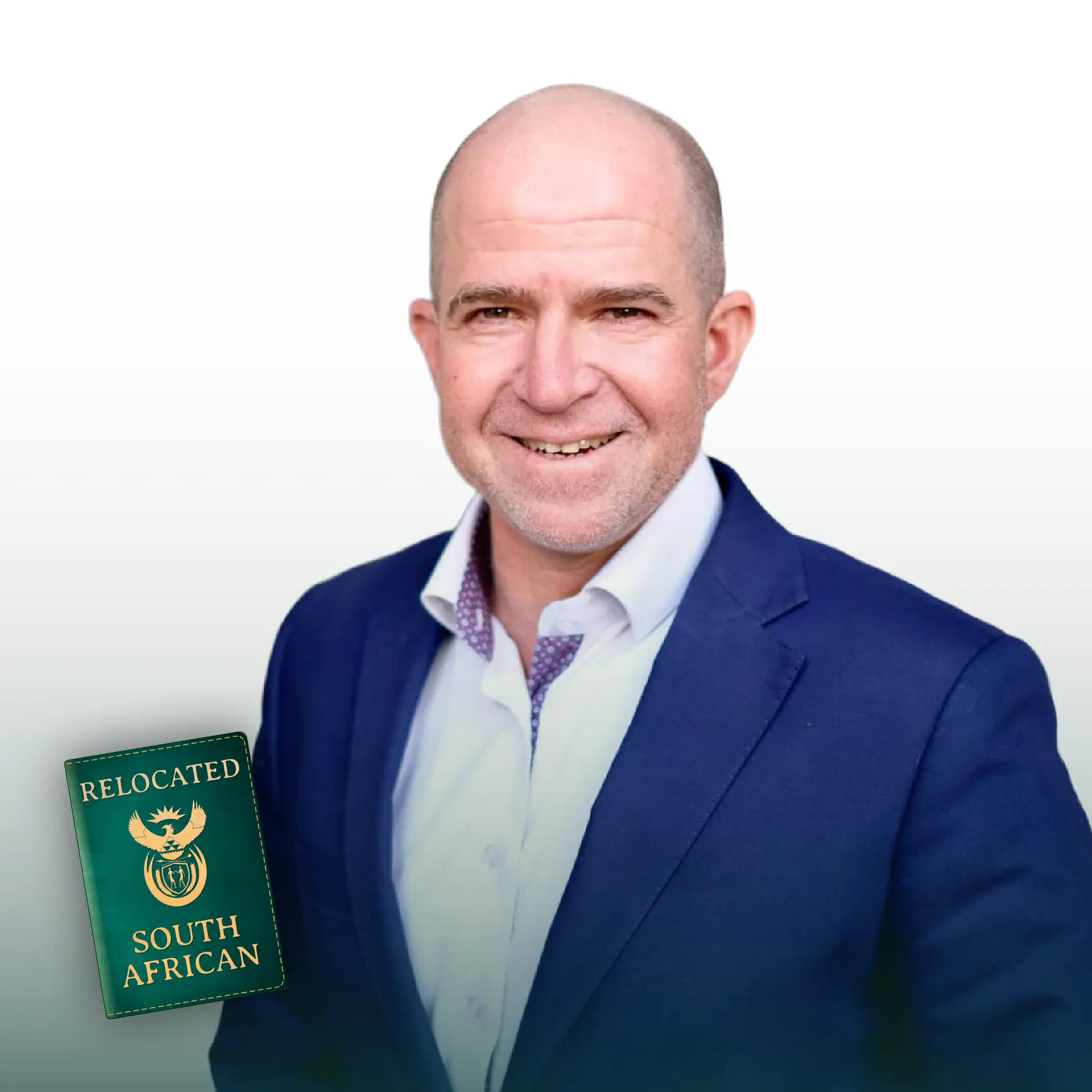
Jan Hugo: Welcome to The Relocated South African. As always, I’m your host, Jan Hugo, from Lagos in Portugal. Today I’m joined by a South African entrepreneur and recruitment specialist who has built an impressive international career in executive search and talent advisory. Rob is the CEO of REDi Holbourne Recruitment Group and has founded and grown recruitment businesses since 2008. His work spans South Africa, the UK, Europe, the Middle East, and the wider African continent, focusing on executive search across sectors such as finance, risk, IT, digital, and professional services. But like many South Africans featured on the podcast, Rob’s journey has also involved stepping beyond South African borders. So welcome, Rob Mailich.
Rob Mailich: Jan, thank you so much for having me on your show. It’s a great pleasure to be chatting with other Saffas, as we say.
Jan Hugo: Absolutely. Just so our listeners will know, I’m sitting in Portugal, Rob is sitting north of London, and here we are talking about South Africa. So let’s go. Rob, I always start just asking people: where did you grow up, study, and what led you to leave South Africa in the first place?
Rob Mailich: Jan, I’ve got to ask you which time led me to leave South Africa, because I’m one of those chaps that I think I’ve immigrated three times and gone back three times. So just in a nutshell: born and raised in Johannesburg in Edenvale. I’m from the other side of the highway, where if somebody says to you, “Listen, my friend,” then you know that the time for listening is over and they are not your friend. But I’m only joking. So I’m from Edenvale, went to Edenvale High School, and then studied accounting after school. We couldn’t afford universities and the luxury of full-time university. So I ended up studying through UNISA while doing my articles at the same time, studying in the evening via correspondence in those days. I finished school in 1992. It was great. I loved my schooling. Lots of sports, playing sports every day, jolling with the friends. Excellent.
Rob Mailich: Then after the articles in 1997, I moved away from South Africa. I spent a year in London, a travel year, going on Contiki tours and travelling with people and working, earning some money to live and enjoy life. Then I went to visit some friends in America and they were actually working for BDO, where I previously did my articles. One chap said, “Hey Rob, why don’t you just come and meet the guys at BDO and interview with them?” So that was in Atlanta, Georgia. I ended up interviewing with BDO, they liked me, and they offered me a position. I went back to South Africa for a few months whilst waiting for my work visa to come through. Then I spent two years in the US in Atlanta, working as an accountant. By the end of 1999, I wanted to be out of the audit fraternity, so I moved back to South Africa at that point.
Rob Mailich: In early 2000, I was doing some contract work in Johannesburg. Then my brother was getting married in London, so around May 2000 I ended up going to his wedding. I got a little bit bored waiting for the wedding to happen. I thought, well, I’ve got a passport to work out here, let me just get a contract and earn some money. That six weeks of waiting for a wedding ended up being five and a half years. I ended up staying in London for five and a half years, met my wife over there, also a fellow South African, oddly enough. Then at the end of 2005, the irony is crazy, in that I wanted to get away from the crime of London. It was hitting me hard, it hit me a few times, and I just felt it was time. So we ended up moving back to South Africa at the end of 2005.
Rob Mailich: I took on a role at one of the asset managers in Johannesburg, at Stanlib, and that lasted a year until I got headhunted, of all places, into recruitment. That was where my recruitment journey started. I did turn the guy down a few times, because I said to him: “Mate, you can’t be that good a recruiter. I’m just a boring accountant. Why me?” And he said, “Well, when I first met you, and this is the part Jan can blank out, I thought you were a crap accountant with a good personality. So I thought you’d be better in recruiting than accounting.”
Rob Mailich: So that’s how I got into recruiting. I ended up joining them for about two and a half years before I decided I wanted to build something more South Africanised, more of a South African business. This was a London-listed company, and I just wanted to help the South African economy and help people get employed. That’s when I started REDi Recruitment, right at the start of the credit crisis. People said to me, “Are you out of your mind? You’re starting a business in the credit crisis.” And quite frankly I said to them, nobody else is crazy enough to do it. So let me do this and see how it goes. If it works out well, I can swim through the debris and catch my competitors a lot quicker while there’s no start-up competition. Thankfully, that’s how it worked out. I ended up setting up a few other different types of recruitment businesses, and that’s where we are today. It was about two and a half years ago that I moved over to London to set up the UK operation and relocated the family.
Jan Hugo: Well, so you are a relocation specialist. Perfect for this discussion. So at the moment, you are not a South African with a base in the UK. You’re now living in the UK. Is that correct?
Rob Mailich: Well, you know what, it’s hard to say that, Jan, when your heart still lives in South Africa. I’m not the norm, let’s put it that way. I’m not somebody that left South Africa because I hated it or didn’t like it or was running away from something. I’ve always maintained my positivity about South Africa, and I never run away from something, I run towards something. There was an opportunity to give my children an international education, and I find that travel is the spice of life. Learning about the world gives you more of an education than anything else. Now that my kids are at that coming-to-university age, still in high school, I thought I’ve got two options: either I can keep the family together and move with them and get them set up before university, or I stay in South Africa and they move abroad to study, because that’s what they wanted to do in the first place.
Rob Mailich: My business, the main operation, is still South African based. Our head office is still South African based, and we’ve got people all over South Africa. I thought it was a great opportunity, once again in trying times, just like the financial crisis and COVID. That’s been my speciality: to set up while there’s blood on the streets, and hence why we came abroad. We came out here with three rules. The rules are: number one, it doesn’t matter who wants it more or less, you don’t blame the other person. If something doesn’t go your way, you don’t throw things at somebody. You just go and enjoy the journey. Number two, you’re a proud South African. If you insult South Africa, you insult me. Don’t ever lose your roots, don’t ever lose your heritage. Be proud of where you’ve come from. And number three, which is also my business mantra: have fun. You are on an adventure. It doesn’t have to be a long-term adventure, but regardless, it’s an adventure. So just enjoy the ride and have fun. Those are our three rules, and we stick with them. We go travelling, we go skiing, and we enjoy everything. That’s the main thing.
Jan Hugo: I think that’s absolutely amazing. There’s so much we can discuss around it. You obviously know about the Lekker Network. I don’t know if you’ve joined the Lekker Network, but that’s one thing I’ve heard so many times now, in dealing with the positivity about South Africa. I think there’s been a bit of a trend of people sitting in South Africa and looking at people who leave almost with a bit of resentment. Maybe, I don’t know. But people sometimes frown upon the decision. And I really like what you say: it is an adventure. We have so many days on Earth, so you may as well make the best of it. And if it’s not in South Africa, why not go and look for it elsewhere? But I also agree with you: never use your immigration to slag South Africa or to justify leaving. Last week I interviewed a lady who, like you, has immigrated three times and is back in South Africa now. I actually also interviewed her in London. And she was saying exactly the same thing. Her only crime incidents have been in London, which I found quite fascinating.
Rob Mailich: It’s when you say that, and sorry to interrupt you Jan, but I actually joke with people that in my last three years in London, I was hit about ten times by crime. I had a little scooter that was stolen six times, a car broken into once. I was roughed up once by some hoodlums, and I had two separate homes in nice areas that were broken into and cleaned out. I was actually going to change my name from Rob to something else, because I thought it was becoming a suggestion.
Jan Hugo: That’s brilliant. I’ve heard that it’s everywhere. I guess it’s just maybe not as violent sometimes, but it happens. That is kind of the issue. But you obviously travel backwards and forwards all the time. So you still experience South Africa and you still have a home there?
Rob Mailich: Yeah, so I’ve still got my home there. However, I have rented it out because I’m not there as regularly as one would like. So I decided to just rent it out and stay in a hotel when I’m back. I am back four times a year for probably about three weeks every time, just to see my clients, see my team back in South Africa, and just smell that fresh SA air.
Jan Hugo: Absolutely. And here, the hadedas. I was watching golf yesterday and my wife didn’t know what I was watching. She said, “What’s happening? It must be Joburg, I hear hadedas.” That’s absolutely right.
Rob Mailich: Yeah, there’s nothing quite like it. Nothing quite like it.
Jan Hugo: Absolutely. And having a braai. When we talk about being South African, we were out with friends last night and just talked about the South African sense of humour. People don’t understand us. It’s so unique. And I think that’s what makes it special.
Rob Mailich: Absolutely. And when it comes to that sense of humour, the one thing I have noticed as well is how open we are with all cultures. In South Africa, historically, obviously, there was the apartheid regime and it was very different. But I do find that we are able to laugh at ourselves and make jokes about ourselves, obviously within reason, and that’s what makes us special. We can all have a good chuckle. I found the service levels in South Africa are second to none. The other day I was back there and the waiter was listening in on my conversation, I was in a client conversation, and then he started chipping in and we were having a good laugh. Imagine that happening in some other place. I must admit there is something special about it.
Jan Hugo: No, that’s for sure. Rob, if we turn to your business now, you talked about immigration and the host is interviewing you about immigration. What would you say are the top five countries now for South African professionals?
Rob Mailich: Apart from South Africa, actually, because I am finding these days the grey listing has been lifted from South Africa, and a lot of people are actually moving back and wanting to move back for family reasons and lifestyle reasons. But I would say in my business, the biggest emigration that I still see is probably to the UK, Canada, the US. The Netherlands is definitely a big one, and possibly still New Zealand and Australia. That said, the world has become so much smaller that people are even moving to Singapore and non-English-speaking countries as well. But I would say those are the majority, the main English-speaking countries, and the Netherlands has become a big one, especially from a tech perspective.
Jan Hugo: And CAs and engineers. My kids tell me that their friends, a lot of the CAs especially, but also the ECSA guys, go to the Netherlands.
Rob Mailich: Yeah, absolutely. And also because the language is very similar. If you can speak Afrikaans, it’s definitely easier to pick up Nederlands as well. And it’s a great qualification. The South African engineers, the South African doctors, the South African chartered accountants: it’s definitely still a great qualification to have.
Jan Hugo: Absolutely. And the current situation in the Middle East. You didn’t mention Dubai or the Middle East as a destination. That’s obviously going to have a major impact.
Rob Mailich: Look, it does have an impact, of course. I think people are going to Dubai, expats are still getting paid well, but I am seeing that less and less. I’m probably seeing more people from the UK wanting to go to Dubai for better weather and better money. But I’m not seeing it as much with South Africans, I can’t tell a lie. Although I’m sure it is happening, because Dubai, the UAE, Saudi Arabia, it’s still like the centre of the universe where a lot of companies have relocated for tax purposes.
Jan Hugo: And you’re in a really interesting position in that you’re taking people out but also bringing them back. You’re benefiting on both sides. Are you seeing a bigger trend of people returning now than before?
Rob Mailich: Yeah, I think there is a bigger trend. But also remember that the network I’ve built up has primarily been running for the last 15 to 20 years, since my articles days. A lot of those more senior people are now hitting their early to late 50s, they’ve made it in their careers, and they want to start winding down a little. They certainly don’t want to be staying in colder climates. And also bear in mind that when you get into the late 40s and early 50s, you’ve also got the issue of your folks getting a little bit older. A lot of people don’t necessarily want to go back, but find that it’s the easier transition to look after their parents. It’s quite an interesting age dynamic. In your late 40s and 50s you get hit from both sides: you’ve still got kids that are young enough to rely on you, and then you’ve got the folks that now start relying on you too. So I do find, for those reasons, a lot of people end up going back. The kids move into universities, they’re settled, and then the parents go back to look after their folks and start winding down themselves, enjoying the better climate and obviously the value of the rand against their foreign earnings.
Jan Hugo: One of the things that’s come out in a lot of episodes here is this family issue. It’s such a massive thing. There’s even a lady I spoke to in Stellenbosch who only deals with parents of children who have left abroad. It’s really tough, because they can’t all go and visit. They’re getting older. It’s expensive. So I can totally understand that. And as you say, people have made money abroad and are able to buy a lifestyle in South Africa with their foreign earnings. It makes a lot of sense. But when you think about South African candidates going abroad, they are really competitive, aren’t they? In terms of work ethic, qualifications, and so on.
Rob Mailich: I met a client this morning and he was just saying they love the South Africans, the work ethic. There’s just something about how they approach things from a problem perspective and from a people perspective. They’re not put into a box. They can think outside the box, they think laterally. And I think that’s part and parcel of our upbringings. We were taught to be rough and ready. I do believe it’s changing a little bit, but the Generation X and even the millennials, there was something about them. And just remember that half of your workforce, even more these days, is millennials, moving now towards Gen Z. But the South Africans have this way about them that people seem to like. I don’t know if it’s the accent, but also remember that South Africa is a primarily English-speaking country. Yes, we’ve got 11 official languages, we’ve got our African languages, we’ve got Afrikaans as well. And I think everybody is able to speak English. There’s just a diversity that we’re accustomed to that definitely helps.
Jan Hugo: Yeah, one of the things that always strikes me about South Africans is respect. Respect for authority, respect for other people’s opinions. I find living here that, I don’t know, it’s in the little things, but sometimes I think Europeans don’t grow up with the same level of respect for other people. They often think about themselves only.
Rob Mailich: You know, you could not be more correct. That was one thing I never got used to. When I lived in America, I was there for two years and I made some very, very good friends. When I left, everyone was sad and everybody hugged and said, “We’ll definitely stay in touch.” And then you try and stay in touch with them and you get no responses. It’s almost like out of sight, out of mind. People were very selfish in that if it’s not in their immediate world, it’s not there anymore. I think South Africans have been very good at staying in touch. When you travel, “Hey, my home is your home.” My home is like an African taxi: there’s always room for more. When people come and visit, we invite them into our homes and there’s always food, there’s always drink. Whereas other cultures don’t invite you into their homes. When we have braais and people come over, it’s generally only South Africans, because others meet each other at restaurants. Their homes might not be big enough, but we make space even if they aren’t. We are very open with each other and very inviting and very warm. That’s just part of how we’ve been brought up and what our culture is. My daughter was chatting to her boyfriend the other day and his meal came, and nobody else’s meals came, and he started tucking in. She said, “Hold on, wait until everybody’s got their food.” He said, “But then mine will get cold.” He’s probably not wrong, admittedly, but it’s just that etiquette, and I find the etiquette can be very different.
Jan Hugo: Yeah, I think in that instance, one of us would say, “Please go ahead and eat, because your food’s going to get cold.” We will say it’s okay, rather than just tuck in. For me, that’s quite a big thing about living here. And in your recruitment business, when you place a candidate, do you follow up after a year or so to see how they’re doing? What is your sense of how well South Africans are doing in their jobs?
Rob Mailich: Without a doubt. In fact, we’ve just been busy on a big project where we are taking all of our placed candidates and looking at where they are currently: where are they in the world, where are they in their roles. Although some are still in the roles we placed them in 15 years ago, invariably people have moved on. I’m very lucky to say that I’ve never made a cold call in my life, because I’ve stayed in touch with my candidates. My candidates have then become clients, and we just keep rolling like that. And that’s what I teach my people: if you are always on top of who you’ve placed and stay with them on their career journey, it’s wonderful to see. And it’s the best way to get new business coming in. I’ve placed people in 2008 who are now directors of companies or have moved on three times, and I’ve never forgotten them, and most of the time they don’t forget me or our team, because we’ve been an intrinsic part of their journey from when they were newly qualified to where they are today. There’s no other job like it. Trust me, recruitment is probably one of the toughest gigs you can ever do. I say to people it’s not the game of appointments, it’s the game of disappointments. Just remember that we’re trading stocks here, and our stocks unfortunately have feelings, emotions, lie, don’t tell you everything, don’t want to hurt your feelings, and unfortunately money is the devil. They are lured by money, even counteroffers, and that’s been a big one in current times. But I still love it. I get paid to change people’s lives. What better job is there?
Jan Hugo: Absolutely. I just wish I knew you earlier, you know, because I’m an accountant. I wouldn’t have been an old dinosaur doing podcasts. I would have had a good job.
Rob Mailich: You know what, if I didn’t do accounting, I wouldn’t have succeeded either. And one of the things I think I missed earlier is that when I was in London, I was so bored as an accountant that I qualified as a mortgage and financial adviser. That took the turning point from accounting into finance and sales, and I think that’s what they liked in the recruitment space: I had that finance and sales element, and obviously the personality to go with it. But let’s not kid ourselves in recruitment. Sometimes you lose that personality and you can be an introvert who excels in this industry. But I think without my accounting career, I wouldn’t have succeeded as well in recruitment.
Jan Hugo: Absolutely. Rob, if you think about the people that you place and the people that want to emigrate, how big a role does family play, especially across borders?
Rob Mailich: Family is massive, and I think there are a few elements here. In particular, the emotional and safety element. A lot of people are very happy in South Africa, but they want something different for their children. There’s a big worry about where their children’s future is and what they’re going to do in South Africa later on. If you’ve got the opportunity, the passport, and the visas to experience something else, it’s like having that green mamba passport but getting some other experience too. Family plays a massive part when you’ve got a younger family. Personally, I think South Africa offers a lot for very young families. You’ve got the helpers who look after the children while you can still enjoy the fruits of your career. Whereas when you come abroad, it’s very expensive to have full-time help and to continue your career. So one of the parents generally needs to sacrifice a great deal, whereas in South Africa you don’t have to. So that’s a big consideration when deciding where to go.
Rob Mailich: Obviously there’s a financial element as well. If you are well qualified and there are just no opportunities and no options, I don’t want to bring in the BEE side of things, but it does affect a lot of people. It also affects people from an age perspective: when you get over 35, you’re often off the shelf. And then we’ve also got a lot of very highly educated people of colour who want to get that international experience and are also worried about the future for their children. They also take the jump abroad. So there are many factors that make people’s decisions easy or hard, but family is definitely one of the big ones.
Jan Hugo: I think you also talked about, when you arrive on the other side, connecting with other people, getting out there and using groups and so on. Because the comment that comes up in a lot of these conversations, especially in the early days, is that it’s really lonely. Even though you’re with family, it’s lonely because it’s just you and your wife, maybe, who have to help and support each other. And you’re not always on the same high. But that support is critical, because it can make a move a success or a failure. When it doesn’t work, I interviewed someone a while ago who said failed immigration takes five years out of your life. Would you agree with that?
Rob Mailich: Absolutely, and you know, enjoy the culture, enjoy the travel, enjoy the food, have fun, go on that adventure. Make it something exciting. Don’t let the weather get you down in the winter. I’ve got a Big Green Egg outside, and one of those little wireless temperature probes, so I can sit in the warmth of my home while watching my braai cook itself in the middle of winter. One day I opened it up and there was snow on the top, but the meat was cooking perfectly and I could see the temperature on my phone. Just laugh and enjoy and have fun. You don’t have to spend a fortune to have fun. Just be around good people. And as you pointed out, life does go by, and if you’re not careful you’re going to miss out.
Rob Mailich: I do think it takes time out of your life and you do go backward, but I also think that a lot of people feel like they’re going back with their tail between their legs. They go back with no savings, having utilised their whole life savings. And I don’t think they should ever go back with their tail between their legs. The country will always welcome you back and will always value you as an individual. You’ve earned experience. You might go back financially worse off, but do you go back from an experience perspective? Absolutely not. In fact, I think you go back appreciating it even more.
Rob Mailich: When I moved back to London this particular time, I had lived here in the early 2000s as well as in 1997 after my articles. I still had a network, I already had a national insurance number, bank accounts, all those things set up. The only thing I had to do, based on Brexit, was that my passport wasn’t sufficient anymore and I had to get a work visa, which was 100 per cent fine. But conversely, when I moved to America in those early days, I only knew a handful of South African friends and they already had their lives, their girlfriends, all of that. So I had to start from scratch and my work colleagues became my friends. But let me tell you, it was very, very lonely in the earlier days. You don’t know the rules. You don’t know the society. I remember in my first few weeks in America, I was driving one evening after being at the pub, sober as a judge, I do need to point that out. I was bashed off the road by some thugs who had followed me, and then I had a confrontation with the police afterwards and I didn’t know what the protocol was. It was terrifying. You don’t have that support network. You don’t have your people to call. You can’t call mum and dad at home because they would just worry. To have a South African network, like the Lekker Network, or just friends who can help you through the first few months, that’s a massive help. Just reach out to all the people you know.
Jan Hugo: And people, psychologically, it can be very tough, especially when things don’t go well. There’s the red tape, and there are just surprises that wait for you. It’s not all moonshine and roses. I think sometimes it’s over-romanticised. But you’ve got to push back because it’ll be worth it. Don’t give up too soon.
Jan Hugo: That adventure, I think that is such an important word. You’re working in a different environment, meeting different people, but you still stay South African. The opportunity to travel, just being in Europe or the UK and being so close to destinations, that’s priceless. You can never buy experience, and I think that’s a critical thing.
Rob Mailich: No, absolutely. Many years ago I wrote an article, I think it was for Homecoming Revolution, and South African Airways caught wind of it and asked if they could publish it in their in-flight magazine. They actually published it in their Christmas issue to attract South Africans back. One of the things I remember writing, and it’s amazing how many people it resonated with, was that every time I left South Africa to go back to my home, whichever country that was, whether America or London, part of my soul stayed on the tarmac of O.R. Tambo. And every time I fly back in, whether for business, family, or whatever, that peace reconnects again. The one thing I say to South Africans is that they do feel that pull of South Africa, and no matter where they are in the world, it’s quite an incredible pull that keeps you proudly South African. And to those naysayers of South Africa, that’s okay as well. A lot of people did leave for more negative reasons. But then don’t go and support the Springboks or the cricketers or the country if you’re going to put the country down. If you’re going to support it, support it wholeheartedly. We are South Africans and we should stick together in the rest of the world.
Jan Hugo: It’s absolutely amazing. Somebody said in an interview that now that they live abroad, they feel more South African than when they were in South Africa. I think that resonates with me as well. There’s so much diversity in South Africa that when we’re abroad, we are more unified. I’ve spoken to people of colour, and in this week’s episode, a guy from the Cape Flats in Copenhagen, you just hear how proudly South African they are no matter where they are in the world. And another point somebody made: we are the only people who talk about ourselves as ex-South Africans, which is actually absurd. You never hear about an ex-Irishman living in New York. We often say we are ex-South Africans, but we actually are South African. We shouldn’t say ex. That’s an important thing to keep in mind.
Rob Mailich: You know, it’s quite interesting. I’m a big Blue Bulls supporter, although people do rag me because I grew up in Joburg. But one of the things is that when I always lived in South Africa, there were the Vaalies and the Capetonians and the Durbanites, and everybody was different and there was rivalry between them. The Capetonians always blamed the Vaalies for stealing their sand in December. But now, living in London, we’re all South African. We’re all one. Sawubona, we are one. There’s no rivalry when you actually leave the borders of South Africa. You’re just South African. You’re not an ex-South African. You are South African, and that is always going to be in your DNA.
Jan Hugo: Did you watch the rugby at the weekend? Did you support Italy or England?
Rob Mailich: I’ll support Italy, of course. I support any team that plays against England, and I’ll support any team that plays against Australia, because we’ve always got that banter and rivalry. But I’m South Africa first, of course.
Jan Hugo: Those were two great matches. And South Africa B played against the French on Saturday at Murrayfield, with quite a few South Africans scoring all the tries, which is great.
Rob Mailich: Yeah, that’s it. Although we won’t talk about the cricket, the Proteas, and their recent performance.
Jan Hugo: No, let’s forget about that. At least New Zealand lost as well. So Rob, getting to the end: if you think back over your career, would you have done anything differently knowing what you know today?
Rob Mailich: The only thing I would probably do differently is go to university full time. But again, doing it in the evenings also moulded my course. I went with my son to his open day for the university he’s going to, and it just looked like that is what sets you up for life, with alumni and friendships and all those kinds of things. That’s probably the only thing, and not for the studies, more for the social aspect and enjoying what university life has to offer full time. But other than that, in my last holiday I put together my top ten items on my bucket list. I’m still going to get through those. I started learning piano, and there’s no age at which you can or can’t do something. I’m doing my Duolingo to learn German fluently. I was just in Austria two weeks ago skiing and I got around in conversational German. I’ve got this mantra, which I always brag about, from Grandpa George, who wasn’t my real grandfather but always said: try to learn something new every single day. So no regrets, but just trying to still learn every day, trying to make myself better and do different things.
Jan Hugo: I’m totally with you. I love learning. This podcast has taught me so much about things I didn’t know, and putting yourself out there takes guts for an introverted accountant, believe me. Rob, maybe a final question: if a young graduate walks into your office, just finished their CA and looking for a job, what would you recommend?
Rob Mailich: Without a doubt: get that international experience. From a CV perspective, it stands out. I know so many young people who’ve gotten that experience and it just pushes them to the top of the pile when they go back to South Africa. They’re no different technically from someone who’s done their time at PwC or EY in South Africa, but they are more globalised. There’s something about that maturity in a young person who’s actually left the nest and struggled on their own, done their own thing, ironed their own clothes, just been away from the nest. That is of huge importance. It’s not how much you know. The South Africans who stay know just as much. But there’s just something about the energy and the aura of people who’ve got that international experience. Some of them end up staying, some don’t come back, which is fine. But I always suggest getting that experience. That’s what I did, and it just makes you a different and a better person.
Jan Hugo: And your favourite country?
Rob Mailich: South Africa, without a doubt. If you ask me what my best holiday destination is, that’s a very different answer. But from a living perspective and a people perspective, South Africa wins every single time. A lot of South Africans might think I’m crazy to say that, but at the end of the day, you love where your heart is. I’m very grateful to be able to travel and to see different parts of the world. I’ve still got ten countries I want to visit. I love food and I love travel, so hopefully we can do a lot more of that in time to come.
Jan Hugo: Excellent. Well, I hope we can see you down here on the Algarve to check out the lifestyle. I always say when people come to visit us, only one thing: don’t go and tell anybody how much we’re suffering here.
Rob Mailich: Absolutely. The Algarve is actually one of the places on the list. Not to swim in the freezing cold Atlantic, I’ll stick to the Mediterranean in summer. But I’ve only heard great things about the golf courses. I’m an avid golfer, so I’m definitely going to be down there playing some golf.
Jan Hugo: Then you have to. We have some amazing golf courses. Lagos with 22,000 people has 600 restaurants. There’s a lot to choose from. We enjoy our life.
Rob Mailich: Before we leave that: last year I went on a golf tour to Turkey and that is very, very underrated. People don’t understand how beautiful and brilliant the golfing experience is there, and the hotels and the people. There are so many beautiful places out there. And one thing I’d say: don’t always listen to what the media says. The media says things for the hype and the negativity, but there are so many beautiful places one can visit. Travel is the spice.
Jan Hugo: Absolutely. Rob, thank you so much for joining us and being on the show. If people want to contact you, you’re on LinkedIn, and your website is rediholbourne.com.
Rob Mailich: Correct, rediholbourne.com. They can also look at our AI portal, onerecruit.ai, and find me on Instagram, Facebook, and LinkedIn. It’s only a pleasure. I mentor a lot of young new graduates as well, so if anybody wants to reach out to shoot the breeze and get some ideas of what is next, I’m always happy to help as best I can.
Jan Hugo: Awesome. We’ll put all the contact details in the show notes as well. Thank you very much, Rob. As always, if this episode resonated with you, you’re welcome to share it with someone who might need to hear it. You can find more episodes of The Relocated South African wherever you listen to your podcasts. Thanks for listening, and I’ll see you next time.
This transcript was generated with the assistance of AI and checked for accuracy.