Jan Hugo: Welcome to The Relocated South African, the show for immigration from South Africa for a better future. I’m your host, Jan Hugo, from Lagos, Portugal. We’ve recently launched our brand new website, www.therelocatedsouthafrican.com. If you want to interact with us or comment on our discussions or even participate in an interview, please contact me on jan@therelocatedsouthafrican.com. Also, if you like our content, why not subscribe on your favourite platform.
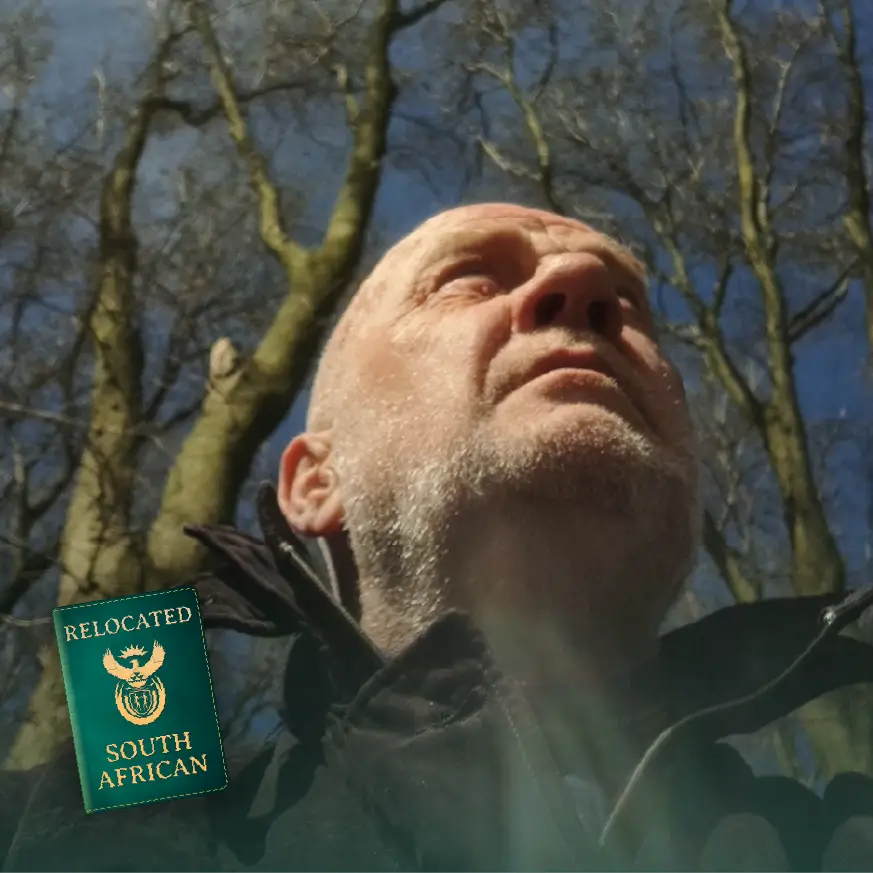
So today I’m really privileged to welcome to the show a man who’s known during the 80s and 90s as the SABC’s man abroad. He had a great career in radio and television, has received numerous awards for his work in media, and he currently resides in Amsterdam. And amongst other things, he runs his own podcast on YouTube named Alles Afrikaans or Beyond Borders. Welcome, Johan Allers.
Johan Allers: Thank you very much, Jan. It’s a great pleasure to be here. It’s my honour to be here.
Jan Hugo: Right, thank you. So just to start, I normally do this, just maybe a brief history for listeners who don’t know you or of you. You and I are the same age, so I grew up with your voice on SABC TV and radio. But maybe just where did you grow up, study and your career?
Johan Allers: Well, yeah, we are. I don’t know if we’re the same age, but be it as it may. I said it the other day in a podcast. In fact, I was born in 1957. I was a young child in the 60s and the 70s. I grew up outside Johannesburg in a small town called Edenvale. And somebody once said to me, wished me luck for my career and said the one thing you’ll have to do is you’ll have to emancipate yourself from the village, the village, the small place that I came from. And here I am literally 40, 50 years later and I can assure you I’m not emancipated from the small village where I sprang from.
I went to university. I never completed my studies because I was poor and I got a job with the old Die Transvaler newspaper. In fact, I had a small stint at Die Beeld before Die Transvaler, but I was given the opportunity to work not as a journalist, but as a photographer because photography was my hobby at the time and I’d built up quite a portfolio of work. And I simply approached the newspaper because I needed a job to survive. My parents had moved to South West Africa and I was literally boy alone in Johannesburg in a one-room little apartment in Hillbrow.
So my first job was as a, I started, as I said, as a photographer with Die Transvaler. And I think within the first four, five, six months, I became bored and asked the editor, whose name was Dave Filion, whether it might be an idea if I can try to write a story or two. And because I was relatively good at doing it, I was then promoted to a photo journalist. And that’s where my career started.
So, and I’ll do the jump for you from there. I worked at Die Transvaler, got involved in some silly little political scandal at the time, and was then seen by Dr. Wimpie de Klerk, the brother of F.W. de Klerk, who invited me to join Rapport. And the idea was going to be, I would imagine I was a young boy, still very naive, knew absolutely nothing about the country, South Africa, my history, et cetera, et cetera. But I think they had the idea that this is a smart kid and we can develop him into an investigative journalist.
That never worked out because I worked as a sub-editor for about a year. And as a sub-editor, all you get to do is to translate text copy from English to Afrikaans. And I decided that I want to leave and do different things. And Wimpie de Klerk was kind enough to introduce me to the SABC, where I got involved with the SABC, also in the news office, worked for about another year, once again, as they called it a sub-editor.
Now, when you’re 21, 22, 23 years old, you think a sub-editor is a smart thing, but you’re actually just the guy who takes the copy from the text tele-machine, whatever the case might be, and sit there like an idiot and translate it and make sure it’s neat and clean for presentation. So I became exceptionally bored and asked the SABC’s news director at the time, a guy called Saki Berger, whether he would be so kind to release me from my duties and to send me to training to become a producer.
We called it a producer. The word producer is used in a different sense today, but it was really like a director, which is what I was trying to do, which wasn’t very grand. They had a chap from the BBC that came in for a period of time. I think it was a BBC chap who lived in South Africa who did the training at the SABC. To cut the story short, I was given the award of the most promising young producer, skip the young, most promising producer of this particular course that I had done, ended up in the office of Robin Knox Grant.
If I remember, he was a tall, very grand Englishman, and I was a Boer seun, and he invited me to join the English Actuality Show, Midweek, who was then run by John Bishop, Christopher Engel, Carol Charliewood, and I suddenly found myself, I think somewhere on the 20th floor of the SABC building in an office surrounded by very grand English people. And I was terrified, terrified. And so my career started.
So I was given every single opportunity in what I think was a different time. I don’t think that my story can be repeated in today’s context where you need papers and documents and diplomas and what have you for everything. I think I come from a time where people said, you know what, this kid is smart. He looks like he can. Let’s give him a chance. These people actually gave me these breaks, these opportunities and launched my career. That’s how it all started.
Jan Hugo: That is absolutely amazing. So you’re born in ’57. I’m ’58. I can still remember the dark blue before it became Rapport, I think. And also grew up not, well, in Benoni, not far from Joburg. So, yeah, there’s a few similarities. Anyway, so obviously, did the SABC actually send you overseas?
Johan Allers: No, no, no. I was very keen. I really loved what I did. I really loved the media. I loved playing with pictures. And let me backtrack if you don’t mind. I’ll give you a little bit of a roundup. When I was about 10 years old, I’m from a relatively poor Afrikaans family, middle class is way above us. We were really poor people. But my father had this knack to find things. And when I was about 10 years old, he came home with a Box Brownie camera, which he gave me as a gift.
And I loved this Box Brownie. You would flip the thing, the little lens open and you would look through this viewfinder and you would box in the world that you wanted to see. You could create pictures. You could create your own world for yourself and cut out all the stuff that you didn’t want to see. The next thing that he got me was a Remington typewriter, one of those old fashioned bang bang bang straight up little old typewriters. And the third thing that he got me was a reel-to-reel tape recorder.
So I was about 10, 11, 12 years old, and my father had the foresight to actually give me the three key instruments that would become part of my life for the rest of my life. The young boy, the only culture that I got was the culture of Springbok Radio. So I grew up with Springbok Radio, and Springbok Radio afternoon stories, and all that. And I started writing my own little stories, and then I would perform my own little stories on this little microphone, on this little tape recorder, and I would mix in sounds and things and start creating what we would call today, hörspiel. I don’t know what the correct English word for it would be, but little stories of sounds and things like that.
And it was a fascinating, intriguing world and, well I mean here I am 68 years old and I’m exactly that same kid today doing exactly that which I did when I was 10, 11, 12 years old.
Jan Hugo: Wow yeah but you say the SABC didn’t send you so you had a natural inclination to travel or…
Johan Allers: No, no. I mean, it’s a little bit of a dramatic story. There’s some kind of history to it all. I was very ambitious. So I soon found myself doing quite a lot of stories for the SABC that were way above my own level of comprehension, understanding. I don’t know if it’s still like that in South Africa today, I doubt it very much, but I think that there’s a certain, I would make a joke about it sometimes and say to people that the SABC was very irresponsible in giving me the kind of stories that I had to do at the time, for which I was really actually not prepared for.
Carol Charliewood gave me a story to do, which ended up a story that was nominated for an ARTES Award. That led to the SABC, I would guess from their point of view, push me and exploit the talent of this young kid that was out there creating and doing things. And at the age of about 26, 27, I ended up doing what would be in today’s terms a very serious documentary about the theme was the use of violence to gain or establish political control, violence and politics.
It was to be a story about the IRA, for example, the Black September movement. I can very clearly remember the freedom organisations in what is today Gaza, Israel. Can’t remember the names of all of the organisations. So the idea was they given me this job to do a story about how violence is utilised and of course the morality or not of the utilisation of violence in terms of your political struggle and tagged at the end of this was take a look at the ANC.
And of course the ANC was a banned organisation at the time so I did not have much access to independent objective research on the SABC but I was given somebody from the I would imagine the South African security police and I was taken into a little office somewhere in Pretoria vaguely in my head and I vaguely remember the name Craig Williams popping up in my head when I tell this story.
So I got at a young age introduced to seeing materials about the African National Congress and doing interviews with, I can’t remember the name, there’s a particular name for it, terrorists that were captured and that turned, askaris.
Jan Hugo: Askaris, yes, yes, I remember that.
Johan Allers: And I had the opportunity of interviewing askaris. So you can imagine you 26, 27 years old, you have no idea about what apartheid is, what the history of your own country is. We were brought up in a very controlled and extremely censored world and so on. And suddenly I find myself in a space where I’m confronted with all of this information. Clearly controlled information which painted this incredibly awful picture of the African National Congress as a terrorist organisation.
Be it as it may with all my ignorance, I ran into this and I did this and I thought I’m making the greatest documentary you could possibly ever make. And for a kid that age, I think it was obviously it was an exciting thing to do. And it came though to the broadcast of this documentary I was called into the offices by Saki Berger, who I think was the brother of the head of police in Johannesburg. Somewhere I have in my mind, Brixton Murder and Robbery unit.
Jan Hugo: Murder and Robbery, yeah.
Johan Allers: And I was called in by the editor to say that they’re not going to broadcast this documentary, which I got many, many good pats on the back for, well made, well documented, well constructed, et cetera, et cetera. But they cannot broadcast it because it shows the African National Congress in too much of a powerful position.
So the thing ended up, what we used to say in Afrikaans, it goes into the fridge, goes on the shelves and it’s forgotten. Till one day when I got a telephone call, I was at home from my editor at the time, there’s a woman called Marie Brains, who phoned me and said, oh, by the way, Saki, referring then to the chief of the news of the SABC, had a call today with Pik Botha, who was our last white foreign minister and Botha approved the broadcast of this document and it strangely enough it did not strike me as strange that the minister of foreign affairs need to approve materials of the SABC before its broadcast but that was just, I was I guess just the done thing and then all my ignorance I was very happy that all they’re going to broadcast my documentary went out the night.
And this is then the dramatic next part of the story and much of it is just from my own memory as well and how exact I, I don’t know, but I remember the next day getting into my car, going to the SABC and driving towards Auckland Park. And all the way along, as you drive towards the SABC in South Africa, they’ve got the lampposts or the huge big posts, billboards for the newspapers. And those billboards had these fat letters on, SADF struck military bases in Swaziland, ANC military bases.
And it sort of hit me that all of this just appears, I would use the word cynical now, but it was morally established that the document that I had produced was used as a kind of a warm up for the South African public to get them ready for the strike that would happen. That’s how I constructed it in my mind.
So within a matter of a month or two months post this, for me, fairly dramatic moment, came sort of nestled in my mind this idea that it was a sense I could never prove it, but it’s just an idea that somehow I feel I’m being watched by the system. And part of that silly idea in my head was because I got this invitation at the SABC to talk to this figure who after the discussion with this figure I couldn’t quite puzzle out what that was all about, but I sort of figured out that he wanted to know if I was interested in spying for them.
So now, just 26 years old, you’re a kid, you don’t know any of this, what’s going on. You have no perspective, you have no understanding of any of this. But you have a relatively creative mind, so you can imagine it didn’t take too much for me to start actually creating also images in my own head.
Jan Hugo: Your own Jason Bourne moment.
Johan Allers: My own Jason, and if I look back at it today, I have a good laugh at it all and so on, but that planted the first seeds in my mind of a growing understanding of what is going on in South Africa. The pivotal moment was when I was as a programme maker, given the material, the first ever woman that was murdered with the necklace thing in South Africa, the woman from Duduza.
When I as a young man had the job to actually edit a news component to these images, and I sat for an hour or two hours in a tiny little studio, the SABC watching this whole ordeal playing itself out in front of my eyes. How these kids beat her up, put the tire around her, poured petrol on the tire, set the body alight. And the first filmed in South Africa, the first television filmed necklace murder in South Africa.
And I had the unfortunate displeasure of having to work on this material. And somehow I think I’m a softy. It had an effect on me. I had sleepless nights for a long time. I had this sense of unease. And I just thought, you know what? I would tell people later on, because a lot of people thought that I was affiliated to the African National Congress and that I would sneak out of the country or many other people later in my career would say, oh, he was probably a spy. And that’s why he went over whatever the case might be.
No, it was really just myself in my own little world felt as I would put it to many people here that I could no longer breathe. I felt a sense of anxiety in my entire world and today, if I look back at it, I think it’s overdramatised. I think it’s the romantic head of a kid who’s read probably too many Heinz Konsalik books in his life. It wasn’t ever as dramatic as that. But I decided I wanted to get out of the country.
And I literally packed my bags, sold my furniture, had 6,000 rand in my pocket and a ticket to come to Germany, which was the only place at the time outside England, I think, as well, where you could enter the country without a visa. And I had one contact. I had a friend who I knew from Hamburg on this vague promise that we will help you to get a job here. And that’s how my journey really started, based on rather flimsy and actually quite frivolous own concocted theories in one’s own head.
Jan Hugo: It just is so fascinating because in this process of having done 26 interviews with people who have immigrated and so on, you know, the one thing that comes into every conversation, it’s a personal decision. It’s not something that somebody can force on you. There’s push and pull and we can talk about it, but ultimately it’s a personal decision and nobody can judge and yet people judge. So I’m sure there’s a lot of people that judged. As you said, they thought you were a spy, but it was what was right for you at the time.
Johan Allers: Yeah, yeah, you know, there’s this whole thing I do, I do the podcast now and I read the commentary and I read how people say, oh, he’s a lefty and he’s a this and he’s a that and all sorts of things. And others always think, well, I have no idea what lefty means come to Holland. I’m actually very, very conservative, but be it as it may.
At the time, I wasn’t involved in South African politics, but I remember joining a march for the funeral of Neil Aggett, for example, with friends that I had. I remember long discussions with friends that I had and I remember knowing a Dutch friend that’s passed away in the meantime, but it’s probably one of my best friends in my life, who was part of an action I later found out that assisted black ANC members to escape the country just through the anti-apartheid movement here in Holland.
So I suppose on the fringes, I had contacts with elements of the liberation movement, but nothing in any way that one can take seriously. I was a young kid, blue-eyed and rather innocent when I arrived here. And in fact, as I hit Europe, I actually became, for the first time, truly confronted with the realities of South Africa as it was seen to the eyes of the Europeans at that time.
And the simple example of the confrontation with that is later, as I got involved in television again, I would want to rent a studio and people would block me as a white racist from South Africa, especially in Germany at the time. They would not allow me in. And I had a few sort of seriously interesting skirmishes with anti-apartheid movement people in Europe at the time.
Jan Hugo: That is absolutely fascinating. Just moving on. You’ve obviously, and I’ve seen it in a lot of the discussions, you’ve interviewed some like really interesting people. What would stand out for you in your career as the highlight? And I know, you know, there’s all the ANC guys. And I think you’ve mentioned Kofi Annan and people like that. Is there one that stands out?
Johan Allers: I think there’s a number of people that really stand out. The popular thing is to say Nelson Mandela, and obviously he stood out. I mean, I had the incredible pleasure of being part of or joining at some points visits of Mandela in Europe and the UK, I think on something like 14 different occasions. And you are then really in close proximity to the man himself. And I’ve had many really fantastic personal little interludes with Nelson Mandela.
Nothing profound, but moments that I shared with him that were private in his hotel room once in Geneva, for example, moments in Scotland, moments, in fact, in Sweden, other countries around the world. That is kind of really part of my dinner talk if I want to hang out a little bit. The memories that I myself kind of find fun and that I enjoy and that I love.
But you mentioned Kofi Annan now, I certainly would put him in the category of one of the most impressive men that I’ve ever met in my life. Now, I had the pleasure of meeting Annan when he was undersecretary of peace for the United Nations. So he was still climbing the ladder. Of course, I later on, I met him as secretary general as well.
But he was a fantastically nice person who as undersecretary for peace at the time virtually spent a whole day his time taking myself and my cameraman walking us around the buildings of the United Nations, taking us to the chambers of the Security Council and that massively beautiful and well-known assembly hall and things like that. And he really spent time carrying little plastic mugs of coffee for us while we were filming and things like that. Impressive man.
There were others. Another figure that really stood out and made a big impression on me was Martti Ahtisaari, the Nobel Peace Prize winner and President of Finland. Through the years, you kind of see them on more than one occasion. There’s only one Mandela. Mandela opened all the doors for us. So you get kind of privileged treatment all of a sudden after you were the baddie.
Jan Hugo: Yeah, the bad guy, the skunk.
Johan Allers: Yeah, so from skunk and it was just fantastic because it had happened overnight I can tell you this that once Mandela arrived on the scene my life changed it is a different world and I was then asked by Alison Sparks to officially become the man in Europe. And I was literally in a position that I could pick up my phone and get to the spokesperson of President François Mitterrand for that matter and get an invitation.
The doors just simply, it is just everybody. I mean, wherever we would go as well as all, you know, Mandela’s people, Mandela’s people. We were embraced and taken into the hearts of everybody and all the doors. And there are then some really funny moments where I as a little boy from Edenvale got the opportunity of having a lunch where the King of Sweden is five metres away from me and the Queen is six metres away from me and I have the opportunity of making a fool of myself in front of the Queen of Sweden and such stories.
Jan Hugo: Those pinch yourself moments.
Johan Allers: Yeah, yeah. Ridiculous.
Jan Hugo: I mean, I’ve put so many questions. Just one that I heard on another podcast, and he’s not a political animal, but Muhammad Ali was also one of your interviews.
Johan Allers: Well, you can’t really call it an interview. I happened to be in Los Angeles, and I happened to know the consul general in Los Angeles who happened to belong to a club that Muhammad Ali was a member of. He was suffering, I think Parkinson’s, if I remember correctly. And we got a call. We were, I don’t know, somewhere on the Hollywood Boulevard up and down doing things. I think we interviewed Margaret, I can’t remember her surname, Gardner, who became previous Miss World or Miss Universe or whatever.
When I got to school that if you go back to the Hollywood, I don’t know where the places where they’ve got all the famous stars, the Walk of Fame or whatever it’s called. If you go out there, Muhammad Ali and his manager will meet you outside some club or restaurant or something like that which is what we did of course immediately rushed out and then suddenly in front of my lens appeared this frail old man that you could recognise as Muhammad Ali and it was a difficult situation because it struck me immediately that he was a pretty sick man that he was not well he was hardly able to speak he would mumble words and I felt obliged to sort of push ahead putting a microphone under his nose but I also felt quite sort of…
In a way, it didn’t feel good to do that. It felt unfair towards him. But his management team had obviously organised this and arranged it. And I think he had just been back from a trip to South Africa where he just met Nelson Mandela. So I guess they wanted the interview, in fact, more than what I wanted at that point when I saw the man.
I can’t remember what I asked him. I guess it was something about his meeting with Nelson Mandela. He mumbled words which still this day I could not figure out what he was really saying to me. I remember I wrote something about it because I did use not the actual interview, but I used fragments of the images that we filmed with him. And you have this image of this dancing boxer, this brilliant man who moved like a butterfly and you suddenly saw this frail, frail old man and so yeah I to say that I interviewed him is an overstatement it was more I met him and we spoke and I left with a lot of it was painful to to go through the whole process.
Jan Hugo: That’s very interesting. So drawing back to this relocated South African thing, I mean, it’s just fascinating. I also read that in your career, you covered something like 54 countries visited, worked in that many countries. So that’s a lot of countries.
Johan Allers: It’s true. And more than once I have to add as well, because you go up and down, you know, you’re back in this country again for the 20th time or whatever the case might be. It was Monday, Geneva, it was Wednesday, Paris, it was Friday on the way to Moscow and next Monday get ready to go to North Africa, Benin for some conference of the European Union or whatever the case might be.
Jan Hugo: So in this process of seeing 54 countries, not everybody has that opportunity. You still settled in Amsterdam. So did you have the opportunity? Did you consider other countries?
Johan Allers: There was a point in my career that I did very well that I actually could consider things. A lot of it has to do with your ability. Can I move? And there was a point at which I thought I would actually like to move to New York. I remember even going apartment hunting in New York at some point. But that was just a fancy idea, I guess.
And then there was this romantic thing with Prague, because I love Prague so much. Prague is, it really is a beautiful city. So I kind of just had a thing with Prague and also had very special moments. I met Václav Havel and his wife in Prague. And I had some really crazy moments that I spent with Foreign Minister Pik Botha in Prague.
But there was something that I had with Prague that I just loved. But it’s more like a romantic thing. The first part of my life, I stayed first of my European sojourn. I lived in Hamburg. From Hamburg, I went to Cologne. I was quite happy in Cologne. I started missing home, my language. I started missing the sounds of my language. And for some silly reason, I thought, well, then you may have to go to Amsterdam.
And I just, if you look at it today, of course, there is the language thing and that was the major motivation behind that. But also after my first visit to Amsterdam, I just thought this is just so beautiful. This is just such well situated as well. It’s an easy place for me to be because I was literally working all over Europe and parts of North Africa as well.
So I settled on Amsterdam and it’s ridiculous because what do you do? You know, I’m not a clever man. I’m not a very smart, organised person. I don’t think of, oh, I gotta get myself an agent to try to find a house. No, I drove around in my car around suburbs in Amsterdam. That looks like a nice place to live. Why can’t I live here? It’s ridiculous. Stumbling into it.
So there was a point at which I still had a little apartment in Cologne on the Neumarkt, out of the city but I actually got an apartment in Amsterdam on a beautiful little island in the harbour called Prinseneiland and I finally settled down in Prinseneiland. It was my first home in Amsterdam.
Now I’m just going to say I’ve been here for so many years and here I am. I’m 68 years old. I’ve lived in this city for what, 30 years, 35 years. I can’t even remember anymore. I think I came here in 1994 or something like that because I covered the South African elections from my apartment on Prinseneiland, I remember, so at least 1993-94 I made the move.
And here I am today, 68 years old on my bicycle, making little films “Pêreltjies uit Amsterdam” for the magazine, Litnet in South Africa, just because I want to do it and just because it’s fun and just because I still so absolutely love the city. And so absolutely discover every day something that I’ve not seen before in this truly fantastic city.
Jan Hugo: Isn’t that amazing? I just remember in 2020, first of October, five years that we’ve left South Africa, and we went via Amsterdam because that’s the only place we could get into after COVID. We stayed there for two weeks, actually, in a little Airbnb on a canal. It was just absolute heaven. But then the lockdown started and we had to go. But anyway, it is a fascinating, beautiful city. So, yeah.
Johan, have you been back to South Africa in the 30 years?
Johan Allers: I have been back. I haven’t been back for a long time now. The last time I’d been back, this is also one of those ridiculous stories. In fact, I just moved into the apartment where I am still to this day when I got a telephone call. I had stopped working for the SABC. I got tired of news. I got tired of South Africa. I got tired of the apartheid story. I got tired of moving between 54 countries up and I just couldn’t anymore. I had a spectacular burnout.
And decided I have to do something softer and more gentle and I decided I wanted to do a series. I want to just jump away from news and I want to get into the creative world. I want to get into the cultural world and I ended up making a television series with Amanda Strydom, which was quite popular in South Africa. And the series that we made with Amanda took me and Amanda on a three month journey in our little car through something like 10 European cities, which was my way of taking a break because even my doctor said to me that if you don’t take a break now, then we’re going to bury you.
So yes, but the answer, I was going to tell you about, going back to South Africa, was during the time of the production of this Afrikaans music series that I did with Amanda Strydom, far removed from the world that I was involved in. I got a telephone call in this little apartment from, obviously, a black accent and said, oh, the president, Nelson Mandela, is celebrating his 85th birthday and would like you to be present.
I said to myself isn’t that spectacular isn’t that just the Mandela that I kind of alluded to earlier on in our discussion that here I am a total absolute nobody not even involved in news anymore but still the grace the invitation to the little man to and I remember the South African ambassador in the Hague was pretty peeved off that I got the invitation to attend his 85th birthday bash in Johannesburg and she did not and that was in fact my last visit to South Africa.
Jan Hugo: Well that is absolutely fascinating because the one question that’s come up you know in the last few days and I always find that interesting when I prepare for stuff like this. Fortunately, you’re a very public person because of your podcast. So you’ve lived in Holland for 30 years, but you’re still in your podcast and the people that you talk to, you’re still actually very involved in South Africa.
And I find that almost fascinating because a lot of people that are long gone from South Africa don’t read the news. They don’t want to know about South Africa. They say it’s not their life anymore. Some don’t have family. And yet, you know, you’re still very, actually, it’s almost like, can I say, concerned about what’s happening in South Africa, even though it doesn’t really affect your life. Am I right in that respect?
Johan Allers: I think the answer can be found in what I said earlier is when I spoke to somebody who said to me go well my friends you’ll make a great career but if you want to make a truly great career you have to emancipate yourself from the village. Those were his words Otto Krauser back in 1985 or something like that. And my answer to your question is I’ve not left the village. I have not been able to.
It is purely my natural self because I’m a combination of myself. I’m not trained. I’m not smart. I’m not clever. I don’t figure things out and puzzle a route out. I live very much in accordance to my gut feelings and my instinct. And I had not been able to shake myself, to rid myself of the village. I am the village. I’m Afrikaans. I’m an Afrikaner. It lives in my soul. It’s the blueprint of who I am. I am the place of my birth. And whether it’s a good thing or a bad thing, it is my thing.
Jan Hugo: I mean that’s such a fascinating answer and I think it talks to a lot of us and to our listeners who now live abroad and we followed our children and kids live abroad. But we will never not be Africans and not be South African. There’s a lot of stuff, our sense of humour, the way we think, the way we react to stuff. And you know, after five years, I still read the news and my wife says, why are you doing it? Because it makes you angry. And I say, well, it is part of our life. So I fully understand what you’re saying. It’s fascinating.
So just talking about a few of these recent interviews, if you will allow me. For instance, Colonel Wynand Louw is very involved in the Afrikaans refugees thing. Do you, for instance, have a view on that? We’re Afrikaans.
Johan Allers: Like you, I would have views. And like most of us who are in some ways still engaged or busy with South Africa, of course we have views. But I think you will also appreciate that those views are also, and I think it might be the same with many other people as well, are schizophrenic. I cannot emancipate myself from the emotional attachment, but there’s also at the same time at work within me a fairly well-exercised bit of experience in the news world and simple straightforward logic.
So I am both ends of the spectrum and I go full circle with South Africa all the time. So my view on the whole Afrikaans thing, the 49 refugees I think that you’re referring to, I think the truth of it is it’s more Trump’s game and Trump’s game and far less to do with empathy or sympathy or whatever with South Africa and with the fate of the white Afrikaner.
I also really believe that the suggestion that there is something like a genocide is an overstated something when we talk about the white Afrikaner. I know and I understand that it is a tool to be used for politicians and they are using it after Reform and Solidarity and all these people are using it.
I will go along with and I feel it and experience it as well. I think there are something that I would not want to call a genocide, but there are elements that is of that genocide that people are referring to. And then I would talk about things like a cultural genocide. I will talk about things that they’ve wiped out our history in the school curriculum in South Africa. I will talk about the BELA Act and the effect that it will eventually have on the Afrikaans language, the Afrikaans culture.
So there is one part of me that is as angry as the rest of every other Afrikaner in South Africa, but there’s another part of me that also says we have to say it in the right context.
Jan Hugo: Yeah, I fully understand. And I think in that interview with Chris Wyatt, he talked about, you know, when he became almost disillusioned with what was going on. And he referred to the truth and reconciliation and later on that debacle with Thabo Mbeki and AIDS and so on. I mean, I guess it goes in cycles. You know, people feel we were all excited in 2017 when Cyril Ramaphosa was appointed. And yeah, we all know where we are now.
So I always talk about push and pull of immigration. I think, and a lot of people say that when you have a good job and the opportunity to go overseas, there’s a pull and you go with a different mindset to people who leave, who feel that they have to leave because of something that’s happened to them and so on. What’s your view today? If you have to speak to a South African now who’s thinking about immigrating, would you say go? Would you say rather tough it out? Have you got a view on that?
Johan Allers: I have, I have many views on it, but I think as I said before, those views will be schizophrenic. There is a part of me that says, I think I said that in an interview with Koos Bosch from Irania not too long ago, the certain realities that underscores a lot of this schizophrenia in me. When I was born in 1957, there were nine million black people in South Africa. When I matriculated, there were 30 million black people in South Africa. And now 30 years post-apartheid, we’ve got 50, 55 million black people in South Africa.
If you talk to clever people about this, they will suggest that by 2060 or something like that, we will have 100 million people in South Africa. And the reality is just that of that 100 million, you will comprise what, two and a half percent of that composition. So what effect of influence will you have over the country, except perhaps your own business and your own pocket?
So these are very difficult questions. On the other hand, leaving is a far more disruptive thing, I think, than what most people actually realise. I think perhaps for younger people, it’s different. We also live at different times now. The world has gone open, et cetera, et cetera. This kind of migration is much easier and much more fluent for young people.
But when you make that decision, that which you give up at the end of the day is a huge component of your own at least emotional wellbeing and now I’m an old man and I will speak as an old man as an old man I will say to you today that there is I don’t even want to use the word regret because it would be so silly and self-defeating it’s not what I mean at all but there is a longing for that which I am and where I’m from that is becoming stronger and stronger as I grow older and older and I make jokes about it and I say to people, God damn it, it is so cold here in Holland. I don’t want to be dead here.
So it might be a way to escape the reality of it all, but you give up a lot when you leave.
Jan Hugo: That is so true. I think, you know, I mean, one of my conversations, I spoke to a very fascinating black gentleman in South Africa, he’s an author and he’s very involved in marketing and so on, a guy called Khaya Dlanga, about also asked a question about black people emigrating. There are black people emigrating and they’re the good people that are going to the big companies.
But talking about family and grief, and I think that’s the one word that comes out in every conversation I have, is we are grieving. My kids live in America and Ireland and everywhere, so we don’t see them the way we would have had we all stayed in South Africa. So there’s a bit of anger as well about that, because if the country was normal, like Holland is, a lot of Netherlands people stay there, and we had to leave.
So there’s a sense of anger and a sense of grief, but it’s very, very tough. And I think people have to appreciate that. I really think I agree with you. And thank you for also saying that and clarifying that.
So maybe getting to the end of our discussion, I always ask this question, if you could ship something from South Africa today, what would that be?
Johan Allers: It’s not going to be Mrs Ball’s or Ouma’s Rusks or boerewors or anything like that, because I think it’s absolutely and totally irrelevant. It is my being a South African. It is my heart. It is the soil. It’s the blue sky. It’s the smell of the day. It’s the character. It’s the sounds of the country. It’s my family. It’s the sound. It’s Afrikaans.
I always say to people that if I am to pack my bags and I sometimes make those sums in my head, if I’m to sell my apartment, blah, blah, blah, what can I do, et cetera, et cetera, how could I sustain myself in South Africa and my old age and so on. So you romanticise about these things.
I always say to people, if I am to go back, I will go back and live in the Karoo. The irony of it all is that I’ve never been to the Karoo, really, South Africa. I kind of travelled through it, but it is so part of the character of who we are. That’s something that’s so deeply embedded in our souls. That’s what I miss. That’s what I would like to, I can’t ship it out. I have to go there to get it again, and to smell it again.
And I have to make peace that, and I think you said we’re the same age. I think guys like you and your family, I think we are in a sense also the pioneers of this new life for our families and so on, and I think we pay the price of the pioneers as well.
Jan Hugo: That is so beautifully put. Absolutely. You answer related to that question. If you had to do this again, if you had the opportunity to go back 40 years, would you do the same?
Johan Allers: That’s a difficult question to answer. Yes, deeply personal in myself. Then I’m not talking about my people. I’m not talking about us as a folk or anything like that. I guess I would, because there’s the other part that is also true, is that there’s this whole new adventure as well. There’s always whole new horizons as well for us to, in Afrikaans, go in to explore.
So no, I think that to be very honest with you, I always say to people, and I in a way really mean it, I’m the product of a poor Afrikaner family. We were like the last kind of dregs of the old depression of the Afrikaner back in the 60s and 70s. But what a privileged life to take that kid from the village and to have put him in a place where he’s actually had the opportunity to see so much, to experience so much, to have had the adventure of, I think, of my life.
It’s been a tremendous journey. It’s really been a fantastic journey and I’m not, yes, yes, I mourn as well, but my goodness, I’m a grateful man.
Jan Hugo: Right, and do you know what the beauty is? If I look at you, you’re still doing what you’re passionate about. And I think that is such an incredible privilege. How many people retire and what am I going to do now? And they become sick and old. And here you are carrying on, probably even doing it better because you have so much experience. And I mean, I love what you do. And I really, really enjoy your YouTubes and everything you do.
So I can only stand in awe and say great, well done. I wish I could one day I want to say the same thing about what I’m doing. So well done. Thank you so much for coming on the show. I really, really appreciate it.
Johan Allers: Thank you, Jan. It’s really my privilege. It’s really my pleasure. And my last little thing I would say to you, this is, how come I still have doubts, like Afrikaans boytjie.
Jan Hugo: Ah, wonderful. I guess I’m over it.
Johan Allers: Thank you very much.
Jan Hugo: Thank you. I can highly recommend Johan’s YouTube channel, Alles Afrikaans or Beyond the Borders. Maybe are there other channels that people can catch you on?
Johan Allers: Well, I’m still on a couple of radio stations, but they simply use the stuff that I’m doing on my YouTube thing. But if you want to see some other stuff that I’m doing, then go to LitNet magazine and I’ve got a weekly little tiny little film that I make called “Pêreltjies uit Amsterdam” post from Amsterdam. I love it because it really tells my story. I’m an old man on my bicycle and I find and discover new pools every single day, new and old pools.
So it’s more kind of creative, more in the world of culture and the arts, et cetera, et cetera, visits to museums and beautiful spots in Amsterdam, little film clips that I make for LitNet that I have the privilege to make for LitNet because it’s kind of really a little bit like a diary of my life.
Jan Hugo: If you enjoyed my discussion with Johan and would like to know more about experiences of South Africans who have left for a better future, why not subscribe on your favourite platform. If you would like to share your story, contact us on jan@therelocatedsouthafrican.com. Until next time.