Jan Hugo: Welcome to the Relocated South African, the show for navigating immigration from South Africa for a better future. I’m your host, Jan Hugo from Lagos in Portugal. Check out our website www.therelocatedsouthafrican.com. It contains a whole lot of useful information and details of all the episodes to date. If you want to interact with us or comment on our discussions or even participate in an interview, please contact me on jan@therelocatedsouthafrican.com. You can also subscribe for the newsletter. And if you like our content, why not subscribe on your favourite platform?
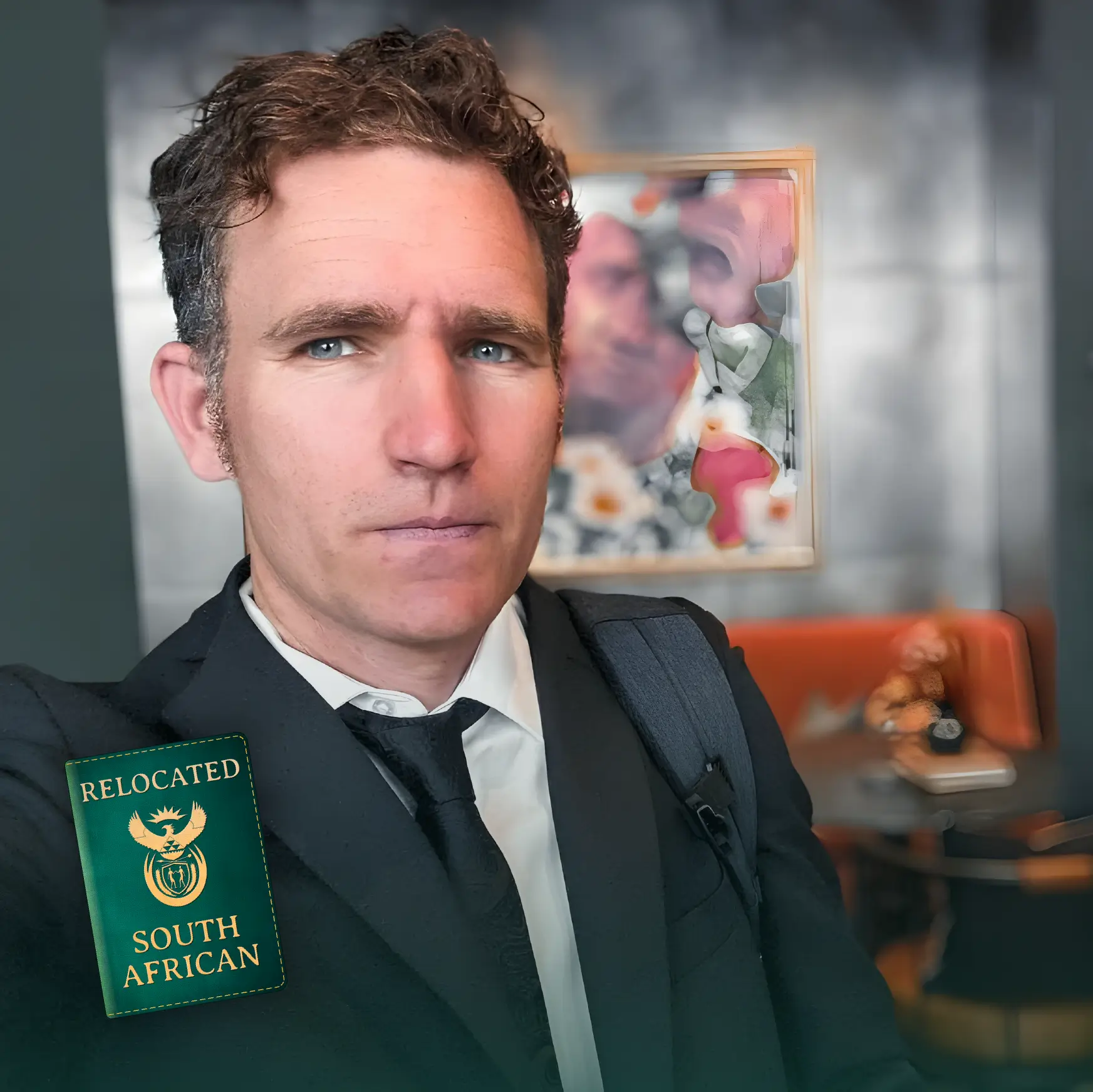
So today I welcome from Port Moody in Canada, Kobus de Villiers. Welcome, Kobus.
Kobus de Villiers: Yeah, thank you.
Jan Hugo: Nice to have you on the show, but maybe just for our listeners and to educate me, exactly where is Port Moody in Canada?
Kobus de Villiers: Port Moody is on the west coast of Canada, just about 20 minutes by boat outside of Vancouver. And it’s the most beautiful part of Canada. Of course, British Columbia are known for its natural beauty. And it’s the part of the country that’s got the most mild weather. So it’s actually a very nice place to live.
Jan Hugo: Because every conversation that you have with anybody in Canada is, what about the weather? So Port Moody is not like that?
Kobus de Villiers: No, not at all.
Jan Hugo: Okay, that sounds very interesting. And how long have you been there?
Kobus de Villiers: We arrived here in July 1997.
Jan Hugo: Oh my word, that is a long time. So because that was going to be my next question, I always ask my guests just for a short summary of how you ended up where you are now, where you’re from, studies, etc. Just a short summary so that we can put into context where you are.
Kobus de Villiers: Okay, so I was born in Bloemfontein in the Free State. I grew up in Welkom at a mining town. And I finished high school in 1967. In 1971, I did my military service. First at 6 SAI in Grahamstown, and then in 2 SAI in Oudtshoorn. In 1972, I went to Tukkies and did mechanical engineering until 1975. And my dream has always been to design and build fighter aircraft and rockets. This story comes from when I was about five years old, was the Russians launched Sputnik. And I was on the farm in the vegetable store with my uncle and my grandfather. And we were looking at this little blinking light going across the sky, Free State night. And I got this kind of thing: I want to do that. I want to build machines like that. And it’s been like that my whole life.
So at school I had a lot of problems with my teachers because I always wanted to go and tell them that I want to go to study at Caltech. I want to work at NASA and I want to build supersonic aeroplanes and rockets. And I remember my guidance teacher, you know, the one that tells you what kind of career you should do?
Jan Hugo: Yeah.
Kobus de Villiers: So she had no idea where Caltech was and she had no idea what NASA does. And she told me it would be better if I go to a technical high school and then I can do an apprenticeship and I can live near Welkom so I can see my parents quite regularly. The other thing is I always goofed off in class because I was always busy in my head with stuff and I was getting bored with what the teachers were doing. So my mathematics teacher wrote a letter to my parents saying they should put me in another class or let me choose other topics because I’ll never finish matric mathematics.
So when I finished Mathematics III at the University of Milan in the school of aeronautics, I wanted to send him a postcard. I just didn’t know where to go. So my parents were not too enamoured with this idea that I want to become an engineer because they were all either dominees or teachers or my dad was a pathologist. And I think he was really disappointed I didn’t want to do what he did.
So I had to pay for my own studies. So I worked in the mine in Welkom and eventually I had a scholarship from SAA. So when I finished my studies, I had to go and work for SAA. And luckily, very luckily, at that time, Atlas Aircraft Corporation was gearing up. They started building the Impala and they were looking for local young engineers. Apparently they went to universities and looked at people’s results. And I got an invitation for an interview and in 1976, I got a job at Atlas Aircraft Corporation. I worked for them for 11 years. Of that 11 years, I’d spent six years overseas either studying or working at overseas aircraft companies on projects for Atlas.
Jan Hugo: So did Atlas become Denel later on?
Kobus de Villiers: Well, Atlas was the aircraft manufacturer as part of Krygkor, you know? They had Kentron, they had Atlas, they had Eloptero. So yeah, we were a Krygkor company, but Atlas was entirely for aircraft design. So after about nine years at Atlas, I became a chief design engineer for all Mirage projects. And in my eleventh year I had a bit of a fallout with my boss because he had a kind of very old-fashioned stick-in-the-mud civil service kind of way of thinking. And me having studied overseas and working in places like Ofakim and at IAI in Israel and at Dassault in France, I had a whole different idea of how this should be done and more modern ideas and also a much more creative way of thinking. I think I had more chutzpah than brains, but anyway.
So I left, I left Atlas and the chief of the Air Force told me to join a group of engineers that was kind of a think tank for the Air Force. And we were housed in some kind of nondescript brown brick building in Pretoria. And I worked there for two years and then came a very, very interesting, very strange thing. I was invited for tea to the chief of the Air Force House on a Sunday. I first thought it’s just my friends pulling my leg, you know, telling me I’ve got to go and see the chief of the Air Force. But when I called the number, it was an aide-de-camp that was very efficient and told me I’d better be there and I must not wear a uniform and I mustn’t tell anybody that I’m there.
So I went and a very strange meeting in which I couldn’t talk about for years and years. He wanted to put together a team to go to Russia and to go and work in Russia on a project where we put the Russian MiG-29 engine into a SAAF Mirage F1 and a Cheetah D. And the one reason why he wanted me to be on the project was I had worked on a Cheetah project for four years, both overseas and at home. And then I went home and this was very, yeah.
Jan Hugo: Can I just interrupt for those who don’t know that. If I’m correct in saying that the Cheetah was a sort of a home version of the Mirage, is that correct?
Kobus de Villiers: No, the Cheetah was a kind of a homegrown version of the Kfir because the Mirage was based on the Mirage but we did things to the Mirage to turn it into a Cheetah.
Jan Hugo: Okay, okay. That’s just for that.
Kobus de Villiers: Since you asked the question, there were different variants of the Cheetah. And I worked on the first one, the two-seater. I was just part of an engineering team. Then on the single-seater, the Cheetah E, I was a little bit more senior on the engineering team. And then we wanted to build reconnaissance aircraft, basically a spy plane called the Cheetah R. And that project was very, very secret, and it was done entirely in South Africa, just by South Africans. And I led that team. And that was why Ben suggested that I lead the team that has to go to Russia.
So I’m 35, divorced, I’m old, and I always wanted to work for NASA or the Americans, but of course, being in South Africa, there was no chance of that ever happening. In fact, I wasn’t allowed to go to the United States. They would have arrested us because remember, they had a whole thing against South Africans going to the United States that had connections with Armscor.
So anyway, we flew in a very detoured route and I described that in my book called Poskaart uit Moskou. We flew to Moscow, four of us, and we did a reconnaissance with some of the people in Russia with some KGB guards escorting us to look at the possibility of doing this project. And I came back, I wrote the report saying it can be done, but these are the pitfalls and this is what could happen. And of course, it was way out of my league. I mean, you’re talking now about the Free State Farm Boy talking to a guy like Andrei Stepanov who designed the MiG-29, which is an aeroplane even the Americans were scared of. But like I say, chutzpah beats four aces.
So we got the job. I had a small team of engineers and we lived in Brezhnev’s dacha and worked in Brezhnev’s dacha with a group of Russian engineers that came in and out and we were flown at night by helicopter to certain places where we worked with other parts of the company amongst other, some of the guys who do the engine and we actually managed to stick a MiG-29 engine in both an F1 and in a Cheetah D. And eventually in 1994, this project was announced by the then Minister of Defence, Joe Modise, at the Farnborough Air Show. And of course it created quite a ripple in the military aviation world.
Jan Hugo: That is amazing. Can I just ask, did you, so you designed, obviously the engine had to be redesigned, but did you actually have the Cheetahs there to build it in?
Kobus de Villiers: No. So that was done back in South Africa?
Jan Hugo: Yeah, we couldn’t do that for two reasons.
Kobus de Villiers: Yeah, we couldn’t do that for three actually. The first reason is we didn’t want to expose any Mirage data to the Russians because it’s French data. And it was just unethical to do that. Secondly, we didn’t want to expose Cheetah data to the Russians because that was our new frontline aircraft. So we did the whole thing on knowledge, computer programmes, and the drawings that we had of the Cheetah and the F1 that we took along. And the Russians did the same. They brought the drawings. They brought the engineers. And it was a magic moment when we came back and we modified the two aircraft in a hangar. That was a very, very secret hangar. We actually had our own gate that was cut into the fence at Atlas aircraft to get in and out.
We actually modified the two aircraft. The Russians modified the engine and two gearboxes because the aircraft gearboxes had to be modified. Then we flew the engines from Russia again in a detour in an aeroplane, you know, marked tractor parts or whatever. And we stuck the engine in the aeroplane and it fitted and it worked. And we did 55 flight tests down at Bredasdorp and not one failure. 55 successful flight tests on both aircraft. So that was really, really kind of the best thing that could have happened.
Jan Hugo: Fascinating. How many times did you actually fly on the Cheetah and the Mirage?
Kobus de Villiers: Okay, the Mirage was a single-seater, so there was no chance of flying in that. I did some flight test engineering when I was a youngster, and I would fly on the backseat with an Impala or some of the other aircraft. But in this aircraft, the backseat on the two-seater was covered in instrumentation. So there was just room for the pilot. So we never got a ride in our own aeroplane.
Jan Hugo: That is amazing. What a story, I must say. We’ll talk about your books in a little while, but I mean, that already is absolutely fascinating. So you were saying that’s in around 1994 when the whole government change happened in South Africa. Is that what kind of prompted you then to move abroad?
Kobus de Villiers: Okay, so what happened then was, firstly I must say, there’s a lot of political background about the decision to go and work with the Russians that I never understood at the time. To me, the Russians were the bad guys. You know, when we served in the army, I mean, I walked patrol in the bush and when people would shoot at us, it was with an AK or an RPG-7 or whatever. When I worked on South African Air Force aircraft, we were always working on self-defence systems, chaff and flare dispensers, radar warning systems against Russian equipment.
So when I was asked to go to the Russians, I had to do a bit of soul searching. And what won me over was, first it was a hell of a challenge. Secondly, can you imagine working with the best or the second best guys in the world with aeroplanes? And this being given to me on a plate. And of course, a huge risk, you know, personally, because the first trip we did in there, we were told by the security guys, remember, we have no line of communication. There’s no embassy. If you guys don’t come back, we won’t find you. So it was quite a challenge.
Jan Hugo: Call it a Jason Bourne moment.
Kobus de Villiers: Yeah, yeah. And also what was happening at the same time was I learned that later when I wrote a series of articles for a magazine called Nongqai. I don’t know if you know the magazine Nongqai, it’s actually a very, very good magazine. And when I wrote the series of articles about what we did to the aeroplanes in the process, there was one of the government officials at the time who actually then wrote an article that’s matching mine to explain why we ended up trying to work with the Russians, trying to navigate around the ANC, trying to get the current government at that time to be supported by the new emerging Russia out of the Soviet Union ashes. So that’s what was happening at the time.
At the same time, I met my wife and this was a very strange thing. I was back in South Africa on a trip. You know, we went back and forth because I had to get the guys to come home to rest because we were locked up in one building with a big garden and a wall with barbed wire around it and some KGB guys with Alsatians making sure nobody gets in or out. So we had to take turns to come home and to rest and I happened to be on an escalator in Sandton City and I saw the most incredible looking woman and I started chatting to her and a few weeks later a security guys called me in and said you must stay away from that woman, we think she’s a spy for the Russians or for the French. So this was kind of a parallel story.
Eventually, after the project was done and she and I got married, the security guys were very, very unhappy with me. But anyway, that’s a subset to the story.
Jan Hugo: But she’s French.
Kobus de Villiers: Yes.
Jan Hugo: And what was she actually doing in South Africa at the time?
Kobus de Villiers: Working for a French insurance company or something. Anyway, but that’s one topic we don’t discuss, what she did for this company. But anyway, so now we have this aeroplane built. We think we’re going to get the Russian equipment. And it was a very good technical solution and financially a good solution for the Air Force, since we’re now going to have peace and we’re not going to need to buy new aeroplanes and spend lots of money on military equipment. But then, of course, you know that there was a big push and a big scandal eventually about buying aeroplanes from other countries.
Initially, I was in the first group of people that had to go and look at this new aircraft purchase exercise because of my technical knowledge. And all I’m going to say is, when we came back from that trip, I said to my wife, there’s no way I’m going to participate in this. This is going where my morals and my values just not going to allow me to go there. So of course, I didn’t have a job because now they’re going to buy aeroplanes from overseas. I don’t want to be part of that.
But in the meantime, we were then marketing Armscor overseas quite drastically. We went to every Air Force air show. We went to all these big military shows in Dubai, Abu Dhabi. And I was representing our company, which we had formed to make this aircraft work, Aerosud. And at one of the air shows in 1994, late 1994 in Dubai, I went to a stand that the Canadian government had where they were recruiting people for their iTEC projects. They were looking for people in their healthcare projects. They were looking for people in their space projects. They were looking for people in their aircraft projects.
I chatted to them. They gave me a lot of information. I went home after the show. And when I got home, we had been burgled for the fourth time in three months. So my wife and I sat down and said, okay, firstly, she doesn’t need to live in South Africa. She’s French. She’s got a very interesting history. She had lived and worked all over the world. She could speak several languages. So why does she have to stay in South Africa? Firstly and secondly, it’s dangerous. The last attempted burglary happened while she and the house help and our three, four month old son was in the house.
So I just had enough of all this danger and intrigue and seeing what’s happening with the Air Force and our military industry and Armscor in general. So I contacted several companies in Canada and I set up a series of interviews. I flew to the east coast and I would do an interview with the company and then go to the next place and do an interview with the company. And I did it in February on purpose because that’s the worst month weather wise. That’s how. And by the time I got to Edmonton, which was kind of the Free State of Canada, I was really despondent. I thought, this is not going to work. I can’t imagine our kids in minus 30 degrees Celsius and things like that. And my wife coming from the Côte d’Azur in the south of France, she’s not going to be pleased with this cold weather and neither am I.
And from there, I flew to Vancouver and I stayed in a little hotel downtown. And the morning when I got up, it was a sunny morning, quite balmy. I only needed a light jacket. And I walked down to the waterfront and there was all these millionaire yachts parked in a place called False Creek, which reminded me so much of Nice or Monaco. I called my wife and said, I think we can live here. And I had a meeting with two companies, one that does aerospace stuff and another one that did very high tech research for a guy called Dr. Ballard. You might know about him. He was developing new batteries for this idea of eliminating cars with diesel and petrol engines. And he had a subset going that was working on hydrogen fuel cells which had a link to NASA because they were using hydrogen fuel cells in the spacecraft.
I had to decide, do I go to the aerospace company, which is a job I know, or do I go with this Ballard crowd, which is something I know nothing about, but it sounded like a hell of a challenge and it sound like the future. And then we decided, you know what, we’re taking this big step. We’re chucking everything. We’re leaving the country. We are taking the kids to a new world. That might as well take a hell of a risk on the job as well. You know, do it all in one go. So in July 1997, we ended up in Port Moody because it was a short drive to where the company of Ballard was located. And that’s how we ended up, yeah.
Jan Hugo: Wow. So you’ve been working for them and with them until you retired?
Kobus de Villiers: No, no. Firstly I worked with them and then my dream came true. I was sent to Caltech because the NASA guys at Caltech was working on hydrogen fuel cells and we were exchanging information. So I got my trip to Caltech and I managed to go and visit Einstein’s office, which he had there when he was teaching there. And then they sent me to Germany. The company sent me to Germany because Mercedes-Benz in their research facility wanted to start making some of these fuel cells for their cars as a research thing. So they shipped us to Germany. We lived in Germany for two years, but I was still employed by the Canadian company.
And then we came back and at that time I was burnt out. I was really burnt out. I mean, we’d been doing everything at, you know, more than 100% for years and years. And the adaptation of a new country, a new fact that, you know, the culture is not… You speak English, but these people are not English. You have a different culture. The French, they speak here more. My wife thinks it’s very funny. And the French people, yeah, I’ve got kind of a very different culture than the French in France. So we were just tired. I was just tired. And also I was away from home too much.
So I decided to retire. And I was 55. Took my package, which was at least 10 times the package that I got in South Africa. And I just, we bought a new house and we moved in and I was busy painting the garage when I got a phone call from another South African, who was the CEO of an aircraft company in Vancouver. And he was trying to get a contract on the F-35, which is the world’s most advanced aircraft. He was trying to get a subcontract on that and a subcontract on the new Chinook CH-47 helicopter that was being built by Boeing and his company had only done civilian aircraft.
So he found me somehow and asked me if I’d come and chat to them and maybe join them for six months or so to set up the place so that they could be coming in consideration for tenders for military aircraft on the American market. So I went there and I joined them and I worked for them for three and a half years instead of six months and we were commuting between Philadelphia, a factory in Texas and yeah in Vancouver every two weeks. We were shuttling to the point where if I get on the aeroplane the air hostess used to give me my drink that I had because they recognised us on every flight.
So yeah, so we were commuting back and forth to the States and that was another whole story to get a secret clearance in the United States as an ex-South African. That was all circuses as well, anyway. But that’s all, that’s another book I could write. So I worked for them for three and a half years. The CH-47 helicopter flew, and Boeing bought 15 of them. And the company that I worked for has built 150 wing sets for the F-35, which was the contract we got from them. That our story is in the last part of my book called Top Secret. Then I retired at 58 and since then we’ve been travelling, doing photography and just catching up on all the stuff we missed in life because of work pressure.
Jan Hugo: Well, that’s fascinating. Can I just ask with the F-35 project?
Kobus de Villiers: Yeah.
Jan Hugo: You obviously must have gotten quite close to that aircraft because I’m fascinated by it. It must have been just really, really interesting from an aircraft engineer’s perspective.
Kobus de Villiers: Oh yeah. Yeah. You know, the rubbish that’s been written on the internet about that aircraft is really entertaining. It’s an amazing aeroplane. That’s what I’m going to say. It’s really, really an amazing aeroplane. And the whole concept of Snoopy on his with his aircraft fighting the Red Baron, that is a concept that’s disappeared completely. These aeroplanes hunt in packs, you can pass a target from one aeroplane to another one that’s got a better angle to shoot at it. The whole strategy and application is completely different from the old idea of, you know, trying to get behind a guy and shooting him down from the back. That is just fascinating. You have a very high probability that somebody will hit you from 80 kilometres away.
Jan Hugo: You won’t even know where the shot came from. Where it came from. That is absolutely fascinating. You talked about your children. Were they born in South Africa?
Kobus de Villiers: Yes, yeah. I’ve got four kids with my wife and I, it’s a matter of yours, mine and ours. So I’ve got a daughter who’s a professor at the University of Stellenbosch and a son who’s an airline pilot for Air Canada. I’ve got another son, which is my stepson, who works for a company that makes things from special stainless steels for medical and food processing. And our youngest son has got a chemical engineering degree and he’s recently been shown as the top student in the Canadian Navy. He’s in the Canadian Navy. He’s a systems engineer in the Canadian Navy.
Jan Hugo: Well, fascinating. Do they all have dual citizenship, South African and Canadian?
Kobus de Villiers: Yeah. Yeah, and French.
Jan Hugo: Of course, and French because of…
Kobus de Villiers: Yeah, because of my wife. My wife and I are both French and Canadian citizens, and as far as I’m concerned, I’m not a South African citizen anymore, but because of this thing that has been reinstated, I’m not sure what’s happening there. It was not a good idea to have a South African citizenship if you wanted an American security clearance.
Jan Hugo: I can just imagine, especially with the military backgrounds. Our kids have lived in Dallas and they’ve just become US citizens as well. They got their passports recently. And you mentioned that your wife’s from the south of France and the reason why I’m asking is when we left South Africa in 2020, that’s where we went and we stayed on the Côte d’Azur because we are cyclists and that was what our life was about before we moved to Portugal. So whereabouts is she from on the Côte d’Azur?
Kobus de Villiers: She grew up in Toulon and Le Lavandou.
Jan Hugo: Okay. We were in Mougins and Valbonne, spent a bit of time in Monaco but I mean that cycling paradise if you’re a cyclist. For my sins I learned to speak French but yeah that’s another story. Portugal is tough as an outsider but I think French is, France is even tougher, it’s really difficult. And let’s just talk a little bit about the writing. Has that always been a passion of yours to write and tell us a bit about your books?
Kobus de Villiers: Well, because I kind of lived in my head most of my life. I used to write stuff, even when I was a kid. I think I wrote my first book when I was about 10, but I’ve still got it. It’s a handwritten book with, of course, extremely childish. But then with all the work and the fact that everything was always highly classified, nothing was put in writing and the kids started asking me why did we live there for so long, why did you go away to some place where you couldn’t tell us and mom always said I can’t tell you where he is or I don’t know where he is and then you’d appear again.
I remember my wife drove past Jan Smuts Airport when it was still called Jan Smuts and our youngest son said, Papa lives there because she dropped me off at the airport so often. Anyway, so I started making notes to kind of just get my thoughts straight so that I could tell the kids where we were, why we were there and unfortunately I really wanted to tell my parents but they both passed away before I reached any stage where I could start telling people what I did. So they were always under the impression I was some little junior engineer, you know, in a back office somewhere, which is a sad situation, but never mind.
And then systematically, I started enjoying writing these stories, and I started concentrating not on the job, but on the experiences, the funny things that happen, you know, about going to other countries. The things that happened to you because you don’t understand the language or you don’t understand the culture. The faux pas you make because you make a comment or make a joke and everybody looks at you with a puzzled look on their face. And there’s fact that there was a Free State farm boy and I end up in the middle of Montparnasse with these women in fur coats and little poodles, thin poodles. And I walked into a huge protest against South Africa.
While in my briefcase I had some documentation that I guess if the people knew what was in that briefcase they would have strung me up in public. So you know you had all kinds of strange experiences and I started thinking I should write those down. Personal growth because of exposure and the things that I had to give up or question about my own culture, my own language, my own people because of being exposed to such a lot of new stuff and things that made sense and that maybe we were not the only people in the world that knew things. So that’s how it started.
And I wrote the first book. And of course I wrote it, my wife helped me in English because she’s a linguist. So we got the book edited and all that. And then when I looked, she decided we should look for a publisher. I looked for a publisher and Malherbe grabbed the book and they published it. And then the Afrikaans version. And then they kept egging me on. Write another one, write another one.
Jan Hugo: And that’s how it developed. Well, I mean, just on the publishing side, I kind of can relate to what you’re saying because when I stopped flying helicopters, I thought I must write everything down and I did and I put it in an 85 page document all the stuff about flying and the adventures that we had and so on. And then I gave it to somebody and I said what can I do with this and they said anything. Don’t publish it because you’ll get sued because you say things about people in there. Long story short, I did a short writing course at UCT and we wrote a book, you know, a novel which was kind of an autobiography about a chopper pilot. And we couldn’t get it published. We just could not find a publisher. In the end, we printed 200 or 400 copies ourselves and we put it on Amazon and that was kind of the end of the book. So it’s great that you found a publisher and a publisher that works for you and pushes you to write more because I think it’s a wonderful hobby and a wonderful thing to do.
Kobus de Villiers: Yeah, well it’s interesting you say that, I mean I recently helped a guy who used to fly for the Rhodesian Air Force and he wrote the whole series of articles and then eventually a book about these experiences, flying Hunters and things. And I think he was a helicopter pilot at one stage too. And Malherbe Publishers published his book. Yeah, I’ll send you their data when we are done. The problem is firstly publishing world is a very close little world. I sometimes read books and I think why was this thing rated as a best seller in New York? In a newspaper in New York, they raved about this book because really the plot is pretty poor or there’s not very good prose. But then it turns out this guy’s mother was an author in her time or something like that. And I found that when I sent my manuscripts to Penguin and all these people, especially now in South Africa, even if it’s an Afrikaans book, even more so. They don’t want to know about some of the historical stuff, number one. And number two, the people who are reading this don’t understand what we are writing about.
You know, if you write about Leila’s Fasani, one of these kind of books, then maybe it gets published, or some controversial thing about what’s happening in South Africa. But a lot of the stuff that we can write about and that you have written about, it’s not understood by these people. And you get a little note back after three months saying, sorry, we had a meeting and this is not publishable. And then Malherbe Publishers took the book. We edited not much from what I sent to these other well-known publishers and the book sells.
Jan Hugo: No, exactly. When we sent it to, what do they call it, this sort of a guy who reviews it, and he writes a master’s thesis about how bad your book is, and not about the good points, and we eventually just gave up.
Kobus de Villiers: And he doesn’t give you any pointers saying, if you do this and do that, it makes it acceptable.
Jan Hugo: It’s all just negative feedback. But anyway, I’d love to hear that. So let’s just talk about the books. The other question I wanted to ask you, I mean, you’re a family man with wife, kids, you travel a lot. I’ve found that writing is quite a lonely sport. I mean, you’ve got to be dedicated to sit down and actually work on it. Is that something that you’ve found as well?
Kobus de Villiers: I always need time to think and to work on stuff, and so does my wife. If you see our house, it’s a library. We literally have hundreds and hundreds of books. She’s got books that she’s collected from all over the world. She lived and worked in places like Saudi Arabia, Pakistan, Australia, Papua New Guinea, Egypt. So she’s been all over the world and she can speak some of the languages or understand some of the dialects. And she’s very, very interested in the literature. So she’s got a huge collection of books. So she likes reading. And when she’s reading, I’m writing. And then on top of that, I’ve got the whole basement set up as a workshop where I build model rockets and model aeroplanes, radio control boats and stuff. And that’s also where I write. So it’s like my cave where I come down here and when I suddenly get a bevlieging, I start writing again.
Jan Hugo: That’s fantastic. That’s absolutely awesome. So maybe just talk us through. I think you’ve published five books. Maybe just give us a bit of a chronological order and what you’re covering.
Kobus de Villiers: Yeah, so let’s start with the Afrikaans version, Poskaart uit Moskou. That’s kind of a little snatches of my life from the time that I can remember, you know, when you, what, two and a half, three years old, your memory is supposed to start working. And it’s based on this principle, the things that I wanted to do, how did I get to a point I want to design aeroplanes and funny incidents, learning incidents, things that I did was completely off the norm. And I was often in conflict with some of the Afrikaans norms and beliefs and things, which got me into trouble and I could never understand it because my mind was working. I wanted to know why this and why that. I can give you some examples later.
So this first book then goes all the way until we came back from Germany and we settled down here and I worked on the last aircraft projects and then stopped. So it’s a summary, it’s not an autobiography, but it’s a memoir, but it’s written in a way that it makes a story because it’s chronological. But you can read the individual chapters by themselves. It’s not like a novel that you’re going to lose track of the characters or something like that. So the people who give me feedback about the book would say, I didn’t worry much about the first two chapters, but the part about the aircraft you flew out of Peru, that was really good or something like that. And so it’s something that I think, like you wrote, you know, but this is more real experiences. All I did was I changed names. Sometimes people’s names, I changed companies names because of the security around our job. And also I can’t use people’s names and stuff unless I have their agreement. So we clean it up to the point that nobody’s going to come back and say I’m representing them or telling them who they are.
The second book is the English translation of the same thing. It’s called Top Secret and Other Anecdotes. And it’s interesting, the English version sells more overseas because Malherbe Publishers sells books via Amazon as well. So when I get my annual or bi-annual statement from them, the ones that are, when you look at the books that sell better, the English book sells better overseas and the Afrikaans book of course sells in South Africa. So those are the first two.
Then I wrote Vlug 237. This was when I was kind of sailing closer to the wind. This was a project we worked on that was not really made public and I think even till today people are not quite sure where this aircraft came from and I worked on that project and I was living at times in the hotel in Jerusalem that is quite famous for where a lot of journalists live. So it’s kind of like hiding in open space. But that I made into a novel, but I can tell you that a lot of it is true. It’s just the names have changed and the dates have changed a little bit. And that was something that I had to do because that was a very intriguing job. And I always felt compelled that this needs to be, the experiences, the things I learned and felt had to be discussed.
I was in, we were in Canada for a while and I was a bit lonely and lost and I decided to go to a club or an organisation of people who come from Africa. So after work I went there and I was the only white face in the place except the lady that was serving tea. And most of these people like third or fourth generation, people who came from Africa who were descendants of slaves or things like that. So I realised that they know very little about Africa. And yet they are Africans. They see themselves more African than me. And I decided I’ve got a right to a book about that. So that’s when I wrote Once Upon a Time I Lived in Africa. And I wrote it in English because I thought the major audience would be in English. And that I think is the most popular book for people who are not interested in South Africa’s history or military service or something. That’s a book that people really like because it tells you what it was like to grow up as a youngster in Africa.
And then I finally, when they started saying I can talk about what happened in Russia and the Russian project was made public, I wrote a book called A Postcard from Moscow, which is a novelised, closely novelised story of what it was like when we were there. And we had a hell of a lot of experiences. I mean, to give you an idea, we were working in this dacha of residence. One morning about four o’clock in the morning, they came and woke us up and said, you’ve got to get ready. We’ve got to get out of here because they are shooting at the White House. Remember, there was this big uprising in Moscow. They were shooting at their own White House. And I think the people who were taking care of us were responsible for our security. They were worried that if it leaks out that you’ve got this guys from Africa messing around in Brezhnev’s on a secret project. So they smuggled us out. It was quite an adventurous trip. We drove right past where all these military things were going on, tanks driving across the road and all that. They got us on an aeroplane. We ended up in Austria for about two weeks with just one set of clothes and no money. And then eventually we were taken back in when it looked like the right guys took over the control in Russia and we just carried on with the job again.
Jan Hugo: Well, that’s fascinating. And in this whole process, as I spoke to you, Johan Allers the other day in Holland, I don’t know if you remember him, he was the SABC’s man. He was a guest on the show. But anyway, talking about, you know, all these military intelligence guys and the spooks as they call them, they kind of follow you and keep an eye on what you were doing. Yeah, I guess so, yeah. It wasn’t openly, but you were aware that they were there.
Kobus de Villiers: Yeah. If you read a book like A Postcard from Moscow, you can see the techniques of shaking somebody following you and stuff like that.
Jan Hugo: Okay. I’m going to definitely get it done. And I think at the end of the programme, we’ll put a link to Malherbe Publishers and your books there, the ones that you see.
Kobus de Villiers: Okay. We’ll make sure that on the podcast as well.
Jan Hugo: Talking about Johan Allers, just to interrupt you, he was actually doing an audio book of Poskaart uit Moskou. And he got quite far along with that. And then he got sidetracked on other stuff. I must contact him again and see if we can finish that.
Jan Hugo: He’s a lovely guy. I can send you. Very interesting guy. I’ve got his number, but you know, he’s got a big podcast on YouTube now, Alles Afrikaans, and he talks to a lot of people in South Africa still. It was a fascinating chat.
Kobus de Villiers: Yeah, I actually listened to your podcast with him.
Jan Hugo: He was a lovely guy. But you just said that they kind of cleared that you could write the last book. When you say they cleared it, who was that?
Kobus de Villiers: There were people in Pretoria that you needed to kind of approach to ask, can I talk about this? Can I talk about that? Winston Brent has written a series of very interesting books. They are actually not stories. They are factually, they are technically correct about the different aircraft and how they were made and all that. And he kind of pioneered the way of finding approval or getting instructions or directions or what you can say and what you can’t say. But to be honest with you, it became such a virtually impossible task to contact these people or to get somebody that understood where to go and look for some of this stuff that I think nowadays it doesn’t make any difference.
Jan Hugo: I can imagine. And Kobus, just getting back to the podcast and what we talk about, if you look back over your life and think, would you do it again? Would you do it differently?
Kobus de Villiers: Oh, yeah. No, I’ll do it again. You know, we have a bucket list and I’ve nearly done all of them on the bucket list, except my bucket list always keeps growing, but never mind. Yeah, and I’ll do it again. Of course, hindsight gives you some knowledge and they would think I would do differently or avoid, but on the other hand, it would have been less fun if I didn’t have made these mistakes and I got myself into situations by accident, which in the end was very good lessons, or actually opened a door for me that I would never have known about. Life is life and I don’t think that I would have changed anything. Maybe I would have done certain things earlier.
One thing I learned about being an Afrikaner is because of our kind of high conservatism and the religion and things like that is we grew up a little bit too much in a box and not willing to take risks or try things out, scared of failure and that I would hopefully would have done differently looking back on my life but I mean maybe some of the stuff I did was exactly because I wanted to break out of that and that got me into trouble but I learned a lot of stuff.
Jan Hugo: No, I think that’s very valid. I think, as you say, we all grew up with critical parents. They come from a different era where they worked very hard to get where they were and they expected a lot of us. I think you’re right. It does open your eyes when you get out of the country.
Kobus de Villiers: And especially if you marry someone, you know, I did exactly what nobody’s supposed to do when you’re an Afrikaner. I married a French girl who grew up Catholic and my, our forefathers, took little ships to go to Africa, which was completely wild in those days, because of their religion. I mean, this is like going to Mars nowadays, the kind of trip that they undertook. And I remember all the teachings about, you know, don’t do anything, stay away from the Catholics and all that. And you know, I end up with my best friend being a Catholic, although neither of us are religious, and it was incredible what I learned from her. She’s an amazing person, a completely different way of having fun and enjoying stuff and willing to explore where we would never have done that if I’d stayed married to a South African woman.
Jan Hugo: Yeah. And Kobus, have you been back to South Africa a lot since you went to Canada?
Kobus de Villiers: No, no, I’ve been back three times only since the time that I left. The first time 2008 when my daughter got married because she didn’t want to leave. She wanted to stay in Stellenbosch. It’s understandable, you know, she married the guy from there and they’ve got a big family and all that. So when she got married, I went back. I went back to meet my grandson. And then I went back one more time. But it was painful. Every time when I went back, my brother and I would drive to where we grew up as kids. I went back to the house that I built with the money I made when I was working on the Cheetah project. And we also had a holiday home at Hartebeespoort Dam in Kosmos. And when I looked at the decay and the destruction, and especially the criminality, I’m a straight arrow. I do not like corruption. I do not like cheating. I do not like taking shortcuts because if we do it, your whole society unravels. And that’s why I find it very painful going back.
I also, I don’t know if you want to shorten the discussion, but I’ve been doing quite a bit of research when I look at what people write on the internet on South African websites. And I have found that the people who lived the largest part of their life outside of South Africa, outside of the new South Africa, they have a very different way of thinking about what’s happening in South Africa than the people who lived the largest part of their lives in the new South Africa. And so we are already disconnected. If I look at what people say or how excited they get about stuff, how they’re still very much involved and how they’re kind of completely unrealistically hopeful for the country. I realise that, you know, there’s already a huge difference in the people who left South Africa, never mind the ones who stayed behind. I wrote quite an interesting article about my last trip when I went there and what I experienced and how I felt by the time I left. And a lot of people like it and then a lot of people are extremely upset when they read it.
Jan Hugo: Okay, and did you publish that?
Kobus de Villiers: Yeah, it’s in a short story book, but I’m thinking to put it in a chapter of the book I’m writing now.
Jan Hugo: Okay, that will be very interesting to see because, you know, I think the one thing that I’ve learned doing this the last six months and 30 episodes, one thing you can’t do is judge. I think it’s very difficult to walk a mile in another man’s shoes because you can’t. And a lot of people are very critical of people who immigrate. They sit in their bubbles in South Africa, they say it’s a wonderful place. Why are you leaving? Look at all the beauty. Look at all of this. And I said, that’s your view. I have a different view. I’ve followed my children. They live all over the world. So we try to get close to them. We’re very happy here. We, as you say, the safety, the less corruption and, you know, just everything that happens in South Africa and where we grew up and what we see today. So I just think, you know, you can’t judge, but we do experience it differently.
And unfortunately, and I don’t know if you got that chance when you were there last, I don’t know when that was. But people are very quick to play a race card against you. You know, you’re a white person. You benefited from apartheid, now you live out of it. So they love to play that card. I’m tired of that because I say I don’t owe anybody anything. And I don’t like what I’m seeing, what’s going on there. So we haven’t been back in five years and I have no intention of going back.
Kobus de Villiers: No, no. If you take the amount of work, risk and stress you put in to emigrate, don’t tell me I benefited from something. I had to start my life twice. I built up a career and a life in South Africa. That was grabbed away from me. And because of my principles and values, I went somewhere else and it was damn hard for a while until we made a success of it. So don’t tell me I got things for free. That’s not an argument that cuts any ice with me.
Jan Hugo: Exactly, exactly. And Kobus, if somebody comes to you today, be it a person in his 20s or a person in his 40s or even in his 60s, and they say, we’re thinking about leaving South Africa. What would your advice be?
Kobus de Villiers: I tell them to make a list, take one piece of paper divided in the middle. On the left hand side, you write all the reasons why you want to leave. And on the other side of the page, you write all the reasons that you think you shouldn’t leave. And you can convince yourself very quickly if you are really, really a candidate for immigration or not. And just being a little bit hurt for something that happened yesterday in the traffic is not a reason for emigrating. And you have to be willing to work and you have to be willing to give up stuff. But at the same time, you have to be willing to be really learning new stuff and go into an adventure that you can’t even explain to other people until you are there.
And then the same people who want to go back. Sometimes people say to me, when are you coming back, I said, you’re nuts. When am I coming back? And the reason is when I look at that sheet of paper that I wrote, the reasons why I left are still there or they got worse. So why go back? Because the reasons why I left is still there. If they are gone, okay, then I could go back.
Jan Hugo: So it’s easy to fool yourself. It is easy to fool yourself. And I think the one thing that I’ve also learned from a lot of people in this process is you’ve got to make a choice. If you decide to go, then you must go. You mustn’t look over your shoulder and say, oh, if it doesn’t work, I’m going back. Did that thought ever cross your mind when you left?
Kobus de Villiers: No. I was so busy trying to make success where I am that I didn’t have time to look back. And then when I did travel there, it kind of confirmed for me why I’d left. And then at one stage when my eldest son finished his degree, he did a degree in, it’s called a degree in aviation, which is kind of a requirement to become a pilot and commercial pilot in Canada, because you learn how to manage an airline or it’s a big commerce degree. He went back to visit and he said to me, you know what, I’m really, really glad you brought us here because for the first time now I can see compared to my cousins and other people at school with me where they are and where we are now.
It’s a very important point that you raised there. I find it strange when you look, you go on a website, a Facebook website where South Africans have discussions and comments and they will talk and talk and talk about how wonderful South Africa is and they get tears in their eyes when the anthem, the new anthem is being sung and all that. And then when you ask them, why did you leave? They say because of their children, they wanted to give their children a better opportunity. And then it happened here with one family that we know. We found out from the kids eventually that they were completely confused because their parents kept telling them they brought them here and they went through the hardship of adapting to a new place, going to school in English and all that because it’s better here than in South Africa.
But at the same time, the parents were always telling them how wonderful South Africa was, kept sending them back to visit their granny and go and see the animals and all the wonderful things. And they couldn’t understand, if it’s so wonderful back there, why did we come here? So you’re not doing your children a favour. If you decide to come to another place, then go for it all out. Don’t give up your roots, you don’t have to deny who you are, but you can’t have this mystical idea about la-la land that’s so wonderful. If it’s that wonderful, why are you not living there?
Jan Hugo: Yeah, yeah, exactly. You know, I’ve also, I’ve mentioned it so many times, emotions that I have about leaving. I think of my, because my problem is I’ve got kids in America, kids in Ireland, son in Ireland, man. And the cousins never get to play with each other like we played with our cousins. And if South Africa was a normal society, they would have, because we wouldn’t have needed to leave. You know, these people leave for opportunities, but they would also go back. And yet that doesn’t happen. So I always feel this grief of families broken up, but I also feel real anger that these guys have allowed the country to get to a point where we don’t feel like we can live there. Yeah, it’s not an easy thing, but I do think that in terms of advice to people, there are times when it’s very difficult. It’s exciting, it’s an adventure, but it’s tough.
Kobus de Villiers: Yeah, but I think if you move, like we did, with the idea that we’re not going to go back, that this is not an experiment, this is a permanent move, and we’re going to make it work, then it’s much easier than when you go there and you’re kind of tentative and think, oh well, you know, people were nicer in the lineup at the shopping mall or whatever. You’re going to, you’re making it hard for yourself if you don’t go all in. I’m not saying you must say where you are is Utopia. Every country has got its problems, but if it’s better here than there, then you have to believe in the reality and make it work and don’t make things difficult for yourself. And you can keep your memories. You can remember all the beautiful things and when you grow up and all that kind of stuff, because it’s still your memories. But when I go back, I can’t find those places which are my memories anymore. They are destroyed, they are dirty, they’re gone. The whole thinking process is not what I remember. So what I’m yearning for doesn’t exist anymore.
Jan Hugo: With you. It’s absolutely right. Kobus really, I really appreciate you sharing with us. Maybe before we close, just can you give us the website of Malherbe Publisher where your books can be found?
Kobus de Villiers: Yeah, can I send it to you?
Jan Hugo: Okay, I’ll add it to the bottom of the page.
Kobus de Villiers: Yeah, I’ll send the link because I don’t have it on the top of my…
Jan Hugo: No problem, but Malherbe Publisher published Kobus’ books.
Kobus de Villiers: I could just say, and on Amazon as well for overseas people. And it’s both printed books and e-books.
Jan Hugo: Okay, and yeah, and it’s Kobus de Villiers, you’re writing under your own name.
Kobus de Villiers: Yeah, yeah, okay.
Jan Hugo: Thank you so much for sharing your journey and geez, these really interesting stories of how you got to Canada and where you are today. And I can only wish you well on your further journeys and exploration and writing and building things in your man cave. It’s awesome. It’s so refreshing to talk to you. Thank you so much.
Kobus de Villiers: Thank you. Yeah, South Africans wherever they are, they’re very interesting people. That’s one thing about us.
Jan Hugo: Absolutely. Thank you so much.
Kobus de Villiers: Well, thanks for having me. Thank you. Thank you.
Jan Hugo: And if you enjoyed my discussion with Kobus and would like to hear more about South Africans and their experiences when they leave South Africa, why not subscribe on your favourite platform? Or if you would like to share your own story, contact me on jan@therelocatedsouthafrican.com. Until next time.