Jan Hugo: Welcome to The Relocated South African, the show for navigating immigration from South Africa for a better future. I’m your host, Jan Hugo, from Lagos in Portugal. Just to let you know that we’ve recently launched our brand new website, www.therelocatedsouthafrican.com. If you want to interact with us or comment on our discussion or even participate in an interview, please contact me on jan@therelocatedsouthafrican.com. We also have a newsletter if you want to subscribe on the website. And also if you like our content, why not subscribe on your favourite platform?
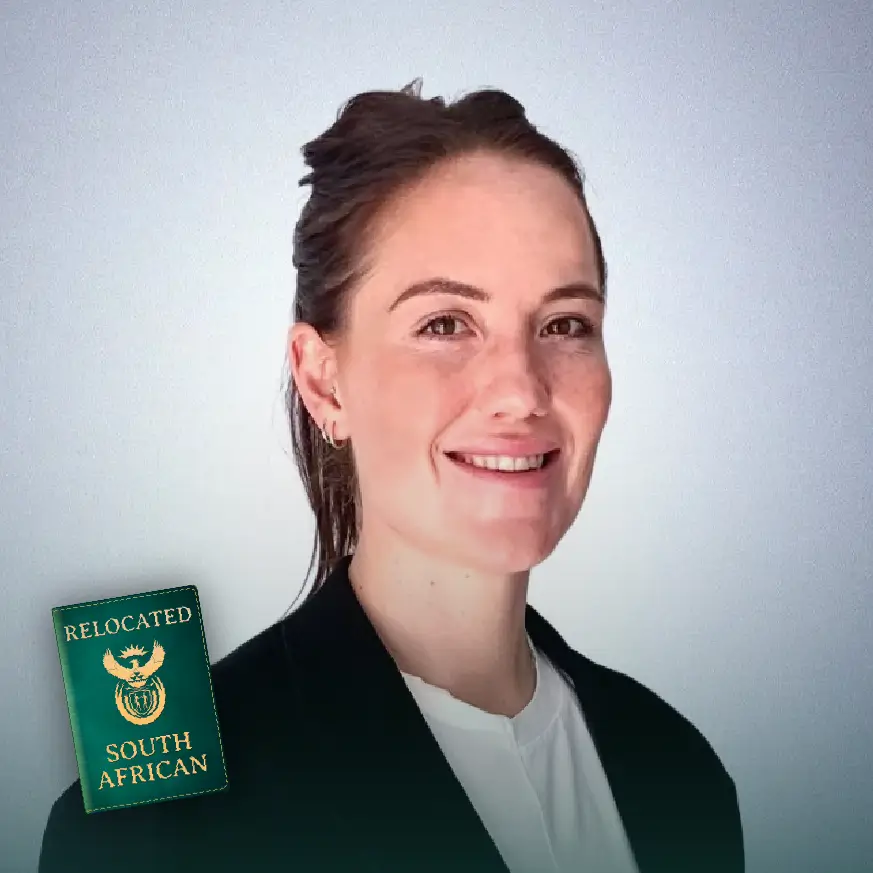
So today I welcome from ‘s-Hertogenbosch in the Netherlands, Ruth Prinsloo. Welcome Ruth, it’s a privilege to have you on the show.
Ruth Prinsloo: Thank you.
Jan Hugo: So before getting into how I found Ruth, then how I made contact with her. And like I do with every guest, maybe you can give us a short family history where you grew up into school and how you got to the Netherlands and family, et cetera.
Ruth Prinsloo: I myself was born in Johannesburg and my mother is originally from Boland, Malmesbury, and my father from Johannesburg. And I’m the eldest of four. I have one brother and two sisters. And the four of us, this is an interesting fact. My brother and my sisters and I all live in different countries. And between us, we have five nationalities.
Jan Hugo: My goodness, that is amazing. But you were all born South Africa.
Ruth Prinsloo: We were all born South Africa. We were all raised in Boksburg, yes.
Jan Hugo: Oh, my word. And where do they all live?
Ruth Prinsloo: I have a brother in Brisbane in Australia, and my youngest sister is in Stellenbosch, but she’s married to a South African who has Portuguese citizenship. And my middle sister is in Rome, married to an Italian. So we’re in… We did it a little, we’re a little bit extreme, I think.
Jan Hugo: Yeah, no, I must say. And it’s probably getting quite difficult to get a family get together.
Ruth Prinsloo: Ah, yes. The last time we were all in one place was for my father’s funeral, actually. Oh, wow. Yeah. That’s six years ago. Okay. But we grew up in Boksburg and I then went to Stellenbosch. I studied BA with music and languages and classical culture. And then because I had French as a major, I decided I wanted to go… My French teacher from high school actually was fantastic. And she, along with the art teacher that we had, was such an inspiration that I decided I wanted to go and see everything that they had taught me about. So with my newly gained French degree, I went off as an au pair to Paris and discovered I couldn’t speak it at all.
Jan Hugo: I was gonna say we can, I speak, we lived there for three years, so I speak a bit of French. We can switch the French, but no, you’re right.
Ruth Prinsloo: It’s completely different when you’ve only had it in a classroom setting. So there was culture shock, it was a huge culture shock for me that. And also we went in January. So we went from the South African summer to this European winter and I got sick and I just stayed sick with flu and whatnot. And almost gave it up. After about two months, I thought I’ve had enough. I want to go home. And luckily the family I was working for, the man and his wife looking after the kids, he talked me out of it. And he said, you’d be sorry if you did. Just push through a little bit more. So I did and ended up living in any case after six months, but I went to work in North Devon in England for a while.
And there I met an American. We became really good friends and I hitchhiked the length of the British Isles from London right up to the northernmost part of Scotland, John o’ Groats, and then down again to Land’s End. And then after that, I went back to South Africa. I started my master’s degree also through Stellenbosch. And then my husband and I got married in 1996. He was also a student at Stellenbosch. That’s where I met him.
And then we decided we wanted to actually see a little bit of the world. And the way that we planned to do it was through then was you could get working holiday visas for the UK for two years. So we went through the entire process of doing that. And I went on the day that I had to collect them from the British Embassy, came back home to my mother-in-law’s house, and I said to her, look what we’ve got. And she said, look what I’ve got. She was a lecturer at UNISA. And that day they had received a circular just out of the blue from the Japanese Embassy saying that they were looking for people for five South Africans to participate in a thing called JET program, Japan exchange and teaching.
And they needed graduates who had majored in English. And they were looking for five to go to Japan to teach English in schools there. And it’s a government funded program. And it was, it’s huge. It was the 11th year that the program was running, but it was the first year that South Africans could participate. And they, I said yes, but look here, I have these passports with two visas for the UK. She said, just phone them and just see. So the next day I phoned and the day after we went for an interview and two days later I got a job in Japan. So we had these British visas, which we didn’t use. And my husband and I thought, this is an opportunity which is, London will always be there, but this we must do. So we went to Japan and we lived in Japan for three years.
Jan Hugo: Was he also teaching English?
Ruth Prinsloo: No, no, no. Because he studied law and he didn’t have English as a major. So because the Japanese insisted for South African participants, they must have English as a major because our culture is so multilingual. When they’re getting people from the US or from other English speaking countries, they know they can speak it. But for us, they wanted proof on a paper, not just the fact that we interviewed and we showed them we could speak it. They wanted it on paper. And my husband didn’t have English as a major. So he didn’t work there. He studied for his LLM. And he did his LLM through UNISA while we were there. Oh, wow. And yeah, that’s what we did. So we lived on the island of Kyushu, which is the most southern one, Okinawa is the most southern one, the belts of islands, but the largest island just above Okinawa is called Kyushu. And we lived on the eastern side next to a volcano for three years.
Jan Hugo: That is fascinating. And did you learn to speak Japanese?
Ruth Prinsloo: We tried as hard as we could. It’s very, very difficult. I believe so. It was the most bizarre experience, actually, because I’d graduated, I was literate, I had a degree, I considered myself educated and I landed there and I was illiterate. I couldn’t read, I couldn’t understand, I couldn’t say anything, couldn’t write anything. It was the most bizarre experience.
But the Japanese themselves are such interesting people when it comes to accommodating others. Their whole culture focuses on the comfort of the other person. So they literally, they would do anything. They would bend over backwards to help us in whatever situation we were in. We had some extremely funny stories about stuff that happened. But that was, it was fantastic. It was the opportunity of a lifetime. And the program was open for a maximum of three years. So we stayed the full three years.
And then in 2000, my contract ended in 2000 and we were intending to go back to South Africa. And we did for nine months. We lived in Pretoria and in Sandton and my husband is newly qualified. It was just at the time of everything was switching around to economic black economic empowerment. And it took nine months and he just simply could not find a job.
Jan Hugo: Even with LLM.
Ruth Prinsloo: Yes. Even with LLM. Yeah. So we decided, well, we can’t continue like this. We’re going to have to try something else. And so he started looking abroad. And within about a month, he had an offer from a company here in Holland to come and work as in-house counsel. So that’s how we came here. We landed in Holland in May of 2001. And we never really intended to stay this long, but we have. We’ve been here for 23 years now.
Jan Hugo: That is unbelievable. And you’re living in ‘s-Hertogenbosch itself?
Ruth Prinsloo: Yes, in ‘s-Hertogenbosch, which is a more southern city. It’s close to Belgium, but it’s an hour from Amsterdam.
Jan Hugo: Okay, okay. I was just checking now when we went in 2020, we left just on the first flight out of South Africa after COVID and the first non-repatriation flight and we ended up in near Amsterdam in a place called De Hoof on a canal in a little Airbnb and then there was a nightmare with COVID and we eventually left to go to France because we didn’t want to get locked down there so but yeah it’s beautiful it’s just the weather oh my word.
Ruth Prinsloo: We’re used to that now it’s actually I mean it’s it’s 12 degrees today and it’s raining but somehow over the years, I didn’t notice it happened, but I noticed that it had happened at some point where it doesn’t bother me at all anymore.
Jan Hugo: And your husband’s still with the same company?
Ruth Prinsloo: No. Well, the company changed hands many times. I think probably about five or six times. And then at one point he had to leave. So now, well, they have a thing in Holland which is called leeftijdsdiscriminatie. I don’t know if you’ve heard of that, but whenever people get to the age of about 50, which is where we are now, if you are retrenched, your chances of finding paid employment again in the Netherlands are about 4%. So we went through a phase where it was very, very difficult. I must say that was probably the most difficult part of being an immigrant for me then was that.
At the same time, I became very ill. I had pancreatic cancer and had to go through surgery. And we had two children at school at that point who were, I mean, they were really struggling as well also because of everything that was going on in our personal lives. But at a certain point, he was just so tired of interviewing here and never getting anywhere that he decided again to look abroad. And now he’s working in London. And that’s how we do it now. I stayed here with the children because they were still at school and we didn’t want to upset that. And also because my own medical care requires a certain amount of stability. So that’s how we do it now.
Jan Hugo: That is unbelievable. What a story. And Ruth, kids were born in Holland?
Ruth Prinsloo: Yes, they were both born in Holland.
Jan Hugo: Yeah. Okay. Did you give them South African passports as well?
Ruth Prinsloo: Yes. Okay. And every time I have to renew the stupid things through the embassy, I regret it. Because it is such a schlep. It is just such a schlep. But when you finally get the passport, then you’re glad you did it. I mean my son, my eldest son has finished school and he’s just left last week for a four month internship at Lanzerac in Stellenbosch and he can do this much more easily because he has a South African passport.
Jan Hugo: Yeah, that’s very interesting. You mentioned that you’re working as well at the moment. It sounds like you have a really interesting job.
Ruth Prinsloo: After I got sick, I had a massive operation to, my whole pancreas was removed. So I live now with diabetes type three. And the aftermath of that operation was the hell itself because it was such a, I don’t know what’s the English word now. So invasive. Yeah, that for years afterwards, I was not capable of functioning on the same level as I was used to. So I lost the ability to concentrate. I couldn’t read. I could literally do nothing for months. Otherwise I would start shaking because the regulator of your sugar is so vital. It’s vital to to head work. You will not believe how much sugar it requires just to think or concentrate on something.
Jan Hugo: I’m a diabetic as well.
Ruth Prinsloo: So I would try to read and I would read a sentence or a paragraph and then my hands would start shaking. And I think, you know, how long is it going to take to get back to any kind of normality after this? And it took a long, long, long time. And one of the things that I decided to do to basically exercise the concentration muscle was to take up all kinds of crafts that required very fine motor coordination. So I started baking, I started doing, you know, like when they make those old fashioned Christmas cakes with all the sugar construction out of royal icing, I did that. I did crochet and I did anything which was little and which was fine.
It took probably about seven and a half years to get back to a level where I thought, okay, this I can live with, this I can start doing things with. So during this time, I had not been working because I simply wasn’t able to. And I also didn’t know what I wanted to do because one of the things that that whole surgery did was also to strip away everything that was superfluous. First it stripped away everything. And then as I built up my ability again, I would then look at things and I’d say, okay, I have a choice now, I can’t do everything. So I have to choose wisely what I am going to do. So I would start to pick, I’ll do this and I’ll do this and I’ll do this. And what it resulted in is a kind of purification in a way, because everything that was superfluous was left behind. And one of the things that I did not know, I had never known my whole life, what I wanted to be when I grew up.
I started at Boksburg High. I actually wanted to join the boys’ technical drawing class. But those were the days when they said, no, you can’t because you’re a girl. And I was an obedient child. So I accepted their answer and regretted it. I never really vocalised that regret. I always just knew that there’s something missing. But I can’t put my finger on it. And then we had an art teacher at Boksburg High who was a fantastic, fantastic woman. She used to sit on her bar stool in the class with her glasses perched on the end of her nose and a huge book open on her lap. And she would tell us about these magnificent things in the galleries of Europe.
And one of the things that she taught us about was the Cire Perdue, the lost wax craft of bronze sculpture. And I was fascinated by it. But I never had the chance to actually see it. And because it’s a complex process, if you don’t see it, there are holes in your understanding. But I always thought this, it’s set kind of in the back of my mind as something I would really like to do or to see at least. But I think South Africans in those days, or I in any case, always thought a little bit of an inferiority complex as far as Europe went. How will a girl from a mining town from Boksburg ever get into the studio of a master? But the idea still sat in the back of my head.
And then when I came to Paris and to England, that’s what I did. I went to every gallery that there was and I went to look for everything that she had taught us about. But still, that wish to know more about the process of bronze casting, I didn’t pursue it. And then life happened. And that whole illness happened. And after about eight years after that illness, when I had picked up to a certain extent socialising and doing things again, one thing I did one evening was I went to a birthday party. And for me, this is unusual because it’s one of the things that I have never done with really great pleasure.
But this particular evening, I went to this birthday party, and it was of somebody I had just met. And there was the most eclectic mix of people there. There was the bishop from the cathedral, and there was somebody from Indonesia, and there was this girl I just met. She’s half Italian. And across the table from me was an old man sitting. And I couldn’t figure him out. He was talking about didactics. It was really interesting, the things that he was saying. How do you teach somebody to do something because very often it does depend on the teacher whether a person picks something up easily or not. That’s why you have good teachers and bad teachers. He’s all idea that he was talking about this. I thought, but what does this man do?
Because the picture that he presented was so bizarre. He was enthusiastic like a little child. He had a very expensive brushed cotton shirt on. I turned up completely to the top, like a little boy and I was just hanging out of his out of his jeans. His jeans were really dirty. And his hands were very soiled. And I thought, OK, well, that means it’s not a banker or something like that. But what is he? I couldn’t I couldn’t figure it out. And then at one point in the conversation, it was opened itself to this. I said, but what do you actually do? And he said, I’m a sculptor. Oh, my word. OK. And then I went to talk to this friend of mine and I said to her, who is this man? He says, is this a sculptor? Yes, she says he lives across the road from her. He has his studio there. And did I know that he’s actually the most famous sculptor in Holland? I said, no, come on. She said, yes, he is. You should look him up and still the penny didn’t drop.
But I went back to the table and he continued his conversation and he was complaining that he never had any apprentices. Nobody ever wanted to learn anything from him. And I thought, well, my son is really interested in everything that has to do with metal. So maybe it would be great if I could bring my son to the studio so that he can look at this. If he is master of the whole process, that means the bronze, everything is done there. So I’ll let my boy come and see it. Will that be all right? He said, yes, you’re welcome. That was the Wednesday and we made the appointment for the Friday.
So on the Thursday, the day in between, I decided I’m going to quickly look up and see who this is. And what do I find? He was 88 years old at that point. He has more or less 150 public monuments in Holland, which is more than three times for the sculptor who is next in line. He’s worked for the Royal Family. He has two sculptures in the gardens of Soestdijk Palace, which he made for Prince Bernhard. He portraited Prince Bernhard. He’s portraited the Royal Family of Monaco, the Royal Family of Belgium. He sculpted politicians. Last week in the studio, we had André Kuipers, the astronaut, the one and only living Dutch astronaut in Holland at the moment. That’s the kind of person that he portraits and that he works for.
So I thought, oh my word, what on earth have we stumbled on here? So I’m taking my son to visit this man and it turns out to be not just a hobbyist, but a sculpture, a fully fledged sculptor. So the next day at two o’clock, we had the appointment, I took him and I knocked on the door and we walked in and my jaw hit the floor. And I didn’t close my mouth for like three hours. It was unbelievable. It was like Aladdin’s cave. The whole house is just full of these most exquisite bronze works. Huge ones, little ones, everything in between. And he can do anything. He can do figurative. He does abstract. He does realistic. He does life size. He does miniatures. He does absolutely anything this man can do. He’s also a silversmith. He also sculpts in stone and he can also sculpt in clay. So he’s multi-talented and still the penny didn’t drop.
So I was walking around and looking at all of this and just my eyes just about were standing on stalks. And then we sat down for coffee and he started again with this tirade of how nobody wanted to come and learn with him. And I thought, but this is so strange because surely this is an ideal place for somebody to learn. And he said, yes it is, but nobody wants to come because the Dutch way of educating artists these days is all state run. They all go to academies and they all go that route. Nobody goes the apprentice route anymore.
And then I suddenly thought, you know what? I’ve lived here for 21 years. I’ve learned how to open my mouth, because it’s one thing you must learn to do in Holland. You must open your mouth and say what you want to say. So the penny dropped and I said, Mr. Bremers, if the Dutch students don’t want to come, can I? Will you take me? And he looked at me and he said, but what can you do? And I said, I’m really good with my hands. I learn very fast and I’ve been dying to try this my whole life. I would like to come if you will have me.
And then I thought, I have to actually show him something, you know, what I can make. So I pulled out my cell phone and I had photos on me of a Christmas cake that I’d made with a whole sugar construction and royal icing. I said to him, look, this I can make. This is what I’ve made. This is what I can do. And he looked at it and he said, if you can do that in sugar, you can do that in bronze. And that was Friday and I started the Monday. That was my job interview.
Jan Hugo: Oh, my word. That is fascinating.
Ruth Prinsloo: I’ve been there for two years and I’ve been promoted to, what’s the word now in English? You get apprentice and then you get journeyman. That’s what it is. Okay. And the next step is master, but he says he’s not letting me get there yet because I’m going too fast.
Jan Hugo: Oh, fantastic. Well done. But it is amazing and it is the most incredible way to learn something, literally one-on-one lessons, two or three or four times a week, with a master sculptor. That’s what I have.
Ruth Prinsloo: You are blessed indeed. Well done.
Jan Hugo: Anyway, okay, so getting back just to the story of as the listeners can hear Ruth is a great storyteller and I’ve read some of your stuff on Facebook and maybe I’ll start and say that’s how I found Ruth. She wrote a piece on South Africans currently living abroad. It’s a big Facebook group with more than 80,000 people on there. I normally put my podcasts on there as well. And she wrote this really, I don’t know if it’s heartwarming, sad, all of it together, just beautiful story about seeing a son go off to South Africa and, you know, sort of, all the kids leave South Africa and here he’s going back. So maybe you want to just briefly tell us, tell us a story about what led to this beautiful piece.
Ruth Prinsloo: He has wanted his whole life, actually, he’s felt the pull of South Africa from when he was very young because we went often, we went back with the children. And also we have very close relationships with my mother-in-law and she has been here often and my kids absolutely love it. And we have still, my youngest sister lives in South Africa and my father-in-law and two of my husband’s siblings. So we have still a strong family tie. My children love going there. It is for them a wonderful thing whenever we visit. But my eldest son, I think has the stronger pull because he’s been saying for a number of years now that he wanted to go and play rugby in South Africa.
I became a rugby mom on the sidelines in Holland. In Holland. In Holland, yes. They actually do play rugby at the club level, club rugby. It’s a little bit, I don’t know what to say. I mean, South African rugby is proper rugby. This is attempting to be proper rugby, but because it’s so in our blood, and it’s not in the blood here as football is, for example, or as ice skating is, rugby to us is something so innate. And somehow he’s just got this bug.
And he just decided when he was about 14 that he wanted to get into a type of school here in the Netherlands which offers what they call topsport talentscholen. It’s a school which top sportspeople go to, and the school work revolves around whatever sport they do, not the other way around. In South Africa, everything is done through a school, all your extramural activities in your sport. It doesn’t work that way here. Everything is done through clubs. So the school has nothing, but these topsport talentscholen, they support, say, people who are going to become Olympic gymnasts and whatever.
So my son decided he wanted to play rugby and he couldn’t get in then because he’d never played before. So he thought, well, what am I going to do? I’m going to get fit. So he joined the boxing club and he got fit. He got really fit. And at the end of that year, suddenly he discovered one day that the tryouts for this topsport talentschool were happening the day after. And mom, please can I go? Because if I get in, then I can go to that school and I can, I can join the rugby club. So I thinking like a South African say, yes, of course you can. We’ll just inform your present school that you won’t be there tomorrow. Oh, my word phoned. And he said, the mentor said, Mrs. Prinsloo, that is not how we do things. Yeah. I said, but I’m, I’m, I’m calling you. I’m telling you that he will not be at school. I’m not lying saying he’s sick or something. I’m telling you that he won’t be there because he’s going for the tryouts for topsport talentschool.
Yes, said the man, but what if he’s disappointed? What if he doesn’t get in? I said, well, if he doesn’t get anywhere, he doesn’t get in, but we’ll deal with that then. He wants to try. So he’s going to try. And there were about 30 kids, I think, who were doing the tryouts that day, and he came second. So from no sporting history, in one year, he built up his fitness to that level that he got in second place. He got into the topsport talentschool. He improved his academic level also by one step up, which is also very rare here. It doesn’t, it doesn’t often happen. And he joined the rugby club and he’s been playing rugby for, for Dukes in ‘s-Hertogenbosch for, uh, what’s it now? Five or six years.
Jan Hugo: Fantastic.
Ruth Prinsloo: Then he got it into his head that he wanted to do this in Stellenbosch. He wanted to go and play rugby in South Africa and where’s a good place to do it. I said, well, I went to Stellenbosch university. They have rugby clubs there. Okay, that’s where he wants to go. And in his own way, because he’s shown himself capable of this kind of decision, he wants something, and he realises it’s a long-term commitment. But somehow or other, he takes the steps necessary to fulfil what he wants to do. And they might not seem at the time that he takes them, it’s not like you’re going to get the result tomorrow. He’s a very long-term thinker.
He decided that he wanted to go to Stellenbosch to play rugby. And then at the same time as his schooling was progressing, he had to go for an internship. They’re very big on internships here and especially internships abroad. So he thought, well, he can combine the two. He was studying marketing and he wanted to go and do a marketing internship and play rugby somewhere. So my sister, who lives in Stellenbosch said, well, why don’t we try Lanzerac? And she took his CV to them. And about a week later, you got a call saying, when can you come?
It’s just like somehow this is the most amazing thing, how you take these steps and you don’t know whether it’s going to become anything. But my own experience of how life works is that if you just do things in faith, you just take the steps, somehow they fall into place the way that they might. And it’s always the way that you think it’s going to be, but it’s always the way that it must. And that for me is one of the greatest lessons in life to be able to let go of my idea of how I thought it would work out and just simply take it as it comes.
Jan Hugo: My wife always says there’s no coincidence, there’s God’s incidents. That’s right. That’s amazing. Just a question. Do you think the schooling, the way they grow up in Holland, makes them think differently? I have an impression in South Africa because of what’s going on there is that people have a very short-term view. They almost don’t know if there’s going to be a tomorrow. Whereas when you come to Europe, you get the impression that people think way further than what we do in South Africa. Where am I wrong?
Ruth Prinsloo: I may be wrong. No, I think that you are right. I think it goes back further than that as well. Europe is a long-term kind of place. And I don’t know whether it has to do with the weather. Maybe it’s built into them knowing that winters were hard and cold and they had to stock up in order to be able to survive the season. It could be something as simple as that. Whereas in places where getting your daily bread, whether it be picking things off a tree, because there’s always something that’s ripe in a warmer climate, maybe it could be that that’s at the root of it.
But what I find really interesting is how long term my son thinks, because I don’t know that I necessarily taught him that, especially because of my own experience of coming through that illness, my own thinking has become very short term, I take day to day. I literally live one day to the next because I understand very clearly that medically I’m living on borrowed time and somehow or other it has been instilled in him this long-term ability to have an idea and to figure out how he is going to get there. And he doesn’t always have all the steps. He actually doesn’t know how he’s going to get there. But this thing becomes available, so I’ll do this and see what happens. But always with the long term goal in mind.
Jan Hugo: That’s fascinating. Yeah. So in your piece on Facebook, you I think you mentioned that you went to sit at the nursery, or the nursery where you were just sitting there missing him. I mean, it’s, I think this is the fascinating part from, from the perspective of the podcast is just these emotions that you’re going through because I mean, one of the thoughts that came up in my mind is, you know, having lived in Stellenbosch myself, we lived in Somerset West before we left, but you know, South Africa is is a different place, you know, just the security, the physical security part. And the thought that came to my mind, so sorry, I’m carrying on a bit, but is that here you’ve got a European boy in all respects having never had any kind of physical threat other than maybe a fight in the school yard, but never a physical threat that like we’ve all had having grown up in South Africa. How do you prepare him for that? Did you try and prepare him for that?
Ruth Prinsloo: We did. We were actually really, really concerned. My husband is not more concerned, but more vocally concerned, I think, than I was. And what made it especially difficult for us was two months ago, a very old friend of his that he of my husband’s that he knew from primary school from Laerskool Lynnwood was attacked on his farm outside of Port St Johns. And in that attack, his girlfriend was shot. She died. She didn’t survive it. And he himself was chopped with a with a panga. So they got him to hospital and he survived it. But I mean, the trauma that he has to live with for the rest of his life, that happened two months ago.
And I told my son this and he said, why are you telling me this? Do you not want me to go? And I said, I want you to know what you are going to. And the closer his day of departure came, I thought that I would become more fearful as it came closer. But I have tried very hard to, whenever the fear starts to come back to simply pray, because I’m myself and no stranger to fear. I have lived with this illness, this invisible enemy for years. So I’m, I know what to do when I’m afraid, but it’s very different when you are afraid for your child. Afraid for myself is one thing, but afraid for my child is something else.
And we tried, we did, we, we didn’t want to drive him away. We didn’t want to annoy him to the extent that he wouldn’t listen to us anymore. But I prayed about it and I thought, please God, if this is meant to be, please just let it be in a way that is as safe as possible for him and that will give us the most peace. And the way that it eventually worked out, I mean, it’s just like heaven dropped another little gift in our laps because my sister lives three minutes from Lanzerac. He’s staying with them. So he has a place to stay with family, with people he knows, who can introduce him everywhere, who will always know that he is safe, who will look out for him. And he works on this, I mean, it’s an amazing place. Lanzerac is just so beautiful.
What’s funny is that my husband, when he turned 21, that was in first year at Stellenbosch University, his 21st birthday dinner was at Lanzerac.
Jan Hugo: Oh my word.
Ruth Prinsloo: And my son will turn 21 in December at Lanzerac also.
Jan Hugo: Are you guys going to go?
Ruth Prinsloo: I don’t know yet. We will have to see. We will have to see. But the way that somehow everything just falls into place and that has given me a great measure of peace. And that’s what I hold on to. And I’ve actually found it was very difficult to say goodbye to him at the airport. I just saw him go and I thought, oh my word. But he’s a responsible, strong, tall, confident, multilingual young man.
Jan Hugo: Fantastic.
Ruth Prinsloo: You’ve done your best. I have. I was at my best. We’ll let him go and see what happens.
Jan Hugo: I think it’s fantastic.
Ruth Prinsloo: I know that he will not do. I mean, he has done ridiculous things here, but what child doesn’t when they when they’re starting to go out and I mean, he’s got a fantastic group of friends, but they’re boys, and boys will be boys, and they’ve done some stupid things. And I said to him often, you cannot afford to drink too much and not know what’s going on around you in a place which is not safe.
Jan Hugo: Absolutely, absolutely.
Ruth Prinsloo: So that kind of thing we were very concerned about. But I somehow think what I’ve seen of him and how I’ve seen him navigate this first week that he’s been there is with the same kind of confidence that he does here. But because he is aware and because he also has our genes, he has our, I won’t say he understands what life there is like, but I think he’s more in tune and more able to make the switch than maybe somebody who had never left Europe before and had no way to understand this.
I remember once a friend of mine who lives in Johannesburg, she said she was driving down to Durban and on one of the on-ramps to the highway that she took there were these two girls, two blonde girls hitchhiking. So she picked them up. She said because she, she just could not leave them and they were going to Durban. She picked up these two. They turned out to be Swedish tourists. Oh. And she lectured them all the way to Durban.
Jan Hugo: Can you imagine? Yes.
Ruth Prinsloo: I mean, for us, the concept… You cannot be this stupid. You cannot do things that are… You will end up somewhere dead in a gutter.
Jan Hugo: You will be dead. Yeah, absolutely.
Ruth Prinsloo: But my son doesn’t… That we are not afraid of. We’re not afraid of him doing that sort of stupid unconscious. I think very often Europeans or whoever go to South Africa and seem to think that a foreign passport gives them a kind of immunity, which of course it doesn’t.
Jan Hugo: It’s a target on their back. Yeah. No, you’re right. It’s it’s absolutely fascinating. I must say I am… Yeah, I can talk to you for hours. I think more people should read your post because I’m just fascinated by the fact that you’re so well-spoken, you write so beautifully. Have you not written a book?
Ruth Prinsloo: I have enough pieces for two books.
Jan Hugo: So why didn’t you put it in a bundle? Honestly, I think more people should see it. I just, I really like it. I was just looking for this quote, somebody that I interviewed, a couple that live in Norway. He was talking about one of these sci-fi movies. And we were talking about this whole immigration thing. And he had this quote from a movie. I don’t know the movie. But it was talking about you know, somebody who was swimming to cross a big span of water. And I was just thinking about your son and the guy said to him, you know, look forward, don’t spare energy for the swim back.
And I don’t know what movie it comes from, but it almost reminds me of what you’re saying about your son, you know, that he’s just looking forward and he’s looking forward long-term and he’s not looking over his shoulder. And I often think this is so relevant when it comes to immigrating, when you decide to go, you must actually go and don’t save your energy for the day that you may want to go back. Because I think that’s why it doesn’t work out for a lot of people that they always think, you know, maybe it will be better when I go back.
Ruth Prinsloo: With one foot here and the other foot there, then you will not find your balance.
Jan Hugo: Absolutely. Absolutely. Ruth, and I mean, it’s just a fascinating story, your journey and getting to where you are and, you know, going forward with your son and your illness and so on. If you think back now over all these 20, 30 years from, you know, when you when you got married, decided to go to Japan, is there anything you’d have done differently?
Ruth Prinsloo: There are small things I would have done differently, small details. But by and large, no.
Jan Hugo: But the journey you would have done again.
Ruth Prinsloo: The journey has been very, very difficult in many ways, not because of the choices I made, but because of things that happened, like an illness that happens. There was no way that they could, that they could relate it to anything. It’s not because I had a family member where it doesn’t have anything to do with genetics. It was just the luck of the draw. I drew a lottery ticket. And the type of things that I’ve learned from that, although going through it was absolute hell, absolute hell. The person that I’ve become, I understand that it was not possible to become this person without that journey.
And a while ago, this was actually quite interesting. That big surgery was 11 years ago now, this October it will be 11 years. The name of that surgery is Whipple, the Whipple procedure, the complete removal of pancreas. And three years ago, so eight years after the surgery, I had to go in for another surgery because some of the internal scar tissue tore. So it was a hernia basically and they had to put in like a mesh mat. And I went in for that. I was lying waiting to go into the theatre and this very tall guy came out, shook my hand and he’s introduced himself and he said that he’s the surgical assistant. And he specifically asked to be able to assist at my operation because I am a very interesting case for them. And I said, Oh, well, have fun. Don’t leave anything in there.
Everything went well. And six weeks later, I came back for the checkup and the surgeon pronounced it all healing well and everything was fine. And then he said that you are a very interesting case for us, Mrs. Prinsloo. And I said, this is the second time somebody said that and now I want to know why. He said, because you are the first Whipple patient that we see back in this hospital. And I tend to laugh at things and tend to joke at things. So I said, why didn’t others get hernias? He said, no, the others didn’t survive because the lifespan generally after Whipple procedure is five or six years, if you’re lucky. And I was then at eight.
So he says to me, you can go home and you can think about this because it is worth reflecting on. And actually it scared me completely silly. I didn’t know what to do with that information. So I drove home and I thought, what am I going to do? What must I think? How must I give this a place? So I decided to phone a friend of mine who is a very devout Catholic. And I said to him, Joseph, the doctor told me something today, I just need your input on it, please. And almost as I had finished speaking, he didn’t even need to think. He said, what you have there is confirmation of a medical miracle. And you have it from the mouth of a doctor. I said, you know, actually, you’re right.
And then he said, as long as you are meant to be on this earth, you will defy every statistic there is. And when it is time to go, nothing will stop that. And it gave me so much peace to hear that said, as long as you are meant to be here, you will. You will defy every statistic there is. And the minute you are supposed to leave, you will. Because this is what God’s gift of life is. He gives it and He also takes it back. So as long as I’m supposed to be here, I will. That is what enables me to live with this.
I’ve become so much happier and so much more at peace and so much more able to just simply enjoy what every day brings me, even if it’s difficult, because it’s okay. It’s all right. I suppose as people of faith, we have a long-term goal. And it was when I realised that getting to the long-term goal, getting to heaven, if we’re talking in the Christian way of seeing things, getting to heaven. The way that I have to walk, I don’t know that road. I can’t see more than one step at a time. But if I were able to lift myself up and look down on that road and see the end point, I can see that road and I can see all the difficult things on it from up here. But I can also see the end point. Would I still be willing to walk that road? And the answer is yes.
The answer is very simple, the answer is yes. So get back and walk it because you know what the end point is and that knowing that’s faith. And that is what enables me to do this, to live with this illness and to cope with the whatever vagaries life throws at us. And sometimes it does, it throws dreadful things in our way now and then. But seeing it from that perspective, all of it leads there. And that’s where I am going. That’s where I want to go. And if I know that it leads there, then I’m willing to walk the road.
Jan Hugo: That’s powerful. And you know, just another thing that comes to my mind in this discussion is, you know, you’ve been in Holland for a long time and sort of in the middle of your stay, you had this illness and the surgery and so on. And during that time, you never considered to go back to rather be with family and to have it, have it done there in this place where you are, you were content to carry on.
Ruth Prinsloo: Yes. God put us here because I think it would have bankrupted us back home. I mean, the number of times that I have been taken to hospital by ambulance, I’ve had this massive surgery, I go at least six or seven times a year for checkups at the hospital. I have constant diabetic supplies and I have never seen one bill. That is what the medical insurance here has given us. So I know that I was supposed to be here because, I mean, God provides, He provides, and this is the way that He provided.
Jan Hugo: Well, Ruth, all I can say is, I mean, it’s just been such a fascinating discussion, we can talk all night, but I really, really, really want to encourage you to even if it’s on a website or somewhere, even if we can take some of your stories and put it on our website, but really get it out there. Because yes, there’s 80,000 people who see it, but people don’t always read long stories on Facebook. I would really encourage you to start your own blog. I think you have such fascinating stories to tell. So please do that. And to the listeners, if you want to read some of Ruth’s stories that she’s already written up, sign up to South Africans currently living abroad on Facebook. There’s a lot of that for you to read. So all I can say is thank you, thank you, thank you. I really, really appreciate you coming on the show and talking to us and being so absolutely open.
Ruth Prinsloo: Thank you for sharing. Thank you. Thank you for asking. I really enjoyed it. I consider it an honour.
Jan Hugo: So if you enjoyed my discussion with Ruth and would like to hear more about experiences of South Africans who have left South Africa, why not subscribe on your favourite platform. Or if you would like to share your story, contact me on jan@therelocatedsouthafrican.com. Until next time.