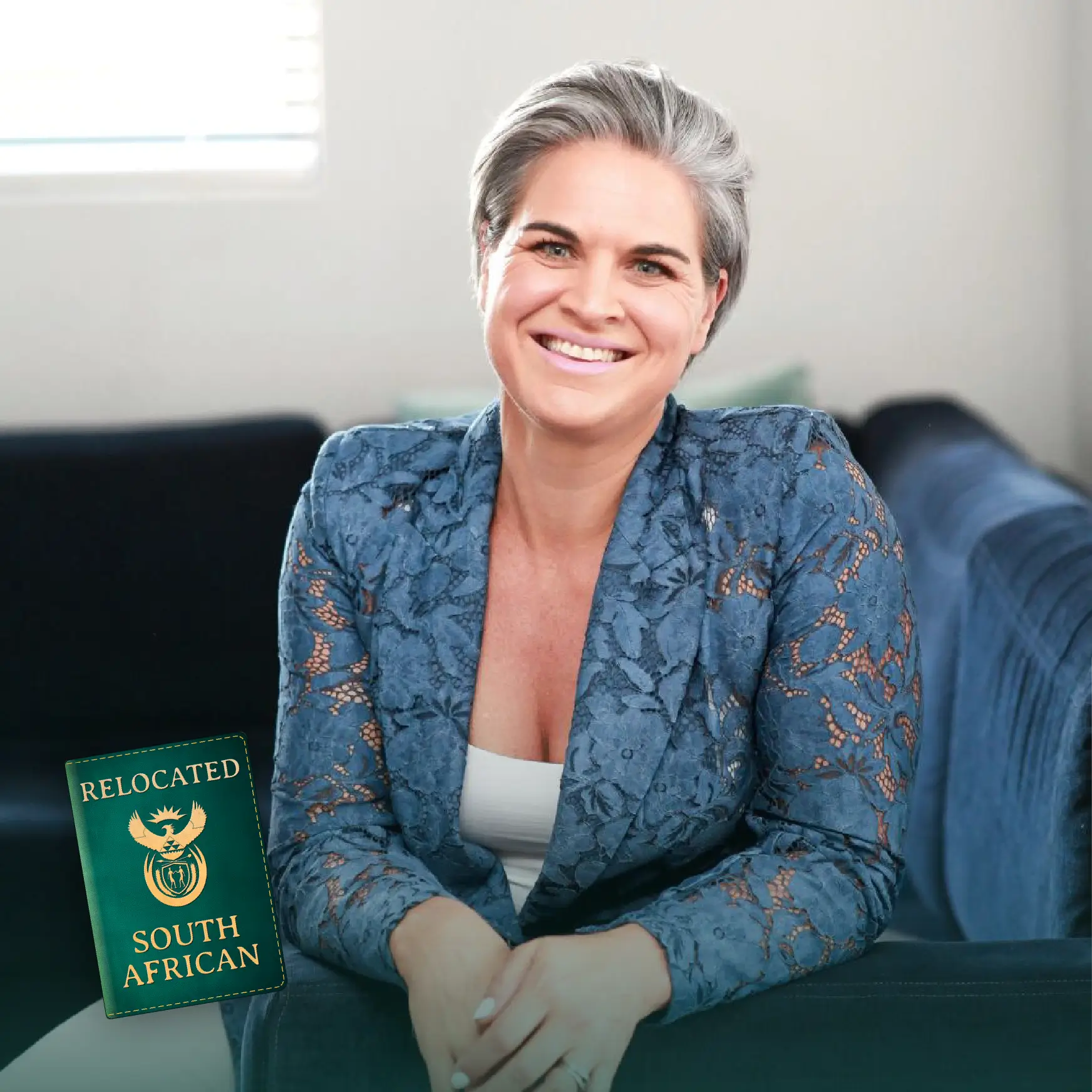
Jan Hugo: Welcome to the Relocated South African, the show for navigating immigration from South Africa. I’m your host, Jan Hugo from Lagos, Portugal. Today we are joined by Lilly Quintal from Amanzimtoti in South Africa. Welcome, Lilly.
Lilly Quintal: Thank you, Jan. Thank you for giving me this opportunity to be able to share my experience with you.
Jan Hugo: Great. So you guys just moved back to Amanzimtoti after a stint in Portugal. How long have you been back in South Africa?
Lilly Quintal: We arrived here on the 16th of December, and I was in Lagos for about 21 months.
Jan Hugo: Okay. And I mean, let’s start at the beginning. Are you born in Great South Africa?
Lilly Quintal: No, I was actually born in Portugal. I was seven years old when my parents immigrated to South Africa. So I’ve lived here 43 years of my life. I speak the language, I’m fluent in Portuguese, read, write, yeah, so the language wasn’t an issue for me at all.
Jan Hugo: Okay, awesome. And your husband, obviously, is also Portuguese. Like you, born in Portugal?
Lilly Quintal: No, no, he was actually born here. His parents are from the island Madeira.
Jan Hugo: Okay, okay. There’s a lot of Madeira people in South Africa. And they went to Mozambique, South Africa and Angola, I guess.
Lilly Quintal: Yes, I did.
Jan Hugo: Well, before we carry on, I have to tell the story about how this interview came about. So my sister-in-law, in Amanzimtoti, told me about a lady and a family who had just returned to South Africa and that she would arrange an interview for me. So long story short, when I saw Lilly’s name, I realized, but I’ve seen that name before. And it turns out that Lilly and her family lived in the village next door to us. And I’d met both her husband and her son, but I never met her. And here we are through a link in Amanzimtoti having this discussion. So it really is a small world. So they were in Luz and we’re in Lagos. So interesting. So when did you decide to leave South Africa, Lilly?
Lilly Quintal: So we left in May 2023. And the reason for us, the immigration to Portugal, and we had actually prayed about it. You know, we had said that eventually we would want to retire in Portugal. And an opportunity came up for Carlos, a work-wise financially. As we had been on this roller coaster ride for about 10 years, and financially for us, it just, things weren’t working out in South Africa. And when Carlos got given this opportunity to go and work for a Dutch company to build eco homes, we thought, well, our prayers have been answered. And we took the opportunity, we sold up everything, and we literally went with our suitcases and our clothes, a couple of boxes with sentimental stuff, and yeah, we left at the end of May, 2023. Yeah, we were there, I think, well, I was four months, it took me about four months to actually find a job. And as with Carlos, the company that he went over, there was just, it was empty promises basically.
So this Dutch company we’re gonna build, I think it was 40 or 50 homes. And nothing actually materialized. They literally took the investors’ money and none of these homes were built. And still today, none of these homes have been built. So towards the end of 2023 in December, there was already red flags for this company. They also promised us they would pay half of our rent and it came to fifth month going and they stopped paying half of our rent. Just financially, it actually put us 20 steps backwards instead of actually going forward. And Carlos actually ended up leaving in February 2024. And that’s when he ended up working with Reece for a couple of months. We were super grateful for. And then from there that came to an end and he ended up working for actually a British company.
Jan Hugo: Okay, one step back to the Dutch company. Was there absolutely no recalls?
Lilly Quintal: No, nothing. Yeah, we actually, we went through to the ACT. And it was actually, there was two families that were actually, it was ourselves and another couple, also ex-South Africans, but they were in Ireland at the time. So between my husband, Collis and this other George, they basically went through to the ACT with regards to this company. And they did put a claim through, but nothing materialized. And I believe that this is apparently quite common in Algarve, where they take people for a ride. They literally take their money and uproot families and that’s what happened with us.
And that was one of the contributing factors as to why I myself had rock bottom depression. My mental health went, it was hard for me. It was really, really hard. Like I said, as we had gone over financial for a better future and at the end of it, it just didn’t turn out that way. And I mean, I’d left my daughter behind and my sister who were very close and yeah it just there was a lot of guilt the fact that I’d left them behind going to Portugal for their future and then unfortunately things just didn’t work out.
Jan Hugo: Wow Lily, that is just unbelievable and the fact that one doesn’t have recourse and you give up everything and that happens. It’s just staggering to hear and I guess from the perspective of helping others, I think it’s very important to say if you think about that, was there anything that you could have done differently in terms of due diligence about this company and knowing what they were about?
Lilly Quintal: Yeah, we Carlos and I’ve actually chatted about that. And if we could go back, we would have definitely done our homework more on the company as we went and Blunt started. And yeah, it literally cost us half a million Rand. this move to Portugal.
Jan Hugo: Wow, that is unbelievable. And the opportunity was in the Algarve. It was here. That’s why you came to Lagos Luz.
Lilly Quintal: The opportunity was there. And we actually always say that even though all my families up north, my parents are there. And we said that if we had an opportunity to settle in Portugal, Algarve would have been our first option. And I mean, we lived in the most beautiful parts. We lived in Praia da Luz. It was beautiful. The safety was there. But all these contributing factors contributed to obviously me being so unhappy there. I mean, I had days where I don’t know who I was anymore. I lost my identity. I just felt like, you know, there was, I didn’t feel like a purpose to even live because of what we went through. It put a huge strain on our marriage. And I can honestly say it was through my faith that actually got me through it. Because if it wasn’t through my faith, I don’t, yeah, it was really, really hard. It was tough.
Jan Hugo: Well, I mean, it’s staggering. And we sit here and we live a few days away and we didn’t know about this. But I listened to an interesting podcast. There’s a very well-known group of South Africans called Oorsee. I don’t know if you’ve come across that, oorsee.com. It was started by a guy in Australia, in Melbourne, South African guy, Stephen Pfeiffer. And he did an interview recently with a lady in America, I think in Virginia. South African lady was a psychologist and she had started a group for people who are expats and specifically for ladies who are battling through some serious mental health issues that go with immigration. And I think it was fascinating listening to her about how many people are battling and are looking for, you know, just help just people that you can talk to because that’s one of the things that I found in a number of the interviews that I’ve done is that one of the things that people miss most is support. You know, young families find that they without their parents, they have young kids, something happens. It’s not just a call to Oma and she’s there because you’re on your own. And that was my other question in terms of community. There’s quite a big South African, but also big expat community in Luz that you find help there or.
Lilly Quintal: I did make some good friendships, which I’ll treasure forever. And I do still keep in contact with them. For example, Vim and Enrica, they were honestly, they were an absolute blessing to my family. They were very good to us. They were very good to Calvin, my son. And we actually met a friend of, well, I call her a friend now, but at the time we actually met at the finances. I think the first week we were there. Her name is Paula. And because she heard us talking in English and she came up to us, she says, you guys from South Africa, are you from South Africa? And we said, yes. And that’s how that friendship came about, was when we went through to the finances on the first week that we were there, and she was at my Earth Angel there. And even till today, we messaged each other every day, morning and at night. That’s the friendship that, and I must say, she was at my Earth Angel there. She was incredible. She really, really was.
Jan Hugo: That’s fantastic to know just for people who are not familiar, Vim is the owner of a very well-known South African restaurant in Pryda Louche, also, obviously, with the name Vim, South African guy, but good people. So, you know, it’s just staggering because I think even though people form these communities, there’s still so much loneliness out there because I don’t know if you found that, but what I’m seeing is there’s a lot of people that congregate here in in groups of English and Swedish and South African and so on. And a lot of people who come here have their own stories, but nobody’s familiar with their stories. So it becomes quite difficult to really relate because you don’t know what’s behind their background and so on. So I’m finding it a fascinating thing, but I really am hearing that there’s a big need to find support just in general expert support.
Lilly Quintal: Definitely that is something like I said because of my family being all up north like six hours away from me It was hard. It was really really hard and obviously when Calvin landed up working for women’s Enrica We found a lot of comfort in them as well and then this friend of mine Paula that’s just bar coincidence that we landed up on the same day at the finances and since then we’ve become extremely very close friends and yeah I mean she’s there I’m here and we still message each other every day she’s yeah like I said she was like my earth angel that’s fantastic so you say when you say your family’s up north up north in Portugal or in South Africa no up north in Portugal okay they lived near Sarra Dishsela it’s near Queenborough Queenborough is a very popular town university town yeah they’re about 30 minutes away from Queenborough my parents and then the rest of my dad’s family.
Jan Hugo: Okay, okay. And in terms of when you left, a lot of people complain about the red tape when you have to do D7 visas and different visas and deal with AIMA and all the difficulty that you have in dealing with red tape. Obviously that wasn’t an issue for you because you both have Portuguese passport.
Lilly Quintal: That’s correct, Jawee. We’ve got citizenship and so do both my children.
Jan Hugo: Okay. So it’s always an option to come back if you want one day.
Lilly Quintal: Yes. Yeah. You know what, Jan? For me right now, I just felt that my heart wasn’t there. My heart was here also because I had my daughter here and my sister. So that for me, this immigration was very, very difficult, leaving them behind because we’ve always been a very close family. So in 10 years time, I could feel different. If we want to go over, we can go over. We’ve got the citizenship, but right now my heart just wasn’t there.
Jan Hugo: I think one’s got to listen to your heart. Life is so damn short. You’ve got to listen to your heart. It’s an ongoing debate. When I look at our situation, we’re different because our children live overseas. So I have kids in Dublin and in the U.S. and my wife’s daughter is an island man. So I’ve got one son still in South Africa. But we ended up moving to get closer to them. And I think we had a a level of hartseer in South Africa as I call it. But we had the opportunity to leave and we are very happy. We’ve made very good friends and the lifestyle suits us. But I’ve always been of the opinion that if you go, you’ve got to go with the idea of not going back. I understand if you’re saying you went, but you didn’t have your heart in it. And I mean, that’s a big thing. And I think that’s an important message to people who are considering immigration. got to really go through all the pros and cons.
Lilly Quintal: Absolutely.
Jan Hugo: And just in general, the 21 months that you were living here, did you enjoy living in Portugal?
Lilly Quintal: There was a small percentage of me that I did. But I would say a lot of the times I always kept thinking of back home always. And I think it’s also because I had my daughter here and my sister. So for me, I think if they had gone with us, maybe things would have worked out differently, even though we had all the contributing factors as to why also things didn’t work out. And all I wanted to do is just come back home, come back home to what I was familiar with, come back home to the support that I had here. After living here for 43 years, this is all that I’ve known. Even though I speak the language, I read and I write, I still struggle to almost fit in if it makes sense.
Jan Hugo: That’s very, very interesting. I’d like to explore that a little bit because, you know, my wife is doing Portuguese lessons twice a week. I’ve given up on it because I speak French and that’s difficult enough. But a lot of people around us do lessons and they get private tutors and they really try hard. But the Portuguese people in the Algarve, they don’t speak Portuguese to us, you know? They immediately revert back to English, and yet you’re saying you battled to fit in?
Lilly Quintal: I did, and I’m a pure breed. I was born there. I mean, my parents were very strict with upbringing. We only spoke Portuguese at home because my parents didn’t want us to lose the language. And I’m very grateful for that because, you know, I wish I had kind of followed that through with my children. And that was one of my biggest regrets that I didn’t, I didn’t do that with Calvin and Michaela. Although Calvin being there for the 21 months, he picked up a lot of the Portuguese language, even though it was 80% English in his working environment, but he did his Portuguese actually started getting better every day.
Jan Hugo: Okay, we met him obviously. He’s a lovely boy. And your daughter, how old is she?
Lilly Quintal: She is 24, and she got married in January, and we’re actually going to be grandparents.
Jan Hugo: Oh, congratulations. Thank you. That’s awesome. Okay, and are they in Kloof or in Durban or?
Lilly Quintal: Yes, well, they up in Kloof, and she’s just finished, she’s qualified as a chartered accountant. She’s busy finishing off her articles.
Jan Hugo: She just passed her last board exam. Oh, also. Well, that’s fantastic. And does she, she has no plans to leave?
Lilly Quintal: At the time when we were in Portugal, she did speak about obviously wanting to come over, well, you know, because we were there. But I think now that we’re back, there’s no plans. I think they’re quite happy to stay here.
Jan Hugo: And yeah, there’s a lot of obviously South African CAs that go to Amsterdam and Dublin and London and all over the world, they’re in high demand. So it’s something that she can do. And with a passport, it’s even easier. So they’ve got options, I think, which is great. Just on the stay here and from the perspective again of advising, telling other people, I mean, it’s such an important thing to be mentally okay. Because you said 21 months were actually quite bad for you.
Lilly Quintal: Yeah, they were.
Jan Hugo: Because your mind was not in it.
Lilly Quintal: No, it just wasn’t there. And if I can say to you, Jan, there was days, there was weeks that I actually don’t remember. I don’t remember. There was such a blur. I had rock bottom depression. And I’m not embarrassed to say it. I mean, there were times that Carlos didn’t know what to do with me. My son saw me at my complete worst. I mean, Carlos would find my sister in South Africa and say, I actually don’t know what else to do with your sister. And I’m not embarrassed to say that I did. I did. I hit rock bottom depression.
Jan Hugo: I have great sympathy because I think it is very, very difficult and I appreciate that you are so open about it because I think a lot of people think it’s just moonshine and roses and you hop on a plane, you get there and it’s like going on a vacation, it’s not a vacation. Life is hard life is difficult and I can relate in a sense because when we are living in France Maybe Carlos told you my wife had a terrible bike accident broke her back.
Lilly Quintal: Yeah, he did mention it. Yeah, I’m sorry to you. Is she okay from it?
Jan Hugo: No, she’s fit as a fiddle. She broke her pelvis again in 23 years in Portugal. So she had two big bike accidents and she’s recovered and she’s playing golf and she’s doing all kinds of things. But I can relate to the difficulty of not having support of being housebound and it’s just tough. I can totally relate and we were fortunate that we managed to get through it and people told us about Portugal and we came and looked and we loved what we saw. So yeah, it’s very, very tough and you talked about making friends and having somebody like that. I mean, I just think there must be an opportunity for people to help others. I think that’s part of what I want to do with this podcast is to say that there is help. What would you say to people that are in that position now, when you were finding difficulty, and yes, you were able to go back, but for people who can’t go back, what would you say to them?
Lilly Quintal: My advice to them is to try and find a support group, a support system, even if it’s just a close friend that they can pick up the phone and chat and just vent. You know, a lot of it are just also, for me, I kept a lot in. Not that I was embarrassed to actually say that I wasn’t in a good headspace, but if I can give any advice is if they can find a good support system, a good friend, that definitely does help.
Jan Hugo: Yeah, absolutely. I think that makes a lot of sense. And you said about when you made this decision to leave, when you left how many months ago to Portugal, and obviously there was this opportunity and so on, and you got on that plane, did you always have this thought that it might not last or you might come back?
Lilly Quintal: No, never. Because we went over financially for a better future for us. because it didn’t go according to plan. And if financially, if that company hadn’t obviously done what they’ve done, maybe I wouldn’t be back here. You know, that financial pressure and the strain that we went through, it did it contributed to us returning back to South Africa.
Jan Hugo: That’s not a cheap place even in Rands. Portugal is cheap in European standards, but it’s not cheap in Rands, that’s for sure. So yeah, that’s obviously a massive issue. But with all the construction going on, was there not an opportunity around here for Carlos?
Lilly Quintal: There was. Well, that’s why when Carlos then left Co-construct, at the end of February. And then it was actually through them once again. That’s why I say he was such a blessing to our family. He was the one that introduced Carlos to Reece. And Reece kept us afloat for a couple of months. And when that work obviously came to an end and then Carlos came across another job opportunity with HCS, which is a British company. and and then he worked for them for a couple of months. I came back home to South Africa and he decided Collis said he’ll still go back to Portugal to obviously try and recuperate some money. Like he said, he wanted to be reunited with his family. And he said financially, he would only come back to South Africa if there was a job opportunity, which he’s the friend of ours who owns his own company, then put that position up for Carlos to say that he’s got a position in his company. And two weeks ago, Carlos actually said to him, he’ll take up the job offer. And yeah, so he’s back on South Africa with us.
Jan Hugo: Okay, fantastic. And with the work opportunity because obviously going back without work would have been quite difficult.
Lilly Quintal: Yeah. No, we say that we were willing to sacrifice until we actually found work back in South Africa.
Jan Hugo: And did you sell your house in South Africa?
Lilly Quintal: We did. Yeah, we did sell. And there was the money that we took over that 500,000. That’s literally that’s what it’s That’s what that trip cost us financially. But you know what? I can’t keep hopping on that because it just makes it did make me sick. And we just got to keep moving forward and knowing that God has a plan. And we’re just very, very blessed to have been able to be back together again as a family back in South Africa.
Jan Hugo: You said that you worked here, Lily. You’re a teacher?
Lilly Quintal: I did, yes. I was also a teacher assistant for a little boy who’s dyslexic and autism. I worked at a private school but my contract was between the parents and not the actual school itself.
Jan Hugo: OK, but at least you were busy. But it must have been just a terrific time. I can honestly just say I wish you well back in South Africa. And I really do hope that things work out. And maybe we’ll see you back in Portugal again one day. I really, really appreciate you sharing your experiences. Maybe it’s the last thought. If you had to advise a best friend now to say, OK, we’re thinking of leaving, what would you say to them?
Lilly Quintal: Thinking of leaving from Portugal to come back here?
Jan Hugo: No, leaving South Africa, given what you’ve been through. Or is that an unfair question?
Lilly Quintal: Yeah, no, it’s not. I would basically, from my experience, I would say that for them to do their homework properly, and maybe go on holiday first, have a good look, see if it’s for them, and then take it from there.
Jan Hugo: And maybe try and talk to other people?
Lilly Quintal: Yes, definitely. We just went and started. Like I said, we didn’t know anybody there, so we literally just.
Jan Hugo: Yeah, I think that’s I mean, it’s amazing we’ve spoken about Facebook. But if you think about there’s a group South Africans helping South Africans in Portugal, I think it’s got about 25,000 members now. And there’s a vast amount of traffic and questions and that kind of thing. So maybe people should join groups like that before they and ask the questions because there’s always people who will answer it.
Lilly Quintal: So definitely.
Jan Hugo: So I really, I can only say thank you so much. Thanks for sharing experiences. I think, you know, our podcast is about relocated South African relocating for a better future. You’ve had a different experience. And I think it’s fantastic that we are able to to share those experiences with with the listeners.
Lilly Quintal: Thank you so much, Lily. Thank you for giving me the opportunity to share my experience with you.
Jan Hugo: Thanks for listening and if you enjoyed our show, why not subscribe to the show and join us for some more interesting discussions with people who have left South Africa for a better future abroad.