Jan Hugo: Welcome to The Relocated South African, the podcast that explores the journeys of South Africans building lives and careers around the world. I’m your host, Jan Hugo, speaking to you from Lagos in Portugal.
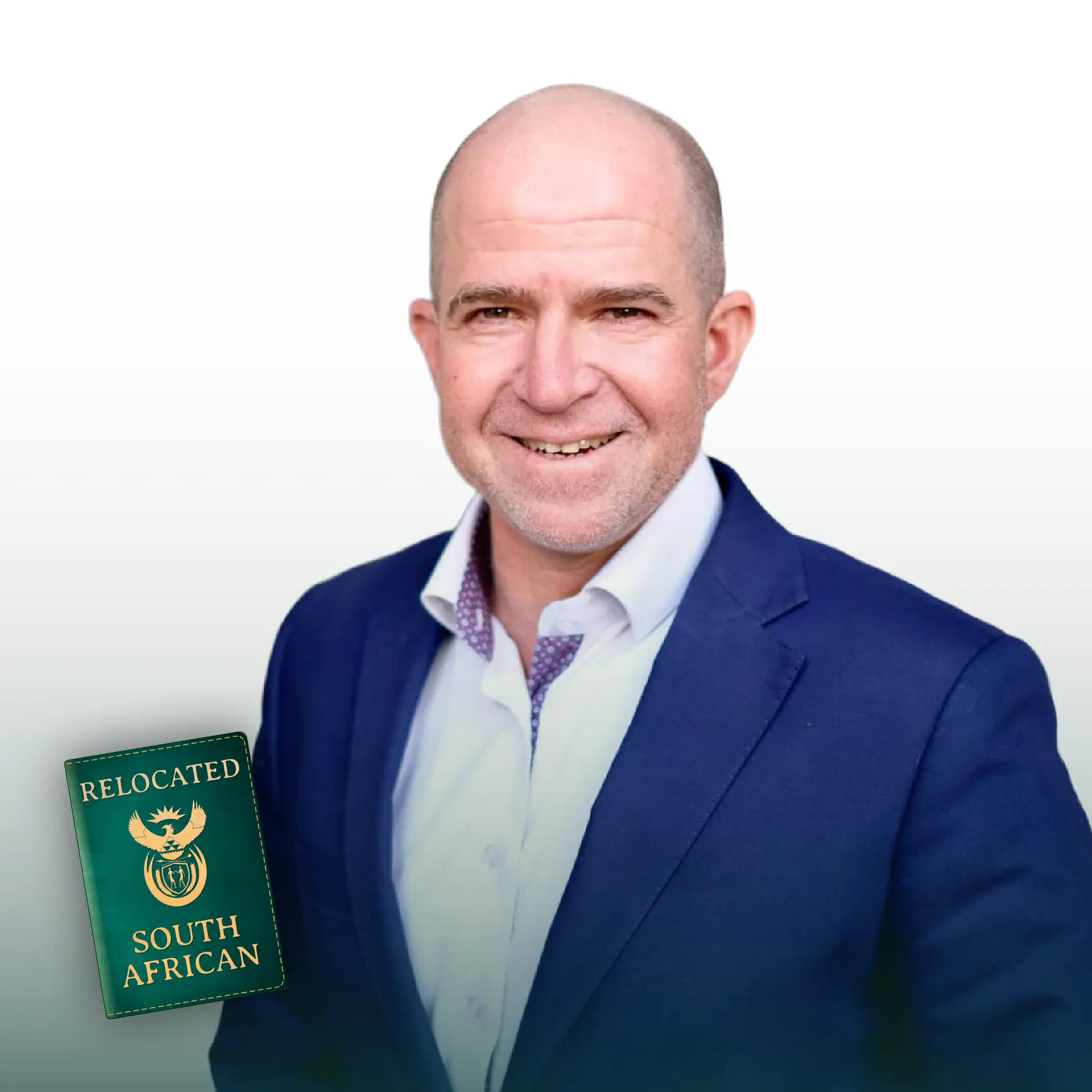
Today I’m joined by Dale Anderson, an entrepreneur and advisor who has experienced both sides of the immigration journey, and may I say a fellow member of the Lekker Network. Welcome, Dale.
Dale Anderson: Thanks, Jan. I appreciate it and great to connect. It’s really good to be part of the Lekker Network. It’s really opened a lot of doors to some interesting people, because we’re all scattered all over the show, us South Africans. So yeah, it’s been a great community and a great way to connect with like-minded entrepreneurs.
Jan Hugo: Yeah, absolutely. Excellent, so good to hear that. So Dale, where did you grow up, study and start your career?
Dale Anderson: So I grew up in Johannesburg, actually grew up in a town called Alberton, so you’d know it quite well, in Johannesburg. I grew up there, but then also when I was around 10, 11, my parents went through a divorce and moved to a farm in Walkerville. So pretty much grew up on a farm, had a forest and a lot of outdoor space. But when I reached the age of around 18, 19, prospects weren’t that great. Parents had hit some financial trouble. So I had British ancestry through my father’s side and fortunately had my British passport. So I was actually in a band at the time and studying sound engineering. You know, when you’re young, you’ve got these dreams and ambitions. So I was playing in some bands. We decided to relocate actually with the band to the UK back then in the early 2000s. So I spent a good 16, 17 years across the pond in London. Got there with just having graduated from college, business studies, no university degree or anything, and then just landed in London with a suitcase, probably 50 to 100 quid in my pocket in about 2002 or so, and started my journey from there, working any jobs, working factories, working call centres. And then I found my passion when I was around 24, 25, which was property and real estate investments.
There’s a broader story there. On the way up I had to do the hard graft when I got to the UK. It wasn’t easy. You have to learn about the rules and regulations, their way of life. But there was thankfully a very good community of South Africans in the south-west of London, specifically the Wimbledon side, and that’s where I spent a lot of my younger days, partying down at the bars and stuff there.
Jan Hugo: It’s absolutely fascinating. I spoke to another lady who’s also in the Lekker Network. I spoke to a guy, she’s also back in Cape Town, and a guy, South African, actually living in Ukraine. And all of you did the same thing. I think it was around that time in the early 2000s when you got that sort of two-year visa for South Africans to go and live and work in the UK.
Dale Anderson: Yes.
Jan Hugo: There must have been quite a big community then of people like that, as you were saying.
Dale Anderson: Yeah, there was. Even though we had a short summer, we’d all get together on the weekends and have braais, and I played in some cool bands as well. So I’d be doing the real estate stuff but then doing gigs around London in the evening, and it was a lot of fun. But then I had children and had the urge to come home. A lot of people don’t make it to like 16, 17, almost 20 years in the UK, because it can also be tough. The expense of living, you’ve got to live in houses to start. You know, we don’t have the benefit of having someone to come and clean the house every few days. Everything there has pros and cons, but certainly from a career perspective, I’ve met a lot of people from all around the globe and it enabled me to travel and get into the career and the business that I’m in today.
Jan Hugo: Okay, we’ll get to that. Just, what instrument did you play in the band?
Dale Anderson: Bass guitar by default. I think everyone preferred to be the guitarist or drummer. It was a band called Starseed. So we used to play lots of gigs at the Clapham Grand and I played in another sort of punk rock band as well, called Delayed, and it was more like my younger days. Obviously now I’m 41 years old, but yeah, I grew up in that era. It was the skateboarders and that kind of thing. One would say I’m one of those people that is analytical and looks at data and stuff, but on the other side I love music and creativity. That’s my sort of part-time thing, alongside the actual career, which is property investment.
Jan Hugo: Yeah, and do you still play in the band or in South Africa now?
Dale Anderson: Guitars are all over my walls now, like art. I’ve got about eight, nine guitars in the office for memories, but I’ve got twin daughters, who were born eight years ago, and I kind of decided I wasn’t going to be spending too much time between work and then in the evenings playing music. So yeah, kind of gave it a break, but I still make music, just part-time for now. Maybe there might be some sort of a comeback at some point if I can find the time. Running a couple of businesses and having twin daughters keeps you quite busy. One needs to prioritise.
Jan Hugo: I can totally understand that. And when you think back to those early days when you went to the UK, I mean, was it just an adventure or did you always think you were going to come back to South Africa?
Dale Anderson: I knew I was going to go there to establish myself and look for opportunities. At the time, I think generally a lot of us had a frustration around South Africa and the lack of opportunities, especially someone like me who grew up on a farm. I was working at a Mr. Video, remember the old Mr. Video and Blockbuster? The younger generation might not remember those days. But literally that’s what I was doing, you know, earning like R2,000 a month. Back then it was enough to pay for whatever I needed to do and go visit my girlfriend, or, say, girlfriend, my wife’s just laughing downstairs. It’s my one girlfriend, who is now my wife for, how many years? Around 26 years? So I’ll have to get that right or wrong.
But I think the crux of it is you’ve got to start somewhere. You can’t go there and just expect, oh, all of a sudden I’m going to move to the UK and the grass is green on the other side. You really have to work from the bottom up. The benefit there is you can do manual jobs. I know guys that have even been what we call garbage collectors or whatever, but there there’s minimum wage. So even if you’re bartending or something, you’re earning a minimum British wage, which in rands at the time was still quite substantial. But actually living in the UK, you really got to work hard to get to that point where you’re actually living a more comfortable life and actually able to invest in things like property, which I was quite fortunate to get to. It took time, but I got to that small percentage.
Jan Hugo: It’s funny, this one guy, the guy in Ukraine, he actually went into a hospital and was sort of, call it a lab rat, they tested medications on him.
Dale Anderson: I’ve got a friend who did that. Literally went and let them do experiments and they took trial new medicines and stuff. I’m like, you sure that’s a good idea? But South Africans, we’re quite strong-willed and we literally get there and just, some would last. It’s funny because some people would last, people maybe living a lot more comfortably in South Africa, their parents have a nice house.
They’ll be there for six months and leave. I saw it’s like a revolving door. But then I had a group of friends who really stuck it out and we escalated our careers and ended up in director positions and things. But you have to go through that tough part, right, and get through that.
Jan Hugo: Yeah, that was kind of my next question. I mean, in those early days, firstly, you say your wife, you’ve been together a long time. Did she go to the UK with you?
Dale Anderson: She went to the UK with me. Yeah, we moved there when I was about 20. Yeah, we’ve been together that long, around there. She was a really great support for me at the time, because I think a lot of people go, maybe it’s lonely, but we met very young and we worked together. Sometimes I was having a bit of a hard time with work and stuff, and then she got a job working at Kia. So that really helped. And then I remember one day I was working for Informa Group, which is just literally data entry. Never realised how important data is until today, but it was literally a data entry job, and she obviously had a job as well. So it kind of helped because we had dual income coming in, which helps you get by. So she’s always been there since we were living in a small house in a really not great studio where you had to put money in a box to make the shower work, you know what I mean? And it was like one of these really old, they call them houses of multiple occupancy, but they just ram in a lot of young people or students. And I just remember Christmas, we had this tiny little Christmas tree. I had just lost my job at this event management, smaller company, they were trying to run it from the garage, this couple.
I was just sitting there and praying and thinking, you know, I need to find something to make a change. The next day I walked down Wimbledon High Street, I saw some real estate guys in ties and there they were, funny pink socks and pink ties. I don’t get it. So I’m like, hang on, I think I can do this. So I just walked into the manager’s office and I said, have you got any work? And he said, have you worked in property before? I said, no. I said I’ve done some call centre jobs. I worked for a company for a period selling inspection visits to Spain, because of course the British problem is the weather, they love Spain. So I spent a few months practising, let’s call it, on the phones. So I walked into the estate agency, just said I’m looking for a job, you know, I’m good at sales. They hired me the next day.
But real estate’s really tough because you really got to, you work until eight in the evening, you’re getting parking tickets because now you do the viewings, right? And in England, you’ve got to pay everywhere you park. So it takes time to view a house, and these are like half-a-million-pound houses, ridiculous prices in Wimbledon. But I got very good at that. Estate agency was very cutthroat and it just wasn’t really for me. So then I decided to kind of pivot and go into the offshore markets and actually helping South Africans who wanted to move money offshore. But those first eight, nine, ten years really forged you, I guess, and you learn a lot of lessons. What’s great is the British, I think they do see us as hardworking. And each role or career I’ve been in, I’ve managed to kind of work my way up quite quickly to team leader or management positions. They joke around with the British and the rugby and the football and this and that and we like to wind each other up, but generally I think the British, South Africans and Australians, we had quite a community there. Made some very good friends.
Jan Hugo: Absolutely, I think that’s amazing. And you talk about those stories of the early living and so on, but those things are character building. So I think they stay with you and they’re great stories. Was there ever a time when you and your wife wanted to turn back and say, this is not working for us, especially in the early days, or did you decide you were going to stick this through?
Dale Anderson: Yes. So there were times that got really tough where, of course we got married, you know, wives especially emotionally, they miss their families, and the time apart is the challenging part, really being away from your family that long. And yeah, you get to see them every couple of years when you can start affording a holiday and it’s great coming over. But then you come back and you also see the problems and you’re like, it’s kind of a wake-up call, you know, how can we help.
So yeah, there was an interesting time where we were sort of at a crossroads and my wife had literally actually packed and left, and I was due to follow her, and then things started going really well at work. My team started growing, I was running a property investment floor, got promoted to project manager, and I had to phone in and say, listen, I don’t think I can head back. I looked for opportunities in South Africa but I couldn’t match the opportunity that I currently had. So eventually my mom stepped in and had a sensible conversation with us both and said, listen, you need to listen to your husband and trust him. So she came back, and another few years later it really took off. We were able to buy some property, get on the property ladder, that went up in value, we were able to release equity and then buy a nicer house. And at that point, of course, the wife became more comfortable, you know, and would visit the parents or fly them over when we need to.
But just before COVID, we sort of, I was sitting on the train one day and thinking, I’m just doing the same thing every day, crammed on the train, everything’s going up in price. And work was almost going too well to the point where, you know, they were keeping me, my children, my twin daughters were born, we struggled to have kids for a long time. So when they were born, I had this moment of, I’m barely ever at home, I’m constantly working. And I resigned from my six-figure job, which is a very bold decision because I was earning good money. But it just happens that company then ran into trouble a few months later.
Jan Hugo: Hmm.
Dale Anderson: I worked for them for like 12, 13 years. So it was a tough decision, but as we landed, my parents sold the farm in Johannesburg, they moved to the Western Cape. So I did a bit of research and I just said, I prayed about it. I’m Christian, and God just kind of said, you know, it’s time to go back home. And I moved back, set up a home office, and I was like, what’s Zoom? What’s this? I’m setting up my new company, hiring all the staff from my computer. And they’re like, where are you? Can we meet for a coffee? Like, no, I’m in Langebaan in the Western Cape. So everyone still, to this day, people still think I’m in the UK. Of course, I visit there, my company’s registered there. Can we meet for a coffee? We can over Zoom, if you’re in Cape Town. But we moved back and then there was the lockdown and things changed and it almost worked. It was tough, but it worked to my advantage because I’d already been working remotely for a couple of months.
And then the whole world shut down and everything kind of changed.
Jan Hugo: So you moved back to South Africa before COVID.
Dale Anderson: Literally about two or three months before the COVID lockdown, to the Western Cape, where I’d never been in my life before. I’d been to Durban, been everywhere. And I just did some research. My mom told me about this place in the Western Cape. And then we sold our house and packed up and we moved back. And then I said to my wife, I’m going to just set up the same thing I’m doing, which is offshore property investments, but I’m going to set up from Cape Town or South Africa. That was the plan. So that’s what we did.
Jan Hugo: That’s a fascinating journey. And it sounds like you’ve backed yourself, but as you say, you made that decision in faith. So, well done. We’ll get to the business side shortly. But when you think about what you’ve built, do you think that would have been possible in South Africa, or did you need to go to the UK to get to where you are today?
Dale Anderson: Prior to COVID, I needed a team there and that team was quite expensive and operations became very expensive. Then COVID hit the market and everything slowed down. So we had to slowly reduce those high operating expenses in the UK. And what I quickly realised, I wish I’d realised it sooner, is a lot of the operational stuff can actually be outsourced. We have a good time zone in Cape Town. I realised a lot of my staff were working remote from home after COVID anyway. They’ve got kids, they’ve got families and babies and stuff like that. But then I had business partners who very fundamentally believed that you must be in the office. So they had an office there, which is fine. But I’d say it’s probably one of the hardest decisions I’ve made because it’s not been easy building from this side and not being able to just meet someone for a coffee in London.
But it’s also been one of the best decisions because I’m now able to build my operation and actually employ locally. So I’m really looking forward to this new chapter with the new company because I don’t have a big operation in London anymore and the expense of a London office. I can run it from South Africa and we have some great talent which I can onboard here as well and give them the opportunity.
But yeah, I’ve got my guys I trust on the ground in the UK if I need. The developers, my contacts, my partners I’ve built over the years. And then this just opens other doors. I’ve made a great network here. I’m closely partnered with Sable International and another group of networks and companies during my last five years. So it’s been good to get a foothold on the ground here, because when I got here, it was almost like when I landed in London 20 years ago. I didn’t know the landscape of Cape Town or the Western Cape. Joburg I knew off the back of my hand, but it was all very new. But it’s the best decision I’ve made, and my wife’s happy, the family’s happy, children are enjoying it this side as well. You get the outdoors, it’s a different culture. I love the UK, I love the British, I love the traditional countryside and the British pubs, but things were also going a bit the other way there, you know. When you see the youngsters and the disrespect to the elders, for example, it’s not quite the same. So it’s got both places have their pros and cons. And although South Africa has its challenges, we are blessed with a beautiful country. So despite the challenges, it was definitely one of the best decisions I made.
Jan Hugo: Very true. And if you think about South Africans moving to the UK, I mean, we’ve spoken about Sable, they obviously help a lot of people and it seems like it’s happening in both directions these days. But sometimes, what are the biggest misconceptions about living in the UK that you come across when you talk to South Africans?
Dale Anderson: The biggest misconception goes back to, and everyone’s probably heard this, that the grass is greener. It is greener. But of course, one of the things is it’s all kind of relative. So what’s nice about the UK is there’s good government support, right? You’ve got the NHS that everybody complains about. But you know, my dad lives in Scotland, he had a heart attack and he got seen to. Now, if that had been in South Africa, it would have cost us a lot of money and it would have been a problem. So the UK is great people, a great support system. I think one of the bigger misconceptions is that you can just go there and make it overnight. You’re going to have to really start at junior level and you’re going to have to work your way up and be humble about that. You can’t go over there with, us South Africans like to think, you know, come on, let’s go. But you’ve actually, you know, the right thing to do is, it’s their country, it’s Britain, so you’ve got to assimilate. And I think a lot of the problem is people go over there and they don’t really assimilate. You just got to sort of make friends, connect with the right people, get in the right rooms. There are significant opportunities and a lot of people in London you meet that you would not otherwise get to meet. It’s a very global city. So I think the misconception is it’s expensive, and I think we know that now. There’s tax and there’s systems and rules that you need to follow. So it’s not an easy path. It’s challenging, but it can be very rewarding if you stick it out. It’s not going to be a quick fix, put it that way.
Jan Hugo: Absolutely, absolutely. Now that’s so important. You’ve already answered a lot of the questions. But one of the things, with immigration, there’s a thing called red tape that follows you when you move across borders. Did you find, now coming back to South Africa, that having to reestablish yourself from a tax and just a general red tape perspective, getting medical aid and stuff sorted, was that a difficult process?
Dale Anderson: So yeah, I mean, again, I’m very lucky to have a wife who keeps me organised with insurance, banking, and the finance side. So it was quite difficult because of course you’ve got to go waiting in queues to get your South African IDs and everything updated. You then have to make sure that you are covered from a tax perspective. Yes, you can keep your businesses offshore, great, in the UK or Dubai, wherever it is, but at some point you’re going to need to factor in the fact that if you’re bringing income into the country, you need to consider, as much as you may not want to, you need to consider your tax position and make sure that you’re set up correctly. Another thing is looking into schools for children. You need to research areas and locations if you’re planning on moving back.
And then in terms of things like, luckily, your British licence, you can still use it when you move back. Your British passport and things like that. But of course, then there is the longer-term situation. Like my brother Kieran Anderson is also part of the Lekker Network, he sold his technology business really well and moved back. Things to consider are his wife is British, right, and his children have British passports. And he was having to go through that whole bureaucracy of applying online and getting that sorted. I think planning ahead and using companies like Sable International can probably help with that, or people in the Lekker Network with the whole relocation. It’s a big move. A big challenge is you’ve set up your life in a different country and you’ve got a lot of stuff. So then you’ve got to consolidate, think about shipping costs, getting stuff back, thinking about setting up bank accounts, and now you need to think about, okay, do I have a registered address. So my advice is when you get your rent sorted, check out the areas, look at the schools, and if you can afford it, always believe in owning real estate, especially in the Western Cape right now, owning is better than renting if you’re able to. But there’s a lot of stuff that you have to relearn and understand that things in South Africa don’t go as quickly as they do in the UK. So you might have to wait. But do get your passports sorted, get anything else you need, make sure that your visa or whatever doesn’t expire, depending on what passport you’re on. If you’re South African, it’s fine. But it’s about assimilating back into the South African culture that you’ve been away from for so long and just getting used to it again. The first three to six months is probably the hardest and then things start to settle.
Jan Hugo: Hmm. And one thing that comes out in every conversation that we have on the podcast is the security aspect. It’s amazing. For people who are leaving, that is a big issue. How did that factor into your process of coming back?
Dale Anderson: So for me coming back to the country, my number one concern was safety for my children. I’ve got two beautiful twin daughters and I wouldn’t want to put them anywhere where there’s a risk. Hence I decided not to move back to Joburg, and saying that, Joburg has some lovely areas. It’s like everywhere in South Africa, you know, you’ve got Steyn City and then you’ve got Hillbrow and in Cape Town, you know, you’ve got the nice towns around like Durbanville and Blouberg where people live and it’s a lot safer. But if you go across to the other side, then there’s people living in poverty. And that’s the real number one challenge of South Africa. And a lot of entrepreneurs I speak to who are moving back, that’s also partly the reason we did move back, was to try and help the country.
I think when you get a bit older, you’re like, it’s a lovely country, and if you choose a good safe family area and do your research, you can make it work. Partly the reason I don’t live in the city is not fear, but I’ve got daughters and I wouldn’t want them to have to experience crime. So it’s a difficult choice, but I would say the headlines in the media don’t help things. The focus is on the really bad negative stuff. There’s a lot of good stuff happening in this country. There’s a lot of people moving back. I’ve now consulted probably four or five friends who’ve also been in London, in Scotland. Good friends of mine that were in the bands and my best childhood friend that was in Ireland. And they started phoning me four years ago, three years ago, asking me all these questions. How is it? Is it safe? How are the schools? Yeah, it’s great. Near the lagoon, the beach, the crime rates in Langebaan are statistically one of the lowest in the country. I did my research. I’m a data guy. I checked all the data, the crime stats. So there are little pockets of areas that are safe, but of course it just depends where you decide to move. Some of us are fortunate enough, if we’ve done well overseas, we can move back, and a lot of the companies are still hiring us in the UK and the USA. So those kind of people have quite a good setup because they’re earning in foreign currency or dollars. And that’s why I often recommend diversification offshore, because then you can start to earn income in pounds, but live in South Africa, and are you living compared to prices in the UK? It’s expensive, still getting expensive, but it’s like 20 to 40 percent cheaper. So if you can earn pounds and dollars and live here, you can live a nice life, you just got to make sure you’re in the right area and you’ve done your research.
Jan Hugo: Absolutely. I think that’s the one thing that I really like about the Lekker Network. I did an interview with Nic Latouf and it’s just the positivity of that network, which I think is absolutely critical for South Africa’s people. It’s so easy to be negative, and as you say, focus on the negative side. So that’s great about the network. Let’s just get to the business. Just tell the listeners exactly what you do today, in a few short sentences if you can.
Dale Anderson: Okay, so basically I’ve been at a director level in sales and project management in off-plan and offshore property investments. So investors looking for a plan B to diversify. I deal with clients from South Africa, Turkey, the Middle East, and they look for investments in places like Manchester City, where there’s a lot of education, university and regeneration happening. So they see it as a sort of a safe haven. Commutable towns around London as well. So my job is to make sure I partner investors with the right developers or property agents, and then we sort out property investments. Now my new company, IGA Global, which I’ve just launched, is going to take a very disciplined approach focused on good quality branded residences. We do a fully comprehensive due diligence process.
I’m very trusted because a lot of the people looking to get some money offshore, they’re speaking to these sales floors and these big trading floors, these young guys out of university who might not really have the experience. I’ve actually done it. I’ve moved there. I’ve built a property portfolio. I’ve built teams that raised over 1.5 to almost 2 billion pounds in real estate transactions. There are a number of awards that went with that. I won some entrepreneurial awards, Small Business Awards, Best Real Estate Agent of the Year, and 40 Under 40. I’m 41 now and won it at 40, so I was still eligible. So I’ve built a good track record there of moving money offshore, but not only to the UK now, because the UK also has its problems. Some people want to, now we’re in the era of digital nomads. So I get some people who own tech companies, or they work in oil or gas, or doctors or surgeons, and they want property in Mauritius, or they want a property in Bali or even Thailand, because it’s cheaper than Dubai. Of course, Dubai, I was just about to launch and something was always holding me back. And of course, now with everything going on, the Dubai market is kind of, it was very hyped, but people are, it’s highly driven by the expat community. So I do the data research on these offshore markets and then I help source property for investors and take a very disciplined approach to capital allocation. Of course, then I have the Fractional Sales Director role with Sable International where I consult for them as well, and that helps me get access to all their additional services such as immigration and tax structures, setting up offshore companies and so forth.
Jan Hugo: Okay, I was going to say, obviously in Portugal we had the golden visa. I think there’s still golden visa schemes in other countries like Greece and so on. That’s not necessarily part of what you do, it’s more an investment type?
Dale Anderson: Yeah, we look for something that you can rent, get a good rental yield on, and then look at the data in terms of market growth and capital growth. So I’m direct to supplier. I don’t charge a fee like a traditional agent, I get paid by the developers. But the main thing is to match up depending on your retirement planning and build a portfolio for you, so we could start with one property and you could end up with four or five. South Africans don’t know, for example, in the UK you can get a mortgage for like 4% interest, whereas here you’re paying 9%. And what that means, if you’re getting like £1,100 to £1,200 a month because rent’s really high there, that’s just Manchester. London’s like £2,000 a month. Say your mortgage, I had an apartment, two-bedroom, in an area called Stevenage, so the commuter belt around London. Paid £200,000 for it about 10 years ago. When I moved back, I sold it for £320,000. My rent was £1,100 a month and my mortgage was £600 a month. So I had £500 every month in my account, and my tenant was paying my debt and the value of the property was going up. Now that’s an ideal situation. Nobody can look in a crystal ball, but it’s my job to do that due diligence for the investors. They don’t have the time. I’m studying the market 24/7, geopolitics and which offshore markets are the most reliable for investors. But there’s the lifestyle aspect as well. We’ve got branded residences, pools and all the concierge and gym facilities and stuff. So it just depends what the customer wants.
Jan Hugo: And are you getting a sense that there’s offshore interest in South Africa? I would just imagine with Dubai and what’s happened there, remember 2008 when the whole place crashed. But I think it’s going to be a while. The money that was flowing in there is probably going to look for other homes. Do you find that places like northern KwaZulu-Natal, for instance, where they built that new Ernie Els Golf Course, that there’s offshore interest in South Africa as well?
Dale Anderson: I’m finding the interesting thing about South Africa is it’s mostly wealthy Africans and South Africans buying here. But then you’re also now starting to see some people from Netherlands, Germany. And what they like is, because of the way things are during their winter, you know, my neighbour is from Switzerland. So I was like, what are you doing in Langebaan? He says, well, you know, he’s got a wife from South Africa and kids here. And so when it’s cold there, he obviously comes to live here and vice versa. So for a time it works perfectly for him. But Cape Town is booming. There’s been a huge amount of off-plan developments. I’ve seen a lot of movement this side in the market. And then even in Cape Town, you’ve got Steyn City. And so there’s a lot of semi-gration, local demand. The problem you have, if you look at the long-term stability of the country as an investment, there are still concerns, and that’s purely down to corruption, high interest rates and a volatile rand. So yes, it can all seem great now and people are moving back, but interest rates are high. So you know, even if you buy property and your Airbnb is doing great, you’ve still got a bit of a shortfall every month. That’s where the UK is, well, my rent’s covering my bond, right.
Good debt, bad debt, rich debt, we can go through all those books and stuff. But the reality is you’ve got to look at the numbers. And whilst I’ve personally invested in the Western Cape and property values have risen sharply, I think it will probably settle. And the fact is, yes, you can have property in South African investments and maybe they can be doing well, but you need to think about long-term legacy and plan B. Because let’s face it, bringing up children in South Africa and just hoping for the best that they’re going to get a good job and have a good life and career is being a little bit ignorant as a father. You need to think, what if. So yes, South Africa is great and it’s booming and it’s got its own local economy and market. The real estate sector did crash and was volatile a few years back. But yeah, there’s a lot of people moving back. I’d actually like to look at the actual data of that at some point. It’s very interesting.
Jan Hugo: Mm-hmm. Yeah, I was going to ask you, because I had Andy Rissik also on the show in December last year and we were talking about, from a Sable International perspective, they’re seeing a lot of flows back into South Africa. And I think what probably also happens is, as you say, with people who’ve done well overseas, they can now afford more of a nomadic type of lifestyle where you spend six months here and six months there, you know, live in one place and then the other.
Dale Anderson: That’s correct. So I’ve still got to get on a plane and go to the UK and meet my partners, and I might need to fly out to Doha, Qatar or Hong Kong. So we’re more mobile. But since COVID, the perception has changed that we have to be in the UK. So a lot of people are like, Dale’s onto something. And they all start phoning me. I say, speak to Sable International, they can be really helpful. I like to stick in my lane and be the offshore guy. There’s really enough estate agents in South Africa. I’ll stick to my niche. But you need to diversify. It’s nice to have a place here.
Jan Hugo: Yeah. And Andy’s got a place up in Cascais, so he lives in Portugal part of the year as well. So we know all about it.
Dale Anderson: He’s done the same thing, he realised he can now spend some time in Portugal and then come to Cape Town. And they’ve got offices in London.
Jan Hugo: Absolutely.
Dale Anderson: So yeah, so IGA Global is the new company we’ll be launching in the next few days. And so I was purely focusing before on the UK, but we will now have Thailand, Mauritius, Bali. We were going to launch Dubai. I probably still will, because there are going to be some big discounts and I’ve got investors from the Middle East still buying there, but cautiously, with a wait-and-see approach right now.
One thing as well, you know, it’s 88% of the population that are expats in Dubai. So if a lot of expats leave at once during a recession, you’ve got a problem. But the way I see it is there’s a market correction and hey, you can buy at a big discount and things will get back to normal, you know what I mean?
Jan Hugo: Hmm. Absolutely. And getting towards the end, if you think back to how your career and things have worked out, would you have done something differently if you’d known what you know now?
Dale Anderson: The one thing I would have done when I was younger is focus more on myself, my health, setting up my own businesses, because I made some people millionaires and left the table with some good money, but not great money, and less partying, less drinking. I’m sober now. And a lot of that might seem fun when you’re young, but later on it can affect you, and you can realise, listen, I’ve got some catching up to do. So I’d say, from a young age, knowledge is key. The book that changed my life was called Think and Grow Rich by Napoleon Hill. And I didn’t have much or anything when I moved to the UK, but it’s that positive thinking, you can really shape who you want to become. You need to think about the person you want to become and focus on those daily habits.
One of my biggest regrets was being caught up in that London culture of the drinking and having to go with the developers after work to party. So my number one advice is: focus on your faith, your business, your health, and becoming a man. There’s a lot of this masculinity stuff going around and a lot of it’s nonsense. I’d say it’s more about behaving. You can have fun when you’re young and it’s good, but don’t get carried away, because next thing you will realise you’re drinking every day to take your stress away. And that’s a bad situation for you and your business and your focus. You can’t be 100% focused and do the best you can at your job if you’re not clear in mind and healthy. So that would be mine. And some of my regrets, because I was a rock star, wasn’t I? I was touring around in the evening. But eventually you burn the candle at both ends and then you have what’s called burnout. And that’s never a good thing. So balance is also key, spend time outdoors, don’t sit on your phone scrolling all day. And if you are, take in the right content. Those are my thoughts.
Jan Hugo: Mm-hmm. Excellent, very good advice. And just maybe a last question: for a youngster now, a guy who’s just out of school or just finished university and he comes to you for advice, would you recommend that they go and explore offshore?
Dale Anderson: 100%. I don’t think I would be where I am today without it. In fact, I don’t know where I would be. But I think mindset’s everything. If you’ve got the right mindset, you can even be successful in South Africa. It’s about getting in the right room with the right people, networking, and just outworking the others. When I was young and didn’t have kids, I’d go into the office on a Saturday while the guys were out watching their football and drinking, and I’d make a hundred phone calls. And one day someone answered the phone and, you know, he was working for high-net-worth families. I wouldn’t have got that phone call that day if I hadn’t gone in. So you do need to put in the extra hard work when you’re young, and don’t be shy to get yourself out there and get on the phone. It depends what you do. Maybe some people want to be coders and they’re not good at sales. Find what you want to focus on, be good at it.
Definitely learn about AI, because that’s right now. You’ll see on my LinkedIn, I post quite a lot about it, not just property, because AI is about to disrupt everything, just like Google disrupted everything and the internet disrupted everything. So it’s not an overnight hype thing. If you can learn to use the tools and become the driver of those tools, you can work from anywhere in the world.
However, on a final recommendation, I would highly recommend travelling or going to work offshore, whether that’s London or Hong Kong. It will give you that experience and access to the right rooms to expand your knowledge, and probably much better than any university degree would have given me.
Jan Hugo: Absolutely. And you can always come back. I think that’s the important thing.
Dale Anderson: I’m not saying don’t go to university depending on what you want to do, but for me, travelling was my biggest teacher. Travelling to all those different countries and cultures, and it was fun. So yeah, if you can, do it.
Jan Hugo: Absolutely. Now that’s excellent. Dale, thank you so much. Thank you for sharing your journey. It sounds like you’ve had an amazing journey and I can only wish you well in South Africa and with your new business that’s coming up. I think you’re an example and it’s amazing to hear that somebody is happy to openly speak about his faith. For me, that’s something that we miss these days. So well done and thank you so much for sharing. I really appreciate you coming on the show.
Dale Anderson: Thanks a lot. God bless. Take care. Cheers.
Jan Hugo: Thank you for listening and I’ll see you next time.
You can find more episodes of The Relocated South African on your favourite podcast platform or visit our website at therelocatedsouthafrican.com.
This transcript was generated with the assistance of AI and checked for accuracy.