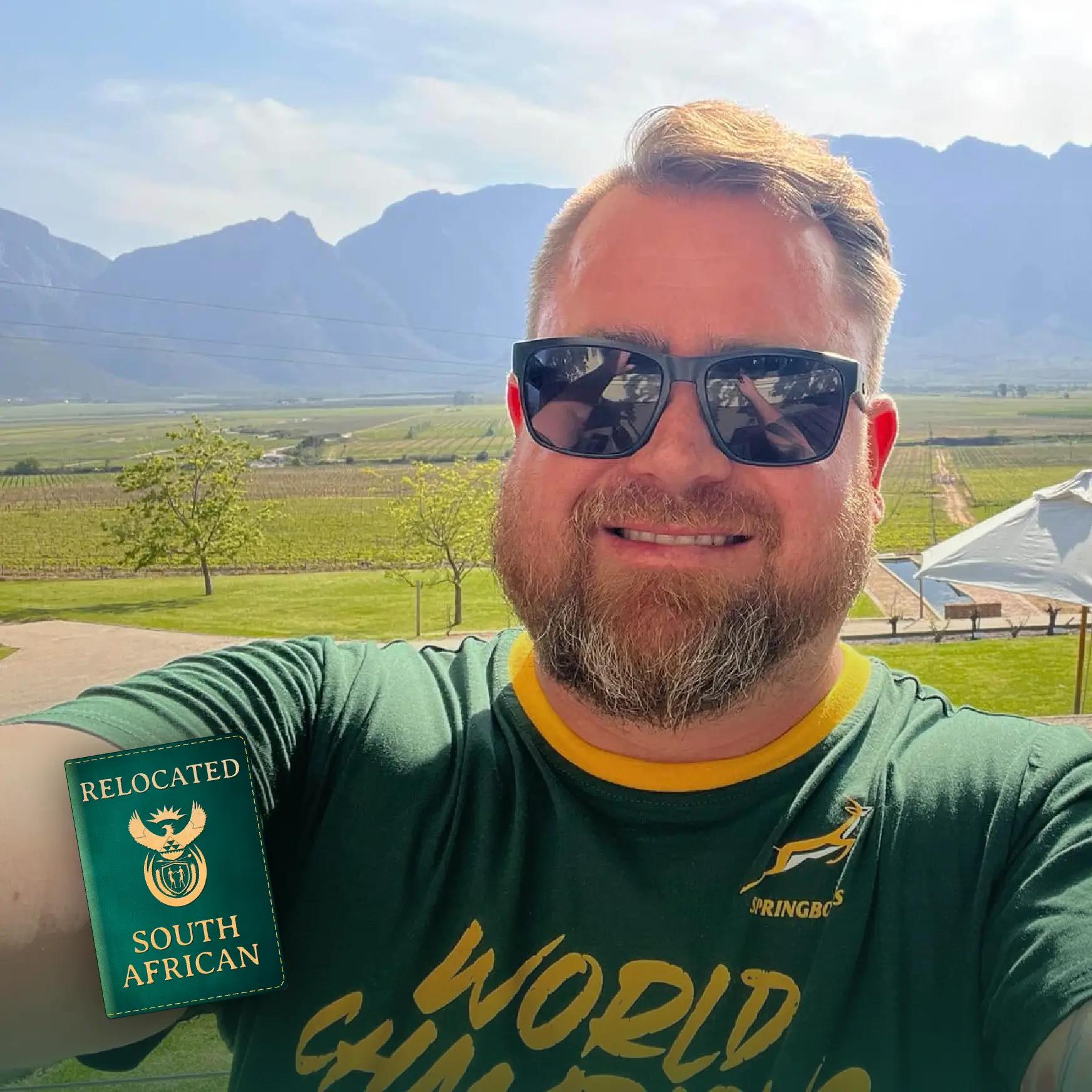
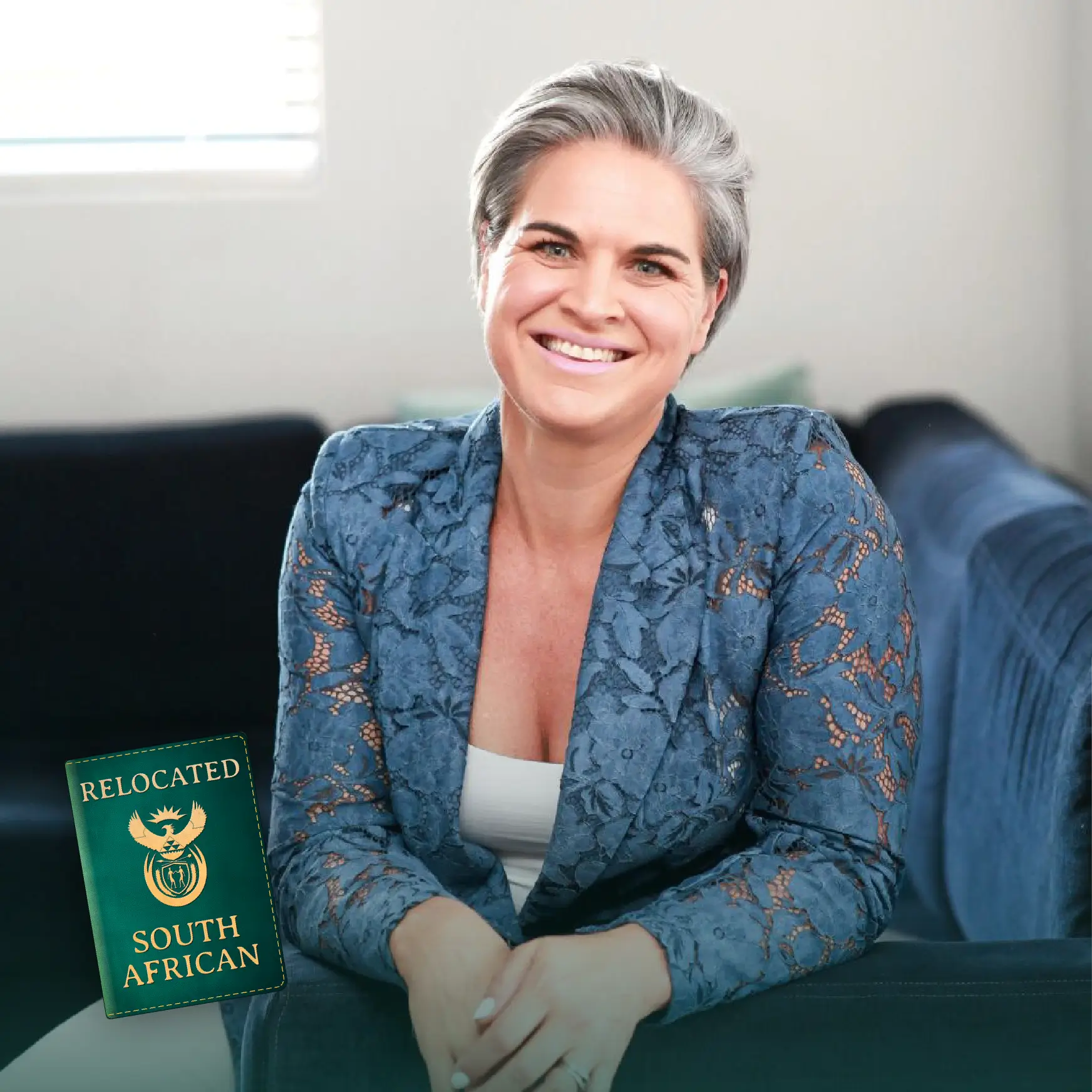
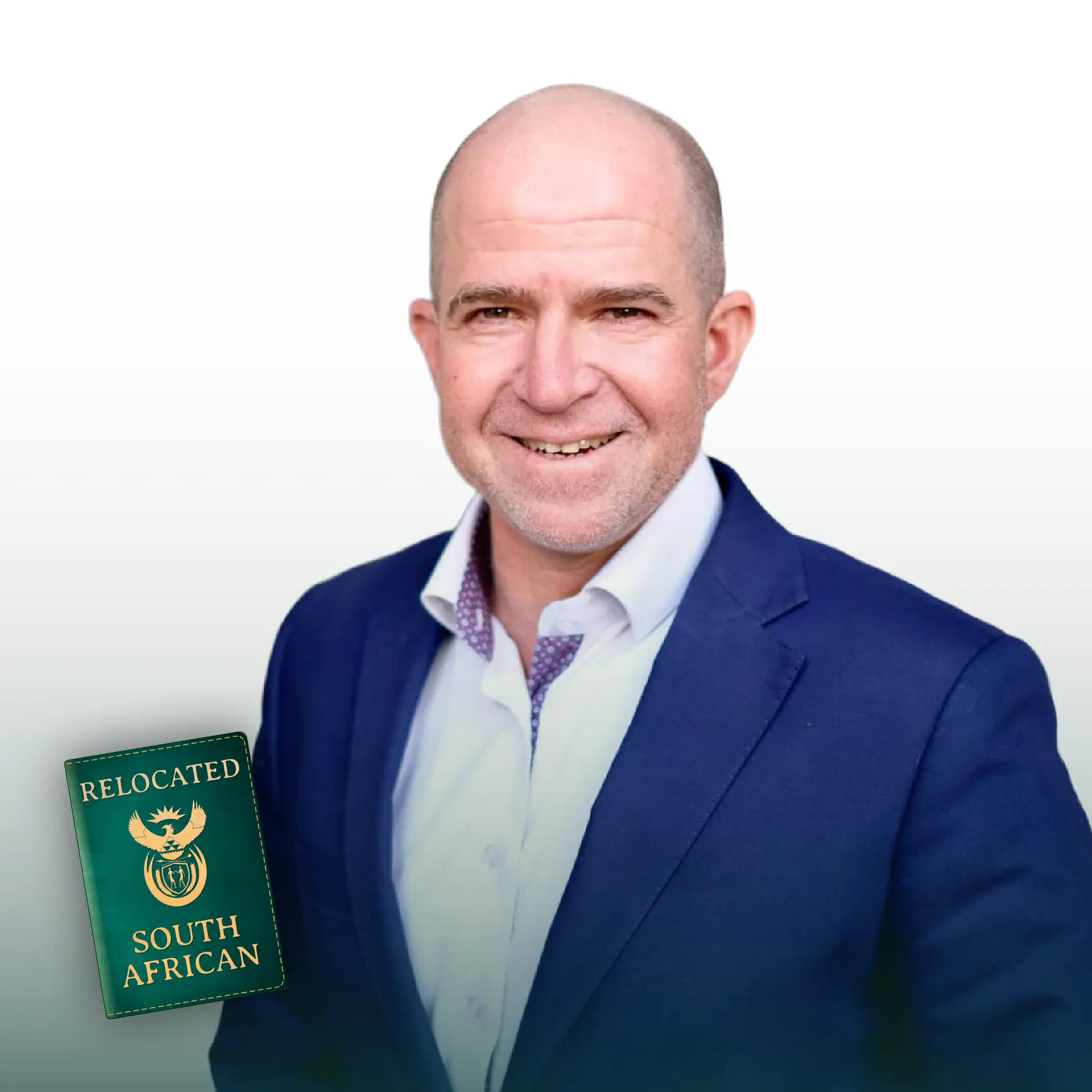
Jan Hugo:
Welcome back to The Relocated South African, the podcast that explores the lives and experiences of South Africans navigating life across borders, whether that means leaving, returning, or rebuilding. Today’s guest has a different relocation story. Most South Africans either stay or leave once. Some people go back and forth between countries multiple times: lives, careers, and identities across borders. Today’s guest is one of those. She has lived in London, returned to South Africa, moved again, returned again, and today she operates internationally while based in Cape Town. So this isn’t just an immigration story. It’s a story about what happens when home isn’t in one place. And may I say, she’s in London today, so welcome, Ankia Coetzer.
Ankia Coetzer:
Thank you, Jan, yes. I need to decide which couch I’m sitting on.
Jan Hugo:
It’s great to have you. Thanks for joining us. Like with all my guests, I always start with just a short history. Where are you from, where did you study, and how did you end up living abroad in the first instance?
Ankia Coetzer:
Sure. So I was born on the East Rand of Johannesburg and then moved to Cape Town when I was eight, so standard one, which gives away my age because I’m talking in standards and not grades. Then moved again from Cape Town to Springs, back to Heidelberg, which is where I matriculated in 1999. And then that’s where the story continues with London and studies.
I’m the third of three kids and my dad lost his job in my matric year. And so any hopes of tertiary education kind of went out the window there. It was a simple case of: if I wanted to go and study, I would need to go and make money to do that. And anybody who is familiar with the geography of Heidelberg: we only got the first mall in something like 1998, so there was very little in the way of career opportunities. There was no cinema. It was a very, very small town. My best friend, who lived on the family farm, learned to drive at 14, that kind of vibe. And so it was a natural progression where, back in those days, you could still qualify for what were called working holiday visas. So I left home at 18 as a very naive, mostly small-town girl and got to London. I literally sat on the plane and thought, I’m going to have to work. I wonder what I’ll do. I borrowed R 6,000 from my dad at the time to pay for my flight and visas and things, and he said, you’ve got six months to pay me back, cookie. That’s how it started, and that’s how I ended up at Heathrow Airport on something like the 1st of March, 2000.
Jan Hugo:
Wow, that’s interesting. Funny enough, the guest on today’s show had exactly the same story. He was also from Kempton Park, 250 pounds in his pocket, and his dad sent him to London. So why London specifically?
Ankia Coetzer:
I think for me it was quite the done thing at the time. If you think about the late 1990s and early 2000s, a lot of South Africans saw it as an opportunity to go. For me, I think there was a certain safety net in my mind: my siblings had done it before and were able to survive and tell the tale. So there was a passed-on familiarity around the experience. As an 18-year-old, you just go and do what they did, not realising that the experience, the context, the shape of it was markedly different for me. But I just went and thought, well, if they could do it, so could I. A little bit of stubbornness there too.
Jan Hugo:
And no other location considered?
Ankia Coetzer:
No. I think the visa route made it quite hard elsewhere. There weren’t that many programmes at a rate I could afford. Even the programmes to the USA, things like the kibbutz in Israel at the time, or the Australian options, those were quite agriculturally based from what I remember. I don’t know if the corporate bug had bitten me yet, that happened six months into my London stay, but working on an apple farm didn’t appeal to me at the time. I genuinely thought on the plane: I’m going to have to do something.
Jan Hugo:
And what did you do when you started?
Ankia Coetzer:
So my first job, again, back in those days, this was before the internet. You had to queue and pay £1 for an hour’s internet in London. But there was this Time Out guide, or was it, I can’t even remember now, a TNT magazine. You would flick through and look at the job ads. There was a vacancy for somebody working at a department store, and I thought that sounded incredibly glamorous for £5 an hour. So I spent a couple of weeks folding scarves at Dickins & Jones in London.
And because I’m such a hard worker, which again is due to having had to wash my dad’s car for pocket money, I got upgraded to the jewellery counter. It was there that somebody came in and asked, do you have any amethyst earrings? And I didn’t know what amethyst was. Heidelberg, Afrikaans girl. I said, what we have is on display. And this very posh lady went, you don’t know what that is? And I said, no, I don’t.
And then I realised retail maybe wasn’t for me. So I very quickly managed to get a new opportunity, through the amazing network of South Africans who quickly find each other when they hear accents on the tube. Somebody said, hey, they’re looking for a receptionist at our office, do you want to apply? A wonderful woman gave me a chance and said, you seem all right, let’s give you a go. And I ended up working there for the next 18 months before coming home.
Jan Hugo:
Awesome. And then you left London after two years. What happened, what prompted that?
Ankia Coetzer:
The plan was only ever to go to London for nine months and work. I left a boyfriend behind in Heidelberg and we were going to go to Pretoria Tech and study IT together. And then, luckily, he cheated on me. We broke up, and I was like, great, I can stay in London for longer now. I managed to build a really wonderful life, met lots of wonderful friends, got promoted, became a consultant in the company I worked for.
This company was all about helping Antipodeans when they first arrived, so I got exposure to so many people. I’m a natural extrovert and everything was really fantastic. I ended up working there for 18 months with some of my best friends, who are still my really good friends to this day. But at some point the visa is only valid for two years. There weren’t that many routes to extension. My manager at the time, Kate, her husband also worked for the company, and we pondered about whether to extend my visa and stay in London, which I really wanted. But Kate said to me, I value you too much, you need to go home and study. She convinced me to go and further my tertiary education. And at the time, there was just no way I could afford UK tertiary education.
Jan Hugo:
And you did your degree at Stellenbosch?
Ankia Coetzer:
So whilst working in this office environment in London, there was this lady who always came into the office and always seemed to know what was going on with everyone. I asked, what does she do? And somebody said, she’s in HR. I said, what is that? And they said, it’s human resources, they do all the people side. I just thought to myself, I’m going to be working in that, because by this stage I loved working. I loved being productive, loved being part of a team, loved having a purpose to get up to. I really loved what I did, and talking to groups of people and helping them, it was quite natural to me. So I went and studied a BCom HR degree, because my dad said to me, make more money with that than with a BA. Never mind that I had never done accounting or anything like that at school. The naivety of my youth was actually wonderful because I just went ahead and did stuff. Even if I didn’t know I could, I just went, fine, let’s go figure it out. So yes, I did a BCom HR degree.
Jan Hugo:
And did you work a bit in South Africa before you left again?
Ankia Coetzer:
Yes. I studied from 2002 to 2004 and then did my honours degree until 2006. But even at university, I had to fund everything myself: waitressing, and then when waitressing wasn’t making enough money, I would help other people get their siblings and contacts to London, because I had that experience and could charge them rather than going through a travel agency. I was quite entrepreneurial by my second year of university and was making money that way, just to fund studies, petrol, accommodation, lunches at die Neelsie.
I didn’t sit there and feel sorry for myself. I had one interaction where somebody said, oh, I saw you arguing at the bank, what was that about? I said, they haven’t released my student loan. And she was like, why do you need a loan? I said, well, not everybody’s parents pay for their education. She gave me R 10.00 and I was like, that’s not going to cut it, but it’s a nice gesture.
You do what you need to do. You apply for student aid, and if they turn you down, you go to the banks and you just make a plan. I speak to a lot of people, and I find that talking connects you to the right people. My friend used to borrow my little Uno, which I managed to buy with my London savings, in exchange for her staff meal at the restaurant where she worked. I’d get to eat and she’d get to go to work. It worked really well.
It taught me the grit I needed, but it didn’t feel like grit at the time. It felt quite fun. I felt proud of looking after myself at such a young age. I could also see how other people had slightly different experiences, and I very quickly realised that they weren’t always as appreciative of what they had. There was a little bit of entitlement there, which made me quite glad things had worked out for me the way they had.
Jan Hugo:
That appreciation is priceless. Absolutely. So when you decided to go again, did you go without a job or with a job?
Ankia Coetzer:
After university, I managed to find some work in recruitment, which is HR-adjacent, and then became an HR consultant. They would often put me on UK-based projects because I had a little exposure to UK culture, and that stood me in good stead when I decided to come back to London. I had exposure to some well-known UK brands, which helped a lot with my CV as well.
You get back to the conversion thing I mentioned earlier about the education differences: a four-year degree in South Africa is equivalent to a three-year bachelor’s, and my HR qualification was not that recognised. There’s a UK equivalency process to prove you have the right qualifications and work experience in HR. The first couple of months were tough. The first time in London I got a job in five days, at Dickins & Jones, and I thought I’d do that again. But by month two in 2011 I was like, this is a little different. My standards had gone up. I wanted to continue pursuing my career and not just take any old thing. I treated the job search as a job. Luckily, I had friends who put up with me and gave me accommodation in exchange for ironing Barry’s shirts.
That bartering system: make yourself useful and you won’t feel like a burden. I landed a really good project with HSBC Private Bank. They just needed somebody and didn’t care about the CIPD HR qualifications because it was temporary. That was my first break. It was a really good brand to have on my CV and things just snowballed from there. I was still quite young, under 30.
I always say that if you’re keen to find opportunity, there is just so much of it in London. As much as I love South Africa, the sheer volume of opportunities you have access to is incredible. From there, things progressed fairly naturally and consistently.
Jan Hugo:
And did you pick up the friendships again from nine or ten years earlier?
Ankia Coetzer:
I did. One of the colleagues I worked with in London Version One, as I refer to it, had become a landlord, and so I rented a room from her in the flat she had bought in Putney. That friendship has spanned from when I was 18 years old. She’s a Kiwi, from New Zealand, and she’s still very much in my life to this day.
Jan Hugo:
Those relationships are worth a great deal. And obviously the first time you had to deal with some red tape. Did that prepare you for what was waiting the second time around?
Ankia Coetzer:
Absolutely. The first time around I was so inexperienced. I had never dealt with anything other than applying for an ID book. The second time around, my visa route led to, I think, a three-year visa at first, which you could extend for another two years. Once you had five years, you could qualify for the Indefinite Leave to Remain process, and after that you could apply for naturalisation to get your passport. You had to keep a very close watch on the changing immigration rules, because depending on the type of visa, there would be cool-off periods or not. In my line of work in HR, we dealt with immigration often, which helped me keep my finger on the pulse, because we had to ensure compliance for our businesses.
I also had to teach myself to be super organised. It was only a few years ago that I let the spreadsheet go, but I had to keep really tight track of how many days I spent out of the UK, on holiday or for work, especially towards my naturalisation. You could only be out of the UK for a certain number of days during that five-year period, because you needed to prove that you intended to live there. Family reasons took me home a lot: deaths in the family, the birth of my niece and nephew, my mother’s surgery and her recovery. I had to track things to an inch of my life.
There was also a job change that went wrong. Labour laws in the UK are different and you don’t have statutory protection rights from day one. Somebody offered me a job, I took it, and three days before I started they reneged. I lost that contract and needed to show employability with 12 months left on my visa, which made other employers nervous about taking me on. It was really touch and go around whether I would qualify for the extensions and for the life I was building for myself. It wasn’t a guarantee. You have to make decisions not just for now, but for future iterations of what you might want, whether that’s naturalisation, going home, or whatever it might look like.
Jan Hugo:
A lot of people see the romantic side of immigration and don’t realise what’s involved in getting settled. I had a client in their mid-50s, identical twins. The one brother lived in London and was subject to those same rules. Their father got sick and the other brother couriered his passport across. He flew out on his brother’s passport without a problem. But you do have to look identical, and they certainly did.
Ankia Coetzer:
Sneaky, but quite genius. Those were the days. Even with the working holiday visa, I’m outing myself publicly, but you were only supposed to work half of the time, yet we all worked full time. There just wasn’t the heavy compliance governance back then. The world is a little different now. You probably wouldn’t get away with those things today.
Jan Hugo:
Absolutely. And by now you were on a British passport, I assume?
Ankia Coetzer:
Yes. I pledged my allegiance to the Queen and got my passport at a ceremony in Wandsworth in 2016. And that, as you may recall, was the year some people voted for Brexit. I always had this vision of getting my British passport and then just packing it in with corporate and going to waitress for six months. And I was like, they’ve taken it away from me.
I don’t regret the effort. The rand value of what that citizenship cost me just to qualify for it is significant. I always say I invested 11 years away from my home country for this opportunity. It is not a given right that you are allowed citizenship of another country. It’s a very great privilege and responsibility, and I don’t take it lightly. I’m very grateful for it, but I’ve worked for it too, and I made sure I complied with what was required. It’s never easy, it’s never cheap, unless you are completely wealthy and can buy citizenships, which is typically out of reach of a normal person, especially one from the East Rand.
Jan Hugo:
I agree. It’s a huge privilege. Because the groen mamba is not so accepted around the world, it’s wonderful to have the options that even a British passport gives you. One can never take that for granted.
Ankia Coetzer:
Absolutely. It’s not just the privilege of now being able to make two homes. It’s hard sometimes. It’s a great privilege, but I’ve got friends and really important things that happen here that I inevitably miss because I’m now basing myself permanently in Cape Town. But at the same time, there’s stuff I’m missing because I’m always in the UK when I travel. It’s great to have two homes, but it does come with challenges. I’m so fortunate to get to make these decisions for myself, whereas that just wouldn’t have been possible if I’d stayed on the groen mamba.
When I plan holidays with friends now, I don’t have all those things: the visa rules, the stacks of documents. Travelling to the United States when I was still on my South African passport, I needed 119 pages of supporting documents just to say why I was the only person in a company of 3,500 people who could go on a one-week training visit. Whereas now, you just apply for an ESTA a couple of days before. It definitely gives a huge freedom of movement, for which I will always be grateful.
Jan Hugo:
And especially travelling to Europe. My daughter lives in Dublin and her friends on South African passports who want to travel to Europe have to get a Schengen visa. They can’t even get an appointment. It’s just a nightmare.
Ankia Coetzer:
Yes, and I’ve had colleagues who even after moving back home faced the same thing. There was a conference six months away and we were all supposed to attend. Ninety per cent of them couldn’t go because there was a ten-month wait for an American visa. It seems unfair, but countries don’t give automatic right of entry. It’s just not how it works.
Jan Hugo:
Unless you come on a boat. Let’s not talk about it. One more practical point. People always ask about tax. You worked in London for a long time and then went back to South Africa. Was sorting out your tax residency quite a lot of red tape?
Ankia Coetzer:
I’m sitting here in my friend’s lovely, glorious, heated front room, and I just got goosebumps. It was especially complicated moving back home. I was very fortunate that my relocation package included a tax consultant. It was extraordinarily confusing.
Something worth mentioning: I had bought a flat in Cape Town when I was 26 years old and kept it. By the time I also bought property in London, there wasn’t the second stamp duty situation that exists now, but there is now. It’s a pokey little flat that I own, but those pokey flats cause tax implications. Even now I have to be very careful with my residency. Please go and see an expert. I am not one.
There’s something around the fact that if I were to change my tax residency back to the UK, the South African government would now tax me on my UK property as if I had sold it and bought it the very next day. It gets really confusing, especially with property ownership. I actually know a lot of South Africans who end up disposing of their UK properties when they make the decision to resettle back in South Africa permanently, because it’s so complicated. And if you get the advice after you’ve already signed your contract to return, you can’t backtrack and say the tax implication is too great, I’m going to stay. You don’t necessarily have that choice.
What I always say is that not every decision has to be a hundred per cent financially astute. Sometimes you make lifestyle decisions. And you only have a tax burden if you have an asset, so you can’t feel too sorry for people in that situation. It usually means you’ve got something to pay tax on.
Jan Hugo:
That’s very true. And people are scared to ask for advice because they have to pay for it upfront. Being penny wise and pound foolish costs you in the end.
Ankia Coetzer:
Yes, and whilst there are companies that deal with tax across UK and South African jurisdictions, I have not necessarily found many experts who deal with the private impacts on individuals, unless you’re really high net worth, which I am not. So that balance around, do you pay R 65,000 to PwC for advice to save you R 80,000 on your capital gains tax? It gets a little complicated.
Jan Hugo:
So let’s deal with going back to South Africa in 2020. You’d had nine years in the UK and got your passport. Why go back?
Ankia Coetzer:
By then I had also done my MBA in 2015, so that study bug was very much alive. I did my MBA, changed careers from HR to tech enablement, spent ten years in strategy and strategy execution, and got my dream job at my dream company. But all of my friends were settling down and moving out of London. I always used to say, I didn’t really come to the UK, I came to London. I fell in love with it in 2001 and it’s what I wanted to come back to. So moving out just wasn’t an option for me. But I found myself being quite isolated. The different phases of life: people change, people move on. They want more space, more family.
You also get tired of going out at some stage when you get a bit older. I just realised, what am I doing in London? Both my siblings lived in Cape Town at this point. My dad lived in Langebaan. My mom was on the Garden Route. Your parents get older and you’re missing out on their kids getting older, on major milestones. My stepmom passed away in 2016, and with the British citizenship I went home for a few months and it was just lovely being around family: proximity, not the holiday vibe. I was there for two months and just thought, I could do this. I missed it. So I started thinking about it.
I started what I considered my dream job in 2018 and was going to move home and then didn’t. It was in and out of my mind. Then at the end of 2019, my boss said to me, look, somebody is moving on and there’s a wonderful opportunity for you to go and lead the function, to really make our mark in the local market. And you’ve always said that if there was an opportunity, you’d want to go home. And then, as you may recall, there was a tiny little global pandemic in 2020.
I had found tenants for my apartment because I was moving home and had signed my contract to move. But then I didn’t want to lose my good tenants. So I moved out, packed everything myself in a Zipvan because there were no services, and a friend posted me her keys to her apartment. I stayed there and watered her plants while she was stuck somewhere. Another friend was stuck in Australia. I was essentially homeless in London.
Luckily, I know some very interesting people through work. So I stayed in a lovely apartment in Maida Vale and then a beautifully renovated house in Walthamstow, looking after these people’s homes while they got stuck elsewhere. That was from March to July, with half my things in a storage container waiting to be shipped, but there were no ships. And at that time, my sister got diagnosed with breast cancer as well, and I was still stuck here.
I eventually got on the repatriation flights. While most people got bored being stuck in their houses, I was literally homeless in London and pleading with the government to allow me on a repatriation flight. I made it home in mid-July. Work carried on. We converted to fully remote work, it was a technology company, and all our clients were converting to online as well. I was supposed to be in Johannesburg but convinced my boss to let me stay in Cape Town while the pandemic spilled over.
By the end of that year, I said to him, look, I’m 40 and I’m sleeping in my nephew’s little bedjie, like a little octopus bed. Shouldn’t I also settle? And he said, well, you never listened to me anyway. So he allowed me to settle, and I bought my apartment in Cape Town.
And then it’s just been a series of things. I was diagnosed with breast cancer: a BRCA2 gene defect. My dad was diagnosed as well. We went from a no-cancer family to a cancer family, all while working full time. It was a crazy couple of years of surgeries and medical interventions, and it really made me reflect on what is important in life. What brings you joy? What makes you happy? How do you want to spend whatever years you have left, which will hopefully be many? But when you face something as serious as cancer, it really does make you sit up and go: let’s pay attention.
Jan Hugo:
Wow. The funny thing is, we left South Africa on the 1st of October, 2020, on the first non-repatriation flight out of South Africa. And we haven’t been back anyway.
Ankia Coetzer:
Crazy times, right? Just how it forced things for a lot of people, not just relocations but relationships as well. All these terrible things were happening, but for me: whatever deity you believe in, I just really believe that the universe gives you what you need. How lucky was I to be in Cape Town when I was diagnosed, on a really good healthcare plan through work, surrounded by family? I got to spend the last few years with my dad in Cape Town. I wouldn’t have been able to do that if I’d stayed in London. As much as I loved London and still do, it was the absolute right thing for me to move back during that time and to be there for what was going to be a very tough few years. Super grateful that I was exactly where I needed to be.
Jan Hugo:
That’s awesome to hear. So are you still working for the same company today?
Ankia Coetzer:
No. I left about 18 months ago. With everything that had happened, I realised that what I’m passionate about at work, through all of my HR years and all my strategy and systems implementation work, is what I’d call system-level relational dynamics: how people show up at work, how leaders operate under pressure. The recurring theme through 25 years of corporate work is that, whether you’re doing AI, packing bags at a retail shop, or manufacturing cars, it’s always about people in the workplace. What I do now is coach leadership teams on team dynamics and very specifically on dyadic relationships, which is the dynamic between two people in a team performing under pressure. Businesses need to focus on business, but we get in our own way and in each other’s way because we don’t understand why we act or show up the way we do.
I’ve taken all of that experience and a bit of accreditation in the coaching space, and that’s what I spend my time doing: helping teams unpack so they can either be proactive about what shows up under pressure, or, when pressure has already made some dents, course-correct and get back on track. It’s the culmination of London Version One, a very naive 18-year-old showing up in a big city and surviving, making different choices through the relocations, the corporate world, the pandemic, the cancer journey, the parental loss journey, and an infertility journey. We haven’t covered that but it was thrown in there too. Just really figuring out the lived experience. Everybody is under pressure. I’ve had the opportunity to do the inner work to understand that side of it, and hopefully that’s what I bring to the clients I serve.
Jan Hugo:
That’s amazing. I always think, especially with this podcast, just how important relationships are. People call these soft skills, but I think they are such necessary skills that people miss in this dog-eat-dog world.
Ankia Coetzer:
Yes, and I read something just this week that said: call them soft skills, but they’re so hard. So hard to learn and so hard to assimilate. In this high-tension world, I still see these amazing stories of people helping each other out. During the repatriation flights in the pandemic, we still really connect, because we are a social species. We do have this really great care for each other. My hope is to help that. The understanding of self and others is what I really try to do every day for a living. It feels like such an honour and such a true calling. I haven’t felt this way about a career in a little while. So it’s really exciting.
Jan Hugo:
That’s exciting. And throughout this whole journey, what I’ve listened to is family, family, family. It has played a major role in your decisions. It’s very hard to leave and go after opportunities. I always say there’s a pull factor and a push factor. Some people get pulled by jobs, others are pushed by whatever happens in their lives. But the thread that runs through every conversation is family: missing family, needing support. Imagine having been diagnosed and having to deal with that in London. It’s nightmarish.
Ankia Coetzer:
There’s another element to that, Jan, which I think we also romanticise. There are wonderful stories of people using the earning potential in pounds to support families in a way they wouldn’t have been able to from South Africa. So many of the older generations, even ten years ago, were doing caring work and being away from family for a while, but then being able to go and live a fairly comfortable retired life.
I thought I had done enough to show how much I cared by prioritising getting home as much as I could, but you can always do more as an auntie. It made me realise how hard it is. We sometimes find it really difficult to understand each other’s decisions, because it’s not our lives, not our minds, not how we think about things, not how we value things. That’s also the challenge: almost justifying your decision to be away when your family may not understand. That’s something that’s often quite hard and that we don’t talk about enough.
Jan Hugo:
It’s very, very difficult. One guest said, my kids are not seeing their grandparents, but I’m hoping that I’ll see my grandkids one day. There’s also a psychologist I’ve had on the podcast who deals with the parents who stay behind. Her whole practice is just for people going through that experience. Because parents suffer, it’s really hard. But can you be selfish? I don’t think it is selfish to leave. If you’ve got to do what’s best for you, what works for you is not necessarily going to work for me, so I can’t judge. That’s the big thing, and people love judging, especially when you sit in South Africa.
Ankia Coetzer:
Some people are just sad, right? Because they maybe don’t have that option. It just doesn’t enter the reality for them, because it’s not their route. Other people would never live elsewhere. I remember my dad being very proud of me, but always, at the same time, being sad because of it. Now that I’m a bit older and wiser, I know it can be both. You can be proud and sad, and that’s okay.
Jan Hugo:
And yes, absolutely. Do you think people only realise what home is after they’ve lived somewhere else?
Ankia Coetzer:
I think people have different experiences of that, but I know that it took me being away to realise just how ridiculously special South Africa is. I can’t really explain it, but I feel tethered to Table Mountain specifically. I never say never: I might end up in the UK again for future opportunities. But there will always be a pull back to South Africa, for the people, the culture, the dynamics, the hospitality, the ridiculous jokes, the lifestyle, the scenery. The list goes on. Even when you speak to foreigners: it’s not until you go to South Africa that you experience the magic. And people go, it’s the best, but they can’t say why. There is something special.
Sometimes, especially when there was load shedding and economic turmoil, we think the grass is greener on the other side. But I’ve genuinely come around to believe that the grass is green where you water it. There’s good and bad everywhere. People just need to consider what’s important to them, where their values are aligned, and what they’re willing to sacrifice. Then make their choices accordingly.
Jan Hugo:
And there’s something that comes up in every conversation: safety. Now that you’re back in South Africa, has living in London versus South Africa changed your mind about physical security?
Ankia Coetzer:
I ponder it a lot. I’ve been home for almost six years now. It didn’t strike me until I moved back the second time, just how safe London is: everything is relative. It’s this weird contradiction because most of the crime that’s ever happened to me has been in London. I was the victim of a sexual assault at 18. My flat was burgled in Fulham in 2011. My house was broken into in 2015. All these things happened in London. Back in South Africa, I’ve had a window smashed for a CD. Nothing more than that, and I’m knocking on wood. So my personal experience of safety is actually skewed towards South Africa being safer.
However, on a day-to-day basis: I went out for a run today. I know I can run at night here. I walk from the tube to my friend’s house. As a woman I always walk with my keys between my hands, but I do it. Whereas in South Africa, it’s taken me a long time and I’m not quite there yet. I’m stifled by the fact that, especially in winter, I have to watch sunset times to walk my dog. I don’t have the freedom I do here. My sister says I’m paranoid. But it’s not paranoia. It’s something I had here that I can no longer have at home. That contradiction, all the crime happening to me in London but some freedoms removed at home, I do struggle with that still, and I think I will for a long time.
Jan Hugo:
Yes. We’re cyclists and we often comment on it, even after almost six years here: when you see a woman cycling or running on her own out in the countryside, you think, how do you do that? That’s the way life should be. It’s all a balancing act.
Ankia Coetzer:
It’s strange. You’re just not used to it.
But this is one of the fantastic things about South Africans. I live in a beautiful neighbourhood called Vredehoek on the slopes of Table Mountain, and a bunch of women have said, right, let’s walk together, safety in numbers. There’s now a walking group. As we say in Afrikaans, ‘n boer maak ‘n plan. We are very actively involved in our communities with neighbourhood watches and things. I can sit there and moan about it, or I can go and actively patrol with neighbourhood watch groups and try to learn about law enforcement. It’s not something I ever thought I’d partake in, but I really enjoy being part of an active community that is actively trying to make things safer. I love being part of that solution back home now. I try not to dwell on the fact that it has to be done, because I want to go and walk on my mountain. We do the things that are necessary to keep us safe and be able to do it. I’m meeting some amazing people in the process. Extrovert over here is happy, and she’s safe, and she gets to walk. It’s still a net win for me.
Jan Hugo:
I must say, I know you’re also part of the Lekker Network. One thing I’ve found about that group is that it’s just extremely positive. Every interaction is positive. I’ve never seen anything negative there. I must really commend the founders for that, because it works.
Ankia Coetzer:
Yes. And thinking about the work that I do and my corporate history: you can put whatever cultures and values on stickers on the wall, but if you don’t have leadership modelling the behaviours and attitudes and values you want, it’s just words and semantics. Whereas I see the co-founders of this network really actively modelling it. It’s in their DNA, it’s in their essence. And so that’s why I signed up. I saw it really consistently and authentically. As positive as I may come across chatting to you now, I’m actually pretty cynical. The fact that I was watching closely and thinking, it’s unlikely that these people are scripting this, and it just doesn’t look like vacant marketing, that said a lot. I joined in September and it’s just been overwhelmingly positive, for those who engage and contribute. That whole “how can I help” question just fosters what you said earlier: it’s about relationships.
Jan Hugo:
I interviewed Nic Latouf on the podcast and it was such a positive conversation. They’re very positive guys. I think that’s awesome.
Ankia Coetzer:
Yes, but also not too tough to ask the tough questions either, right? I’ve been in some of the business networking sessions, and this retail entrepreneur just needs help thinking about how to accelerate his e-commerce retail product. And Nic doesn’t mince his words. He’ll step in and go, hey, when you’re trying to sell women’s clothing, why is it only men in the room? I love that. He’s not shy to really push the agenda and make you think about what’s going to accelerate your business. Really balanced, positive, enthusiastic, solution-focused. I love that.
Jan Hugo:
We’re getting close to the end. I have to ask you: when you lived in London, what did you miss about South Africa? And when you’re in South Africa, what do you miss about London?
Ankia Coetzer:
Oh, now we need another hour, Jan. I always miss proximity. It was a big reason why I moved home. London is just so vast, and by the time your friends have settled with their families outside the city, nothing takes less than an hour. I know if I have to sit in traffic for 24 minutes to see my sister, I’m outraged.
Within two hours, which is the furthest any Capetonian will drive for a weekend away, you get so much variety and experience. The proximity to friends, to adventure, to variety: that’s what I missed when I was here in London. Spontaneity. London is very planned. You say, let’s go to movies with your friends in New York, that sounds so fun, and then you whip out the calendars and you can’t find a date for another six months. I really love spontaneity. Funny enough, now that I’ve moved home, when people ask me last minute to do things, I’m like, my goodness, it’s not in the calendar. So I clearly miss the pre-planning of London too.
As a fairly new entrepreneur, it’s tough, which is why I come to London. My network is still here and the opportunities still seem to be here. I perhaps naively thought there would be more connection in South Africa, but the employment market, the attitude towards organisational development interventions, is a little lagging. It’s a much tougher macroeconomic climate. There are sociopolitical issues that everyone is dealing with. I understand it, but it doesn’t make it easy for an entrepreneur doing what I do.
Jan Hugo:
But you’ve got the best of both worlds. When your expenses are in rands and your income is in pounds, you’re in a good spot.
Ankia Coetzer:
Yes. I miss the proximity to sheer access to work, contracts, relationships, and partnerships the way that London has.
Jan Hugo:
That’s a huge benefit, having built that network. Okay, if you think back on such an interesting journey, is there anything you would have done differently?
Ankia Coetzer:
I don’t believe in regrets. I just really don’t. I feel like everything has led to this moment and to you and me chatting here. But I do sometimes reflect on what has shaped me and why I am so resilient. Why do I have so much grit? Where did that come from?
Coming here as an 18-year-old with very little work experience: whilst I’m very proud of that, I sometimes wonder. I used to joke and say I was surprised my dad let me on that aeroplane. That first year and a half, if I reflect now, it was really, really tough. I think making sure that somebody is equipped emotionally, not just financially, to understand and have the support structures is so important. With modern-day technology and cheap calls home, some of the risks I experienced are no longer there. But that naivety. Was it a good plan? Was it a good idea? I’m grateful for it, but I sometimes wonder. That’s awfully young, especially for where my maturity was at the time. If I ever had a daughter, I’m not sure I would let her get on an aeroplane by herself.
Jan Hugo:
I was just thinking, I wouldn’t have done that. So you were very brave. Last question: if a young Ankia came to you today and said, I’ve finished my matric now, what should I do?
Ankia Coetzer:
Brave or stupid, one of the two! I’ve just said I don’t have regrets, but I’m going to go: get on that plane, baby girl, because you’ll sort it out. You’ll figure it out. There are some hard things coming your way, but they’re going to teach you just the strength and resourcefulness that you have, which maybe I wouldn’t have had otherwise. So yes, get on that plane. Maybe save a little bit more, and don’t put so much money on the video jukebox at the famous Three Kings in West Kensington.
I would probably tell her to just have a little bit more fun. As much as there was fun, I was very serious and very much in pursuit of my goals. I think I would just say to her: it’ll come. You just don’t have to get to the point of burnout quite so ferociously.
Jan Hugo:
No. And the one point that you made is just having friends and people around you and building a support network. It’s even benefiting you 20-plus years later, having built that at a young age. Those special relationships are worth a lot.
Ankia Coetzer:
Yes. And I would say that to young people now: I know that there are introverts and extroverts, and not all of us get our energy from people, but building those relationships wherever you can, there’s just an energy exchange between people that is not replicated online. Please just try and get out in the real world, in whichever country that is. And just travel. The horizons that it gave me, seeing how other people live, all the different cultures I’ve experienced through my travels, you just cannot read that in a book. You have to be there, you have to smell it, you have to see it, you have to feel it. So if the opportunities are there, just don’t be scared. Have your backups, plan for it, and then just go. Absolutely do it.
Jan Hugo:
Just do it. People can get hold of you on LinkedIn, where you’re very active. And your business is www.yellow-cable.com. Is that right?
Ankia Coetzer:
Yes, if I can get my website relaunched, there’s a technical issue there. But yes, that is the website. I’m very active on LinkedIn, it just seems to be the natural home for business coaching. You’re also welcome to email hello@yellow-cable.com if anybody is interested. I even have a South African and a UK cell phone number still, because that’s just what it involves to be based in two countries.
Jan Hugo:
Absolutely. Well, Ankia, thank you so much for sharing your story so openly. I think this conversation tells us that immigration is not a single decision. It’s a journey that unfolds over time. Sometimes the bravest decision is recognising when a chapter has run its course.
Ankia Coetzer:
Yes. Just a hard look at what brings you joy and how you can amplify that. What does that look like? What do you need to do? Sometimes it involves a bit of hustle, sometimes a bit of chill. Just having those questions and asking them has been instrumental for me, especially later on when I realised: just check in every now and again. I hope people do that more and more in this busy time.
Jan Hugo:
We only have so many days on Earth, so you may as well use them to the best.
Ankia Coetzer:
Exactly. I can’t believe it’s been an hour, Jan. Thank you so much. It was such a great chat.
Jan Hugo:
Thank you so much. Thanks for chatting. As always, if this episode resonated with you, you’re welcome to share it with someone who might need to hear it. You can find more episodes of The Relocated South African wherever you listen to your podcasts. Thanks for listening and I’ll see you next time.
This transcript was generated with the assistance of AI and checked for accuracy.