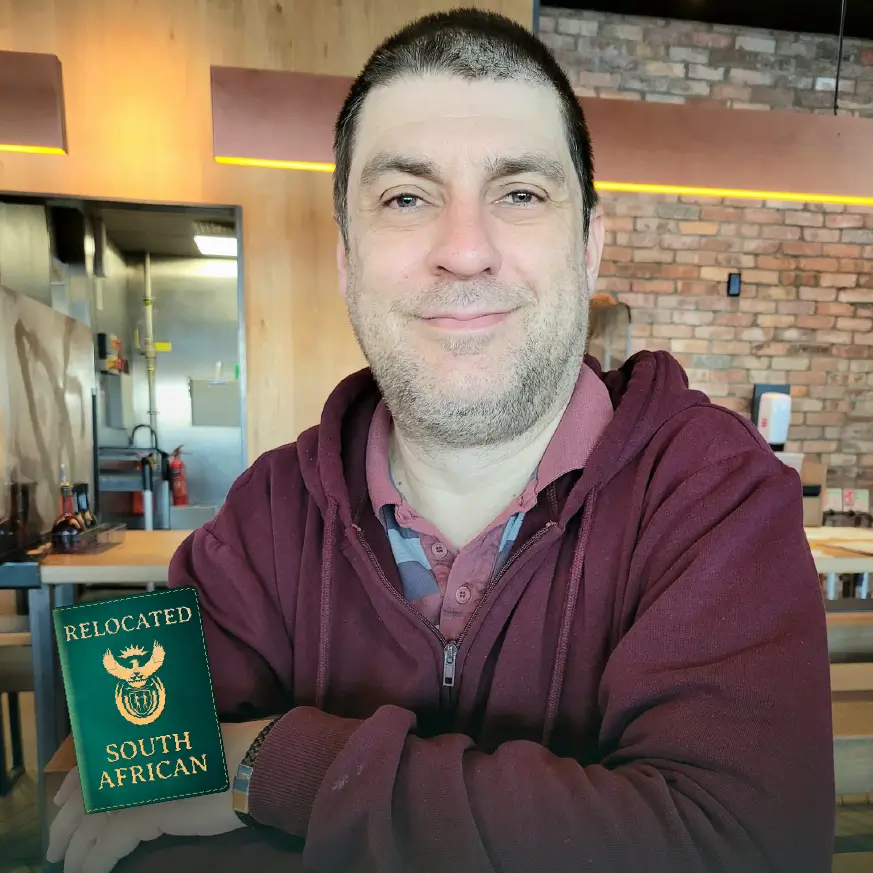
Jan Hugo: Welcome to The Relocated South African. As always, your host Jan Hugo from Lagos, Portugal. Today, my guest is Kerry Deamer, South African life coach, who made the move to the UK. He’s talking to us from Kent, just outside London. Welcome, Kerry.
Kerry Deamer: All right, thanks, Jan. Thank you. Nice to be on the show.
Jan Hugo: I always start by asking where you’re originally from, where you grew up, and how you got to move to the UK.
Kerry Deamer: Yeah, perfect. Born and bred in Kempton Park, right close to the old Jan Smuts, and now Johannesburg International Airport. I went to Norkem Park Primary and Norkem Park High School, one of the two English schools in the area. My whole life was also spent at Kempton Park Cricket and Kempton Park Hockey Club.
Started there at five, and played there until about 35, 36; I was chairman of the cricket club for around about eight years. Then I made the move through to Scottburgh, on the KwaZulu-Natal South Coast. Pretty much after a bit of a life-changing event, I decided it was time to make a move, and went to Scottburgh.
I’d always been in transport, working for a company, and then decided to make the move and buy a few trucks and start my own, which was in 2007. I had that company until I left in 2019 for the UK. I’ve always had the British passport, and we decided it was a good opportunity, given there was a lot of theft going on in transport and life threats; it was just breaking up one racket after the next, not really concentrating on work, and I just made the decision to move to the UK. Unbeknown to us, COVID was about to strike, so it was a bit of an unsettling time to make that move.
Jan Hugo: Wow, I can imagine. Living in Scottburgh, that’s obviously close to the Transkei area. Was that where your transport business focused, country-wide? Was it a delivery service, or was it big trucks?
Kerry Deamer: We ran bulk tankers, mostly delivering hazardous chemicals, solvents and petrochemicals, mostly on the N3, from Johannesburg, with a few blue chip customers like Sasol and Sappi, and a few others.
Jan Hugo: Wow. And were you the sole owner of this business?
Kerry Deamer: Myself and my wife, correct; we were the owners of that company.
Jan Hugo: And Kerry, was there a moment, for the kids’ sake and so forth, where it just clicked and you said, okay, we’ve got the passport, it’s time to go? Or did it happen gradually?
Kerry Deamer: There was an incident in early 2019, late 2018, with a crime syndicate. We were trying to break away from them; they kept stealing product. It was continuous, but this time it just got a bit more threatening and a bit more personal than ever before. I think it was at that stage: they started bringing in a few heavyweights, and just threatening you personally, and your family, that we just decided to chuck the towel in.
Jan Hugo: Wow, Kerry. From a perspective, because this seems to be still going on in South Africa, and I don’t want to dwell on it, it just seems like people are unable to protect themselves against these gangs and mafias that are running all kinds of industries. Was that your experience?
Kerry Deamer: Yeah, pretty much so. I mean, I’m not one to back down, and I’m not one to turn a blind eye. It was breaking down one fuel theft, or tyre theft, or product theft, and the next one popping up. So it was getting on top of that, and then the next one comes. We had quite a number of Zimbabwean drivers; I’m not saying it was mostly them, but yeah, a lot of the theft was definitely happening through Zimbabwean drivers and South African drivers. It was a syndicate, and the drivers got involved, maybe accidentally the first time, and then they also just got sucked into the whole syndicate. It was something you could never crack, and it’s still going on, as you say.
Jan Hugo: And have the cops in their pockets as well.
Kerry Deamer: Cops in your pocket, and you can’t really dismiss them; you try to dismiss them, and the unions get involved, and it’s just ongoing. Eventually, I think you just get tired of the fight, to be open and honest.
Jan Hugo: And how did you convey all this to your kids at that point?
Kerry Deamer: The youngest would have been five, I think, and then the oldest was 13, I’d say, when we made the move; 13, 14.
Jan Hugo: Okay, and how traumatic was it for them, to make this call to leave?
Kerry Deamer: At first it didn’t seem so, but I think it definitely had effects on them. My oldest was in high school, enjoying a bit of boarding school life, and coming and trying to fit into the UK lifestyle; a bit different from the youngest, who hadn’t started school in South Africa, and then had to almost skip the first year when he came to the UK, starting in year two because he was too old to have gone into year one. So yeah, it was fairly traumatic.
Jan Hugo: And I mean, at least from the point of view of you and your wife being on the same page, that was obviously important, because you can’t be arguing about a decision like that and make it successful.
Kerry Deamer: No, no, I think we’d both decided.
Jan Hugo: Okay. And did you guys have family abroad?
Kerry Deamer: My dad’s side of the family have mostly passed on now, but he’d relocated, so that side was more Bristol based. My wife’s side, her brother is in the UK, in Kent, and that’s why we chose Kent. He’s married, with two daughters this side. So there was a bit of backup support in that; that’s why we chose to come to Kent.
Jan Hugo: Okay, and did you leave family behind in South Africa?
Kerry Deamer: Yeah, my wife left a sister and parents in South Africa, and I left a brother and sister in South Africa.
Jan Hugo: Okay, Kerry, when you arrived, thinking back to when you arrived in the UK in 2019, was it late 2019, just before COVID?
Kerry Deamer: It was July, early July, I’d say, when we arrived. It was a fairly good summer that year. Originally, it almost seemed holiday-like for the kids, with good long days and sun which they’d never experienced before. So yeah, I think the first month or two was a bit of a holiday vibe, to be honest.
Jan Hugo: And did you have employment in the UK at that point, or not?
Kerry Deamer: I was still trying to sell the company. We also had an issue with a tank that had had an incident overnight; in fact, the first day I arrived in the UK, we had an incident. So I was going back and forth to South Africa initially, trying to resolve that and get the company sold. For about the first year, I was still working with the company, eventually getting a portion sold, and selling off assets, those types of things.
Jan Hugo: Okay. And if you think about your expectations versus the reality: people always talk about that first month being like a holiday feeling, almost a honeymoon period when you arrive and everything is new. Did it live up to your expectations, or, being with a UK passport, you’d obviously been to the UK before, but living there is always different.
Kerry Deamer: Only briefly, on holiday, Jan. We hadn’t really spent a lot of time there; I think we’d been twice, on holiday. It did, for the beginning, I think. But once the honeymoon period was over, which was maybe five, six months in, the lifestyle change started setting in a bit, and you just crack on with it. We were still going back and forth a little with our company; my wife went back also, once or twice. We got the kids into school, moved into our rental, which isn’t too far from where we live now, and settled down. Then, after about a year, I got a job in the transport sector, and just really started getting into the lifestyle. In November 2019, we purchased a house, and obviously went through the first lockdown; the second lockdown was just at the very start. It hit fairly hard with COVID, and I was hospitalised for a few days as well. I think that was a bit of an awakening, and we started homeschooling and all of that with the kids. It was very disruptive, after just trying to settle in, I suppose.
Jan Hugo: And how surprising were things like cost of living, coming from a South African environment, because it must be very different? I think of us in Portugal: it’s just, lifestyle’s different, people are different, everything’s different, and you have to try and settle in.
Kerry Deamer: Correct. Grocery shopping and purchasing, we didn’t find it too different; very much like on like. Going into lockdown, you couldn’t do too much of it at that stage, but eating out, very expensive. Five, six pints, or maybe back then, £4 a beer.
Fairly expensive, and just general going out, entertainment, going to sports games; being a big cricket and rugby fan, going to sports games, that was very expensive, very different fees, and subscriptions to sports clubs, much more expensive. As for the day-to-day grocery shopping, we didn’t find that too different. It was more on the entertainment side, I’d say.
Jan Hugo: Yeah, and I guess I always get the impression when you speak to people in the UK and Europe that they’re a lot more housebound, in a way, but when they go out, they go out to a restaurant. They don’t braai in the garden like we used to do in South Africa, and organise a big barbecue and have lots of people around.
Kerry Deamer: Correct, we still braai a lot in the garden. We’ve got a few good South African friends; one of mine has actually just returned, we’re army mates together, he’s returned to South Africa. But we’ve still got a good South African friend not too far away; we do a few braais together and all of that. But yeah, we haven’t really made too many close UK friends; it’s a different way of living, as you say. Not really being invited to the house; more, if you’re going to meet up with someone, it’s going to the pub, and that. I’ve played, my oldest and I have played cricket for a club close by. And yeah, you just struggle to make good friends like you did in South Africa. I’ve had a few good friends who moved to Ireland, and over the last year I moved to Ireland for about 11 months, still working on and off for an Irish company at the moment, while getting back into the UK and kicking off the coaching business. The Irish are much more friendly than the UK, but you really struggle to make friends in the UK, to be honest.
Jan Hugo: That’s my impression as well. My kids live in Dublin, and I have so many friends; it’s scary, much more than they’ve had in South Africa. But a lot of them are South Africans. When you guys arrived there, obviously pre-COVID, were you able to make friends with South Africans through South African Facebook groups, and typical get-togethers of South Africans, or was that not really an option?
Kerry Deamer: It didn’t really happen straight away. I think we were mostly travelling back and forth to South Africa initially, and the place we were meant to move into wasn’t ready, so we went off to Folkestone, which is not far from Dover; they supplied us a holiday rental for a month or so there. So it was a bit disruptive, going back to different places, before we eventually got the kids into school and moved into our rental. We didn’t quite meet up with too many South Africans, apart from my wife’s brother and his family, a bit. But yeah, we didn’t quite get into any groups straight away, put it that way.
Jan Hugo: And in South Africa, did you sell up everything when you left?
Kerry Deamer: Not immediately. We had a few properties, which have all been sold up now, but it was a process.
Jan Hugo: Okay. And during that initial, post-honeymoon phase, when things got a little bit tough, did you guys ever consider going back?
Kerry Deamer: I don’t think initially, Jan, but now, my wife and the two kids have got their passports as well now. I think it’s always in the mind now, to be honest. I think the weather eventually gets to a few of us, and it’s always in the back of the mind that you’ve got the option, but unfortunately my wife’s also got fairly ill of late, and we’re really reliant on the NHS at the moment. So, yeah, it’s not a possibility, definitely not for the next year, in any case.
Jan Hugo: Okay. It’s interesting that quite a few people from the UK are heading back to South Africa; guys are saying, when they’ve made some money and can buy a lifestyle in South Africa, maybe that’s a possibility. But it’s always difficult when you’re looking over your shoulder, thinking, if it doesn’t work, I’ll go back; then you start looking at going, and you’re never happy where you are. So it is…
Kerry Deamer: No, correct.
Jan Hugo: I think it’s a difficult thing. If you think about that, and leading into your coaching story: what did you personally find the hardest about moving to the UK?
Kerry Deamer: I think it was just the interaction with friends and family; people you’ve grown up with. As I said earlier, my lifelong friends are still cricket and hockey friends from Kempton Park. Just not having that interaction with them, with your siblings, parents, parents-in-law, those types of things. The move itself went relatively seamlessly; we’d moved provinces in South Africa before, so I’ve never been a person who feared change. But it was probably just the solitude, I’d say, that became the biggest fall for us all. And then, as it got longer and longer, I think the weather starts creeping into the mind as well.
Jan Hugo: I can totally relate. And as you say, that solitude, that missing friends and family; I guess part of what we’re trying to do with the podcast is to let people know that others experience the same. The move from South Africa isn’t going from Joburg to Cape Town, it’s a proper move, and it’s very difficult to just hop on a plane and go back; it’s getting more and more expensive, and parents and people are getting older. So it’s really, really tough. So, you said you’ve now moved on from the transport business and you’re getting involved in coaching, actually helping people. Maybe elaborate a little on that.
Kerry Deamer: Yeah, so pretty much when I moved back from Ireland late last year, I had quite a bit of time just to dwell on what I wanted to do and where I wanted to go, and started thinking on life choices and where our decisions had taken us. I started getting more drawn towards coaching, thinking, well, I’d like to assist others who’ve made the move to the UK, or anywhere really, feeling that same sense of solitude, and get, I mean, it’s all a thought, isn’t it? You can change your thoughts, and suddenly you change your experience, or capture people before they’re making the move, and let them start thinking, instead of just doing it out of panic or out of a moment of frustration: are they making the right move, are you moving to the right country, have you given it some decent thought? The entire experience may have been totally different if we’d decided to attempt New Zealand or Australia, instead of going for the easier move, where I had the passport, so the family could come across on that. It’s been a five-year haul, getting the others their passports, but so yeah, I got accredited in life coaching and NLP; I’ve studied a lot under Tony Robbins. So, I’m just starting to set it up and get going with that now.
Jan Hugo: I mean, I think that’s unbelievable, because I think there’s such a need for that. I’ve spoken to a couple of psychologists and so on; there’s a couple of angles. One is the parents and siblings who stay behind; people often don’t think about them, but they suffer as much as the people who leave. Similarly, there’s a lady in Australia I spoke to who’s written a book on caring for elderly parents back in South Africa when you’re abroad; things like doing banking and helping them, because they can’t do it themselves, but doing it from abroad isn’t easy. And just people generally, I guess, not living up to expectations, and couples suffering. Yeah, it’s very tough. And then they go back, and that’s also not the solution. So I guess, for me, I think it’s wonderful, and I think there’s a huge need for it, and I think there’s a niche, even if it’s just allowing people to talk about it, because I think, especially South African men, we don’t like sharing.
Kerry Deamer: It’s not the same, is it?
Jan Hugo: I think that in itself, getting people to just open up about their struggles, and knowing they’re not alone. So have you actually set it up and got going?
Kerry Deamer: It is set up, and I’ve got one or two customers, yeah, just more local at this stage. I haven’t really, I’m still trying to attract South African customers in; the niche in the market I’m looking for hasn’t quite kicked off yet, but I’ve got no doubt it will kick off. It’s just getting my name out there. And as you mentioned earlier, it’s more conversation, and just talking, guiding, letting them unload their experiences on you, and then just pointing them in the right direction, or letting them think, letting them just put their mind to it and slow down a bit, and make decisions, correct decisions, instead of rash decisions.
Jan Hugo: And I think the beauty of where you’re coming from is that you’ve been through the journey; you’re not talking from a textbook, you’re talking from personal experience. So I think that’s critical. I’d imagine there’s so many of these Facebook groups, South Africans living abroad, South Africans in the UK, and so on; you must just get your name out there. And you’ll be surprised how many people will respond. I’m just looking at what’s happening with the podcast, and the responses I’m getting, so I’m positive, and hopefully this will also help to get the word out there. In terms of you saying you want to focus specifically on South Africans, there’s obviously a huge expat community in the UK, but you want your niche to be South African. Is that because you come from South Africa and know how it feels?
Kerry Deamer: Yes, I mean, I think you’re part of that community, and you’ll always be part of that community. You could try to give your experience and advice to someone who’s moving from Eastern Europe to the UK, or somewhere else, but it’s a different tradition, a different mindset. So, a hundred percent, if there’s someone I can help, a hundred percent I’ll get involved. I think it’s just easier, and I can understand the struggles of South Africans.
Jan Hugo: Yeah. And from what you’ve seen, obviously it’s early days, even in your own experience, what would you say are the biggest struggles that South Africans face after they’ve emigrated?
Kerry Deamer: The biggest one is leaving their loved ones behind, and struggling to make friendships and deep friendships here in the UK. As you mentioned, you can see that on the Facebook groups, you can see it in the people you speak to; that South African friend of mine who’s just moved back, that was his biggest qualm the whole time. Speaking to him the other day, his best move was done, moving back. It’s not possible for everyone, and it’s costly, though; I don’t think everyone moving back will have the same experience, and it’s still early days, but you want to almost intervene from an early stage, and just make sure they’re making the right decisions, for the right reasons.
Jan Hugo: Well, obviously that loneliness you’ve spoken about, that’s massive. Do you think people feel like they’ve lost their identity when they leave South Africa? I mean, we’ll always be South African, but they don’t really belong, because, as you said, the English are difficult to become friends with; we’re just different. I see it here: we laugh at stuff that they just have no clue what we’re talking about, the English who live here in Portugal.
Kerry Deamer: I think you’d think the interaction’s going to be much easier, but it’s alarmingly different. Even at work, you go in and sit almost in confinement for your nine hours, just doing work, very little social interaction, and hardly anyone else speaking to you; maybe you strike up the occasional little friendship. But it’s just a totally different setup, compared to South Africa. And I think there are things you don’t really even consider; in your mind, you’re just going to think, I’m going to get a job, and it’s going to be same old, same old, but it’s definitely different. I’ve worked for a few different companies here, and my experience has been the same: it’s just going in, doing your job, and going home.
South Africa is fun, almost, to work at times; it becomes part of your life, but here it’s just a chore. You just get on with it, and I think that’s also, it deflates a lot of people quickly; they just don’t get that stimulation. And I’m not saying everyone, I’m sure there have been a number of people who have, but it’s definitely a culture shock.
Jan Hugo: I think I’ll call it career disappointment: you go over with a good job and salary, but the salary doesn’t always make up for the cost of living surprise, and then also that the job, as you say, is a chore. South Africans are generally hardworking, and what works in South Africa may not work in that market. So I can totally understand. Do you get the sense, and you’ve mentioned people are going back, and I’ve certainly seen that too, do you think people often regret emigrating?
Kerry Deamer: I think so, yeah, and I think there’s definitely a section that does. I’ve mentioned one who’s gone back. We also had another friend, early days, at the local cricket club, also South African; his wife moved over, she was a teacher, and she just never fit in. She absolutely hated teaching in this country, went back, and is back in KwaZulu-Natal, loving teaching again. So I think it’s just that expectations aren’t met. Again, I think it’s often down to rash decisions. I think you get fed up of South Africa, you get fed up of the battles continuously in South Africa, and you stop seeing the positives in the country, and make a rash decision, and you’re stuck with that, and it’s a huge bill for quite some time; once you’ve made the decision, it’s almost too late, or it is too late.
Jan Hugo: Well, I guess that’s the thing. That’s also what comes up a lot: this push or pull. Some people are pulled to another country because of a career opportunity; others, I’ve had people say they’ve had a gun against their head and they’re never going back, regardless. But when it gets so bad on the other side that you start thinking, well, I’ll even go back after that, but then it’s late and it’s a costly exercise to go back. That’s also my impression, that financially, it’s sometimes just not possible.
Kerry Deamer: A hundred percent not. And then you start looking at other solutions, and maybe let’s move to Spain or Portugal or wherever. And again, are you making the decision for the right reason, or are you just desperately trying to get away from the weather, or find a positive out of a negative? And sometimes the only way in life to get out of the hole is to stop digging, and just take account of where you are in life, how you got there, and just understand what needs to change to make change.
Jan Hugo: I think you’ve answered my question, because I was going to ask how people should decide, and I think what you’re saying to me is: don’t make a rash decision. When you decide, weigh up all the pros and cons, and try to do as much due diligence as you can before you make that final call.
Kerry Deamer: I think you just need to get a quiet mind as well, Jan. If your mind’s busy and frustrated, and you’re negative, and you’ve really thrown in the towel, you’re only seeing negatives. If you quieten your mind, and get yourself positive, you’re going to start seeing life a bit differently, and the decision might be the same, but at least you’re doing it for the right reasons then.
Jan Hugo: I’m with you. And Kerry, say somebody has just arrived in the UK: what would you say to somebody asking, what can I do to make this transition easier, how can I make this whole move easier? Thinking back to your experience, what would have made it easier for you?
Kerry Deamer: I think time would have made a big difference; no one could really have foreseen COVID. But I think getting involved, if someone’s just moved out, getting involved in sports clubs, in charity, in volunteering, getting involved in the community, and not expecting the British lifestyle to suit you; you’ve got to blend into the British lifestyle. As soon as you try to create a mini South Africa on your doorstep, I think you’re going to get let down. It’s about understanding the British culture. Yes, you’re going to have your South African friends, you’re going to have a braai, you’re going to be able to have a few dops around the fire, those types of things. But if you’re trying to make local friends at the same time, you’ve got to understand what makes them tick: they like getting outdoors as well, but they don’t like entertaining in their houses; the houses are small and confined, the weather’s gloomy, they’d rather go to the pub, go for a walk, meet at the pub, go for a walk and end at the pub, have a beer or two, and go home.
You don’t get that same, what’s the right word… that you get in South Africa; it’s just different. And you’ve got to understand that as well; you can’t expect them to change for you. You’ve moved to a different country.
Jan Hugo: I think that’s very sound advice. Getting towards the end: if somebody is listening to us and they’re sitting on the fence now, asking should I not emigrate, what would you say to them? That’s maybe an unfair question.
Kerry Deamer: Yeah, again, everyone’s circumstances are different. I’d go into it and just ask them the reasons for moving, and quickly you have to sum up if they’re moving purely out of aggravation and negativity, and throwing in the towel. The problem is, once you’ve thrown in the towel, eventually you’re going to want to get up off the floor, like a boxer, and start fighting back. And if you’ve thrown in the towel for the wrong reasons, you’re going to regret it. I think you’ve got to make the choice for the right reasons. Just slow down, slow down your thoughts, get some family members involved, friends involved, who are still relatively positive; don’t go to your negative family or your negative friends. Just surround yourself with positive people, mentors, and just make sure you’re making the decision for the right reason. Again, for some people it’s probably the best decision, and for others the worst; everyone’s motives and circumstances are different, but just make sure you’re making it for the right reason.
Jan Hugo: And if I listen to what you’re saying, it almost sounds, and I’m not saying there’s anecdotal evidence, but people who feel like they’ve been pushed out are less likely to succeed than people who are going after an opportunity.
Kerry Deamer: I think definitely. If you’ve come here just because you’re fed up, you’ve probably, a few years after the move, looked back and almost see yourself as maybe a loser; you’ve given up, you’ve left, compared to a person who’s left for the right reasons, opportunities, or getting the passport, whatever your reason is. Just make sure the story you’re telling yourself is true; it’s either true, or it’s not true, or you believe it’s true, but make sure the story you’re telling yourself is true. I think that’s critical, yeah.
Jan Hugo: Excellent. Kerry, where can people get hold of you? You said to me you haven’t set up a web page yet, but maybe we can put your email address in the show notes.
Kerry Deamer: Yeah, if you don’t mind, please put the email address up, so people can email me, and then I can be in touch and forward on my website once it’s set up.
Jan Hugo: What is your email address? I’ll put it in the notes.
Kerry Deamer: The best one to use is kerrydeamer@icloud.com.
Jan Hugo: All right. Okay, and it’s K-E-R-R-Y, D-E-A-M-E-R, at iCloud.com. Awesome. Kerry, thank you so much. Thanks for sharing your journey and your perspectives. It’s not easy out there, and I think it’s wonderful that you’re prepared to help others, because I think there’s a huge need. There are a million South Africans living abroad, and people are suffering; it’s not easy. So thank you very much, and hopefully we can get your business going with some people. We say, if you help one person, you’ve already succeeded. So well done, and thank you for coming on the show.
Kerry Deamer: No, thanks for your time, Jan. Thanks for your positivity on the show, and listening to some of your previous podcasts was really uplifting. So thank you for that.
Jan Hugo: Awesome. And to our listeners, if this episode resonated with you, please consider sharing it with someone who might enjoy the conversation. You can find more episodes of The Relocated South African on your favourite platform, or visit our website, therelocatedsouthafrican.com. Thanks for listening, and I’ll see you next time.
This transcript was generated with the assistance of AI and checked for accuracy.