
From suppressed emotions to the lack of support systems in South Africa, this conversation explores the hidden cost of emigration that nobody talks about – the parents who wave goodbye at the airport and return to empty homes.
Why We Need to Talk About South African Parents with Kids Abroad
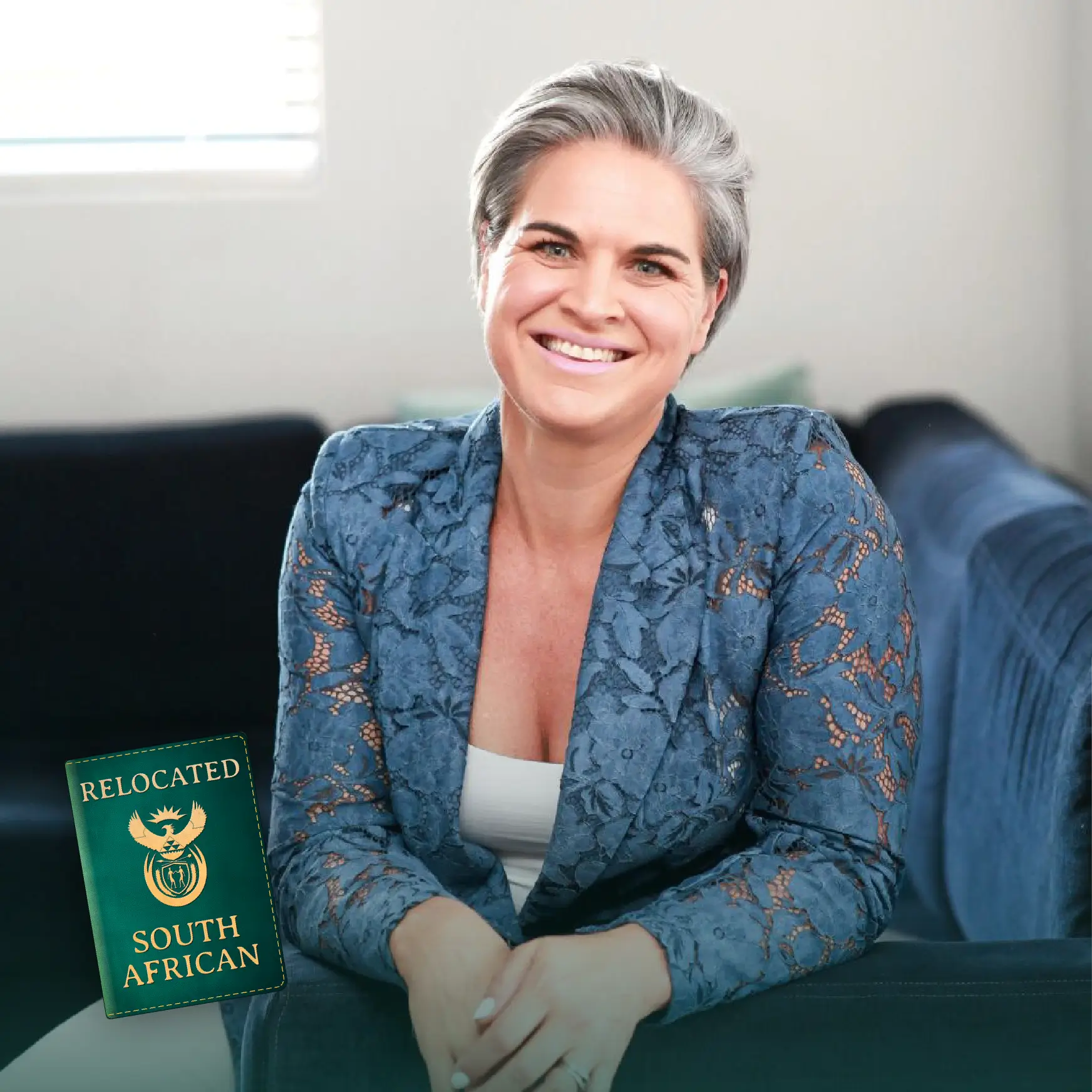
In a powerful reversal of perspective, host Jan Hugo speaks with Rene Koekemoer from Amanzimtoti, KwaZulu-Natal, about the experience we rarely discuss: what it’s like to be a South African parent with kids abroad.
Rene, a single mother who raised three daughters whilst working in real estate, now lives with her eldest daughter and three grandchildren in Amanzimtoti. But her two other daughters live thousands of kilometres away: one teaching in Shanghai, China, and the other, Carine, in New Zealand with her husband, clinical psychologist Kobus du Plooy, whom Jan interviewed just two weeks earlier in Episode 27.
Meeting Rene Koekemoer: Raising Three Daughters Alone in Amanzimtoti
Rene’s journey began on the East Rand in Springs and Boksburg, where she married and started a family. After divorce, she made the brave decision to uproot herself and her three daughters, moving to Amanzimtoti 25 years ago without knowing anyone or having a job secured. “I came here, I didn’t know anybody, I didn’t have a job, and 25 years ago I bought a house and moved in and I’m still in the same property.”
Working at Pam Golding Properties whilst tutoring to supplement her income, Rene worked “like a mosquito because we never sleep. It’s 24/7.” Through sacrifice and determination, she put all three daughters through school and varsity, creating a stable home base in Amanzimtoti that became their anchor.
Empty Nest Syndrome: The First Goodbye to China
Rene’s first encounter with empty nest syndrome came five or six years ago when her youngest daughter graduated and accepted a teaching position in Shanghai, China. “That was my first step in order to say, well, I mean, China is far away. The time difference there between them and ourselves is six hours, so that’s still a little more manageable during the day.”
Her daughter, with a degree in communications, loves working with parents in Shanghai’s Western first-world environment. But she works from 6am to 7pm in a high-rise cityscape that offers little appeal for visits. “Even if I do go there, there’s not much for me to do and I don’t want to travel all the way there and spend the most of my time somewhere else. I go there in order to visit my daughter. I want to spend time with my family.”
When Carine and Kobus Decided to Emigrate to New Zealand
Eighteen months after her youngest left for China, Rene’s middle daughter Carine and her husband Kobus du Plooy made their decision to emigrate to New Zealand. Both clinical psychologists, they toyed with the idea and discussed it privately before approaching their parents. When they broke the news to Rene, she’d already “had the opportunity, not a good one, but to start to work through those emotions.”
Rene understood their reasoning completely: “They are two adults, which I do trust their cognitive abilities. They’re both clinical psychologists. So they’re high-functioning people and they look at life maybe also in a different perspective than us laymen would do because they have more knowledge.”
“Only One Compartment Is Filled”: Living as Parents of South African Emigrants
With her eldest daughter and three grandchildren living with her, Rene explains the emotional reality of being a South African parent with kids abroad: “Only one compartment is fully filled. I have two other compartments that still need to be filled and you can only do that unless you have lots of money to go visit.”
The presence of her eldest daughter helps ease the pain. “In a sense, I do think that because of her living with me and with the little ones, a big part of the void that was left, that was created when my other two kids left, is actually filled with that.” But it can never fully replace the daughters living halfway around the world.
Grandchildren Living Abroad: The Heartbreak of Distance
Perhaps the most heartbreaking aspect of being a South African parent with kids abroad is the grandchildren living abroad. Rene’s grandsons in New Zealand were born there, growing up thousands of kilometres from their South African grandmother. She recalls the emotional goodbye when Kobus’s father put his hand on the car window and the little boy reached back from inside: a moment of connection before months or years of separation.
“It makes me even more sad to just think that I don’t know when Kobus’s parents are ever going to see the kids again,” Rene reflects. With the journey from South Africa to New Zealand taking around 36 hours and flights costing tens of thousands of Rands, visits become rare luxuries. Elderly grandparents may not be physically able to make such journeys, meaning some will never see their grandchildren living abroad again.
The impersonal nature of video calls versus “that personal touch and that personal hug and the kisses and the plays and the crawling” creates a constant ache. “That’s important for them and to build that relationship with the young ones that you miss out on. And even for them, they miss out on that as well because they don’t have a grandparent. All their grandparents are in South Africa.”
The Grief That Parents of South African Emigrants Carry Silently
In one of the most emotionally honest moments in the podcast’s history, Rene admits: “I don’t think I dealt with it actually because I suppressed a lot of the emotion and I don’t think that I actually have worked through it 100%.” The tears come as she speaks, revealing the depth of pain that parents of South African emigrants carry silently whilst supporting their children’s decisions to build better lives abroad.
Rene describes the daily reality: limited phone calls (maybe once a week if you’re lucky), WhatsApp messages saying “I miss you, I love you,” and video calls with grandchildren who wave and blow kisses but can never be held. “There are many times when we do chat, also on WhatsApp. I say, I miss you, I love you. And I get the same back when we speak to each other. We will shed a tear or two and say, Mum, don’t cry now, but then they can start to cry as well. But it’s just a normal human emotion.”
Jan Hugo makes a profound observation: when someone dies, there’s a period of mourning, and then life continues. You work through stages of grief. But when your children emigrate, “you’ve lost people, but they’re still alive and they’re there and you see them, but you can’t touch them. For me, that’s almost the worst thing.”
The Anger a South African Parent with Kids Abroad Feel About Forced Family Separation
Beyond grief, Rene expresses something many South African parents with kids abroad feel but struggle to articulate. It’s not anger at her children, but fury at a country that forces families to make impossible choices.
“We all love South Africa. Believe me, they talk about patriotism in America. I don’t think that they know the ‘Boer’ nation that well. We are really, very proud of our nation. We love South Africa. But for them, if they are happy and they thrive, that’s the most important.”
Jan Hugo draws out this complexity: if South Africa were a normal society like any other country, these families wouldn’t be broken up. But with no opportunities, rising crime, and the impact of BEE policies, brilliant young minds like Carine and Kobus had to choose between staying near family or building futures for their own children.
“I did hate the choice that they made, but I also want them to be happy. And I do know that they’ve made a huge sacrifice.”
Rene Koekemoer
Rene explains that her daughters would still be in South Africa if opportunities existed for them. But the reality is stark: there are simply no opportunities for young, highly qualified professionals. Her daughters need to make a living, and after years of study and the substantial sacrifices both they and Rene made to earn those degrees, they want to apply themselves professionally. The family worked hard and paid dearly for those qualifications. Now, with brilliant minds and valuable skills, her daughters deserve the chance to use what they’ve learned and contribute meaningfully in their fields.
Why There Are No Support Groups for South African Parents with Kids Abroad
Jan Hugo makes a crucial observation: South Africans who emigrate immediately find support systems. They meet other South Africans in Australia, New Zealand, the UK, and elsewhere. They form communities, share resources, and help each other navigate new countries. But in South Africa, there are no support groups for the “agtergeblewene” parents of South African emigrants left behind.
“I don’t know of any support group like that,” Rene admits. “Maybe because I haven’t made any effort in order to find out. There might be, but it might also be a good subject for these learned people to do a thesis on.”
She knows many people in her 5km radius experiencing the same pain: South African parents with kids abroad whose children have “jetted all over the world” to build lives elsewhere. Some cope better than others. One colleague went into “complete total shock” when her son moved to America and “just withered away,” even though she had another daughter and a supportive husband in South Africa.
Jan suggests that churches could create support groups, spaces where parents of South African emigrants can simply talk and share their emotions with others experiencing the same loss. Sometimes all you need is to know someone else feels the same way.
Coping with Empty Nest Syndrome: Setting Goals and Planning Visits
Rene has found ways to manage the ongoing empty nest syndrome that comes with as a South African Parent with Kids Abroad. “I think your mindset is so very important. If you can stay positive and look forward to positive things, like for me, I’m going to visit them now coming January.” Having a trip planned to visit her daughter who decided to emigrate to New Zealand, tickets booked, something concrete to look forward to: these small goals help fill the emptiness between visits.
She also finds comfort in knowing her children are happy, safe, and thriving. “What helps me a lot is to know that they are happy. They’re satisfied with the choices they’ve made. They’re doing well. They are excelling. They live good, healthy, safe lives. And that to me is really a major, major cornerstone for me to be more happy and to be more content with the situation.”
The Parenting Philosophy That Prepared Her for Being a South African Parent with Kids Abroad
Throughout the interview, Rene demonstrates a philosophy that has allowed her to support her children’s emigration despite the personal cost. From the time they were young, she intentionally stepped back to let them develop independence. When other mothers went on school tours with their children, Rene chose to let hers go alone, believing they needed to become strong, independent people who could survive without her.
“The day when my eyes close, I can go with the knowledge of knowing that I left a good, solid person behind,” she explains. This parenting philosophy created stepping stones that made accepting their emigration easier, though it’s still never easy to know your children aren’t close.
She also refuses to make them feel guilty. “For me, I can’t tell you, no, you can’t leave me. What about me? You can never do that because it’s now their turn in order to live their lives.”
Understanding Why South Africans Emigrate to New Zealand: The Brain Drain Reality
Rene articulates why brilliant young South Africans like Carine and Kobus chose to emigrate to New Zealand rather than stay: “It’s a big loss not only for us as a family, but also for society and for South Africa, because there is so much brain matter and grey matter that’s lost that could have been well used.”
The tax revenue alone is staggering: two highly qualified clinical psychologists now paying taxes in New Zealand instead of South Africa. But more significantly, South African society desperately needs the expertise and skills that are leaving in droves. “The society in South Africa could really use what they have to offer.”
When asked about the direction this country is going, Rene acknowledges that her children “are not stupid. They’ve seen the direction this country is going.” The decision to emigrate to New Zealand wasn’t made lightly; it was made by two highly educated professionals who assessed the situation and concluded their children would have better futures elsewhere.
“Somebody Has to Make the Sacrifice”: Generational Love and Loss
In perhaps the most powerful statement of the episode, Rene articulates the generational sacrifice that parents of South African emigrants understand: “Somebody has to make the sacrifice and it’s our generation and our children, that generation. Those two generations have to make the sacrifice in order for the next generation to have a better life. And that’s love. I think that’s love.”
She continues: “I know I’ve had my turn in life. I had a good life. I still have 20 good years left, I believe, maybe more. Yeah, they have the rest of their lives ahead of them and we want them to be happy and to be safe and to be content and just thrive.”
This isn’t martyrdom or resignation: it’s unconditional love making space for the next generation to flourish, even when that flourishing happens on another continent. “Because I could die tonight, I could die tomorrow. And they still have to sit in South Africa that’s not working for them. Just because of me, they have to stay. I can’t do that to them either.”
Two Sides of the Same Emigration Story
This episode provides essential context to Episode 27 with Kobus du Plooy, Rene’s son-in-law who emigrated to New Zealand. Whilst Kobus shared his family’s journey to New Zealand, the challenges of emigration as clinical psychologists, and the emotional moment when his children said goodbye to his father through a car window, Rene now reveals the other side of that story – the South African parent with kids abroad that is left behind, watching the car drive away, returning to a home that will never be quite full again.
Together, these episodes paint a complete picture of what it means to emigrate to New Zealand from a South African family’s perspective, not just for those who leave, but for the parents of South African emigrants who stay, supporting their children’s decisions whilst quietly carrying a grief that South African society has no infrastructure to support.
What Advice Would You Give Other South African Parents with Kids Abroad?
When Jan asks what advice she would give other parents facing similar situations, Rene is refreshingly honest: “That’s a very difficult question because human beings differ from person to person. Every person has their own way of dealing with trauma because it is trauma.”
She acknowledges that mothers may struggle more than fathers because of different roles: mothers as primary carers have a different relationship with children than fathers who traditionally focus on providing. What works for one person won’t work for another because “everybody’s heartstrings are being pulled in different ways.”
Her only real advice for another South African parent with kids abroad is this: focus on knowing your children are happy. If they’re thriving, safe, and satisfied with their choices, that knowledge becomes the cornerstone of your own contentment.
Why This Episode Matters: The Hidden Cost of South Africa’s Brain Drain
This is one of the most important episodes of The Relocated South African podcast because it voices an experience that is pervasive but rarely discussed. Hundreds of thousands of South African parents with kids abroad are living this reality: children scattered across continents, grandchildren living abroad growing up in foreign countries, family gatherings that now require international flights and thousands of Rands.
These parents supported their children through school and university, working hard to give them the education and opportunities that would allow them to thrive. But that very success has created a generation of South Africans qualified to work anywhere in the world, and with South Africa’s limited opportunities, crime, and political instability, many choose to emigrate to New Zealand, Australia, the UK, and beyond.
The brain drain isn’t just an economic issue or a policy failure. It’s a human tragedy playing out in homes across South Africa, where parents sit with their phones waiting for the weekly call, counting down months until the next visit, and wondering when they’ll see their grandchildren living abroad again.
For South Africans Abroad: A Reminder to Call Your Parents
If you’re a South African living abroad, this episode is a powerful reminder of what your parents are experiencing. The brave face they put on during video calls, the “I’m fine, everything’s good here” responses they give: beneath that, they may be suppressing profound grief and loneliness.
Rene’s honesty provides a window into your own parents’ hearts. Consider calling more often, sending more photos, planning visits home when possible, and understanding that while you’re building exciting new lives, someone back home is quietly missing you every single day.
This episode expands The Relocated South African’s mission beyond just the stories of those who leave. Emigration doesn’t happen in isolation; it creates ripples that affect entire families, communities, and a nation losing its brightest minds to better opportunities elsewhere.