Jan Hugo:
Welcome to The Relocated South African, the podcast that explores the lived experiences of South Africans navigating life across borders, whether that means leaving, returning or rebuilding. As always, I am your host, Jan Hugo, from Lagos in Portugal. Check out our website, www.therelocatedsouthafrican.com, and subscribe on your favourite platform.
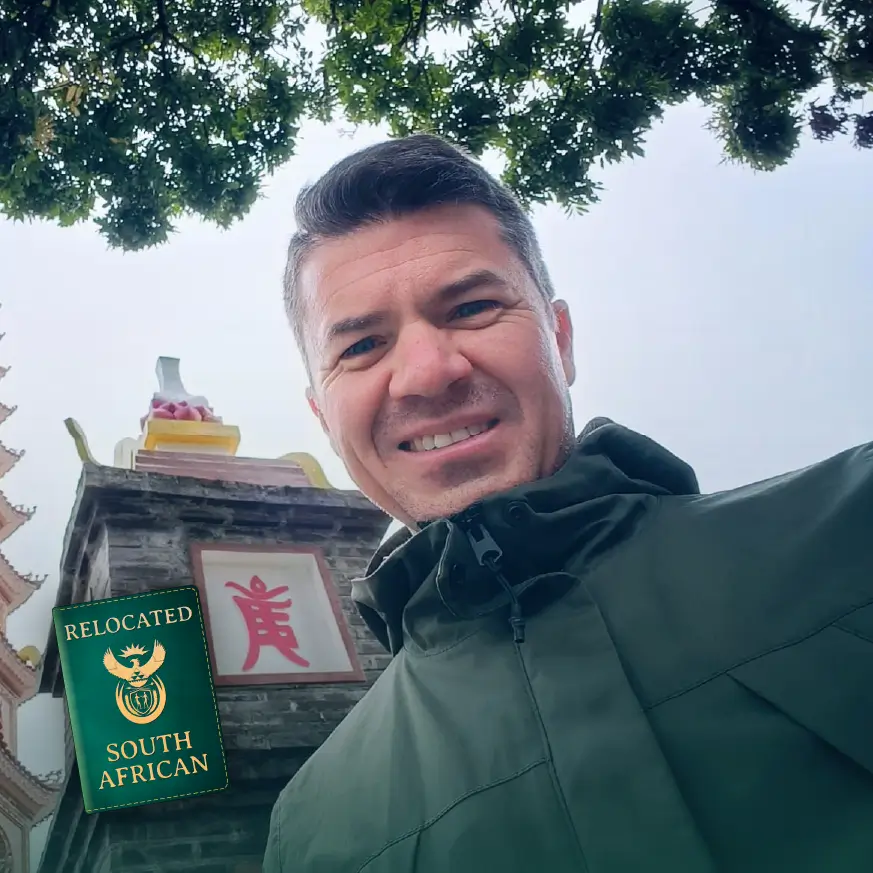
So today my guest is John Pereira. He is a South African currently living in, well, in Ukraine. It is not the Ukraine, is that right? You say Ukraine.
John Pereira:
Yeah, that is right.
Jan Hugo:
Okay, well, so it is so cool to have a guest who lives in Ukraine. And John is very active on TikTok. He said to me that the power may go down while we are talking, so let us hope that does not happen. Welcome, John. So lucky to have you.
John Pereira:
Yeah, thanks, Jan.
Jan Hugo:
Excellent. So I always ask my guests just for a short history: where did you grow up, go to school? You told me beforehand that you lived in the UK for a while, now in Ukraine. So just give us a bit of background history and so on.
John Pereira:
Yeah, so I start every TikTok video with, “I am a South African living in Ukraine.” So I think I will start now as well. I am a South African living in Ukraine.
And yeah, I am from Kempton Park. I grew up in Kempton Park in South Africa. For a while, we lived in Natal when I was a little boy. My dad is an aircraft engineer, so we were always around airports. That is probably why we ended up in Kempton Park.
But yeah, so I left South Africa when I was 20. I finished my Matric. And then my dad said to me, you know, do you want to go to university or do you want to go overseas? And I was never really somebody for academics. I struggled in school a little bit. So I was like, okay, I will go overseas. So off I went to London. That was in 2004, end of 2004. And I have never gone back.
Jan Hugo:
And so your trip to the UK, what did you do there?
John Pereira:
So obviously my dad used to work for SAA, South African Airways. I do not know if they are still around or not. I have not seen any of those aeroplanes around. So anyway, yeah, I got a free pass. I flew over to London for free. My dad gave me the free pass for South African Airways.
And I did not plan anything. I was 20 years old, I wanted to go overseas. This was before I knew how to use the internet properly. So I just went. The internet was for rich people in South Africa back then. So I went to London, I did not set up a job. My dad gave me about 250 pounds or something like that. And then I worked as a labourer in London.
Jan Hugo:
Okay, okay. And then you said that you ended up in the British Armed Forces. How did that happen?
John Pereira:
The British Armed Forces, yeah. But that was after a while. So I went to the UK on a working holiday visa for two years. For two years I was messing around. So I did some medical trials. I do not know if you are familiar with those. I think a lot of South Africans do this when they go to the UK. They test medicine on you, like a guinea pig.
Jan Hugo:
Whoa, no way.
John Pereira:
Yeah, that was my first paycheck. I went to London and I found this thing called a medical trial. So I went in for a medical trial. Luckily I do not smoke, so I got accepted. I went into the hospital for 10 days. They tested antidepressants on me, a new antidepressant. I had wires and all kinds of things. I enjoyed it because there was food, computers, and the internet. So for me it was all right. But some people later on actually died doing this. I do not recommend it. But yeah, that is how I got my first paycheck.
And then I went off to do some labour jobs. The working holiday finished, two years passed, and I had to make a plan. I was like, okay, do I go back to South Africa or do I stay? By that time I had ended up in Scotland. I met some guys there, some Scottish guys, who said to me, we are in the army, and we have a lot of South Africans with us. This was already 2007. I was like, that is very interesting.
I got their contact details and went to visit the guys in the barracks in Edinburgh, in Dreghorn Barracks. I thought it was cool, you know, because I grew up hearing all my uncle’s stories and my dad’s story. Did you serve in the South African Army?
Jan Hugo:
Yeah, I had to do, yeah, two years.
John Pereira:
Yeah, so everybody had a story in South Africa, but my generation did not, you know. So I thought, okay, this is my chance. I can get a British passport, and I can also have some military stories to tell around the braai. So off I went to join the army in the Scottish Regiment.
Jan Hugo:
And was it infantry?
John Pereira:
I was infantry. So that is maybe a mistake I made. I think I should have probably tried engineers. But like I said, I was not very academic, so I just wanted to get in. I just took whatever they gave me.
Jan Hugo:
And the South African passport was not an issue to join the British Armed Forces?
John Pereira:
No. I mean, my visa was about to expire. I think I had about two months of my visa left. So they said to me, okay, apply for a holiday visa, get a six-month or three-month holiday visa. I cannot remember which. So I applied, got the holiday visa, and then I managed to get through the process. But I mean, it was during Afghanistan and Iraq at that time, so they were recruiting heavily from the Commonwealth.
Jan Hugo:
Okay, okay, wow, that is amazing. And what was training like? Was it tough as an infantry guy?
John Pereira:
Yeah, so it is all fun and games when you say you are going to go to the army. But then you actually get the reality check of the fitness, the exercises, the discipline. The basic training is in Yorkshire, in England, at a place called Catterick Garrison. I got there in February so the weather was already starting to change, but it was still not great. So yeah, I had a shock. It was a culture shock.
And when I first got there, I did not really understand what was going on in Afghanistan and Iraq at the time. I was quite naive to be honest. The first videos I saw of the fighting in those places, I was like, okay, well, this is actually real. I did not know what to expect, really.
Jan Hugo:
And I guess in your case, when you go in as a volunteer, we had to go in South Africa, we had no choice. But you are going in, so it is different.
John Pereira:
Yeah. But so now I live in Ukraine, right? And I am sure we will speak about Ukraine. But in Ukraine, they do not have national service. They do not have it here. And for me, it is confusing, because the country is at war. Why is not everybody going to the army, even if it is just basic training? They do not have it here.
So anyway, I think Ukraine can learn from South Africa during those periods of time. Like, first of all, manufacturing everything. In South Africa, we built some amazing military vehicles, the Rooivalk. I do not know, you probably know more than I do.
Jan Hugo:
Yeah, and the Rooikat and the Rooivalk and others.
John Pereira:
Yeah. And in Ukraine, they are too dependent on the West. So I believe South Africa could be a really good example for how they should be navigating this war. But yeah, we will probably talk about that later. But anyway, yeah, I was in the army for six years in Britain.
Jan Hugo:
Okay. And I mean, did you actually get deployed to Afghanistan or Iraq?
John Pereira:
Yeah, so I finished my basic training in 2007, end of 2007. And then I was deployed to Iraq just about a month later. So I went to Basra in Iraq, and it was okay. It was right towards the end of the war. Not long after that, the British actually pulled out. So I was like one of the last guys who was actually in Basra. It was okay. We did not have much action there. We were mostly doing patrols in vehicles in Basra itself and escorting convoys down to where the port was.
Jan Hugo:
That is just fascinating. I am sure you could write a book about all those experiences.
John Pereira:
I do not know. Yeah, and then in 2009, I deployed to Afghanistan. Yeah, that was worse. But it was proper soldiering. Everything was on foot. You had your kit, your backpack. You had to carry your water, carry your ammunition.
So yeah, I got strong in Afghanistan. I was a GPMG gunner, a general purpose machine gunner, so I had all the link ammunition. I was carrying about 800 rounds of link on me. So my bag was very heavy. Every day just doing foot patrols in Sangin, in Helmand Province. That was quite an active zone. There were craters everywhere, from guys that had stepped on IEDs.
Jan Hugo:
And did you actually have bullets coming at you?
John Pereira:
Yeah, not every day, but yeah, we had a few contacts. We lost two guys in that tour. Two guys got blown up. I had three friends who lost their legs. So yeah, it was a reality. It was proper. And then I went home and, you know, you are standing around the braai and your uncle is like, yeah, you young guys, you do not know what war is. And I was like, well, Afghanistan was pretty intense. But you know what South Africans are like. So yeah, we saw action.
Jan Hugo:
Okay, awesome. And then, okay, so the next part is you left the UK, but you went to Ukraine. Now to the casual observer and news follower, that just does not make sense. Tell us what happened.
John Pereira:
So I finished the army and then I went to work as a bouncer in Scotland. I tried to go to university. I went for first year to study business management, because the army helps you financially when you get out. I went for first year, I did not like it, I did not last. But I worked as a bouncer for another six years in Scotland.
Jan Hugo:
Six years, wow.
John Pereira:
And I was building my business on the side. During the day I would work on my online business. I started an Amazon store. Doing that during the day and then at night time I would go work on the doors at nightclubs and bars.
Jan Hugo:
My word, that is interesting. Any interesting stories from being a bouncer? We always see the UK movies and things about pubs.
John Pereira:
Yeah. I mean, I am from the East Rand, right? Boksburg, Germiston, you know. So I know what it is like in Boksburg. And I would not be a bouncer in Boksburg, no ways. The guys just moot each other all the time. You are from the Cape, right? Yeah, so Kempton is rough, you know, the East Rand is rough.
But in Scotland, the people are very controlled. Health and safety is a big thing, and people follow the law better than us South Africans.
Jan Hugo:
Yeah, it is more respect for the law, I guess.
John Pereira:
It is. And I was never a big guy or anything, but I could speak to people. I never had to lift my hands. Sometimes I had to grab people and get them out. But I was never really in serious trouble. I got punched twice, once by a guy and once by a girl.
Jan Hugo:
That is funny. If she knew you were from the East Rand, she would not have done that.
John Pereira:
Yeah, but Scottish girls are tough, you know. So yeah, I did that for six years. I had got my British passport by the time I left the army. That is how I could stay longer. And then once my business started making good money, and I set it up in a way where I could travel.
So in 2018, everything was good with the business and I decided to come to Ukraine for a holiday. I just came here on holiday.
Jan Hugo:
Yeah, and that was obviously before the war.
John Pereira:
Well, the war had already started at that time. Remember, it started in 2014 in Crimea, Donetsk, Luhansk, but it was not the whole country.
Jan Hugo:
Okay, okay. And when you moved across, you could just continue with your business, you liked it and you decided to stay?
John Pereira:
Yeah, I mean, I met a couple of ladies here and obviously whenever there is love involved, you can make some decisions, right? So yeah, I met some Ukrainian girls and I was like, yeah, it is lekker, it is cheap compared to the UK, cheap compared to Western Europe.
And I made a lot of friends. There were a lot of foreigners at the time. A lot of American guys, Swedish, Germans, Brits. So we had a little expat community, and everybody was into online business and IT and computers and all those sorts of things. So we had a really good community. And then COVID happened, and then the war started.
Jan Hugo:
Yeah. And John, initially you said you were in Kyiv. Kyiv, I believe, is how you pronounce it. It is not Kiev. And what was that like during the war?
John Pereira:
So before the full-scale invasion, I enjoyed Kyiv. For 12 years in the army I did not really party. I travelled a lot, went to Germany, went to Cyprus. But I could never really enjoy myself. I never went out, it was always in the barracks.
So I always wanted to, you know, I like a jol. And so in Kyiv it was lekker. There were nightclubs, cool bars, it was full of beautiful girls, it was cheap. So I sort of fell in love with that. I really enjoyed my social life in Kyiv.
And then the war started. In ten days from this recording, it will be the four-year anniversary of the full-scale invasion. So on the 22nd of February, me and my girlfriend were lying in bed and at 5am the sirens started. So I woke up.
There had already been a lot of media coverage before that. The media started reporting activity on the Russian border in November of 2021. So there was a lot of talk of war, but nobody really expected it to be the way it is today. So we woke up at 5am, sirens going, and I left back to the UK for nine months.
Jan Hugo:
And also you mentioned that they targeted the electrical infrastructure, a lot of load shedding, power failures and that kind of thing.
John Pereira:
That is this year, yeah. I would say this year has been the most effective. They really broke it this year. Previous years it was like maybe a week of inconvenience, but this year, yeah, it has been bad. They are getting better at targeting, hitting their targets. And they are overwhelming the system now. They send in like 200 Shaheds as drones, and then follow up with ballistic missiles.
Jan Hugo:
And it must be, I mean, it is really interesting just from a news perspective. For me, sitting on the outside, you read this about Putin, this about Zelensky, this about Trump. You actually do not really know what to believe and what is really going on there. What is your take on the thing? Is there an end in sight, or is it just going to carry on?
John Pereira:
So I do not really follow it anymore. I have come to realise that I cannot change anything. I like this place. I like the culture. I feel tremendous sympathy for the people, especially the older people, the pensioners and the kids. I feel really sorry for them because a pension here is small. It is like South Africa. My mother is on a pension in South Africa. I think it is R2,000 a month that she gets from the government. So here it is the same.
I mean, there is a lot of, I do not know how to say it, around Ukrainians stealing money out of the war and buying these multi-million dollar houses in Europe. And I am sure that is happening. There is corruption here as well, like in South Africa. It is like whenever there is new money.
So remember, South Africa went through apartheid. And now you go to Sandton, in Johannesburg. You go to Sandton and you see the people hanging out in the restaurants in Mandela Square. You have been to Sandton?
Jan Hugo:
Yeah, yeah.
John Pereira:
So you go to Mandela Square and there is a lot of affluent black people in Sandton, in the restaurants, all wearing the Prada and the Louis Vuitton bags and all this stuff. So I strongly believe that there is old money and new money. Us farmers in South Africa, we are old money. We do not really like to show our wealth. I mean, it does happen, but it is not so obvious.
And the Ukrainians are the same. After the Soviet Union collapsed, before that, people were poor, they had their own struggles. It was like their version of apartheid. And now people like to show off here. So you can go to a nice restaurant here and there will be girls wearing $2,000 clothing, G-Wagons and Land Cruisers and those sorts of things. My point is that in Ukraine, our history is more or less the same as South Africa.
Jan Hugo:
And you have moved from Kyiv to further west, you said. What is the town called where you are now?
John Pereira:
So now I am in Lviv.
Jan Hugo:
Lviv, okay. And life there, is it just a normal city like any other European city, other than the electricity issues? Or do you guys have a sense of fear as well?
John Pereira:
So I do not think as much as in the east. I am sure there are still people scared here because we do get attacks. But it is nothing like in Kyiv. Kyiv was hit hard. What I can say about this city is that Lviv has got Polish and Hungarian roots. In Ukraine, they have always been at war. It is nothing new. It is either been the Russians or the Mongolians. Genghis Khan came through here, you know.
So this part where I am right now used to be part of the Hungarian Empire. It is much more European on this side. If I walk around in this city, it feels like you are in Krakow or in Prague. It is old, very historic, it has got the classical historic city centre like you see in Prague and Krakow. But then you go more east and you start seeing the Soviet architecture, which I think is ugly. It is all square. There is a name for it, but I do not know the name for it.
But yeah, it is a beautiful city. Lviv is very beautiful. It has got a lot of restaurants. It is a very touristic city.
There is martial law in Ukraine right now. So that means if you are a man, a male between the age of 18 and 60, you cannot leave the country. Everybody is stuck here. The men are stuck. If they try to leave the country, they will go to prison.
Jan Hugo:
Wow. And do they get rounded up to go and fight, or is that just a nonsense story?
John Pereira:
No, they do. Yeah. So there is something called the Titsika. I do not know what it is short for, but they call them the Titsika. And the Titsika are military guys who are at the train stations, walking around in city centres, and they stop men and check their documents.
And if you do not have your documents, there are some horrible stories where these guys drag people into a van and off they go to the war. That I do not like about this war. We spoke about national service in South Africa, everybody had to go to the army. But the way they are doing it here, I have read now that Zelensky has appointed a new commander in the military and they are working on changing this, because a lot of guys are living in fear. They are not going out, they are staying at home. Too scared to go to the shops, too scared to go to the cinema or the shopping mall. So they just stay at home. And it is a problem for psychological reasons. There is PTSD for the guys on the front line, and then there are the guys at home who do not want to go to war and have been hiding at home for four years now. So they are smoking marijuana, drinking heavily, playing video games. That is their life.
I am lucky because I am a foreigner. I cannot be drafted into this war. The Titsika can stop me, and they have, and I just show my passport and they say okay, they cannot touch me. So yeah, it is sad.
Jan Hugo:
That just sounds horrible. But for you now, I mean, you said you go out to restaurants, no problem, no restrictions. You say the martial law is just about leaving Ukraine?
John Pereira:
Well, there is a curfew. So we have a curfew, that is midnight. It is not so strict. Yeah, till 5am.
Where I live, it is not so strict. There have been many times where I have been out, a little bit drunk, walking home. I have been stopped by the Titsika, but normally I do not have any issues.
But yeah, there is a curfew, and there are other laws as well. So I recently purchased a second vehicle. Right now I have a Jeep and I also bought a Tesla. That is a business venture I am working on. I am going to rent it out as a taxi business to taxi drivers. But we have got power outages, hopefully that gets better.
But yeah, there is a law here that if you own two cars, the government can take your second car and use it for the war.
Jan Hugo:
Whoa, that is amazing.
John Pereira:
Yeah, so I have a Jeep and technically they can take my Jeep because I have two cars. But I am on a volunteer visa. I do some volunteer work as well. I am part of an organisation called UA Lifeline. It is nothing serious. A friend of mine that I met in Kyiv many years ago, he is a veteran as well, and he has got this volunteer organisation. So I am part of that. We use the car for that as well. So I think my car is safe because I am doing some participation.
Nothing serious, like, I went to Sumy last year, to the east. It is about 30 kilometres from the border with Russia. We went there, did some training with the Ukrainian military, took them some medical equipment, some medical training, stuff like that. So yeah, I am a little bit involved, but not much.
Jan Hugo:
And the restaurants operate like normal, and people go out and go about their daily lives?
John Pereira:
Yeah. The food is nice here. It is very tasty, good dishes, it is fresh. Ukrainian food is very tasty. I would recommend everybody to visit. There are probably Ukrainian restaurants all over Europe now with all the refugees who have left and started businesses. So you will find a Ukrainian restaurant probably in your city. Go and have a good time one night and order borscht. It is a soup, a traditional soup, like a beetroot, tomato and cabbage soup. Very tasty. I recommend everybody to go and try some Ukrainian food if they can.
Jan Hugo:
And I was going to ask you about dishes and things. Is meat readily available?
John Pereira:
Yes, but it is not as nice as South African meat. That is one thing I do miss, our meat. But yeah, they like pork and chicken here. Beef is quite expensive.
Jan Hugo:
That is absolutely amazing. And so you have made friends and so on. Have the Ukrainian people been quite welcoming to foreigners and outsiders?
John Pereira:
Yeah. I am single now, so I go on a lot of dates. I quite like the culture. It is very similar to Afrikaner culture. It is very conservative, very religious people. That is sort of why I came here as well, because Western Europe is becoming a little bit too vague for me.
Poland as well. Poland is still very much conservative and traditional, like us Afrikaners. So I guess maybe in that sense I find similarity.
The guys are very friendly but once you get to know them they are not as friendly as South Africans, where you walk in the morning and people say good morning. It is not like that. But once you get through there, I say it is like an onion. You have to peel away the layers a little bit. And once you start getting into their life, they will always be very helpful.
Like I have a big problem here with the language. I can speak Ukrainian enough in the restaurants and on the streets to have a basic conversation, but I cannot solve big problems. If the car wheel needs to be changed, I need to get the translator out or need somebody to translate for me. But yeah, very friendly, and I think they are very open to foreigners.
Jan Hugo:
And if you can speak Ukrainian, can you speak Russian as well? Is it very similar to Russian?
John Pereira:
So Kyiv is where the country starts splitting a little bit. Before the war, Kyiv was predominantly Russian-speaking. My ex-girlfriend is from Donetsk, so they speak Russian. I was going to Russian-speaking clubs, trying to improve my Russian.
But then when I moved to the west, the west of Ukraine has always been a little bit against speaking Russian. This part of Ukraine is very Ukrainian, very patriotic. So when you come to the west, they do not like it when you speak Russian. So I had to switch.
Jan Hugo:
Okay. I chuckled after we spoke on the phone the other day when you said you can speak enough Ukrainian to ask, are you married?
John Pereira:
Yeah. So like I say, I am going on a lot of dates here and sometimes the girls do not speak English. We figure it out somehow, and I like it because my Ukrainian improves a lot more. When I am with somebody who speaks English, my Ukrainian does not grow.
Jan Hugo:
Excellent. And John, one of your TikTok videos, and we will talk about your TikTok at the end, but you talked about average salaries in South Africa compared to what it is like there, and comparing cost of living in Ukraine versus South Africa.
John Pereira:
Yeah, so average salary in Ukraine is about $500 a month. I think even that is on the high end. I think some people are on $200 to $500. That is your average person.
But there is a big IT sector here. There are a lot of software developers, and that is why they are becoming a big player now in drone technology. I think it is because of the IT sector they have here. They are clever people. If you are in IT, you are earning a good salary.
So all the guys in the nice cars are probably working in IT, or maybe they are a diplomat in the government, and they are probably a little bit corrupt. It happens everywhere. But most guys in IT are earning $5,000 to $10,000 a month. And for Ukraine, that is an amazing salary.
Like, I can go out to a restaurant here, have a three-course meal, and it is 15 euros. Fifteen, twenty euros, it just depends where I go. I can go to a lanie place and it is the same prices as Europe. But in general, you can find very cheap places.
My rent, for example, I am living in a one-bedroom with living room. My rent is $650 a month. They like to pay in dollars, so whenever you pay for rent it is in dollars, because the currency is so volatile. But gas and electricity for me is about 40 euros a month in winter. So yeah, cost of living is cheaper here. But you want to earn money online. You want to earn your euros. To come and work here for their currency is not a good idea.
Jan Hugo:
Okay, and that is your business, so your business is online?
John Pereira:
Yeah, in pounds.
Jan Hugo:
Yeah, okay. And in terms of just thinking about it, do people drink beer and vodka? Is it similar to elsewhere?
John Pereira:
Yeah, I mean, they have a problem here, like in Russia as well. The guys die young. A lot of girls I meet, their fathers are dead, not just because of the war, but because they drink too much. And I used to like it, you know. As South Africans, we have a big drinking culture as well. And here as well.
So yeah, you will see a bunch of older guys sitting at a table and there will always be a bottle of vodka on the table. They do not order by the glass, they order bottles. And so they will have the pickles, the onions, and salo. Salo is like pork fat. So you will take a shot of vodka and they love to toast. Whenever you go to a birthday or something like that, there is always a toast, and everybody toasts. Then it is like davai, budmo, and then the vodka shot.
And I used to like it, but then I had a terrible gat one night, got too drunk and ended up in hospital. That was New Year’s Eve. And it was a public hospital, so it is like an African hospital. After that night I decided to stop drinking. I do not drink anymore.
Even though it is very cheap to drink here. Vodka is cheaper than water, and it is tasty vodka. Actually, vodka was invented in Ukraine. It is called horilka. That is the proper word for vodka. But the Russians say it is theirs, you know. So I do not know who is right or wrong. But yeah, big drinking culture here.
Jan Hugo:
And do they brew their own beer, Ukrainian beer as well?
John Pereira:
Yeah, they have craft beer. There are a lot of craft bars. It is very modern, and they spend a lot of money on it. There are a lot of beautiful restaurants here, a lot of beautiful cocktail bars. They have got breweries, like you go into a craft beer place and they have got all the big tanks there and they are making their own beer.
Lviv is very popular for beer. They have a beer here called Pravda. Pravda means truth in Ukrainian. It is a very nice beer. My favourite beer is from Scotland, it is the BrewDog. And my second favourite is this Pravda beer. Very tasty, and they have a huge selection.
Jan Hugo:
Excellent. You briefly mentioned ending up in hospital. What is the healthcare like? You say the public hospitals are like Africa. Is there decent private healthcare?
John Pereira:
Yes. So the private healthcare is good, but not everybody can afford it. Normally if I am sick or need something, I go to a private clinic and it is about 500 hryvnias for a consultation, which is about R250. You see a doctor and then they will say, okay, you need an X-ray or blood work or whatever, and you come back. And it is very good. The private healthcare in Ukraine is better than in Europe.
Jan Hugo:
That is amazing. And do the doctors not get called up to go and work on the front and help with medical services in the war?
John Pereira:
Yeah, there is a lack of labour here. Construction, like my friend is Ukrainian, he has got a construction company and he is struggling to get guys. Because they are working in Portugal. There are so many Ukrainian guys working in construction there.
But the women are stepping up. Ukrainian women are very strong. A lot of the females have stepped in. There are a lot of women working in pharmacies, restaurants, doing administrative jobs, working as doctors. But there are still a lot of guys around. I do see male doctors.
Jan Hugo:
And you mentioned, when we spoke the other day, you showed me the snow outside. Have you adapted to the weather? Going by Scotland and then into Ukraine, are you comfortable with the weather?
John Pereira:
Yeah, so Scotland, I do not know how I survived there for 12 years. Like really, Scotland is like Ireland. I think a lot of us Africans who are in Ireland would agree, yeah, it is miserable in Scotland.
So here it is more seasonal. You know when it is spring, when it is autumn, when it is winter, when it is summer. In Scotland, you do not really know.
But this winter has been tough. Very cold, a lot of snow. Apparently colder than any winter in 100 years. So yeah, it has been tough, and it is depressing, I am not going to lie. I do not know if I want to do another winter here. It is dark now. It is 4:30pm and the sun is already going down.
But in Scotland it is even worse. In Scotland the sun starts going down at 2pm in winter. But then in summer it goes down at 11pm.
But I guess it is important to have the right clothing. You are not going to walk around Ukraine in khaki jackets.
The first time I saw Russian people was in Helsinki. Because they also have a brutal history with Russia. Every country next to Russia has had a difficult time. So the first time I saw Russians in Helsinki they had these fur coats and fur hats. This typical image we have of Russians. And here they have the same thing. They know how to dress for the cold. If you do decide to come here, you want a nice jacket, a scarf, a hat, some gloves, the thermals. And you want shoes that can grip on the ice, because it is very slippery.
But it is very beautiful. I am close to the Carpathian Mountains. The Carpathian Mountains are so beautiful. I would recommend everybody to visit. West Ukraine is safe. If anybody wants to come and visit Ukraine, come to Lviv and then go to Bukovel. Bukovel is a ski resort, about four hours away.
Jan Hugo:
Okay. And you said you cannot fly into Ukraine, but you can fly into somewhere like Prague or Krakow?
John Pereira:
No, no. Yeah, so I usually take one of three routes. Either Warsaw, from Warsaw I take the train to Rava-Ruska, and then I change trains in Rava-Ruska, which is in Ukraine, and the passport control is there. The second option is Krakow. Krakow is also an easy destination, you can get a train or a bus. But the border is a nightmare. Sometimes if you come by bus or car, you can sit at the border for up to 10 hours.
Because the whole country is coming in and out at the border. If it is busy season, before Christmas or before Easter, you are sitting on that border for hours. And if you have a flight, you miss it. So it is quite stressful.
And then the third destination is Budapest. Budapest is also an easy destination.
Jan Hugo:
And John, we are starting to get towards the end, but just briefly, you were in South Africa recently. What was that like for you? Be honest.
John Pereira:
Yeah, so I mean, I am from the East Rand. And it is gone. I mean, there are still nice areas where my dad lives, in a gated community. But where I went to school, it is not squatter camps, but it is slums. The flats where my grandpa used to live, it is now rubbish everywhere outside. There are people with tents on the grass. There are prostitutes, and I even see white prostitutes now as well in black areas. I think a lot of them are foreigners, from different parts of Africa.
And it is terrible. For me, it is harder to see that than what I see in Ukraine. I know Ukraine is going to get through this. But how is South Africa going to get through that? I think it is a downhill spiral from here. How are they going to get everybody up to a decent level where everybody has something to lose? Because right now, people are committing crime because they have nothing to lose.
Jan Hugo:
That is very true. As you say, it is a bit of a reality check for you as well. Obviously you said you may not live in Ukraine forever. South Africa is not on the cards as an option for you?
John Pereira:
I think it is good to live between both. I do not want to earn rands. In my TikTok channel I made a video where I went to change money at the bank, just dollars. I could not even change $100 for rands. I did not have my passport at the time. It is so controlled. Why can you not just change $100? Here in Ukraine I can go now and they will take the money.
So I do not want to be part of the ANC’s plan. As long as the ANC is in charge, and I know in the Cape it is different, you have got the DA, but as long as the ANC is in charge of Gauteng, I will never ever go back to South Africa. I want the ANC gone. It is like Putin. I feel the same way about Ramaphosa and all these guys. They are all corrupt, and it is the poor people on the street who pay the price.
Jan Hugo:
I hear you. That is amazing. You touched on the TikTok videos. How did that come about?
John Pereira:
So there have been a few videos where I hit a nerve and got a lot of views. The first video I made was about the black guys who were caught here in Luhansk. They were poached, offered jobs in Russia, and then they ended up in the war. So I made a warning and said, if somebody approaches you and offers you a job in Russia, because there are a lot of desperate people in South Africa, and if somebody says we are going to pay you $2,000 a month, you know, if I was living in a squatter camp I would probably say okay, yeah, I will go. Right?
So these guys got caught up in this war. I just made a video and said, listen, you are going to end up in the war and you are going to die. And these Russians do not care. All the black people in South Africa think Russia is their friend because Russia supported the ANC during apartheid. But these Russians do not care. They did not even care about their own people.
So anyway, I made that video and it got some traction. And then I was like, okay, if I talk about political things and mention certain things in the video, I get quite a lot of views. So I kept going with it. But now I am a bit tired of political videos. I would rather make positive videos about positive things, but you just do not get the same views. People like the drama.
So I am not sure I am going to continue with TikTok, but I tried. There are a couple of nice videos where I go into restaurants and show the food and stuff like that. I would like to make a business around TikTok at some point. I do not know how, but that is the plan.
Jan Hugo:
Yeah, that is awesome. That is interesting. And I have seen some of your videos have had crazy numbers of views. What is your TikTok handle, just for the listeners?
John Pereira:
So it is diary_safa_john_travel. Or @john05735.
Jan Hugo:
So diary_safa_john_travel. Awesome. Now people can find you.
John Pereira:
Yeah. I would love to. I have started doing TikTok lives, and a couple of people tune in and we talk. I do not really like to talk about politics. It is always good to focus on things we can change. But yeah, that is the plan, to make a business out of TikTok.
Jan Hugo:
Awesome. And I mean, getting close to the end, if you met a young John coming out of Matric today, knowing what you know now, what would you have advised him? To do exactly what you did, or to go a different route?
John Pereira:
So I would say, I wish I had saved more. Everybody goes to the UK back then to earn money, earn the pounds, and then to buy a house in South Africa. Now I would say, not necessarily do that, but invest. Get financially educated. Take the opportunity when you are earning these currencies, when you do decide to leave South Africa and come to these international countries for a better life, because we are also refugees in a way, like the Ukrainians.
So if you do decide to come abroad and you are young, make sure you do not do stupid things by drinking too much and partying. Because it is expensive to drink, especially if you go to Western Europe. In Amsterdam, it is nearly 12 to 15 euros for a beer.
So when you are earning the euros, make sure you get yourself financially educated so you can invest the money, either in the stock market, save up, build a credit score wherever you are. Try to buy some property in these first-world countries and maybe rent it out.
I wish I was more financially educated when I came over to the UK. I would have made much better decisions and been in a better position. But no, you know, as South Africans we are thinking about Braai and Dop, Brandewyn and Coke and a chop, you know.
I see my cousins who are 21 years old and I am like, come on guys, focus on investing, get financially educated. That is my biggest advice for youngsters. I wish I had somebody who took me under the wing. My dad is an engineer, he never really showed me anything. My mom was a housewife. I think as South Africans we never had the exposure to the internet and financial education as much as they had in America and those places.
Jan Hugo:
Very, very true. Excellent. You said that when I asked about the meat, you said you miss South African meat. Is there anything else you miss from South Africa?
John Pereira:
I miss Afrikaans. I miss speaking Afrikaans. I think our Afrikaans language is going to die out one day. Maybe. I do not know. I cannot see it lasting for two, three hundred years. So many Afrikaners have left, and for some reason they lose their accent. They are not proud to be Afrikaners.
So I miss Afrikaans. I miss the braai, the bush. I miss the bush. My mom lives in the bush outside Bela-Bela, or Warmbad. I love going there and sitting around the fire, hearing all the insects, and there is like a kudu walking there, and a gemsbok.
I really miss that. We really have a beautiful country. The problem is that here in Ukraine, people are used to bombs falling now. They are used to sirens, like it is part of life. And in South Africa, people are used to things getting run down into the ground, things not working. And they just accept it.
So I think we can also learn from the Ukrainians and fight for keeping people accountable. If our government is corrupt and stealing everything, and nothing is working, no electricity, water pipes are bursting, robots getting stolen, like in Kempton, 50% of the traffic lights do not work. It is treated like a stop street. And people need to keep people accountable.
So I miss South Africa, just the people, the spirit. But I will probably go back one day with a Ukrainian wife.
Jan Hugo:
That sounds awesome. My word, I really enjoyed chatting to you, John. Thank you so much for being available and just sharing what life in Ukraine is like. It is awesome to just get a picture from somebody who is actually living there. I really want to say thank you.
John Pereira:
Yeah, so if anybody has got an adventure bone in them, come over to Ukraine. Write me a message on TikTok and I will be more than happy to show people around here in Ukraine and point them in the right direction if they want to come over. I think it is okay.
Jan Hugo:
Excellent. Thank you so much, John. I appreciate it. As always, if this episode resonated with you, you are welcome to share it with someone who might need to hear it. And you can find out more on therelocatedsouthafrican.com, where all our podcasts are listed. Thank you for listening and I will see you next time.
This transcript was generated with the assistance of AI technology and has been reviewed for accuracy.