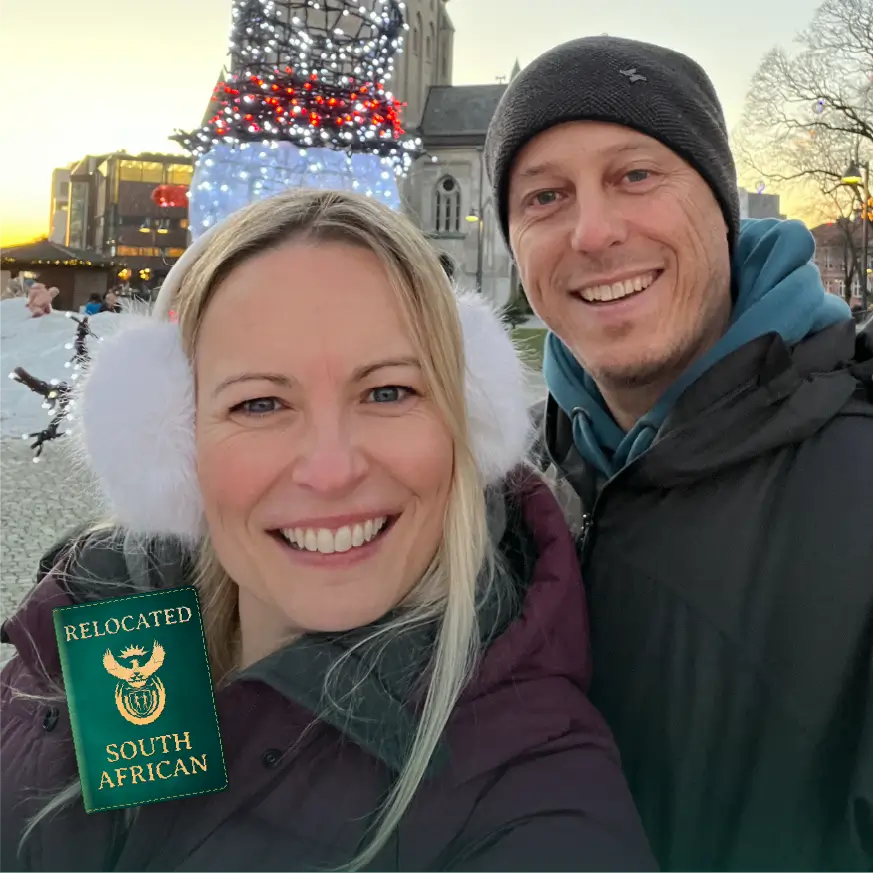
Jan Hugo: Welcome to The Relocated South African, a show for navigating immigration from South Africa for a better future. I’m your host, Jan Hugo, from Lagos, Portugal. Check out our website, www.therelocatedsouthafrican.com. It contains a whole lot of useful information and details of all episodes to date. If you want to interact with us or comment on our discussions or even participate in an interview, please contact me at jan@therelocatedsouthafrican.com. Also, if you like our content, why not subscribe on your favourite platform?
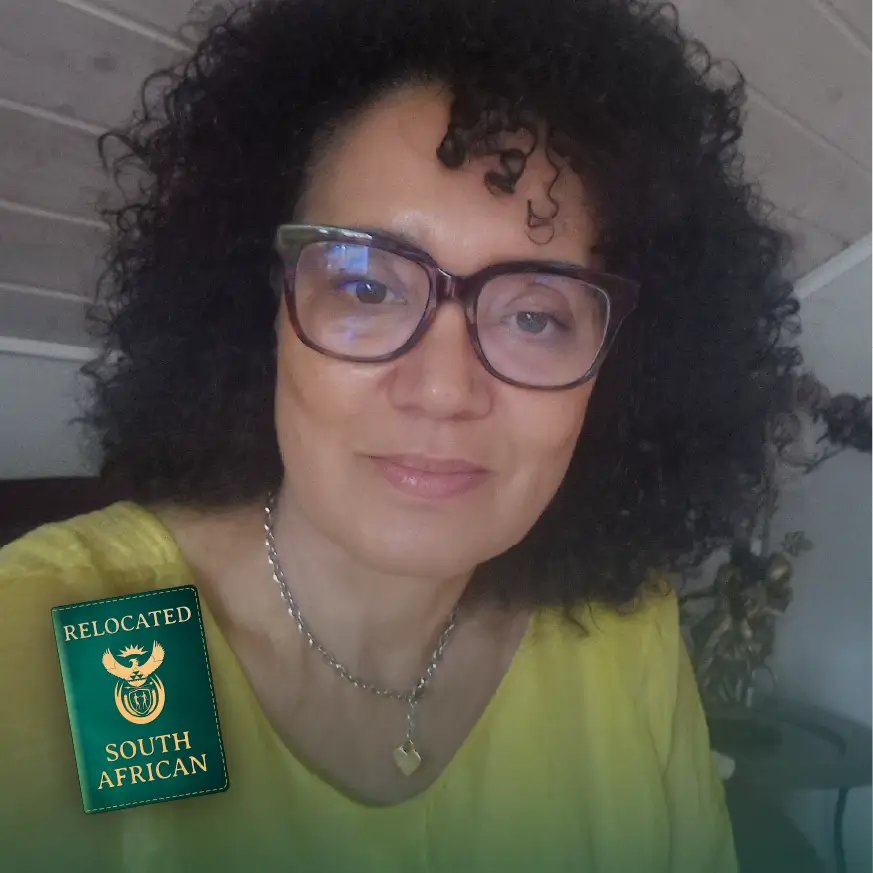
So tonight, I’m very pleased to welcome to the show, and this I have to say is my first interview with a person in Sweden. Welcome, Wendy Carlsson.
Wendy Carlsson: Thank you, Jan. Thank you so much. I’m excited to be here.
Jan Hugo: Fantastic. Wendy, before we started, you were talking about being in the countryside. Maybe you can explain to us exactly where you are in Sweden.
Wendy Carlsson: We live in a town in Sweden called Altuna. And this little town is about, well, it’s not really a town, it’s a village. It’s about 45 to 60 minutes out of Stockholm. And our closest bigger town is Enköping. So we’re in the countryside with one other neighbour, Dutch neighbours on the other side of the road. And we live on a smallholding that’s in the forest, about between 7,000 and 10,000 square metres of open fields, a little bit of forest. So yes, that’s where we are.
Jan Hugo: And have you had snow yet?
Wendy Carlsson: Yes, we have. We have had snow. We had snow last week. Funny that we had from one day to the next, we went from eight degrees to minus 15 the next day. We’ve had snow. We’ve had snow melted. It’s now, we have five degrees at the moment, which is warm. It’s a warm evening in Sweden. Yes. That’s the weather for us for now, for the dark November into December.
Jan Hugo: Wendy did say that the fibre internet has not arrived in the countryside yet. So if we have some connection issues, we will apologise. But maybe just to start, Wendy, just give us a bit of a history and background. Where did you grow up, go to school? And interesting, how did you end up living in Sweden today?
Wendy Carlsson: OK. I was born in 1966. I’m 59 years old. Born in Athlone, a typical coloured community in Cape Town. One of four siblings and two stepsiblings. I went to school, many different schools in Athlone as well as in Kensington. We moved around quite a bit. We were quite a gypsy kind of family. And in my high school, my last high school years were spent in a suburb called Strandfontein, which is just next to Mitchell’s Plain, where during the Group Areas Act years we had been moved to that part of Cape Town out of the central Cape Town. So this township was built in the late 70s, early 80s, and that’s where I finished my high school in 1984. So that’s a bit of myself and four siblings at home, and mother, father. My mum was a housewife and my dad was a hawker, so he sold fresh fish, snoek and eggs. Do you know snoek?
Jan Hugo: Absolutely. Do you know that fish? Yeah, of course I do.
Wendy Carlsson: My father, hey. OK, so you know snoek. My father was a fisherman that came around from door to door with a fish horn, blowing the fish horn, obviously in our areas closer to us. And so he had one vehicle for fresh fish and another vehicle for fruit and vegetables. So that was our upbringing, going to Kalk Bay to get the fish, helping him count out the money at night time when he came home from selling. So that was my kind of upbringing in the earlier years.
Jan Hugo: Fascinating, Wendy. And after school, did you start working?
Wendy Carlsson: Yes, I started working. My dad died in 1981 when I was 15 years old. He had cancer. So I finished high school. I was lucky enough of the four of us to finish high school. My older brother finished just, you know, then they called it JC, Junior Certificate. So he finished Standard Eight. My brother that was younger than me also finished high school, and we had a younger sister, we have a younger sister who was nine years younger than me.
Anyway, so after school, finished matric, passed matric. And before that, when my father had died, I’d started working as a casual at OK Bazaars, you know, OK Bazaars, the candy stripe uniform at OK Bazaars. So I worked as a casual on a Friday and a Saturday. In those days, shops wouldn’t open on a Sunday yet. So I worked in OK Bazaars in Mitchell’s Plain, and I matriculated and then went on to try and find a job. My mum obviously needed the income, and I got a job in a printing company as an invoice typist. So I would do invoice typing. I did various jobs. The next job was at an advertising agency in administration. But my background after that, I had Lisa, my daughter, in 1991. I then opted to go into sales because sales, it was a better opportunity in terms of having a better income. So you’d at least have commission to add to your salary. But that was my foundation.
Jan Hugo: Amazing. That’s fascinating. And your partner, now your husband, when did you meet?
Wendy Carlsson: So Lisa’s father, my daughter was born in 1991. I divorced her father in 2000, and we were on our own from then, Lisa and I. But I met Lars in 2017. So I met Lars in 2017. I met him in Spain, in Málaga. I had been, I decided after Lisa turned 25, I decided that I was going to do something really wild, sold everything I owned. I didn’t own a house at the time, but sold my knick-knacks and my car and decided to go do a TEFL course in Spain. I thought, right, Wendy, do something totally different out of the norm.
And I had always been a traveller. And I’d always been a reader. And I think when you’re a reader, you become a storyteller. And I’d always had this wanderlust to travel. I’m backpedalling a little bit. In the year 2000, after I divorced Lisa’s father, 1999, I took her on a trip to the States and to Disney World. And once that travel bug hit, I was just wanting to travel.
Anyway, fast forward to looking after Lisa on my own, taking care of her, I was in sales. I did sales for a while, and then I decided to sell everything and go and do a TEFL course in Málaga. And that’s where I met Lars online. TEFL is the English teaching course. So you go and do an in-person teach English as a foreign language course, which was interesting because you’d actually go and teach Spanish people to speak English. And you’d do half day, half day you would do theory, and half day you would actually do the teaching, the actual teaching.
So I met Lars while I was there. And back and forth from, I hadn’t thought that I would meet a, that I’d meet a Swede, or Sweden wasn’t even on my radar. But I’d come to Sweden to visit him. He’d come to South Africa with his two sons to visit me. And eventually he asked me to move to Sweden. And at the time, because after Spain, I went back to Cape Town, Lisa told me that she was going to have a baby. So I went back to Cape Town after spending four months in Spain. And after seeing Lars a couple of times, back and forth, spent a couple of months here, he asked me to move here. And I decided, well, why not? And that’s where, I don’t know if it was pure craziness or courage on my part, but yes, I moved to Sweden. It took nine months for the paperwork to be okayed. So I got a spousal visa, which is coming, moving to somebody that you’re going to live with. In 2019, I moved to Sweden.
Jan Hugo: Wow, you are a lady of courage.
Wendy Carlsson: I don’t know about that, most probably. Thank you, though, for the compliment. But a combination of brave and crazy, courageous, all those words come to mind. Life is so short that one has to do these things. And I’m sure you haven’t looked back.
Jan Hugo: So your daughter is still in South Africa with your grandchildren?
Wendy Carlsson: Yes, my daughter is in South Africa. She now has two grandchildren. Leah is eight, and Franco was born in 2020 during COVID. So Franco is five years old now, and Leah is eight. And yes, thank God for video calling and for being able to see them. I travel to South Africa quite regularly. This year I’ve been twice. I usually go once per year. I went twice this year because I wanted to surprise Leah on her eighth birthday in September.
Jan Hugo: That is fantastic. And so tell us about life in Sweden. What’s that like?
Wendy Carlsson: Life in Sweden has been wonderful, wonderful growth, perfect growth for me in that in a world where you don’t have to worry about safety, about security, I think that you then create the capacity to learn other things. I think this peace that I sought and found here is something that money can’t buy. Seeing children, you know, I still am amazed with seeing children walking through the woods or cycling through the streets on their own. It’s quite a sight to behold.
Sweden has also offered me this opportunity to start this business, which I love because think about me cleaning houses. And while I’m cleaning houses, I can listen to your podcast.
Jan Hugo: Thank you.
Wendy Carlsson: Yeah, so you told me offline before we started about your business. And that’s fascinating. So maybe just tell the listeners what you do.
Wendy Carlsson: Yes, yes. So I came to Sweden in 2019, and after trying to get a job, I realised that without the Swedish language, I wasn’t going to be successful in getting a job. English is the second language of the Swedes, but obviously they prefer and choose to speak Swedish when in Sweden. So after trying to get a couple of jobs, I looked at what cleaning people were being paid, and I started my own business. So went through the red tape of getting a VAT number and having designed my own little logo. I’ve called it EnviroClean, and EnviroClean is now running well.
Jan Hugo: Fantastic. And do you do it just in your area, or do you go further afield?
Wendy Carlsson: So I’ve got a few clients in Stockholm. So I do like a day in Stockholm, or yes, one day a month in Stockholm, because those clients only want once a month cleaning. Most of my clients opt for twice a month cleaning, which is every two weeks. But it’s about 30 minutes away from where we stay. So before we bought this house that we’re in now, this country house, we used to stay in a town. So the town was 30 kilometres away. But yeah, so that’s what I do while I’m busy cleaning. I’m listening to podcasts.
Jan Hugo: So you’re listening to The Relocated South African or The Diary of a CEO?
Wendy Carlsson: I like him as well. I also listen to that one. Yep.
Jan Hugo: And Wendy, I mean, the obvious question that we always ask people who live in the Northern Hemisphere. I spoke to people from Norway the other day. He sent me a message last night to say they just have rain, they haven’t had snow yet, but it’s coming, it will come. But have you adapted to the cold winter? You know, and I think another lady, the lady from Norway said, there’s no such thing as bad weather, there’s bad clothing. When you’ve got the right clothing, it’s all okay. But you know, funnily enough, I think that the big thing for me is the light, the loss of light. So this morning at 8:20, it was pitch dark. And half past two, three o’clock, it’s starting to get dark in the afternoon already. So it’s a lack of light. I think I miss the sunshine so much. The lack of sunshine is what actually can make you really depressed.
The cold, the cold can get bitterly cold. It’s a different kind of cold, you know, into your bones, icy cold. And it was quite a thing to know that you need snow tyres. You need winter tyres. You need, when you buy a vehicle, you must, do you have winter and summer tyres? Yeah, so Sweden is an acquired taste in terms of, of course, it’s not going to be the same as South Africa. Nowhere else is quite like South Africa. You know, I’m proudly South African. I love Cape Town. I love the people. You know, I love hearing when you’re at the airport and you hear somebody with our accent, you have to talk to them and say, hello, are you from South Africa?
But the different opportunities that Europe has to offer, it’s just amazing what you can build here if you want to work and choose to work hard. So it’s such a big difference. And the weather is, you know, you adapt. It’s the first, it’s my sixth year, and it’s the first year I am welcoming winter with a coat.
Jan Hugo: That’s excellent. So I mean, talk to us about food and what’s a typical Swedish dish that we wouldn’t know.
Wendy Carlsson: Yes. Now, I’m married to Lars Carlsson, who is your typical Swedish man. And he loves his Swedish food. He was born on a farm close to where we stay now. And it’s funny that he’s come home now to where he used to live as a child. But he’s the cook in the family, so he likes to make his Swedish meatballs. You know, you usually get them at IKEA.
Jan Hugo: OK, so the Swedish meatballs. I go there for the meatballs.
Wendy Carlsson: Yes, yes, it’s a classic Swedish meatballs. But sometimes he makes stew because, you know, I like my stew. I come from a proper, my mother was Xhosa, and we used to eat stews. And so he would cook a stew as well. And so would I. He just doesn’t understand why we would put potatoes with meat and rice. He can’t have potatoes as well as rice. I’m South African, you know. But we have a good rhythm going. When you’re older and you fall in love, it’s a different kind of love. We have a lot of stories. We have a lot of fun together here in the countryside. He’s built a sauna in the barn. He’s built a sauna in the barn, so we have a sauna. And we create our own little garden with potatoes. Of course, you want potatoes, so potatoes and herbs.
And so Sweden has been an interesting transition. People are slow to warm, like the weather. They’re slow to warm. But once you have a connection with the Swedes, you’re trusted. You’re respected, you’re very respected. And you know, if you go into a restaurant for lunch, you will have the street sweeper and the accountant sitting at the same restaurant having lunch because the street sweeper can afford to have lunch, eat lunch out. So it was a different adjustment, like going to church and worrying about my coat being stolen at the back of the church, and laughing at myself afterwards to say it’s not going to be stolen when everybody else’s coat is hanging out there. So yes, it’s been a, I have a lot of conversations in my head where I just laugh at the differences and the way one thinks.
But it’s also incredibly sad for me not to be with my daughter in my country. And I’ve chosen to come. It hasn’t been that I’ve come because of safety. Safety is a factor. They did the smash and grab with me twice when I was in South Africa. Nobody came to help. People are scared. But yes, South Africa has changed so much. We can’t deny that we had a tough, tough apartheid to deal with. So unfortunately, and we have to mention that, that we had the pre-democratic South Africa was tough. The transition is tough now because the government is trying to get things, to get the country in a better state. So yes, it’s sad that we have to leave to have a better future, especially for the safety and the violence that’s happening in South Africa.
Jan Hugo: I guess, especially where the area where you lived and went to school today, you see a lot of bad news about that and the violence and the gangs and so on.
Wendy Carlsson: A lot, a lot, a lot. And you know, the focus is not to be a victim. The focus is to relay facts, the facts that there was a really difficult transition and still is a difficult transition happening in the country. Of course, I want to see our country flourish. We all want to see our country flourish. I’ve got family there. Most of us who are expats, we have families in South Africa, in Cape Town. So yes, I’ve seen quite my share of violence and the 1976 riots. I mean, we lived in an interesting time. We’ve lived in such an interesting time through South Africa, seeing the apartheid as well as seeing the post-apartheid. So yes, it is sad. It’s sad for me. I wake up on Sundays, and I’m sad because Sundays are the days I miss my daughter the most. People say, why don’t you bring your daughter over to Sweden?
Jan Hugo: Yeah, it’s not as easy as just bringing her over here. It doesn’t work that way. Unless she’s, I can’t just bring her over to Sweden. I wish I could because I would love to see my grandchildren running around in the countryside.
Wendy Carlsson: Yeah. No, it’s very sad. It’s very sad. And Christmas time coming, it’s sad for everyone, you know, being away from family and not being able to be close to friends and family. And, you know, I always say we have so many days on earth, and it’s tough when you can’t spend those days with the loved ones. So yeah, I hear what you said.
Jan Hugo: Just another question. The cost of living in Sweden, how do you find that?
Wendy Carlsson: It’s expensive. It’s expensive, but you know, it’s all relative to your earnings. It’s all relative to what you earn. The interest rate is low. So when I purchased, well, half of what I purchased with my husband, the interest rate was 2.75%. Interest rate is low, but food is expensive. A loaf of bread is about R 60, R 70. I’m telling you in rands because it’s easier to relate. And I’m not sure if Portugal is cheaper than Sweden.
Travel is lovely because I like to travel. I go to Italy every year. I go to Italy. I’ve been to Porto in Portugal. I’ve been to Denmark. So it’s easy to travel, and there’s that opportunity. Food is expensive, and we opt not to eat out as much. Also, I think in terms of if we’re going to have 10 meals out and I can take that 10 meals money and buy a ticket to Cape Town, I’d rather opt for the ticket to Cape Town than spending that on eating out.
Yeah, it’s all, it’s kind of bittersweet, Jan, because I feel like I don’t 100% belong here. And when I’m in Cape Town, I don’t 100% belong there.
Jan Hugo: Yeah, I hear you. I think a lot of people can really relate to that. It’s very true. And have you got South African friends in Sweden? I guess out in the countryside probably not.
Wendy Carlsson: Not in the countryside, no. I think in our town there are three South Africans in our town. But I’ve got South African friends in Stockholm, quite a few, about five, six, seven. Yeah. But it’s funny that also when you move countries and you go to the South African meetings, it’s not everybody that’s going to be your friend that you’re going to gel with. So maybe you’ll meet 20, and two you really gel with. And as you get older, you also feel that you don’t need the quantity. You prefer to have smaller quality friends and a smaller group as you get older because we become quite selfish with our time, you know, and who we spend our time with. So that changes. But there’s quite a big South African community. I think there are 2,000 South Africans in Sweden.
Jan Hugo: OK. And the other side, you did talk about Swedes and when you, it takes time for them to warm. So you obviously now have Swedish friends. The big question, have you taught Lars to braai?
Wendy Carlsson: Oh, yes. Oh, yes. Oh, yes. I’m so bossy because sometimes I try to take over, you know. I try to hang back a little bit, you know. And now he loves to braai. He loves his beer. And I taught him a couple of swear words too, of course, that you have to do, teach him a couple of swear words. But we’ve also built a community of other immigrants. I think that’s important, you know. So I find that I need a community, and I need people around me. So I’ve adopted an adult daughter who’s from Rwanda with her husband and two children. And I’m like the surrogate mother for her. She calls me Mama Wendy, and I’m surrogate grandmother for her two children. And I’ve got my other friend, Anna, that’s from Cyprus, and my other friend, Tahira, that’s from Zimbabwe. And my other friend that’s from Poland, you know.
And you connect, and we talk about, it can get quite sad because each person has the same story. Like, how do you come to be? How do you feel about home? How do you feel about fitting in? And sometimes, you know, you don’t fit in, and that’s also OK.
Jan Hugo: I hear you. But I think that’s fantastic because it just comes out in every conversation. If you continuously sit and moan about South Africa and hate where you are, you’re going to want to go back. And it takes a lot out of you to go back. And then you get there and you say, really, I shouldn’t have gone back. You know, so I think it’s very good that you’re fitting in and making an effort and being part of a community because that’s ultimately what it’s about. And I think a lot of people have each other, you know. It’s you and Lars, and you two make your own journey. And I think that’s critical, you know. You’ve got to, because sometimes when one person’s up, the other one’s down, and the other way around. So that’s very important.
So if you think back on your journey of leaving South Africa, is there anything that you would have done differently?
Wendy Carlsson: I definitely would have learned to speak more Swedish before I got here. I would have definitely learned to speak more Swedish, especially while I was waiting for the visa to be approved. It was nine months. But you know, it’s so different in terms of all your other guests. They came with their families, their spouses. They came, and they had to plan if they came with children. You know, I was lucky enough to come to Lars who already had the infrastructure, and he already, you know, he is Swedish, so he already is established in the country. So luckily I had him, and I had him to lean on in terms of the business that I started. So I can’t take all the credit for that.
In terms of doing anything differently, no, I’d still be that cynic standing at Cape Town International with a case, thinking everybody is going to be so lovely and welcoming when you get here. I wouldn’t change anything because if I’d known how cold it was going to be or how hard it was going to be, I possibly would have not come.
Jan Hugo: That’s very true. That’s true. I mean, you’ve obviously said, I always ask this question, you said that you would love to have your daughter there. But other than her and your grandkids, if you could ship something from South Africa tomorrow, what would you bring across?
Wendy Carlsson: What would I bring across? Eat-Sum-Mor biscuits, koeksisters, Crosse & Blackwell mayonnaise, Cremora, coffee cream, you know.
Jan Hugo: That’s so funny. My wife has exactly, she talks about Crosse & Blackwell all the time. She says that mayonnaise in Portugal is tasteless.
Wendy Carlsson: Yes, it’s tasteless. And you know, when I come home, I wrap it in a thick jersey. I come home, and now the jar’s empty because I came home in September. The jar’s empty. And I’m thinking, Lars, we need to try and make this mayonnaise at home. You know, like, you know, there’s nothing quite like South African food. There’s nothing quite like walking through Cape Town, you know, when you come through, and you’re handing your passport, and they say, welcome home, you know, and you’re smiling from ear to ear. There’s nothing quite like that friendliness of South Africa. We have a very friendly nation, you know.
I like to try and keep eye contact when I walk past people because I’m going to smile. I don’t care whether you’re going to smile back at me or not. I’m going to smile because where you go is where you are. You have to bring something of yourself. So yes, besides the normal things that I would bring, I think that being here will make a difference to my daughter and my grandchildren’s lives. And next year, when I’m 60, I’m going to have a party in the countryside. God willing, my grandchildren and my daughter and her husband will come for the 60th birthday party of Wendy in the countryside.
Jan Hugo: I look forward to hearing all about that. That sounds like a wonderful, wonderful idea. Wendy, and maybe a last question. If somebody that you know, a young person or a friend of your daughter or somebody comes to you and says, what do you think? Should I stay in South Africa? Should I leave? What advice would you give them?
Wendy Carlsson: I would advise them to leave and see what life is like in another country. I would advise them to leave and see what it’s like in another country because it’s so important to expand yourself.
Jan Hugo: Yeah, it’s an adventure. And as you say, it just expands your horizon. South Africa is a wonderful country, but it’s great. And you know, you can always go back. But it just makes you a richer person. I totally agree with that. That’s awesome.
Just last question. You mentioned church. Is Sweden also Catholic, like a lot of European countries?
Wendy Carlsson: No, no, no, no, not Catholic, more like Baptist or Anglican Church. There are many, many churches here. There’s so many, many churches here. Of course, Swedish churches. And then you also have, like in Stockholm, you’ll have the Hillsong, and they will do English service, or they will have translations. You can put on a set with translations in English. So yes. And yeah, it’s quite an experience also to go to the different churches. I like doing that too.
Jan Hugo: Yeah, I can imagine. And how is your Swedish? Can you follow a church service in Swedish?
Wendy Carlsson: I can follow a church service, yes. And if I don’t, I just go to the reading in the Bible, and I just turn to the reading in the Bible. But a lot of the words are similar to Afrikaans. So my husband and I, when we started seeing each other, we’ve been together for several years. When we just met each other, and we went up to his cottage in the north, and he got so tired of speaking English, and we were walking, you know, and it was snowy. And he said, I looked at him, and I said, “rook” (smoke). I know what you’re saying. There’s smoke coming out of the chimney. He says, oh, there’s hope for us here. So a lot of words are similar to Afrikaans.
Jan Hugo: We’ve got Swedes here that we play golf with. But when they talk fast, it sounds almost like gibberish, you know. I can’t follow.
Wendy Carlsson: Exactly. Exactly, exactly. It was tough in the beginning, but now it’s better.
Jan Hugo: OK, awesome. Well, what a note to finish on. Thank you, Wendy. Thanks for sharing. I mean, it’s such a positive story, and I think people love listening to you. And I really, really appreciate you contacting us and chatting to us. I really enjoyed this.
Wendy Carlsson: Thank you. Thank you so much. And watch out for the book. I’m writing a book.
Jan Hugo: Awesome. Oh, that’s even better. So we’re looking forward to hearing all about that. Thank you, Jan. And if you’re ever in Sweden, you’re welcome. You must contact me.
Jan Hugo: Definitely. That’s one of the countries on my list. So yeah.
Wendy Carlsson: Yes, you’re welcome.
Jan Hugo: OK. Thank you so much.
Wendy Carlsson: Thank you.
Jan Hugo: If you enjoyed my discussion with Wendy and would like to hear more about experiences of South Africans who left South Africa, why not subscribe on your favourite platform? If you would like to share a story, contact me at www.therelocatedsouthafrican.com. Until next time.
This transcript was generated with the assistance of AI technology and has been reviewed for accuracy.