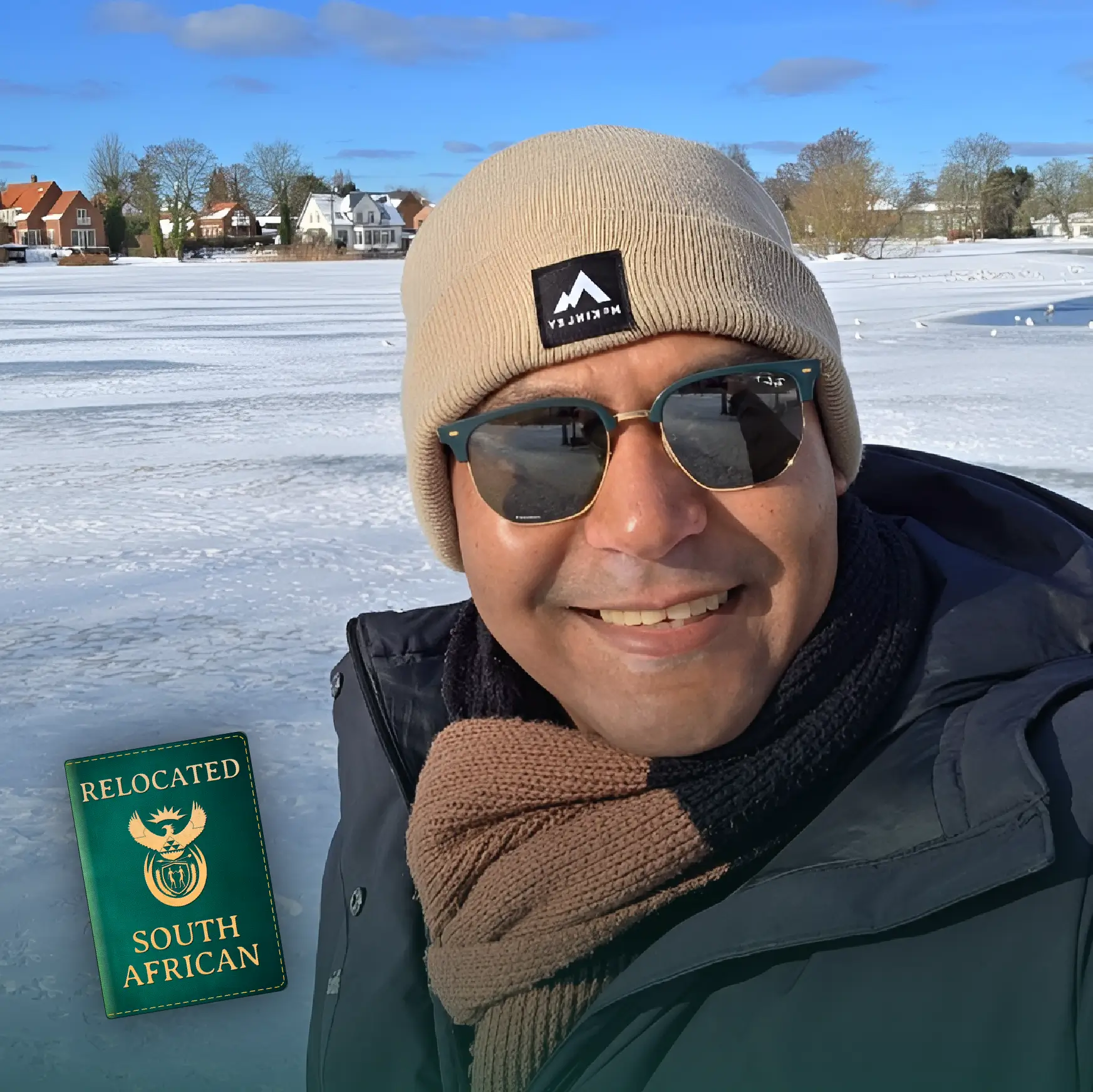
Jan Hugo Welcome to The Relocated South African, the show for navigating immigration from South Africa for a better future. I’m your host, Jan Hugo, from Lagos in Portugal. Check out our website, www.therelocatedsouthafrican.com. It contains a whole lot of useful information and details of all episodes to date. If you want to interact with us, comment on our discussions, or participate in an interview, please contact me at jan@therelocatedsouthafrican.com. Also, if you like our content, why not subscribe on your favourite platform? Today, I welcome from Copenhagen in Denmark, Kurt de Bique. Welcome, Kurt.
Kurt de Bique Thank you, Jan. Great to be here.
Jan Hugo Is that the correct pronunciation? Okay. So Kurt is my first guest from Copenhagen, or Denmark. So we’re making history today. And I always ask my guests, Kurt, to give us a bit of history. Where were you born? Where did you grow up? Your schooling, university? And maybe lastly, how did you get to live in Copenhagen?
Kurt de Bique That’s perfect, absolutely perfect.
Kurt de Bique Absolutely. Thank you, and thank you for the opportunity to be here. So I’m a Cape Town boy. Grew up in Cape Town, initially on the Cape Flats in the Mitchells Plain area. And when I was around five years old or so, there was an incident in front of our home where my dad walked outside and there was some gangsterism going on. This guy looked back at him and actually threatened him to just get back inside, or else something would happen. And he always talks about that moment. He said that was a pivotal moment where he needed to make a decision, knowing he had a young son.
So we moved, and we moved to probably the total opposite side of Cape Town, to an area called Northpine, which is close to, it’s kind of between Kraaifontein and Brackenfell, out in the northern suburbs. And this was an area which was very new and fresh, so there weren’t any real social issues. It was actually a fantastic environment to grow up in and to have a level of freedom in that little community. It was like a little incubator community that was new and fresh for us. I then attended school in the area. I kind of grew up in the Brackenfell, Bellville area, went to Brackenfell High School, and matriculated there around 2000.
I then moved out to Goodwood initially with my family, but then when I got married, we lived out in the Milnerton, Blouberg area. And before we moved to Copenhagen, we were there for about 12 or 13 years. So it was really the Blouberg, Strand area, the Sunningdale area.
Kurt de Bique I’m married and I’ve got two little girls, an eight-year-old and a ten-year-old. In terms of schooling and university, I went to UCT and I’ve also done a master’s at Maties. My career has been in the human resources field. I’ve worked in HR for the last 20 years, mostly for big multinational organisations, including Chevron, and then most recently with Maersk. That has been an amazing experience for me because it opened up many, many doors.
I remember as a little boy, I had an aunt who moved to Port Elizabeth. From time to time, we would go and see her off, and the whole family would make this occasion of driving to the airport. It’s a 50-minute flight, but it was such a big occasion. Wow, someone in the family has actually moved out of Cape Town. Amazing.
Jan Hugo (laughs)
Kurt de Bique But I remember as a little boy having a feeling like, I actually wouldn’t mind that one day. I had this sense that somehow I was going to be getting on planes, flying around, and exploring the world. So that was a seed that was planted in me very, very early. Working for international companies, that just grew. And I got my first taste of travelling to Dubai and seeing the Burj Khalifa being built, going to the States, and so on. So my journey then became a fairly international one via my work.
I also lived in the US for a couple of years, from 2013 to 2015. My wife worked in London. And then we came back to South Africa. Then with Maersk, which has its global headquarters here in Copenhagen, they offered me a role here. So it was work that brought me to Copenhagen, but it was also a deliberate decision. We had enjoyed living overseas, we enjoyed the opportunities it brought, and we enjoyed travelling.
What really struck me about Copenhagen was, initially, the weather was not attractive. That’s what everybody says. It’s cold, it’s dark, it’s grey in winter. But I remember coming here on a business trip and going out for dinner one evening, and after dinner, it must have been around 11 pm, there were so many people on the streets. Young people and grannies alike would take a train at that time of the night and it was so safe. I could walk through Copenhagen with bicycles parked all over the place, with nobody bothering about it, in complete calm. And I thought, wow, I’ve got two little girls. This is a really good environment for them as well.
Jan Hugo Hmm.
Kurt de Bique So that was a big factor, along with the career opportunity and the adventure of it all, knowing that we’re in a season of our life where we want to do this.
Jan Hugo Awesome. Well, I think we’re going to get into some of that detail. Kurt, just a question. You said you lived in the States. Which city were you in?
Kurt de Bique I was in San Ramon, in the San Francisco Bay Area, for about a year. I worked at Chevron’s headquarters there, and then they moved me to Houston, Texas as well.
Jan Hugo My kids lived in Houston. They were in Katy. Yeah, amazing. I’ve been many times.
Kurt de Bique Okay, yes. Have you been to Houston? You’ve visited? Many times, yeah. We lived in the museum district area, which was lovely. We’ve got good memories of it.
Jan Hugo Yeah, they’ve since moved to Dallas, but I enjoyed visiting. It’s just a bit hot and flat.
Kurt de Bique It’s very hot, I tell you, in the summer, and incredibly humid.
Jan Hugo And I’m a cyclist, so I don’t like flats. Only hills and bridges. It’s an interesting place.
Kurt de Bique Yes, look, there’s a lot of cycling here in Copenhagen, but it is flat, so you’ll miss that aspect. You can go through forests and trails, but I honestly missed the mountain biking back in Cape Town. Just driving to Durbanville around the corner and going up and down those winding estates, up and down. That was awesome.
Jan Hugo Yeah. OK, well, just to give a bit of background to the listeners: I contacted Kurt after he posted on Facebook in December about his family’s journey. I said before the interview to Kurt that I really loved his post because it resonates with me after so many episodes on this podcast. I think it’s probably the most analytical and clear post about immigration that I have seen. So you made the point, the first point was that it is not for the faint-hearted. I always say it’s not for sissies. I totally agree with you, but why do you say so?
Kurt de Bique I’ve moved a few times in my life. The first one, as I’ve alluded to, when I started my career, wasn’t quite immigration, but it felt like it. It was Cape Town to Pretoria for work opportunity. For me, it felt like a big move. But that was much easier because I was single. I needed just a one-way ticket and a small bag, rock up and start work. Fly on the Sunday, start work on the Monday. It was simple and easy. And of course, all the adaptation I learned from moving to Pretoria, those were important early learnings.
Then the second time we moved, I mentioned the States. We were married and it was a little bit more difficult, but actually my company did a lot of the prep work and made it an easy landing. The most challenging thing was renting out our house. We took very little with us, just our shipping allocation, which was essentially a box and suitcases. We stored everything else.
But when we moved to Denmark, we had two kids. We had two homes that we had to sell, two cars to sell, kids to take out of school, and we had to find new schools in the middle of the year, which was super tough. One day the kids were in the pool at home in our lovely, comfortable house in Sunningdale, and the next day, literally when we landed, we went from T-shirts to beanies and jackets. We got picked up in a taxi and went off to the company-arranged rental for a couple of months.
And literally as we stepped out, it was just pouring with rain. It’s like, welcome to Denmark. And we had no car. That was the other big thing. I had not been without a car for a very long time, and we actually did not have a car for about the first year and ten months, with two kids, where I was used to dropping them at school and having that kind of freedom.
Jan Hugo Yeah.
Kurt de Bique Public transport is amazing here, as it is in many parts of Europe. It’s reliable. But still, when it’s zero degrees and you need to get your daughter to gymnastics, and you’re cycling while the blistering cold is smacking you in the face, you find yourself praying very hard. What did I do? Why did I do this? This does not feel like progress. I thought coming to Europe was supposed to be progress.
And it’s all those early moments. The kids are super resilient, yes they are. They love it here now and don’t want to go anywhere else; they make that very explicit. But they also had connections, friendships, grandma and grandpa back home, and their friends from inside their old house. So it was definitely an adaptation for them as well. The first six months were tough.
So it’s not for the faint-hearted. I think letting go and leaving, being like Oprah Winfrey at home and giving all your cousins and friends all your books, all your extra gear that’s never going to fit into your European place, because you can expect a much smaller space, is all part of it. It’s a process of letting go, getting through that rough first period, and then pulling on what I call your relocation resilience. You’ve got to dig deep.
Jan Hugo I think that’s a very good phrase. And we’ll get into more of that detail. You mentioned your aunt leaving and getting on the plane to PE. So one of the questions I have is: if you go back to three years ago when you were all at the airport to say goodbye, can you remember that emotion and how you all felt? And may I say, I assume that you and your wife were on the same page with regard to leaving and travelling, because that’s an important thing. But was it quite emotional to say goodbye to family?
Kurt de Bique Yes, it was. And yes, my wife and I have always had a very aligned appetite to explore. She has been incredibly supportive, because most of the moves we’ve done have been driven by my career. So she’s been super supportive, both in the US and for this move.
There are a couple of emotions one feels when you do your traditional thing at the airport, which is to go sit at the Spur, right? That’s what we do. You go sit at the Spur and you act as if everything is hunky-dory, because you don’t want to make it too emotional for anyone. Our parents, both my wife’s parents and mine, were there. It is tough, but our parents were fully prepared. They knew we had a desire to explore, and they were very happy for us. They weren’t too clingy. They know we love them and it has got nothing to do with that. They adore their grandkids and they said, okay, this is going to benefit them and benefit you, so go for it. That actually helped a lot. And then we try to stay connected closely by phone and we try to go home at least once every 18 months. So we navigate it in that manner.
Jan Hugo Yeah, we’ll get to that. Also, in your post you talk about your faith and how important that is to you. Was that a big part of your decision-making in going to Denmark and taking the family?
Kurt de Bique Absolutely. My faith has played a big role in all of my major decisions in life. Whenever I make a big decision, it’s soaked in a lot of prayer, a lot of reflection, and a lot of conversations with the people who are impacted. It’s definitely been a rock, because when you rock up in Copenhagen, you realise, listen, there’s not a massive crowd waiting for you. You’re on your own now. You’ve got to have something deep that’s going to hold you.
I’m a believer, and that has directed my decisions and my career. The other thing is, you never know what you’re going to get. You think you’re coming here for a job, and that’s the door that opens. But when you come from a point of faith, you believe you’re on a bigger mission. There’s a bigger purpose. There must be something God is going to use you for, connections to be made, a reason you were selected for this opportunity.
And that has actually been a major part of our experience here, because while I was dealing with tax and immigration and all the logistical things, my wife was looking for a church for us to land in. You sit on the other side of the world and you read about the very secular nature of Scandinavian society, and you wonder. But she found an amazing church.
Kurt de Bique She started watching it online and said, let’s go and visit. We went the first week we were here. It’s called ARK Copenhagen. The moment we walked in, people were just welcoming. Danes were welcoming, internationals were welcoming. Our kids settled in and we felt, this is a great place. So we didn’t go church-hopping at all. We just felt this was the place, and we’ve been involved there for the last three years.
It’s probably been the biggest thing that has held us, because there are relationships, there are connections. It’s half Danish, half international. The pastor mentioned there are 56 nationalities represented in the church. So you’re not the only one. You come in and your friend from Singapore is there, you meet a diplomat from somewhere in Europe, their kids become friends with your family. Europeans, non-Europeans, Africans. It’s been a great place for us to stay rooted and grounded, and it has really deepened our faith.
Jan Hugo That’s excellent. And are there South Africans in that church, or are you the only ones?
Kurt de Bique No, there are actually South Africans. There are a few, maybe five or six that I know. It’s not a massive South African population, but there are certainly a few of us.
Jan Hugo Yeah. I think, coming back to the point that this is not for sissies, one thing I’ve found across so many conversations is that the couple must be strong. There are days when you’re going to be down and she’s up, and the other way around. Having a strong relationship, and then being anchored in your faith on top of that, I think is amazing.
So let’s explore some of the more detailed stuff. You mentioned giving up your home and dealing with accommodation. What is accommodation like in Denmark? Typical European smaller homes?
Kurt de Bique Look, there’s a full range. Copenhagen is not actually a massive city, which is one of the things that is super nice about it. Things are nicely dispersed. There’s a city centre, and then as you move into the inner suburbs, those tend to be more expensive and compact. And then you have the surrounding areas, still within good proximity to the city centre, where we are. We’re about 20 minutes door-to-door from my workplace, which is very convenient.
The closer you are to the city, the smaller you’re going to get and the more you’ll pay per square metre. But we’re fairly happy with what we’ve found. We’ve got a nice townhouse in a complex of a few blocks that go three or four floors up. We’ve got enough space for our family. It wasn’t South Africa, where you’ve got a big braai porch and the kids can run around the garden, but it’s enough. Three bedrooms, three bathrooms. We do miss a little bit more space, because in Europe space is at a premium. I think people here are paying double what we paid for our four-bedroom, three-bathroom home with a pool and 600-odd square metres back in South Africa.
Jan Hugo Yeah.
Kurt de Bique Here you’re paying double that for 130-odd square metres, three bedrooms, and so on. It is definitely expensive. Housing is your major cost; people spend between 30 and 40 percent of their income on it. And there’s a lot of competition in the property market. That said, just across the road from us there are some really large homes, mostly Danish families who have been there for generations. So not everybody is in a small box, certainly not in the suburbs.
Jan Hugo Good.
Jan Hugo But a lot of people I’ve spoken to, me included, have made the mistake of shipping furniture from South Africa at great expense, only to find it doesn’t fit in the smaller European homes.
Kurt de Bique Yes, exactly. And because I work for a shipping company, I had a container as part of my deal. With two small kids, you accumulate a lot of stuff. So we did bring things in that container, but we also gave away probably a double garage’s worth of stuff to friends and family, because we weren’t sure where we were going to live and simply wouldn’t have the space.
The one thing that was a real mission was my massive corner couch from Coricraft. It just was not going to fit, because European rooms tend to be a different shape. It ended up being split into two separate couches, one upstairs in the office and one downstairs. And the guys couldn’t get it through the door; I actually had to coach them to lift it through the window. They were talking about hiring a crane. So we made it work.
Our bed also couldn’t fit up to the third floor, so it went into the spare room, which is now the guest room. What they do here, which is common because a lot of people live in apartments, is two single beds clipped together to form a master bed. So we bought one of those.
Jan Hugo Okay, from IKEA?
Kurt de Bique From a bed shop, actually, but there is a lot of IKEA here. And that’s the other thing: you don’t have the domestic help that you get in South Africa. So I’m a keyboard warrior, and when I needed a new table or a cupboard, I had to figure it out myself, step by step from the IKEA instructions. And then you feel quite proud at the end of spending a full day putting a cupboard together.
Jan Hugo Yeah, no, we’ve done the same. My wife is very handy, but from time to time, when there are more screws left over than there should be, I start speaking in tongues. I’m not very handy. So we’ve had our fun with the flat-packs, but the quality of the stuff you get from there is excellent. Anyway.
Kurt de Bique Yes, yes.
Jan Hugo Could we briefly touch on the weather? People I’ve spoken to in Norway say you don’t have bad weather, you have bad clothing. Have you found the same? Are you coping with the weather?
Kurt de Bique Correct. That’s exactly the same saying here, and exactly the same mantra. In my third year, it actually is manageable. You develop a strategy around it. You’ve got to have the right clothing. I think I’ve bought the most expensive jacket of my life here in Denmark. It’s properly layered inside. Your K-Way jackets are not going to cut it here. I bring the K-Way jacket out for a chilly summer’s evening.
Jan Hugo I agree.
Kurt de Bique You’ve got to get the right stuff. The kids have thick layers of snowsuits. And people just get on with their lives. You’ll find runners out all year round, cyclists with all the right gear. There are a lot of clothing options here that you wouldn’t find elsewhere in the world, all made for the conditions.
Jan Hugo And winter sports? Do the kids skate and ski?
Kurt de Bique Yes, my kids are quite active. My one daughter does gymnastics, which she started in South Africa already, and that’s indoors, so it works well. The outdoor activity she does is horse riding; she’s very passionate about that. My other daughter is more musical, so she’s more into music.
Jan Hugo Awesome, that’s fantastic. Another question on the kids and the language. In your post you mentioned that you’re still working with Google Translate. How are the kids coping with Danish?
Kurt de Bique They are very curious to learn the language. We put them in international school, which means most of their friends are going to be international, but they do get Danish lessons and they mix with Danes in other social settings. In my workplace, nobody ever said you have to learn Danish, because it’s an international company. So there wasn’t a lot of pressure on that front.
But you hear it and you realise you’re missing out on so much. Correspondence is in Danish, you want to be able to greet your neighbour, invite someone for a coffee. So my wife and I both started taking Danish lessons in our first year. We felt a bit humbled by it and needed a break, but we’ve picked it up again. I’ve actually started again. We’re all also on Duolingo; it’s like a competition in the house. One of the first things that gets done after everyone is ready in the morning is to learn Danish on Duolingo.
I think you’ve got to be patient. My approach was never to force it. Just see how it goes. But I can see my kids are naturally wanting to learn. At some point we may need to decide whether the international schooling environment is the best for them to really accelerate the language, because it does pull them back towards English.
Kurt de Bique So yes, we’re still figuring that one out.
Jan Hugo And what does the language sound like? I know Norwegian and Swedish are kind of similar.
Kurt de Bique Yeah. So if I introduce myself, I’d say “navnet er Kurt,” which means “my name is Kurt.” If you meet someone and want to say good to meet you, you would say “Godt at møde dig.” And then if you want a cup of coffee, you’d ask for a “kop kaffe.” So some of the pieces are easier than others, but it’s not always phonetic. What you see written is not always what you need to say. There are sounds and letters that trip you up. Afrikaans can actually help sometimes, because certain phonetics feel similar. But then there are vowel sounds that are completely different.
Jan Hugo Okay. Yeah.
Kurt de Bique It’s not an easy language. Most people who come here struggle with it. I’ve even heard Germans, who are only a few hours south, say it’s completely different to what they expected. So it’s a tricky one.
Jan Hugo OK, yeah. You also mentioned that it’s always a surprise when you arrive in Europe with the cost of living. Even in rands, was that quite a shock that you and your family had to adapt to?
Kurt de Bique Absolutely. I won’t lie, it’s very expensive. And the price of things generally are higher. One of my pet peeves is going to McDonald’s and seeing that those little tomato sauce sachets cost four kroner, which is like the equivalent of ten rand, just for a sachet. So you’ve got to pay for that. Nothing is really free here. Everything has a value, and that value is high. That’s just the way it is.
I remember taking the family out to a burger place that’s popular here, called Gasoline Grill. We all had burgers and I think it was around 700 kroner for the four of us, which is like the equivalent of about R1,500 for four burgers and a drink. And that hits you the first time, especially because when you first arrive, you haven’t earned your first salary yet. I was living off my South African credit card for that first month, and the conversion rate was hitting me every single time.
After a while you accept it. You go for a coffee, it’s 30 to 40 kroner. But once you’re earning in kroner and you’ve adapted, you stop thinking about the conversion so much.
Jan Hugo Exactly. Coffee is expensive.
Kurt de Bique But you’ve got to be a good steward of your finances here. You see the digits and for years your mind has been calibrated to rands, so you see ten kroner and your brain says ten, but it’s actually worth a bit more. That’s the adjustment. And people generally do try to cook at home. When we go out, we take the kids for sushi once a month, a sushi buffet at the end of the month as a treat. We pick up street food here and there. But it’s not like being at the Waterfront and deciding on the fly to go and have a steak. You plan it.
Jan Hugo No, I hear you. Just to clarify, is Denmark part of the EU?
Kurt de Bique Yes, absolutely, Denmark is part of the EU. But the one thing they negotiated to retain was their own currency. So they kept the krone rather than adopting the euro.
Jan Hugo It’s the same in Hungary, they kept the forint. Can people spend euros there, or is it strictly krone?
Kurt de Bique No, it’s strictly krone. And the other thing is that Denmark is essentially cashless. I probably draw cash once every three months, usually because the kids need it for something at school. Everything else is card or contactless.
Jan Hugo Yeah. And just another question on daily life: medical. Do they have a good state medical system? Do you have private insurance? How does it work in Denmark?
Kurt de Bique The public healthcare system here is very good. I say that having not had to rely on it too much, but it has a very good reputation. I’ve got friends who’ve had babies here and the maternal care is world-class, from what I hear. And working in HR, I see how people experience it through benefits processes.
I’ve also got private backup through my company. But the public hospitals are the standard and most people get good care through that. Where it is very different from South Africa is that you don’t just go to your doctor after three days of coughing and ask for an antibiotic. That’s never going to work here. You can get basic over-the-counter items, but medication is prescribed very conservatively. That’s one way they manage demand on the system. So I actually hardly ever go to the doctor.
Kurt de Bique I have heard of friends who have had to push hard in emergency situations, insisting on care for their child and not being sent home to wait until the next day. Those stories exist. But when people have received care, the experience has generally been good. My daughter had a sprained ankle once that we were worried about, and they took care of her well. If you genuinely need emergency care, I believe you’re going to get it.
Jan Hugo Yeah, okay. And taxes? Income tax? Is it very high?
Kurt de Bique Yes, Denmark is known for very high taxes, and those taxes fund the welfare state: the public healthcare, the public schooling, the roads. And you can see it. Last week we had snow. By the middle of the night, someone was already clearing the pathways so you could walk out in the morning. The roads were cleared. When you get value for your taxes, you can see it. But yes, taxes are high. It’s a progressive system ranging from around 30-odd percent to 56 percent. It’s substantial.
For expats like me, there is a preferential tax rate for a period of about seven years, which is around 33 percent. But that doesn’t last forever, and going from 33 to 56 percent is a significant wake-up call when it happens. I don’t see Danes complaining about their taxes, though. If the snow is not cleared or something is not sorted out, they call the municipality and it gets sorted out.
Jan Hugo Yeah, when you get value for it, you don’t mind. And VAT? Ours in Portugal is 21 percent.
Kurt de Bique I think VAT here is 25 percent. It’s high. And the other thing, which I don’t know if you have in Portugal, is the recycling deposit. They charge you for the bottle when you buy a Coke or whatever. You pay an extra two kroner, and then you can get it back when you recycle the bottle by popping it into a machine and getting your money back.
Jan Hugo Yeah. I know Ireland has something similar. We don’t have that here in Portugal. But I think it’s a very good idea. Anyway, Kurt, let’s move on. In your post, and I think it’s a great way of looking at it, you reflected on the difficulty of what you give up but also what you get in return. We’ve spoken about faith, which you say has made a huge difference. What about professional growth, from your perspective and your wife’s?
Kurt de Bique Yes, I think professionally it has been better. In my case, working for a big global company, if I stayed in South Africa there was really only one other role I wanted to do internally. Moving to corporate headquarters opened up more opportunities. And when I looked at the broader external market in South Africa at the time, the options in my field felt limited. Going to Johannesburg would have opened things up, but I didn’t want to do that from a family perspective, being a Cape Town family. So Copenhagen made sense for professional growth.
Also, once you’ve established yourself here, there are broader opportunities across Europe. That said, it’s not easy. Denmark actually has very easy hire-and-fire laws. As an HR professional, I’m used to a very robust process before dismissing someone. Over here, a company can act very quickly. So the market is quite competitive and flooded with talent. There are opportunities, but there is a lot of competition for them.
I moved from an Africa-based role into a global position. A couple of global positions I’ve held since being here, where you sit much closer to key stakeholders. And my wife’s career has also been better here. She’s a social worker by training, and she worked in the UK in that field. She then pivoted when we had kids, stayed at home, ran a baking business, and later worked as a kindergarten teacher. Now she’s an educational counsellor at the International Business College here. Her profession is highly underpaid in South Africa. Here she gets the same benefits as a corporate employee: leave days, pension, and so on. So career-wise, it has been better for both of us.
Jan Hugo Excellent. We’ve spoken about safety, cleanliness, taxes, and the value you get. One of the other things you mentioned, which people sometimes overlook, is the travel and the proximity to the rest of Europe. You’re on a residence permit that allows you to travel freely in Europe, is that right?
Kurt de Bique Yeah, we’re on a Danish temporary residence permit, which we’ve had for a few years and which can be renewed. That allows us to travel around Europe, yes. Spain is a particular favourite because when you want to escape the Danish cold, a two-hour flight to Mallorca is just incredible. You land, take your jacket off, feel the sun on your face, and you wonder where you were two hours ago. Coming from Cape Town, we took that sunshine for granted.
Jan Hugo Yeah, I mean, you’re in a much sweeter spot here in Lagos than Copenhagen for climate. I will say, this week I went to play golf and it was five degrees when I left home. So it’s pretty chilly in winter, but it warms up to 16 degrees and the sun comes out. You just take layers off as the day goes on. It’s amazing. Kurt, we must move on. Is there anything you would have done differently in the process of moving to Denmark?
Kurt de Bique That’s a good question.
Kurt de Bique Possibly the schooling. That was a big stress point for us in those first few months. Our kids weren’t settled well, and perhaps we could have prepared them a bit more for that shock and investigated the schooling options more thoroughly. In South Africa you have so many options: public, private, different schools with different approaches. When you land somewhere new, you’re limited and you just have to go with what’s available. And the structure is different here. In South Africa, sport, cultural activities, everything revolves around the school. Here, school is predominantly for academics and socialising. For everything else, you’ve got to find and join separate clubs, and there can be waiting lists. We had to wait to get our daughter into gymnastics. Those are things we could have been better prepared for.
The other thing I would highlight is that as a temporary resident, your entire reason for being here is tied to your work. You cannot take that for granted. It’s not a place where they hand you permanent residence after just a few years. You’ve got to demonstrate integration and language proficiency. The normal timeline is around eight years before you can apply for permanent residence. So if your intention is to stay long-term, you’ve got to play the long game, day in and day out, patiently. That can be unsettling when you feel like you’ve settled in and built a life, but legally and formally, the process is still ongoing.
Kurt de Bique Denmark is not the easiest place to integrate into fully, and you’ve got to understand and accept that. Your neighbours will be polite, but you’re not going to have those long, easy conversations over the fence the way you would in South Africa. You’ve just got to prepare yourself for that without taking it personally.
Jan Hugo Good. What do you miss most about South Africa?
Kurt de Bique I miss the warmth of the people. It hits you every time you return to South Africa, wherever you go. The moment you land at the airport, someone wants to help you with something, they’re chatting in the taxi, you sit in a restaurant and that vibe that we have as South Africans is truly special.
I got a little bit of that during the Rugby World Cup, actually. I flew over to Paris and watched a couple of the games, the opening game against Scotland and the semi-final. Getting into the train in Paris and seeing green everywhere, hearing the accents, it was electric. And here in Copenhagen there’s a South African pub where we get together to watch the games, and that warmth comes alive again.
Of course, I also miss Table Mountain. I lived in Blouberg where I had that wide-angle view of Table Mountain every day. I miss being able to hike up there and do the mountain biking. And then of course we miss family and friends. But you make your decisions, you make your trade-offs, and you make the most of this new way of living.
Jan Hugo No, that’s very true. I had a guest on the podcast a few weeks ago who is very passionate about rugby. He says his goal is to see South Africa win five of the next ten World Cups. And the same story about being in Paris during the tournament and feeling deeply South African when they win. It’s really a good place to be.
Kurt de Bique Absolutely, absolutely.
Jan Hugo Listen, in closing, you probably don’t have your Facebook post in front of you, but I do. So, if you’ll allow me, I’d like to read the ending to the listeners, because I think it really speaks to what you’ve experienced. Is that okay?
Kurt de Bique Sure, go for it.
Jan Hugo So Kurt ends his post by saying:
“We love South Africa. While having values, ambitions, experiences, and adventures we feel worth pursuing abroad, looking ahead, we are still learning, still adapting, and still discerning what the future holds. But we will continue living in the present. This journey has stretched us, shaped us, and clarified what matters most. It has shown us that we are resilient, can let go of known comforts, adapt, and embrace the new. Every major life decision has pros and cons, and most will not see the tough, non-Facebook-post-worthy days. Life is short. Be intentional. Discover and identify the life you want to live, and pursue it with conviction.”
I think that’s just awesome. Well done.
Kurt de Bique Thank you, I appreciate that.
Jan Hugo Thank you so much for sharing your journey. I really enjoyed talking to you. I knew it was going to be a good discussion having read your post, and I think you’re doing great. Your faith, your family, it all shows that you can make it work anywhere. Well done. Thank you so much for joining us.
Kurt de Bique I appreciate that, Jan. And yes, we are South African. We can make it anywhere. Thank you. I wish you well. I’m loving the podcast. I actually went through quite a few of the episodes last night. It’s opened up a lot for me, reading about other South Africans across the world and their experiences. What you’ve created here is a fantastic platform. Thank you for that. We are indeed all over the world, and we bring something special to the places that we are in.
Jan Hugo Excellent. Thank you, Kurt.
If you enjoyed my discussion with Kurt and would like to hear more about the experiences of South Africans who have left South Africa, why not subscribe on your favourite platform? If you’d like to share your story, contact me at jan@therelocatedsouthafrican.com. Until next time.
This transcript was generated with the assistance of AI technology and has been reviewed for accuracy.