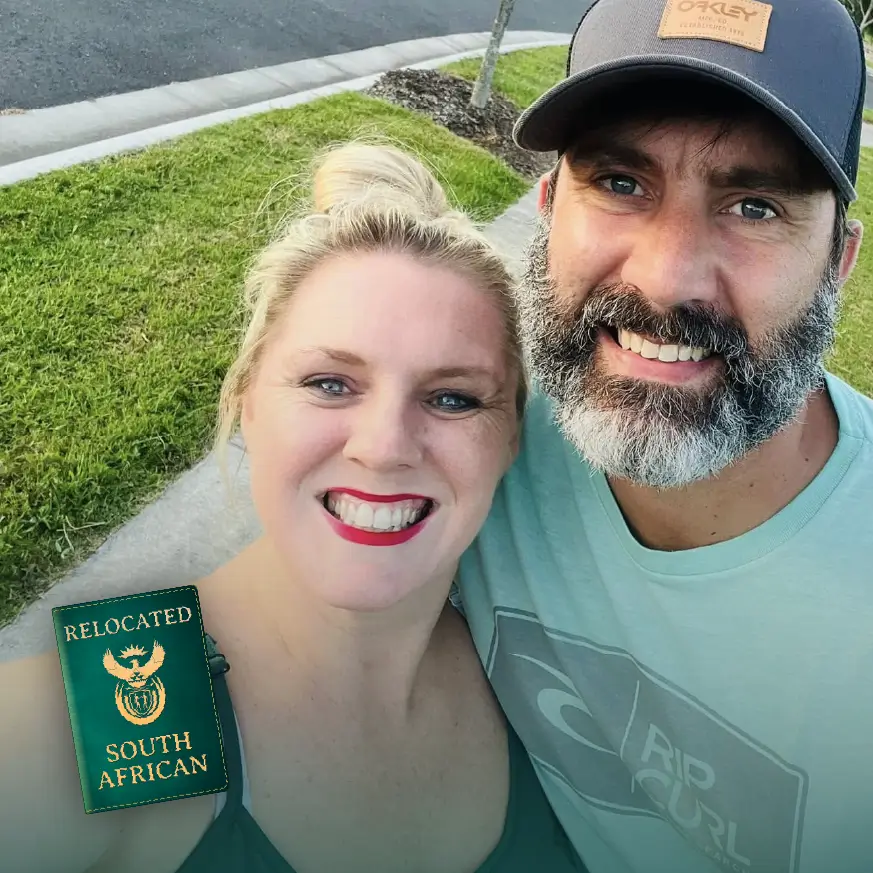
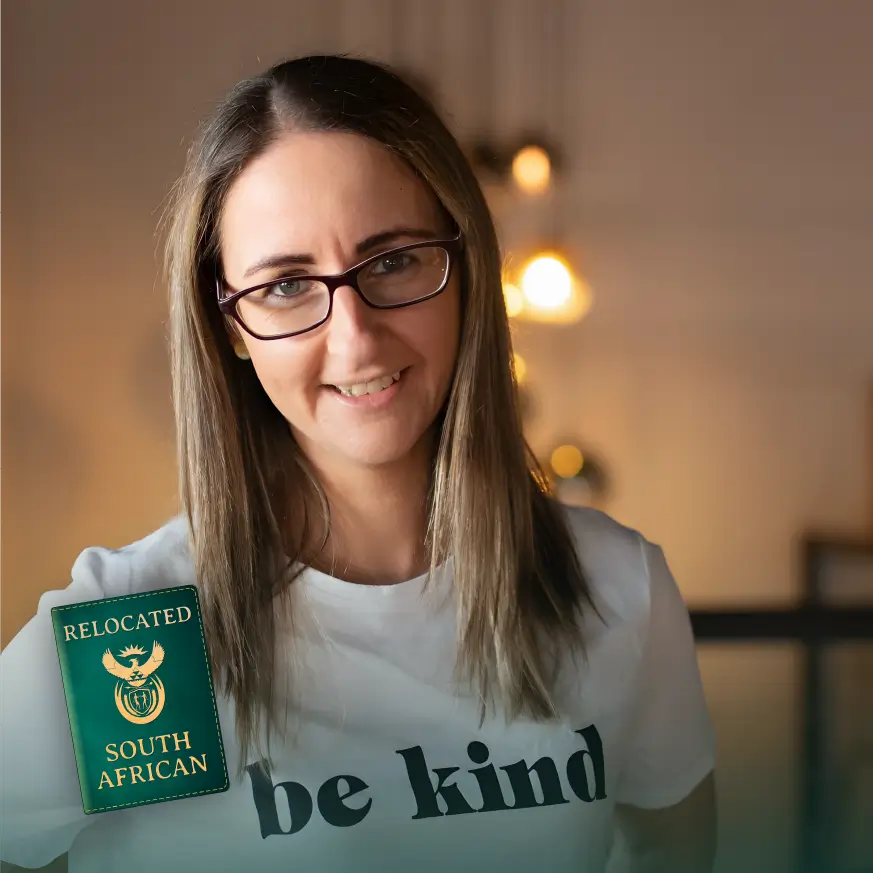
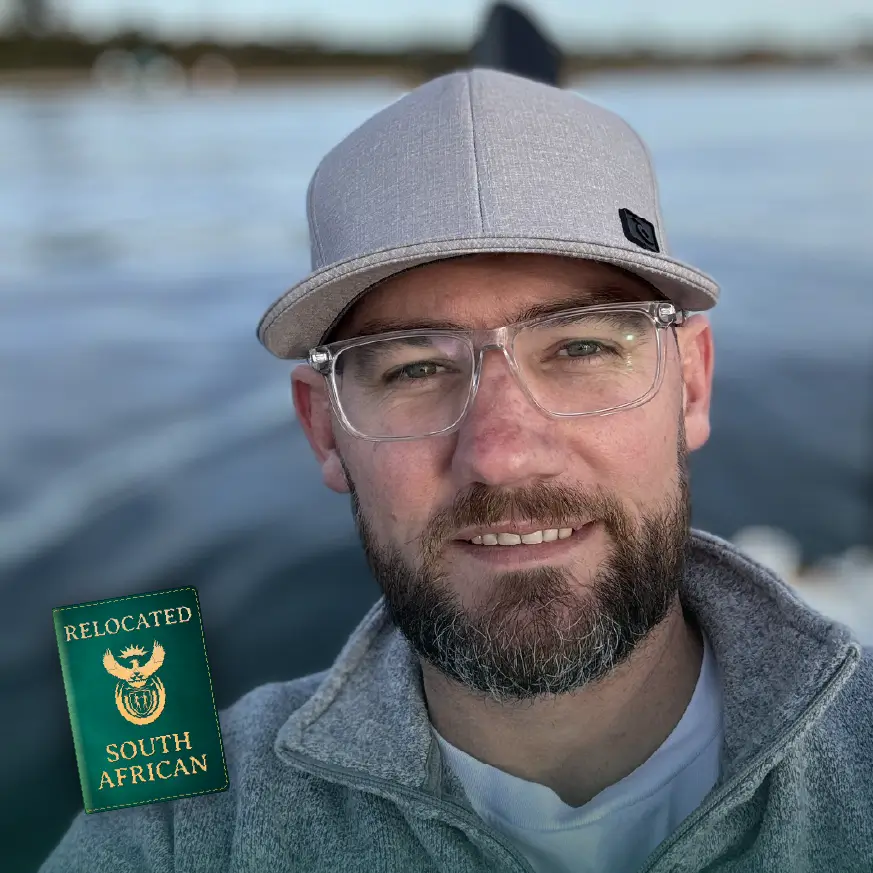
Jan Hugo: Welcome to the Relocated South African, the show for navigating immigration from South Africa for a better future. I’m your host, Jan Hugo from Lagos in Portugal. Today, I’m joined by Lindi Dercksen, all the way from the Gold Coast in Australia. Welcome, Lindi.
Lindi Dercksen: Thank you.
Jan Hugo: The Gold Coast, I know Brisbane, but how far are you from Brisbane?
Lindi Dercksen: We are about 40 minutes south from Brisbane towards the northern part of the Gold Coast in Australia.
Jan Hugo: Okay, and originally you’re from Amanzimtoti?
Lindi Dercksen: Yes, born in the Free State and then moved to Amanzimtoti when I was two, and we lived there the rest of my life until we moved, yeah.
Jan Hugo: Okay, and weather wise, were you all similar to Amanzimtoti?
Lindi Dercksen: Very similar, humid, warm summers, warm winters, summer all year long, yes, very much the same.
Jan Hugo: OK, and how long have you guys been in Australia?
Lindi Dercksen: We will be. Our two years anniversary is coming up now in the first week of April. We would have been here for two years.
Jan Hugo: Oh, it’s amazing. It’s time flies, I guess. And if I may ask, what made you decide to leave South Africa in the first place?
Lindi Dercksen: So I think the main, main reason for us was definitely our kids and the opportunities that we wanted to give them or, yeah, to give them. That was our main reason. I think it’s easy to say that we do it for our kids, but we do it for ourselves as well in positions where my husband Bertie lost his job. He was retrenched where he worked at a refinery for the past 20 years, and he had to then go and look for another job turning 40, and that’s not an easy task in South Africa. So I think as much as we say we do it for our kids, we do it for ourselves as well.
Jan Hugo: That is very sensible. Just how old are your kids?
Lindi Dercksen: So I’ve got a almost 10-year-old, let’s say 9-year-old and a 5-year-old. But when we arrived, Lianca was 7 and Malay was, she just turned 3.
Jan Hugo: And they love Australia?
Lindi Dercksen: They love it. That’s all they know.
Jan Hugo: Okay, fantastic. And if you think back to when you made the decision, I mean, obviously, as you say, what happened with your husband, work wise, had a major impact on your decision, was that kind of the trigger? Or how long before you actually left South Africa, did you start with the process?
Lindi Dercksen: So we had a funny story. We actually paid a deposit for an agent to start the process in 2017. So we paid the deposit in October 2017. About 2018, I would say halfway through 2018, I had a miscarriage. Our file pregnant with our second child was before Malay was born. I had a miscarriage and because of that we decided to stay with family and to stay close and yeah we left it at that.
In 2021 in July we had looting in KZN and I think that was probably the drawing point that was before Bertie had lost his job at the refinery or before they were starting to talk about retrenching them. And yeah, so then we started up the process again. We got in contact with the agent again. And so that was probably about 2021. That took until 2022, 2023 and March. Our visas were granted. So probably like two years, I would say, yeah.
Jan Hugo: Okay, and the decision process, was it a difficult one? Did you sit and weigh up pros and cons when you finally decided, as you say, when you got the visa and you restarted the process? Was it a matter of weighing up pros and cons up to the last minute or did you just, when you made the call, you said, this is it, we’re going?
Lindi Dercksen: Yeah, I think in 2017, at the first time round, we were not both convinced. So it was a thing of that roller coaster ride of today, you feel like we’re going tomorrow, you feel like, no, we shouldn’t. And in the next day, you feel like, no, we need to do this. And in the next day, you feel like you shouldn’t. But after the looting, after everything that has happened, we were both convinced. We both knew we weren’t looking back. We just had to get it done and get here.
Jan Hugo: OK. I mean, these are difficult decisions. They always say they’re not for sissies. People think it’s easy to just up and go, but it’s not. And I suppose in the process you mentioned his work and yourself, you arrived in Australia with work.
Lindi Dercksen: So it’s amazing because there’s so many South Africans in Australia and so you automatically have contacts with people that you can get in contact with, but it was incredible. Before we left, our visas were granted and then I had an interview with a school in Brisbane and I actually got the job, I got the position. And then when we arrived here, we took a drive and we decided we didn’t want to end up living in that area or I wasn’t going to send my goals to that school because of the area and I declined that position. And I had another interview at another school probably the next week and the week after that I’ve got the job. So I started teaching three weeks after we arrived in Australia.
Jan Hugo: And your husband, has he subsequently found work?
Lindi Dercksen: Yes, so he started work. We arrived in the beginning of April. He started with a job eight weeks later.
Jan Hugo: Well, that’s fantastic. Is that common in Australia to South Africans? I mean, you say that there’s a lot of South Africans around. Do they have the same experience?
Lindi Dercksen: Yes, absolutely. At the school where I teach, I often laugh and say that I speak more African at that school compared to the school that I taught at in Amanzimtoti. I’ve got most probably like six, seven South African kids in my class. my husband as well he works with I think they’re about three or four South African guys working for the same company. Yeah it’s just it’s definitely a thing of there’s so much work that you coming from South Africa you feel like you can’t leave your job because you’re not sure if you will get another job if you’ll find another job whereas yeah people jump between jobs because there’s so much work there’s so many options.
Jan Hugo: Okay, that’s quite an important thing for people who are thinking about leaving, that there is work. I think it’s maybe slightly different in European countries. Obviously, IT people are in high demand, but language is always an issue. If you come to Portugal, you can’t speak Portuguese. It’s pretty difficult to come and work here. Definitely. And the one thing that I found in all the conversations that we’ve had so far on this podcast is that a common thread is missing family and missing friends and missing, you know, what they had in South Africa. You still have a family in South Africa?
Lindi Dercksen: Yes, we do. We don’t have any family yet. We have all our families still back there.
Jan Hugo: OK, and missing them on a daily basis is part of what it is?
Lindi Dercksen: Yes, for sure. I think if I had this conversation before we arrived, you came in with the mindset of thinking that it’s going, you know, how are you going to survive? How are you going to do every day without your people and your family and your parents and your siblings? But it’s funny how now you just kind of cope with it and it’s become part of life. And we phone and we do video chats and I think it’s probably the sad, what’s more sad for our kids, not being able to grow up with their grannies and their grandpas and their cousins and so on. But we try and cause as much as we can. We speak to them every day daily. Yeah, try and look forward to visits, that type of thing. But it is hard. It is definitely, I think that’s probably the hardest part about the whole thing is not having family around.
Jan Hugo: Yeah, I think that, as I say, that’s a very common thread. And particularly when you need help, you know, gets get sick. And when you are in South Africa, it’s very easy to just call a granny or it’s close by and now it’s a very different story. So, yeah, I can totally understand that. What would you say was the biggest challenges to actually leave?
Lindi Dercksen: I think probably to make sure that you’ve got the finances, it costs money, visas cost money. We were in the fortunate position where my husband got his pension and we were able to bring that money over. So I think financially it’s it causes a lot of stress when you’re not sure of how are you going to set up a new house. We didn’t bring anything with us. We didn’t bring any furniture. We didn’t bring a container over. We came with the aid bags that we packed, got on the plane, and that’s what we had. So we had to really start from scratch with nothing. But then in saying that, I also think that it’s amazing how you then realise what you really need. because you you just slow down you just buy what you need you don’t you don’t need what you had in South Africa we yeah we live a very much more simpler life than what we did back there um so I think definitely that and I think something like the day that you greeted everybody at the airport. I think that was huge. That was sad for everybody. It was dramatic. It was emotional. But as soon as we got onto, we went through the gates. We said, this is it. Now we’re looking forward and we’re doing this. And then also, obviously, job wise to the stress of thinking, are you going to have a job? Will they not back out and not give you a job surviving until you get your first pay? paying rents upfront without any credit record in the country.
Jan Hugo: That’s up a thing, yeah. Okay, it’s very interesting because my very next question was, tell me about the day you left and you had to go to the airport. That must have been, as you say, that must have been ugly and stressful.
Lindi Dercksen: Yeah it’s stressful because you’re not sure if you’ve you know in that moment you think have you done the right thing should you do it and then you’ve got the family that’s upset and that’s sad and you’ve got your own kids it’s not just I often say if it was just me and my husband who left I think it’s much simpler the whole process now you’ve got these two kids who have packed up everything that they had they we gave everything away they’ve got their little one bag and that’s it and their whole life is packed into that bag and so it’s emotional for them and the more they see you being emotional it’s upsetting for them as well so you kind of have to be strong for them but yeah so what we did is we went to the airport with our family went as well and we said our goodbyes, then we greeted each other there, which was obviously very sad. We have luckily seen my parents have been, my husband’s parents have been, so we’ve seen them. We haven’t seen our siblings from the time that we left, but I think now we look forward to the times when we do see them, when they do come and visit.
Jan Hugo: Okay. And for the kids, I mean, they knew they were going somewhere far. Did they concept of forever? Does it come into their thinking? Or don’t you, I mean, you’re a teacher, you may know what kids think about.
Lindi Dercksen: I think maybe with my older one she kind of understood that it was going to be goodbye and we’re not coming back here to stay. We might go back to visit one day, but we’re not coming back to stay. But with my little one being three at the time, or just turned three, she didn’t have an idea of what was happening. She’d say goodbye and think we’ll see them tomorrow again. But I think it’s an emotional thing for them, but kids are so resilient and they are so much stronger than what we think. My kids personally have been in a school, the school where I started to work when we just arrived. They were in that school and then I’ve since changed to another school with a bit more of a stronger South African community and more South African kids and more South African teachers. So my kids have changed to this school as well. They were actually on the waiting list for this school, the one at the current school. Since we were in South Africa, they just didn’t have space. I mean, they’ve changed. They’ve been in two schools in Australia already, and they are flourishing. They’re happy as happy as can be.
Jan Hugo: Well, that’s fantastic. And one of the things that always comes to mind for me is the question of looking back over your shoulder. Did you or do you have thoughts of, oh, if it doesn’t work, we’ll go back?
Lindi Dercksen: No, so the day we got on the plane that was that we there’s no turning back. There’s no going back. Yeah, that this is that we making it work.
Jan Hugo: OK, I think that’s for me. That’s one of the most critical things. I always say that when people say if it doesn’t work, we’ll go back. It wouldn’t work because you you’re going to go back if you keep the door open and you’ve you’ve actually got to embrace what you’re doing. So that’s.
Lindi Dercksen: Always have that option. And it was never, yeah, it was never an option for us to go back. Our kids also know we, this is our life. This is where we are. We are not going back. My mom will often say, what happens if something happens with one of you? Will the other person come back? And my answer to this, if I had to go back and live on a teacher’s salary and have to look after my two kids in South Africa, we would not be able to survive. Whereas I live here on a teacher’s salary. I can look after my kids.
Jan Hugo: That’s fantastic. Okay. And turning to where you are now, I mean, you’ve mentioned there’s quite a big South African community. And do you guys stick together the South Africans? Do you have other Australian friends as well?
Lindi Dercksen: Yeah. So I do think the South African people kind of stick together. It’s funny. We’ve even got a WhatsApp group with the South African moms. And I mean, there’s probably like 20 people on there. And it’s not everybody. It’s just the people that maybe know each other or that sprains and see each other out of school. staff wise as well, teacher wise as well at the school, I speak Afrikaans more there than compared to when I was back in South Africa. So it’s definitely more of a South African community. But then you do find schools where you don’t have that. So I suppose it just depends on the school. We do have Australian friends. We are quite involved in our church as well. And I think that makes a big difference where you kind of find your place. Our kids are happy at the church. My husband is involved in the worship team. He plays drums in the worship team. We are quite involved in the kids church and there we’ve got a few Australian friends as well.
Jan Hugo: Okay, that’s awesome because it’s great that one will always be a South African but in a sense you’re a visitor in their country now and you’ve got to embrace their culture as well. So it doesn’t mean you have to be an Australian but you’ve got to be respectful to them.
Lindi Dercksen: No, for sure. Like you said, showing respect towards them. We often laugh and say, you find people that will always say, but in South Africa, we did it this way. But in South Africa, and that’s the one thing that they don’t like you to do. They don’t want you to constantly refer back, but in South Africa, we did it this way. You are here now. You’ve got to embrace that you’re in Australia and move on and do it the way they do it.
Jan Hugo: Yeah, I think that’s absolutely crucial. And another question about life there, the lifestyle is similar, you know, outside and rise and sort of similar to the lifestyle you had in South Africa.
Lindi Dercksen: Yes, for sure. Very much the same. I think mainly maybe because of the weather, that’s very much the same. Definitely our doors. I do think that we have a better quality of life. They do value family time more. I would often get given time off to go and attend some of my kids’ functions or fun runs or things at school. Yeah, I do definitely think that they value family time, but very much the same, same type of lifestyle. Yeah.
Jan Hugo: And it’s obviously a subject that comes up in every conversation with South Africans. The safety issue, are you very aware of that?
Lindi Dercksen: Yes, for sure. We still, even up to today, I mean, we’ve been here closely two years. We have to pinch ourselves to just realise that we are here and that we are able, our kids play outside on the grass outside the house. There’s no fence, there’s no gate. My bedroom window is on the road, literally on the street. It’s a different laugh. It’s a completely different laugh. If we walk into a shop, markets are able to go into one aisle and I can go into another aisle. They do not stick with me the whole time. It’s very different.
Jan Hugo: Yeah, I guess that’s a thing that we also have battled to we almost five years that we’ve been out of South Africa, but that’s one thing we still battled to get used to when you see a lady running on her own or lady cycling on her own out in the country with The concept of physical safety is not something that these people think about.
Lindi Dercksen: It’s really amazing. Absolutely not. One thing that was quite huge for my kids, and it sounds like it’s a silly thing, but when we arrived for the first month, maybe two months, they wouldn’t open their windows as we were driving because inside I figured they couldn’t have their windows open. It was too unsafe. And we had to kind of relearn and re-teach them that it’s okay to have your window open. It’s safe for you to have your window open. You can feel the wind by your window and there’s no one at the traffic light. There’s no one that is going to break your window and will try and attack you. That’s little things like that. Like I said, playing outside without, I’m in the house, they playing outside on the grass in front of the house without me being there. playing with the neighbour’s kids. You see kids riding their bikes outside. You see kids walking to school, riding their bikes to school. I mean, if I think back to South Africa, we lived behind huge walls, huge gates, electric fencing, had to lock your doors. I can drive on my own to church at night if I have a church meeting. And so they forgot I couldn’t drive from home to church. I had to find my husband as soon as I arrived at church to say that I’m safe there, that I’ve made.
Jan Hugo: That’s a massive sacrifice that people in South Africa make and I guess you only realise it when you’re on the other side, when you experience a safety. We say our doors don’t, we don’t know how to lock our doors, we can’t. we have electric shutters which we close when we go away but when we sleep at night all the doors are open so it’s maybe it’s a false sense of security but it is an amazing thing that you don’t even think about it you know.
Lindi Dercksen: Like you said it’s not I think you don’t realize it until you’re on the other side. And it’s difficult to explain it to someone because I don’t think that they really get it. And even the people here around us in Australia, they can’t understand the other day we were talking to someone and telling them about the electric fence. And they couldn’t understand that you would have electric fence around your property. Why? Why would you put that there? They just cannot grasp it. And for us, that was a normal thing. That was every house around our house had electric fence. You had to have it.
Jan Hugo: Absolutely. And when you talk to South Africans, so many people have had incidents and so on of home invasions or carjacking, so that kind of thing. So that unfortunately leaves a permanent mark on you. And so that’s a negative side of South Africa. There’s still a lot that’s positive. But unfortunately, people make a call and you stick with your call for a future. Do you still have lots of contact with friends? I’m not talking family with friends in South Africa and people who are maybe not critical but questioning what you guys did.
Lindi Dercksen: Yeah, I think we do have contact with friends back there. I think maybe people don’t openly question you, you know, face-to-face. They might say to each other or think, why did you leave or how could you leave your family? But I don’t think they necessarily question you face-to-face. I do think people probably judge you along the way. They do question and wonder how could you leave your family? How are you able to to go and live far away? But the one thing that we’ve said is there’s no use in us staying in South Africa for the sake of my mom and dad or my mom-in-law and my father-in-law or our siblings. If in 10 years, 15 years, how many ever years time they are not there anymore, we are stuck there with our kids and our kids would then leave South Africa and then we would be left behind because we would be too old. to leave the country or to get in. So I think that was part of our driving thing is to not be the parents where the kids had left, but to have rather come with. We know people here where they’ve been in Australia for 35 years. Their kids were two, three years old when they came, and they now have grandkids. And they are able to be with their grandkids in Australia, whereas my kids’ grandkids are back in South Africa because my mom and dad are still there. Yeah, that type of thing.
Jan Hugo: And I do believe there are parents who kind of put pressure on their kids not to leave because of their very selfish but and it’s not that they openly put pressure on them but there’s this underlying pressure and people feel that they cannot go and I think that’s so unfair because you’re actually sacrificing the future of your children for your own You know selfish reasons so yeah that’s very true.
Lindi Dercksen: Definitely something that I think if you can get over that barrier with your family or your close family I think that takes off so much pressure of the whole situation. So many people come with that burden and it shouldn’t really be a burden it’s actually a blessing to be able to give our kids this.
Jan Hugo: And just if you’re able to do this over again, two years into the process and you’ve been there for two years, is there anything you would have done differently?
Lindi Dercksen: um we often say we would have if i knew what it was going to be like we would have wanted to come earlier maybe five or ten years ago um but then i also know that there’s a reason why things happen the way they do there’s a reason why we had to have our kids in South Africa so that they at least knew their grandparents as much as they as much as they could before we left um yeah but i think you know that’s probably the only thing is you often think that people who come over being 21, 22, 23 years old, they have a much bigger advantage than us coming at the age where we came 37, 40 years old and then having to restart and start over. But then for us, it was worth it. We were willing to take, you know, to make the sacrifice to forget everything that we’ve built up there, sold everything that we, you know, built up there and then to just come and start from scratch.
Jan Hugo: Very interesting observation as well. I was going to say, what advice would you give to someone who is considering immigration now?
Lindi Dercksen: I think the first if you marry then it would be definitely number one is from both of you need to be on the same page. Both of you need to decide it together. There’s no ways that it would work if you go into another country, going to live in another country, but one person wants to do it and the other person is not sure. And for us that was the number one thing we would both get on the plane and we would both feel a hundred and cent percent about it or we won’t go. That was definitely number one and then two. I’m going to say when when possible to have the finances. I think it makes it easier. But then in saying that I read about people who would come and arrive here with literally nothing with no money and they’d still make it. So yeah, I think probably more more so to be on the same page.
Jan Hugo: OK, that’s very important. And you mentioned the idea of coming just with your suitcases. We, on the other hand, listened to other advice. And we arrived with a 40-foot container, which became a 40-foot donation because… The furniture didn’t fit into the European houses and so on. So I think that for me, if I had to do it again, if I have to advise on me, just go with your suitcases. Secondhand furniture has no value where we are and where we were. They end up being donated and go and start over because we learned that we were just hoarders. We just ordered stuff. We gave away so much when we left. I’m not sure if it was the same in your case.
Lindi Dercksen: Yeah, no, the exact same. Maybe I can add that if we would have to do it again, that’s the one thing that we would definitely do again is not bring anything. Again, like you said, there’s so many people around as you brought their containers and they literally have nothing left because they’ve sold it. In Australia, they put the second advantage on the streets and there’s a certain day in a week or a month. that you are allowed to put it on the street and then if you take a draft people have finished their houses completely with with second hand things from other people that they’ve given away and very often that South African people who like you said the houses are much smaller the living room catches they don’t fit or the tables don’t fit or the beds doesn’t fit yeah definitely we wouldn’t want to change that in bringing anything with.
Jan Hugo: Okay, and maybe just one last question is it’s twofold. What do you miss most about South Africa and what do you appreciate most about Australia?
Lindi Dercksen: Okay, appreciate about Australia. Easy safety being able to drive at night, kids play outside. Yeah, sleeping, sleeping while at night, not waking up with the alarm going off, not waking up with load shedding and it’s dark, not waking up with being worried if there’s someone on your yard in your yard. So definitely safety. And then what we miss about South Africa, I would think is the food. The Australian food is very bland. Doesn’t taste like much for us. Yeah, probably needs more salt, I don’t know. But we definitely missed a good burger or a wimpy burger.
Jan Hugo: Yeah. Okay, awesome. Well, thank you so much, Lindi. I really appreciate it. Thanks for sharing your experiences. I really enjoyed chatting to you.
Lindi Dercksen: Pleasure. Thank you very much. Appreciate it.
Jan Hugo: Thanks for listening. If you’ve enjoyed hearing about our experience of relocating from South Africa, why not subscribe to the show so you can hear more from people who have left South Africa for a better future abroad. Thanks and until next time.