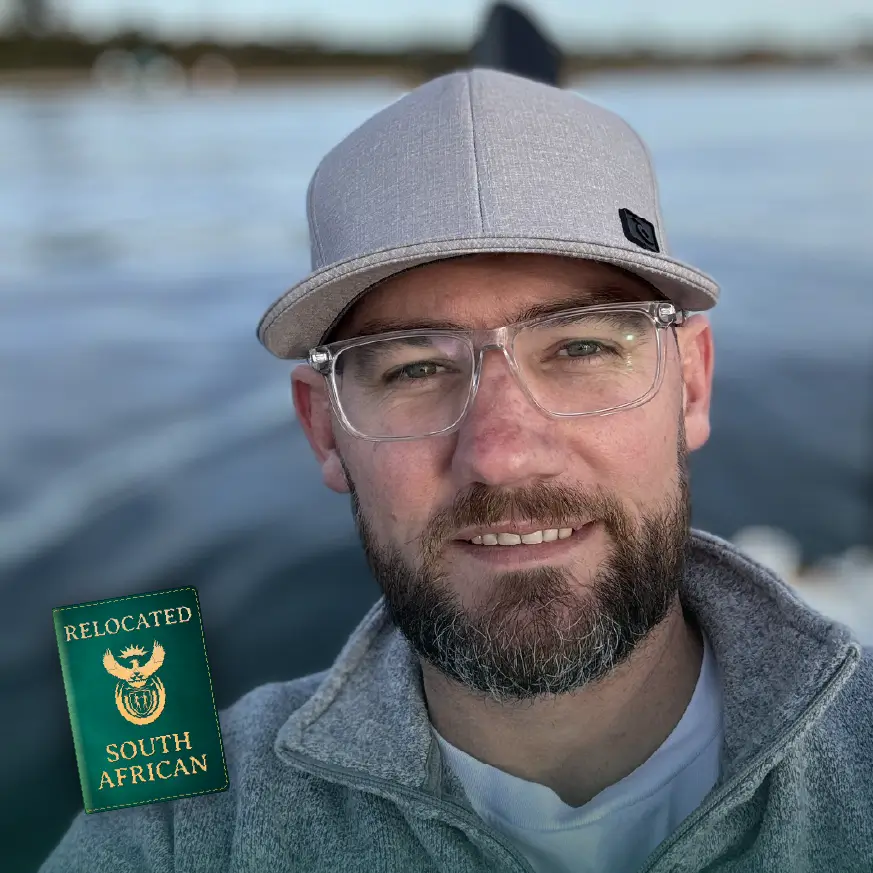
Jan Hugo: Welcome to the Relocated South African, the show for navigating immigration from South Africa for a better future. I’m your host, Jan Hugo, from Lagos, Portugal. Tonight, slash today, slash, I don’t know, I’m in Portugal and Rudolph is in Canberra. I’m joined by Rudolph Botha, all the way from Canberra in Australia. Welcome, Rudolph.
Rudolph Botha: Yeah, thanks a lot. Yeah, it gets very confusing with the time zones. I’ve got sisters in the US and Canada and you don’t know which day you should phone them for their birthdays. We always get it wrong. It’s super time zones because you have to phone them yesterday or something like that to congratulate them on the same birthday. That’s just one of the fun things about being an immigrant.
Jan Hugo: Absolutely. So I’ll let Rudolph tell us a bit about himself, but let me say that he’s got a very interesting apart from his career. He’s a podcast host or co-host, and in Afrikaans we say a ‘potgooi’. That’s right. So he’s a host of Magalies Potgooi. So if I may ask, how did Magalies Potgooi see the light of day?
Rudolph Botha: So, Magalies Potgooi is an international Afrikaans podcast. There are a few of those, actually. We’re not the only one. So, there are four of us. Not all four of us are there every episode. And we were together in school. We come from the Magaliesberg region. So, that’s why it’s called the Magalies Potgooi.
And it started, we used to have the type of conversations we have on the podcast in private. And at the time when we started the podcast, I was very into podcasting and listening to podcasts and really enjoying podcasts. And I was having similar conversations with these friends of mine. And I said, hey, why not just start recording it and see how we go with a podcast. We recorded a few episodes and I think we’re in year five now and just having so much fun.
It’s such a good way to stay connected with each other and such a good way to connect with other South Africans and African South Africans all over the world. It’s such a nice way to stay connected. So I’ve been immigrated for now for about 17 years. So it’s a really nice way to stay in contact with South Africa.
Jan Hugo: Awesome. That’s so interesting. I looked the other day, I think you have 168 episodes. I may be wrong. I really look at some of the philosophical stuff and I must say it makes an accountant like me quite nervous when guys get into this. Grey stuff, more black and white, but it’s really very interesting and I said to you that I listened to the one about your pros and cons of being in favour of or against Trump the other day and it was fascinating. I think there are a lot of those conversations.
Rudolph Botha: Yeah, that’s not a very typical conversation for us. We try to stay away from politics. Yeah, especially South African politics because I feel a little bit as someone who immigrated from South Africa, I don’t have much to say about South Africa. Being on the ground is a lot different because then you really got a feeling of what’s going on.
So we mostly stay away from politics, but as you said, we like having philosophical conversations, things like free will, what’s reality, what’s it being a person, a bit more of philosophy. But we try to mix it up every now and then. So we try to have one week a serious conversation, one week a light conversation. And one of those themes is having similar conversations like the ones you are having, talking to South Africans all over the world and get a feel for their experiences.
Jan Hugo: I love it. I like the name of that segment, Henshopper. And for the English listeners who don’t know what a Henshopper is, if you Google it, it’s a derogatory term used by the Boers in the Anglo-Boer War for those who surrendered and put their hands up. So Henshopper in that regard. So I think it’s really great. Do you consider yourself a Henshopper?
Rudolph Botha: Oh, man. Oh, man, that’s very hard. That’s a good question. But, at the end of the day, our decision was to, as many of your other guests already said, is to do the best for our family. And there’s a difficult play between doing it for folk and fatherland versus your immediate family. And it’s a very hard decision, but at the end of the day, I mean, I’ve got three daughters. We did what we thought would be best for our three daughters. So yeah, I guess I am a Henshopper in that respect.
Jan Hugo: Now that, I mean, it’s what I found also is that a lot of South Africans who didn’t leave are quite outspoken about those who leave. And when somebody comes back, there’s also a lot of, I told you this was going to happen, you know, you’re not going to make it. And I think every person’s circumstances tend to be unique and people leave for their own reasons. There’s no one rule that applies to everyone. Whether they call me a Henshopper or not, I don’t care. I’m doing what’s best for me and that’s that’s how it is.
So you said you grew up in Magalies. It’s just an interesting little anecdotal story. My wife is from she went to a backer school in in that area. So she was in a London school there.
Rudolph Botha: Okay. Yeah, we were just there. So we grew up in Akasia, which is just outside Pretoria. So just outside the big city. And yeah, of course, today I live in Canberra. And Canberra is very much like the Pretoria of South Africa.
Jan Hugo: It’s nice, easy living there. And that’s the administrative capital of Australia, is that right?
Rudolph Botha: Yeah, it’s the capital. So it’s a small city of 450,000 people, but we absolutely love it. We lived in Sydney for 11 years, but Canberra is so awesome. Just like you, I’m a bike rider. So it’s an absolute mountain bike heaven.
And it’s really a family-oriented city. It’s pretty small, so some people think it’s a bit boring, but it’s boring in a way that I like it. It’s not too crazy busy. Sydney is really, really crazy busy. I enjoyed Sydney for a long time, and I like the excitement of Sydney. I like the buzz of Sydney. But now I just love Canberra. It’s such an outdoor place. It’s all built around the lakes. Yeah, and you’re watching kangaroos on a daily basis and things like that. You know, really enjoy it.
Jan Hugo: That sounds awesome. And work wise, business wise, do you have a business in Canberra itself or do you work for a Canberra company?
Rudolph Botha: I’m a contractor. I’m an IT contractor. So I’ve been doing that type of work all my life. I have a long list of type of clients I worked for retail companies. The first company I worked for was called Franklin’s, which is an Australian name. But at that point in time, they belonged to Pick n Pay.
So when I immigrated, I used a work visa and one of my interviews was in Afrikaans. And the first place I worked for was Franklin’s, so there were so many South African influences there. So it was quite an easy landing in that sense to work for a South African company. So I dealt with a lot of South African people at that point. And I still today I deal with South African people here.
Jan Hugo: Okay and Canberra, I mean if I listen to Steven Phyffer the guy from Oorsee, I mean Melbourne, Sydney, Gold Coast, big South African communities, do you have the same where you are in Canberra?
Rudolph Botha: You don’t meet South Africans every day or every week. We seldom run into South Africans. At work I have a lot of South Africans. Yeah, I mean, Sydney’s got a church or a few South African churches. I thought on the car churches, but Canberra doesn’t have something specific. There used to be a shop that was a bit of attraction. Every now and again, this is social. I was at the Soco a year ago or so. But yeah, there’s not really something. I mean, there’s a Facebook group and so on that sort of keeps people a little bit together.
But I think in Sydney, the head from the Kirk Church was quite a driving force for some people. It wasn’t for me at the end of the day. Yeah, I’ve moved away from that conservative way of thinking there from the Kirk. But yeah, I deal with South Africans almost on a daily basis.
Jan Hugo: Yeah. I mean, as you said in my podcast, I’m dealing more with it, with the, you know, life and living abroad and so on. You obviously went to varsity in Pretoria, I assume?
Rudolph Botha: Yeah, I went to Tukkies. You had a quite interesting conversation with Steven, who also lives in Melbourne. And I didn’t realise things he said that in Australia, there’s so much things happening, there’s so much going on, you can build your life around a mountain bike group or a charity group. There’s so much happening there that we reckon that’s why South Africans don’t go and seek each other out. There’s so much else going on that you integrate into the community. That was actually quite an interesting observation that he had. Yeah, I’m here to answer your other question. Yeah, I studied in Tukkies. I studied engineering, but I don’t work as engineer, but yeah, from Tukkies.
Jan Hugo: Okay, yeah, I went to Tukkies as well with a little bit before you. I was still in Taaibos in those days. Taaibos was still around when I was there. So yeah, that’s a long time ago. So you just talked about the better future. That was basically what drove you guys to leave South Africa?
Rudolph Botha: Yeah, yeah, we immigrated around the time when it looked like Zuma was gonna become president and it was like, and it’s so funny. I remember Leon Schuster had this one movie where this guy had this dream about an alternate future where Mandela became president and we all thought it’s so hysterical funny Mandela became president. We never could foresee that. And eventually it did happen.
And then at some point in time, people start making fun about Zuma. I said, oh man, this guy is going to become president at some point. And it was a joke. It was such a joke. But then it started becoming reality. So, well, this guy is really going to become president. And it’s about that time that we left the country. It was, of course, not the only motivational factor. And Zuma came when he went and the country survived. But yeah, that definitely had the impact on our thinking.
But yeah, my parents, for example, from an early age, they said, no, we should immigrate. And I never thought we would. But eventually, when we had our first child, that’s also a big factor. When we had the first child, we realised, yeah, OK, you just start thinking differently when you’ve got kids to look after.
Jan Hugo: Absolutely true. I mean, three of our four kids live abroad, so that’s part of the reason why we left, but that’s another story. But you talk about your parents. I think there are a lot of parents that are more selfish than that, that won’t encourage their kids to leave. And it is quite an unselfish decision from parents to say to their kids, leave, because one of the things that I constantly hear in these conversations is family, networks, when things go wrong, when babies get sick, there’s no ouma that I can call to come and help. And people find that very difficult. Is that one of your observations?
Rudolph Botha: Yeah, absolutely. Yeah, I mean, at some point in time, you can ask me for advice for someone who emigrates. And I’ll just jump to the question immediately. And that’s one of the things if you can move to a place where you’ve got some sort of support system, that is I think one of the biggest advantages. I mean, you can get over not having chutney every day and things like that. But having someone around that you can count on is so valuable.
And the best times that I had as an immigrant, some of the best times was at certainly a one point in time, my cousin was living just a suburb away from us. That was such an awesome time to have a family there. And now we’ve actually got my wife’s got an aunt that’s about three hours away from us and my wife’s aunt and her husband is like grandparents to our kids and we go there for Christmas. Oh man, having someone to go to for Christmas is such a big thing. So yeah, those family networks or close ties are so important. So if you can have that wherever you immigrate to, it’s so valuable. Not saying people can’t make it without that, but it just makes it a lot easier. It’s such a nice thing to have.
Jan Hugo: Yeah, and I assume your parents are still alive?
Rudolph Botha: Yeah, my parents are still in South Africa, went there last year to visit them. As I said before we started recording, I’ve got sisters in North America and three of us met my parents last year in South Africa and did a bit of a road trip. It was such a good experience here. So keep in contact with them.
And yeah, to your point earlier is the way I see this, we do the hard work for our kids. My parents don’t have their kids around. I don’t have my parents around and same with my wife. But my kids, they have the Christmas. They’ve got the family Christmas and things like that. So we’re all making that sacrifice for them. That’s what it’s all about.
Jan Hugo: It’s a massive thing. And I have a lot of empathy for that because, you know, when I think back of and maybe you heard in my episode when we left, I was just so tired of what was happening. And it was a push from that side. But we also had the pull of our children living abroad. And I think sometimes when I get emotional about it and one can have many conversations and you think of what the last 20 years and what happened in South Africa, what that’s done to families. It’s actually staggering. We’ve destroyed families.
My little grandson in Ireland has now been to America to see his two cousins, but they 13 and 10, you know, it’s the first time he’s seen them and they’ve seen him and probably won’t happen for a few years and that that’s very sad. I find that for me is the saddest thing about this, this thing of moving.
Rudolph Botha: Yeah, you go through all sorts of phases when you immigrate. The first thing is when you set foot, you’re like a child again. We had to redo our driver’s licenses. You had to get a tax number. You don’t know what the shops are. You don’t recognize the names. You need to learn new brands. You need to learn the road rules. You’re like a child. So that’s the first phase.
And you go through multiple phases and at some point, yeah, you miss the foods and like I said, the chutney and the Aromat, which you can get your hands on in Australia, but it’s of course expensive. So you go through different phases, but at the end of the day, it’s the connections that you miss the most. You can get used to the other things. You can get used to not going through Kruger. You even get used to the blue gum trees in the beginning the blue gum trees to me was awful and how I love them, but it takes a while for you to realise it’s not the blue gums that are done belong here, it’s actually you, but then you start loving the country, start loving the blue gums and you get used to it, but at the end of the day it’s those connections that you miss the most and yeah.
Jan Hugo: Yeah, I think that’s the other thing that people don’t appreciate, that it takes a while to build new networks. You know, as younger working people and people with kids at school and so on, it’s probably a little bit easier to build networks if I look at my children in Dublin. They’re extremely happy and have good work and good jobs and got a lot of friends and similar from school with kids that go to the same nurseries and so on. So it’s more difficult when you get older, but those networks take time to build and you can never recreate those what you had in South Africa. I say never, but my view is that it takes quite a lot of time.
Rudolph Botha: Yeah, I mean, one of the points that you keep on making on your podcast is that you shouldn’t try to recreate things because you won’t have the same you had in South Africa. Your type of networks would be different. I mean, one thing that was good for us, for example, very silly, but the punchline, the overall punchline is you have to find your community.
And one of the ways we found our community is the dog park. So we got a dog during Covid, we were one of those suckers that paid ridiculous money for a dog during Covid because everybody was what it was toilet paper and at some point it was bicycles and dogs where we paid $1200 for a mongrel. A fox terrier sausage dog cross and eventually joined a you just go to your local park and and and and yeah this is a little community there and we made a lot of friends through the dog park and yes you just have to find your community and that really helps build those networks.
Jan Hugo: Absolutely. I can’t agree with you more. I mean, just cycling. I found that some of the best friends I’ve made all over the world has been on cycling trips and cyclists just seem to be easy people to get along with. Is that the same there? Have you made good cycling friends?
Rudolph Botha: Yeah, that’s how I got into mountain biking or back into mountain biking in Canberra. I used to do mountain biking in South Africa and in Sydney, it’s a little bit harder. You can still do it mountain biking. But when I moved to Canberra, one of my colleagues in Canberra, who I already had a connection with, he sold me his old bike and a few weeks later, my wife bought his wife’s old bike and we started cycling with him and I joined his cycling group for about a year and made some really awesome people there. I also joined a running group at some point. Yeah, so that again, as you noted, you have to find that community and cycling friends are good ones. My on-the-bike ones are sometimes a bit crazy.
Jan Hugo: Some of them. Yeah, but that’s just a joke. But no, that’s yeah. I relate and I think that’s again for people who are listening, the advice is that life’s not going to come to you. You got to flip and get out there and put yourself there. Otherwise it’s not going to happen. And you can end up being very unhappy.
Rudolph Botha: Yeah, yeah. No, you have to keep on working at it.
Jan Hugo: I mean, you’ve been away for 17 years. That’s a long time. Obviously, you said you went back to South Africa in that visit. And at other times, did you ever consider going back?
Rudolph Botha: No, no. I guess one of the biggest reasons why I wouldn’t go back is I’ve got enough keeping me here now. I’ve got my family here. Maybe if I was single, I would have considered it. The idea of being back in South Africa and having a life there is to some extent appealing to me, but I’ve got such a lifeboat here now that it doesn’t really come up.
Jan Hugo: Okay, awesome. And when you talk to Aussies about South Africa, do they tend to know a lot about the country or do you have to explain it to them?
Rudolph Botha: Oh, they tend to, I mean, I’ve heard these stories about people in other countries tell people that they ride on rhinos to school and things like that. But no, the Australians, there’s so many South Africans and they totally know what’s going on. At this stage, if I tell people I’m from South Africa, they don’t even ask me, why did you immigrate? Because they all know the answer. So they know a lot about South Africa. Australians, they keep up to date with international things. And as I said, they deal a lot with South Africa. And so they know the stories. They’re very much familiar with us and our history.
Jan Hugo: And typically you said that Canberra is like, your typical life is it much very much outdoor type life with kids playing in parks and as you say mountain biking and braaing and you know the life that we kind of used to?
Rudolph Botha: Yeah, yeah, Canberra really encourages that outdoor life. I tell everybody if you’re in Canberra you have to mountain bike because you’re such a great place for mountain biking, you’re a fool if you’re not mountain biking, but we’ve also got massive lakes and I don’t row so there’s just so many options.
And as soon as we moved here, our kids just started going out on their own. I remember my one daughter, she was eight or something, maybe 10, but she was pretty young and we went out without her. We went somewhere and she didn’t want to go with us. And we came back and said, oh, how was, well, were you okay being alone? Because it was the first time. And she said, yeah, it was fun. I went walking with the dog in the bush. And we thought, okay, maybe just warn us if you’re going to do that next time. And she just had no issues. Yeah. I think she was about 10. I just took the dog, went out in the bush and walked around on her own in the bush.
Yeah, so yeah, that’s Canberra sort of built in the bush and you see small kids doing some cross-country training in the bush. Yeah, it’s really outdoors. Winter is quite harsh. Yeah, so people tend to be more outdoor in summer. Winter can be hot, but we still cycle through right through winter and so try to make it through winter.
Jan Hugo: That’s one thing that also obviously comes up for everyone. It’s safety. We often talk about people’s reasons for leaving. When you listen to some people who have had home invasions, that kind of thing, you understand that that’s just enough and they’re leaving. But safety in general for us as cyclists in Stellenbosch, we left just in 2020. Cycling became really dangerous, especially road cycling, but even mountain biking you know guys had to hide in groups and people even in groups were attacked so the safety thing for us is so critical when we ride out here in the countryside and you see women on their own cycling and people running and you know there’s nobody around and it’s farmland and that’s how life should be. It’s just for us South Africans, I guess it’s a strange phenomenon. But once you get used to it, I think it’ll be very difficult to go back to the lifestyle where you have to look over your shoulder.
Rudolph Botha: Yeah, I mean, we started recording 5:30 in my time. And when I woke up, I saw my wife has already gone out the door. She went for a bike ride in the dark on her own. And she often does that sometimes she wakes up at four in the morning and was well I’m awake now I’m gonna go for a bike ride. And on the safety thing when you say safety, people think it’s just about the risk, it’s about the idea that you are safe, you don’t have a risk, you don’t have to look out for yourself all the time, but it’s so much more than that it is. It’s just the ability to just go anywhere, anywhere. It doesn’t matter if you’re a woman or a child. Of course, there are always risks.
I once spoke to a South African who came to Canberra for a visit, someone still living in South Africa. He gave me a hard time for allowing my kids to walk on their own in the bush. He said, there’s always a risk. But I mean, if I lived my life like that, what’s the point of immigrating? But the point I’m trying to make is not just about the safety factors, it’s about the freedom. When we went to Sydney, just after we immigrated at some point, we went to the beach at night. And I told one of my colleagues, yeah, it was so awesome to be at the beach at night. And she said, why would you go to the beach at night? And my answer was, because you can.
Jan Hugo: Oh, I can so, so relate to that. It’s, you know, and I don’t know, maybe Australian people know more about it, but just today we were sitting with off the golf chatting to some Swedes and just generally about South Africa and the concept of not having fear for your own personal safety. The concept doesn’t make sense to them. They cannot understand that anybody can threaten your life. They look at me like, what are you talking about? And for us, it’s just everyday conversation. Go into that. But I think the safety thing for us is huge.
We can’t, our doors don’t lock. We don’t know how to lock them because they broke it. So we sleep with open sliding doors every single night. So maybe we’ll wake up one night and there’s a dude standing next to us. But I’m sure he’ll just want food or something, I’m just joking. But seriously, you become so used to not having to lock things you obviously is petty crime. You have to not you can’t leave your laptop on your car seat and think nobody’s gonna look at it, you know, but it’s It’s a huge thing that safety and my wife and I talk about it all the time for us. It’s she was also a cyclist until she had an accident but the safety thing is probably, for us, one of the biggest things. And the fact that things work and you switch the lights on, as you said, and the lights are working. You don’t have to think about things like that, things that are normal.
A riddle of maybe just one other question that also comes up a lot with people. When you make a move like you did, like we did, obviously there’s a lot of red tape involved. Did you find the Australian system difficult? Was it difficult for you to go through all the red tape? Although that’s how long ago probably doesn’t apply anymore.
Rudolph Botha: We were lucky because we immigrated before the global financial crisis. So at that point getting work visas was quite easy. So I got a temporary work visa through the company that recruited me. And they did almost everything. They did my permanent residency as well. So that’s my initial work visa. And then a few years later they did my permanent residency. Of course there’s a lot of paperwork. But they were great and helped me with that. It’s a lot of work, but with support like that it was quite easy for us. We were lucky in that sense.
Jan Hugo: I think my sense is that people sometimes underestimate what is involved in making a move like this. I sometimes listen to people, maybe more my age people, the retired guys, they say, oh, when whatever hits the fan, then we’re going to leave it. And I just say, guys, you have no idea what you’re talking about. When it hits the fan, it’s way too late. But also, it doesn’t matter how much money you have. You’ve got to start over. You’ve got to find an address, and you’ve got to do this and do that. It’s not that easy.
Rudolph Botha: Yeah, and Australia is also a socialist country. So if anything goes wrong with you medically, they look after you, roughly speaking. So they look out for that risk. So if you apply for immigration to South Africa or permanent residency, you have to go through medical tests and they look at your medical history and things like that. So, yeah, there is that element and in that respect, the earlier you do, the better. The younger your kids are, the younger you are, I think that helps.
Jan Hugo: Awesome. One other question. Any regrets about leaving?
Rudolph Botha: Before I answer that, just a very quick question. You’re being unfair to me, because every single episode, you talk about the furniture, the whole issue, whether you should take your furniture or not.
Jan Hugo: Oh, my word is because I’m trying to black it out.
Rudolph Botha: All right. Okay. I mean, there are so many pros and cons and we decided not to take furniture. And of course, now I see the disadvantage of not taking furniture. So my view is biased. But the one thing that if I can add to the furniture discussion is the one thing not to forget is your familiarity of having your own things. When we moved into a place and the country is new, the people is new, the TV is new, the shops is new. If we had that familiarity of your furniture and things like that, I think that would have helped. Of course, we had the advantage of we were able to move in and out of places easily because we didn’t have a lot of furniture. But yeah, just one thing to add to the furniture argument is that emotional, strangely emotional connection to your furniture. Yeah, it might play, should play a role in that decision. It’s not only about the money. Is it cheaper to buy new stuff or not? The mistake we made is before we immigrated, we googled the prices of furniture in Australia. And only when we got to Australia, I looked at my notes, all my screenshots I took off and I realised the place that I used as my benchmark for the price of furniture is sells the crappiest furniture in Australia. So that didn’t help either.
Jan Hugo: Yeah. I mean, just to add to that, as I say, we listened to a friend who had emigrated and he said, no, you must take everything. I think you’ve heard the story, but we loaded a 40-foot container. We had a four-bedroom house. We loaded a 40-foot container. And we didn’t even have an address because we didn’t know where we were going because it was Covid at home. Anyway, eventually we were living in France and the 40 foot container arrived. We were in a rental house that was furnished. So it had a cellar and it was packed with our furniture and eventually the only thing we could do with it was donate it and we gave it to a South African lady who was married to a French guy and they they had to leave South Africa because their business went much lower during Covid. So at least, you know, they were very, very thankful. But certainly in Europe, the furniture would have been big for the size of their houses. So it’s the furniture.
Rudolph Botha: It’s a debate. I mean, it doesn’t matter what you do. You’re going to make mistakes. You’re going to do things that you think you did wrong. And other people would say, no, you did the right thing. As you said, one of the themes in your podcast, it’s so individual. You really need to, I mean, with immigration, even, even this decision of immigration, you learn so much about yourself because you really need to understand what your preferences are.
Jan Hugo: And you’ve got to test your reasons. As I say, there’s this push on the one side, there may be a pull, and you’ve got to be absolutely sure. And a big thing is you must do your due diligence. You must really know what you’re getting into. I spoke to a lady who left Portugal after two years. Her husband came here on a scam. The job that he was offered didn’t exist when they got here. They’d sold everything in South Africa. And they were devastated. It was heartbreaking to listen to this lady. And I’m not saying they made a mistake. The problem is maybe they just didn’t know they just didn’t do the due diligence. But I would say one must be very sure of your facts because it’s exciting. It’s freaking exciting to get on that plane and get ready. Obviously when you leave family and so on. But there’s a lot of that excitement. You say new shops, new new brands, everything works. If you’re not irritated by a car guard and a guy who’s asking you for money around every corner and that kind of thing it takes a bit to get used to and it’s quite exciting but you’ve got to do your homework so yeah that’s furniture is a story. We also arrived with eight bicycles. We didn’t have storage for it. So we sold our two mountain bikes. We sold the gravel bike that we had to sell. Now I miss my damn gravel bike. I think I might acquire one again.
Rudolph Botha: All right, the gravel bike to work. I love it. It’s such a versatile bike.
Jan Hugo: We bought two e-bikes, so we go everywhere on our e-bikes. We got it down, go to the pharmacy. It’s just so easy not to look for parking and everything is closed by where we live.
Rudolph Botha: To answer your other question, regrets? No, I don’t have any regrets. I mean, at some point in time, maybe I thought I had regrets, but no, really, really happy here. It’s not perfect. It’s not South Africa, but we really love Australia and our new life.
Jan Hugo: And, okay, very last question. You have people in South Africa, do you get questions? What should I do? Should I leave? Should I stay? What should I do? Does that not really happen in your network?
Rudolph Botha: No, no, don’t really get that question. There is one friend that’s thinking about it and asked me about pros and cons. But most of my friends seem to have made up their minds. Some of them are so happy in South Africa and are happy for them. They think I’m crazy to move to leave the country. So I think most of my friends already made up their minds. So no, don’t get rid of that.
Jan Hugo: Okay. Awesome. Any final thoughts?
Rudolph Botha: No, I just, I love what you’re doing. Yeah, keep on talking. We’re going to have you on Magalies Potgooi as well. So I really like what you’re doing. I’ve listened to every episode. So keep on doing what you’re doing.
Jan Hugo: Awesome. Thank you so much. I look forward to chatting to you guys as well. And it will be in Afrikaans.
Rudolph Botha: All right. Yeah, yeah, yeah, yeah. See if you can still speak Afrikaans.
Jan Hugo: Yeah, I could spread Afrikaans, but yeah, so no problem. But so, thank you Rudolph for a really entertaining, interesting discussion. I love what you guys do with Magalies Potgooi. Keep it up and thank you so much for chatting to us today, tonight, tomorrow. I don’t know, whatever day it is, but thank you.
Rudolph Botha: All right, we’ll talk again.
Jan Hugo: Thank you and if you enjoyed my chat with Rudolph and would like to hear more stories from people who have made the move from South Africa for a better future, why not subscribe on your favourite platform? If you would like to share your own story, contact us on jan@therelocatedsouthafrican.com. Until next time.