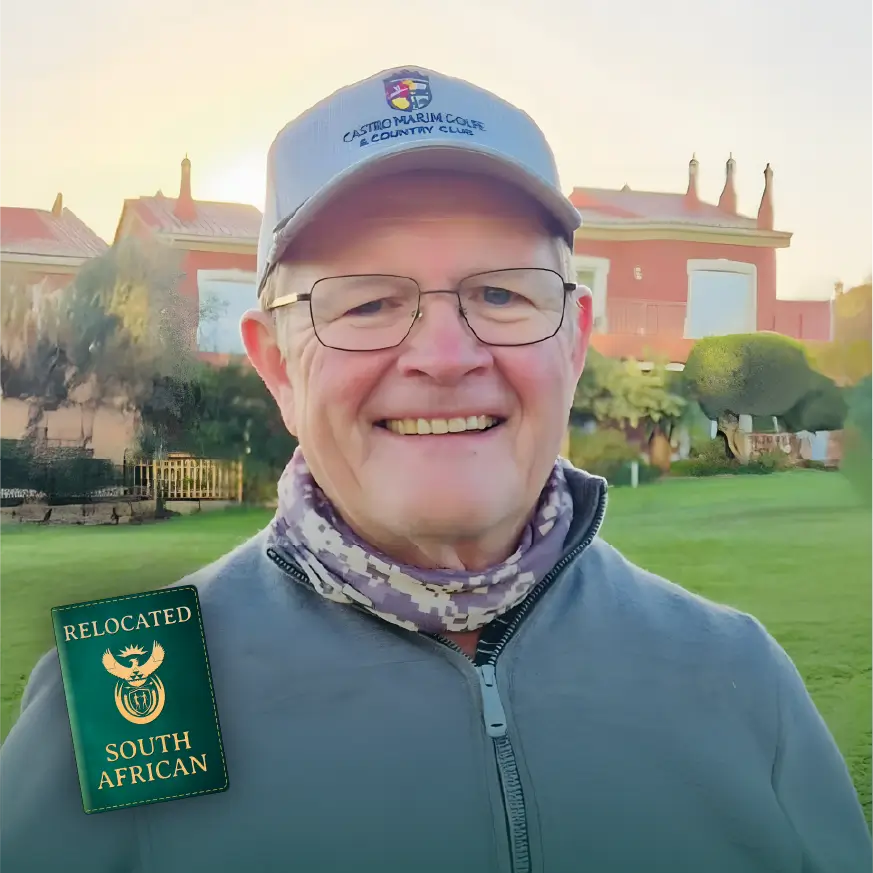
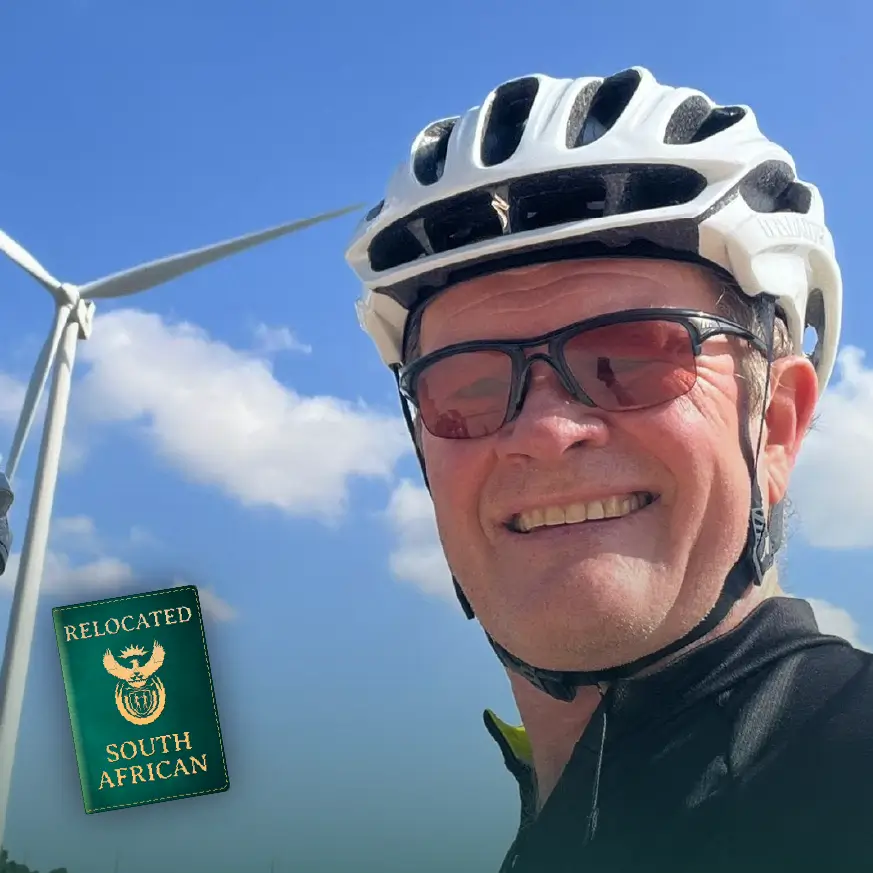
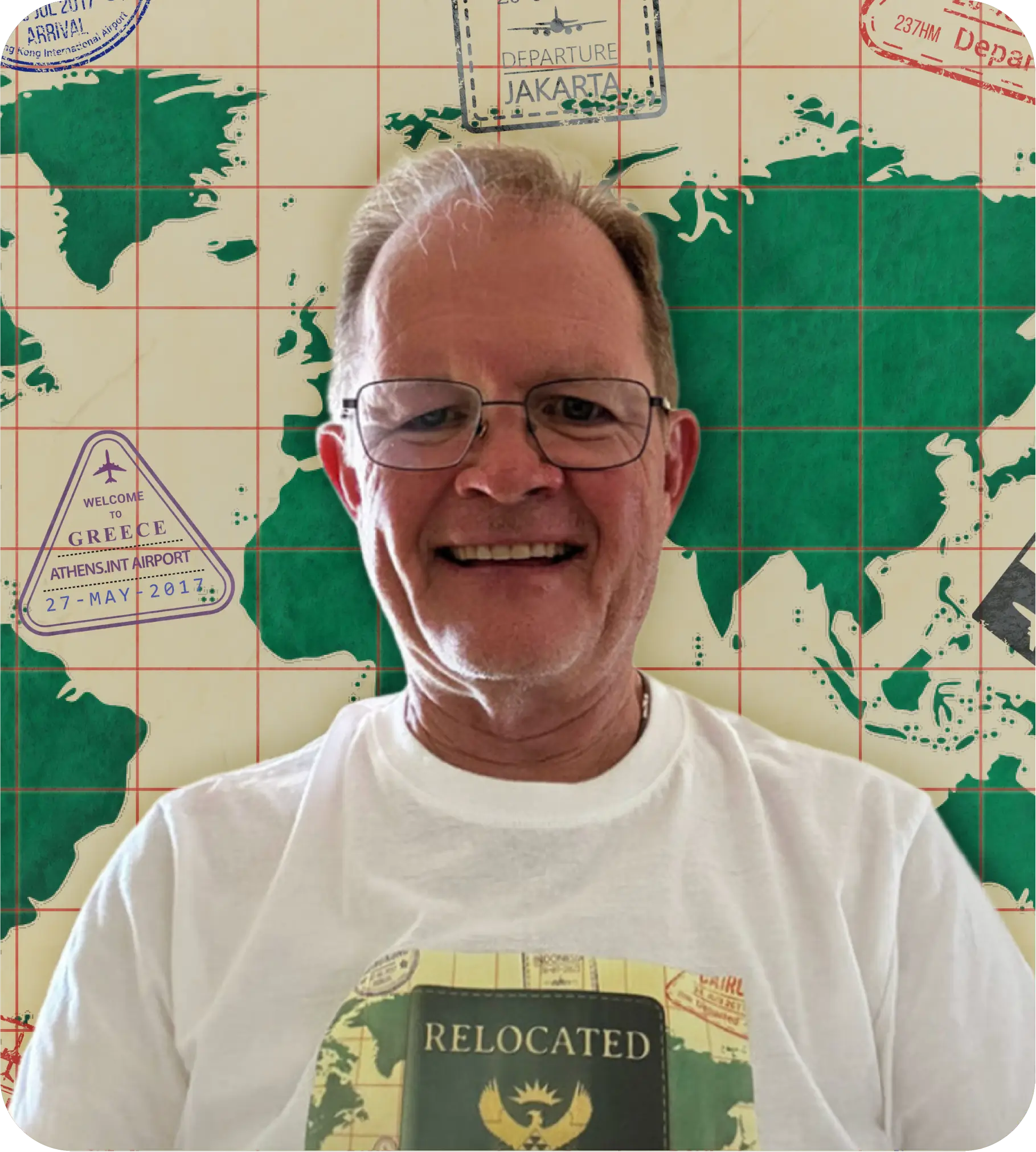
Jan Hugo: Welcome to the Relocated South African, a show for navigating immigration from South Africa for a better future. I’m your host, Jan Hugo, from Lagos, Portugal. I’m joined tonight by a good friend and fellow nomad, Ian Visser. He has lived in numerous countries. Welcome, Ian Visser.
Ian Visser: Hi, Jan. Thank you for having me. It’s really nice to be talking to you again. As you say, I think by some freak of nature, I sort of ended up in a whole bunch of countries. So I might be able to help people with a little bit of information.
Jan Hugo: Excellent. Thank you. And as I’m sitting here in Portugal, I was just saying, it feels like Africa is not leaving us because we are expecting a lot of Sahara winds and Sahara dust in the next few days. So just to remind me that I’m from Africa. Anyway, in today’s episode, we’re not going to delve into how many countries Ian has lived in because I didn’t think he knows, but we’re going to debate some of the considerations when one makes a call to emigrate or not.
I’m probably biased because I live in Portugal and we’ve decided to make it our home. I think on the other hand, I recently read that 45% of people who emigrate go back to their home country. That’s quite a statistic. Ian, do you agree immigration is probably one of the biggest decisions that one can make in your life?
Ian Visser: Yes, Ian. I didn’t really appreciate that that number was that high. It almost sounds like the numbers that would apply to the success rate of a marriage. I didn’t realize that, but to be honest with you, I’m not surprised.
When you talk about is immigration a big decision? I sometimes feel sad when people that emigrate don’t receive a little bit more understanding. I think especially in a South African context, it’s a nice country. I think most people that leave here are not leaving to go somewhere. They’re leaving to move away from something. And in the process, it’s probably not fully appreciated, but you are walking away from an entire life. Everything that you’ve built up since childhood, your career, your friends, your humor, you’re basically leaving at the door and you start again.
I think what is underappreciated is probably one of the most courageous things that a person or a family can do. Secondly, if it doesn’t work out and you have to reverse it, it’s actually extremely difficult to get yourself back in the same position. I do think that if you’re not suffering permanent harm, you’re still going to suffer significant harm. So it’s a very important decision to consider carefully.
Jan Hugo: I think that’s very, very true. And I guess one of the questions that I would ask in that regard is when you move, what would you regard as a successful move? Is it you stay there forever or it works for you? It gives you comfort and peace and you’re happy. But you sometimes get the impression that some people just can never be happy wherever they go.
Ian Visser: Malcontents. Yeah, that is such a good question. I think we need to cut ourselves a little bit of slack with this one. A person is not a tree. You can move. I fully understand the reasons people want to move in South Africa. I did the same. In our case specifically, I moved because foreign exchange restrictions scare me. I think that’s a fundamental human right. What made immigration slightly different for me is once the funds were offshore, that constituted a success, and in my mind, I could come and go then as I pleased.
But I think you’re setting yourself up for a very hard time if you measure success by measurements such as, okay, we’ve gone to another country and we’re now staying here at Sandton. If you’re really not happy there and it’s really not working for you, you’re probably better off by just admitting in this particular case, I may have made a mistake and I need to rectify that and go back acknowledging that there’s going to be some damage in the process. I mean, it’s probably not a success, but it’s not the end of the world. It’s a very difficult thing to do this. It’s probably the most difficult thing you’re going to attempt in your life. So I’d be very careful to set very strict benchmarks of what one thinks constitutes success. And I think it’s a really good question because I think that those benchmarks will differ for every person. And I’m certainly not going to try and answer that for everybody.
Jan Hugo: I mean, as I say, I think I agree with you. It’s a very difficult question. One of the thoughts I’ve had since moving, and we’ve been here for five years now, there’s a big mindset thing that comes into it. So let’s take all the other things away, take family money, everything away. But the mindset of saying, I’m relocating from South Africa to this place. I didn’t do that. I moved through three other places, but I eventually ended up in a place, but it’s not in South Africa. But I’ve never had the mindset of if it doesn’t work, I’ll go back. And for me, that’s quite an important thing. I don’t know how you would react to that comment, but I think a lot of people go and they say, if it doesn’t work out, let’s just go. We’ll go back. And then as you say, it’s such a massive upheaval in terms of everything that it’s a huge decision to actually go back.
Ian Visser: I mean, Jan, you’re right. I don’t want to belittle it. If you have to go back, that’s a setback. I also absolutely agree with you. You’re not just saying what we said earlier. You’re basically walking away from everything you’ve ever known. So if you should run, God forbid, you should run into some hardship where you’re going to, I’m not for a moment suggesting that one not be resilient. If you are easily scared, then you’re going to find a reason to reverse your decision. I agree with you. Especially for some people, it’s very difficult to come back just from a career point of view. And I think the viewpoint that I’ll just go back is probably something you can’t afford just in terms of sticking it through and making it work.
Jan Hugo: I guess it’s in a way, it’s a very simple example. It’s like buying and selling houses and moving around all the time. It’s quite a costly exercise when you do that. And the cost of moving is not insignificant. Even if you go with a company and people pay for most of the stuff, it’s what you leave and go back to, that is very, very difficult.
Ian Visser: Absolutely. I think I just want to move on. At the same time, if it’s really, really, really not working, it’s your life. You know, if it’s a better decision for you to go back, then do so. I’m sometimes annoyed at simplistic views that people have, you know, sort of when you come back, I see we told you South Africa is the best place. It’s not. It might be that South Africa is the best place for you. I think you have to be true to yourself.
Jan Hugo: I think that’s very true and life is really short. So you can’t go and sit in a place and go through the motion and say, it’s just not working. So I can’t sit here because I’ve made that decision. So I agree with you. It’s possible to go back. It’s costly, but it’s possible. Obviously, this whole immigration thing is currently very topical because of what’s going on in America. All the stories that you see in the news, so there’s a lot of people that say, go. There’s a lot of reasons to go. In our case, we followed our children. So it was, apart from being hard-full, we also followed our children. But we had a push and a pull. You know, this is also maybe a question in terms of if people look at what they have now in South Africa, it’s a life they know, it’s maybe a life that doesn’t work for them, careers, that kind of thing. So there’s so many things that you have to take into account when you look at your current situation versus the unknown of what’s waiting on the other side.
Ian Visser: Yes, that’s very true. I think that’s probably what makes any decision difficult. You’re comparing one aspect that you fully understand to another which you don’t have full information on. I think you also touched on something with children that there might even be a pull. I live on a golf security estate with probably 200 other coffin dodgers that are just as old as I am. literally 95% of our children are abroad. That’s sad, actually. Well, that’s really, really sad.
Jan Hugo: Absolutely. And I’m also the Coffin Dodger generation, and we decided to make the move. As you say, I think one sometimes forgets just what’s waiting for you, but on the other side, it is still an adventure, but there are things that you must. So what are the nitty-gritty things that you have to consider? You think of what you have in South Africa and how you’re moving to Europe or you’re moving to Australia or America, wherever you’re going. What are the things that come up in your mind that you would say, ‘shoot, I should really consider this?’
Ian Visser: If you say that 45% of people come back. Some of them may be coming back for professional reasons. I think in a lot of cases, probably what they expected didn’t work out for them. Maybe where we can possibly help people is I honestly believe to limit your chances of being in that 45%, you have to keep an open mind to the possibility that if you really think about what’s waiting for you, the best decision for you might actually be not to go in the first place.
The biggest thing that most people plan to go to what they perceive to be first world countries. We are absolutely spoiled with space in South Africa. Your housing, both the cost and the space and the luxuriousness of this is going to be a shock. you’re going to feel that you significantly constrained from what you used to have. Just on the lighter side, I think I moved from about a 700 square meter house to one that was 78 square meters and it crossed four times as much. Just to put it in context, that is a big thing that I think people sometimes underestimate.
Jan Hugo: So I think maybe what you’re saying, for instance, just with housing, maybe the way to talk about it then is to say that you’re giving up something in South Africa that you know and that you understand. And you’re going across to another country and you have to make certain compromises. And this is kind of, maybe it’s the accountant in me that thinks about it this way, but you have to weigh up the pros and the cons. And if we talk about some of the basics, like you say, much bigger housing. In South Africa, we used to having people around us who do the cleaning. In Europe, when you do that, you have to pay at least minimum wage, which is a lot of money in South African terms. So it just doesn’t happen that way. You have to do your own washing and cleaning. And there are many things that one has to take into account that you may have to compromise on.
Ian Visser: Yeah, I mean, I remember we moved to a large house in England, not because we needed the large house, we wanted to do a renovation. And by about the 20th time that I had to mow the lawn, I absolutely promised myself I would never buy another house with a lawn. That’s not something that occurs to you when you’re in South Africa.
Jan Hugo: Absolutely. No, that’s me too. And I mean, there are so many things. You know, I always say people, most South Africans are on Discovery medical aid. And Discovery medical aid works and it works well and the medical services in South Africa are great. But having tested it in three or four different countries, I found that it’s not that simple and it’s not that cheap. So it’s also something that you have to consider. We are all this, so we have to look at that from that perspective. But often people with young families, it’s critical that you have good medical care and affordable medical care. That’s the other thing.
Ian Visser: I mean, you spoke about Portugal earlier. I think for a variety of reasons, it’s an excellent choice. One of those is that Portugal really has, from what I can get, excellent medical care. South Africa is probably in the middle of the road, but maybe when we talk about medical care, maybe the message is it’s very country specific. Be careful. I mean, if you end up on the NHS, God help you. Literally, the time between a cancer diagnosis and your first treatment is three and a half months. You want to let that sink in for a little bit. I mean, even in South Africa, if you diagnosed with that, unless the doctor is playing golf tomorrow afternoon, you’re going to have your first treatment tomorrow.
Jan Hugo: That’s very true and I have to say that I guess in Portugal it’s kind of similar to the state medical. They always say if something happens to you that requires critical care, the state to look after you, they will fly you somewhere and they’ll do something. but if it’s like in our case when my wife had an accident and broke her pelvis they said when I asked them they took her by ambulance to the local state hospital and when I said to them okay if she needs surgery how long will that take, the guy said well if it’s not too serious maybe six to eight days you know lying in pain and we were fortunate that we have private health care and we transferred her to hospital the same day. She didn’t need surgery, but we got it to private care and it was fantastic. So we’ve seen that part of it. But I think the message maybe is that’s a big thing and a big due diligence that you’ve got to get sorted before you leave.
Ian Visser: Absolutely. And I think the cost of it can be mind numbingly high if you get it wrong.
Jan Hugo: Yeah, very true. I mean, a few other points that we debated. You know, obviously for younger people, cost of schooling, if you have to go to private schools, that’s also mind-numbing, as you can say. You know, people have to spend a fortune. Universities in Europe and America, those places are really expensive, and they should get scholarships, but it is expensive.
Ian Visser: Yeah, I think it’s best to send Yanni out on the driving range so you can get a golf scholarship because you’re not going to afford it.
Jan Hugo: Very, very true. Just a couple of other thoughts that in some of the interviews that I’ve done, people underestimate the lack of a network and the lack of family support, especially young families when when kiddies get sick and mom and dad have to work and they just don’t have the network. There’s no grandma or grandpa that can just hop over and help.
Ian Visser: I think we sound like we’re trying to discourage people from emigrating. It’s not. I think what we may be doing is helping them, as you said, with a due diligence. I think that refers to what I meant by you walk away from your life. There’s so many things that you take for granted. Unfortunately, you are from South Africa and it has a lot of specific problems. We might necessitate you moving. But on the other hand, I think we spoke about this on a different occasion. You know, there’s a big polarity in view amongst South Africans. You know, it’s very often you get people that think this is the absolute base country in the world. And others that think that it’s the worst country in the world. And obviously neither of those statements are even remotely true. I mean, you could be living in Gaza, for instance, if you really want to see how bad life can get.
But to get back to your point, one of the things that we have is we have institutionalized structural discrimination. It’s historically justified, and it’s a completely different debate as to how long that needs to be in place. But that really irritates a lot of people. And it’s a valid reason for a lot of people to emigrate. What one does not fully appreciate is if you immigrate somewhere else and you arrive there, you have no network, or very seldom do you have a network, and you are the immigrant. So it’s not institutionalized, but you have to understand that you very last in the queue when it comes to people thinking about opportunities for you. They’ll find reasons to appoint their own native people first, you know, own citizens before they do you. So don’t think that by going there, you are solving discrimination. You’re not. You’re right about the help. I remember when I told you about the house that we had in England, that was a little bit too big for us. We got a lady to help us clean the house for an hour a week at cost of 70 pounds an hour. That’s big but maybe it is all that sort of amount per hour. And I think Maybe what you’re saying, Jan, is, you know, a support network is something that you take for granted when you hear and you only miss it when it’s not there.
Jan Hugo: I totally agree. Yeah, I think, as you say, you know, it’s, I mean, we’ve maybe focused on some of the difficulties in the things. Maybe the point of that is just to say to people, consider these things. They exist. It’s not, it’s not like you can go and recreate your home in Welgemoed or your home in Durbanville or your home in Sandton and you’re going to live in Portugal or Ireland or the UK and you’re going to have exactly the same life. That’s a pipe dream. That’s not going to happen.
So if you start with that and you say, okay, I’m going to make certain compromises. I’ve got to do my homework and I’m going to go overseas and I’m going to live there. The other side is there’s a hell of a lot of positives in making the move. Again, thinking Europe, I’ve spoken to people in Australia and it’s a different world, much closer to South Africa, just far from everything, but there’s a lot of South Africans and they have huge communities and so on. So people are extremely happy. So it’s not all doom and gloom.
I think it’s a matter of making it work on the network side. You have to get out there. You have to put yourself out there. You can sit at home and say, oh, they’ll come to me. They don’t come. Trust them. We’ve all seen that. And a thing that’s important for us, for instance, as keen cyclists, is the safety aspect. So that’s a big issue in South Africa. It comes up everywhere, all this stuff that’s going on in the news about threats and so on. So if safety is a big issue, my word, you can’t get it better. I mean, Portugal is just fantastic in that respect. I always say, when I go out in the country and I see a lady cycling on her own or a lady running on her own, I think to myself, this is how life should be and this is what I like. So there are a lot of positives to consider as well.
Ian Visser: Absolutely. Just to go back to what we said earlier, people are moving away from something and those things are very real. They revolve around physical and financial security. If you have a home invasion, I mean, personally, I don’t think you should wait for that to happen. It doesn’t happen in other places. That’s why you’re considering leaving. So we’ve sort of gravitated towards discussing things tonight that would help you undertake this process with open eyes that you don’t think that you’re going to go to another place and all the problems that you have right now are going to disappear. That’s for sure. That’s why you’re leaving. You’d be a little naive to think that there are not new problems of a different kind that will present themselves. And I think maybe that’s what we’re trying to do is just prepare people a little bit to cost their minds to that. And that’s a very useful way to decide as well is how much is this safety worth to me firstly. Secondly, could I get it in South Africa? What happens if I move to a security estate, with no really rock-solid security. I mean, in your case, for instance, that doesn’t help you at all. You’re a cyclist. But these are the things that you’ve got to weigh up. It took me a long while of living in Europe to stop being surprised if I switch the light switch on and the light actually goes on. It still happens. It still happens. South Africa is by any objective measure is either a failed or a quasi-failed state. It’s not the worst in the world, but there are very valid reasons to go somewhere.
Jan Hugo: I agree. I totally agree with you. From a safety aspect, our doors, I should repair them because they can’t lock. We have sliding doors around the house, but we don’t know how to lock them. The only time we lock doors is when we put the shutters down, when we go away. You become so used to this lifestyle of how it should be. So there are a lot of positive things. I mean, we really have become part of a community, a golf club and cycling. And we go out a lot more than we did in South Africa. And it’s a great lifestyle. So we’re very fortunate to be here. And I think it’s possible to do that. And my children that are living overseas are all very happy. They are raising families and things are working for them.
So yeah, I think it’s a matter of maybe the message tonight is just go into it with open eyes. Don’t just leave without doing your homework and a good life is possible. I mean, maybe if we can end on this note, if you were imagining yourself now with young children that are building a Korean South Africa baby in whatever field. They say they’re professionals. What did your advice to them be? Which country do you want to go to? That answers it. So your view on balance is for young people who have the opportunity, just go and explore it.
Ian Visser: I mean, I think in conclusion, if you’re thinking about this at all, I would suggest you do it as soon as possible and not wait. It’s a lot easier to build networks when you’re young. It’s a lot easier for your children to adapt when they are young. And maybe you raised a very valid point earlier. The time that you saved or that you save on a daily basis, not having to lock your ass up, maybe you should use that time to build a network. Go there and work at it. It’s not going to come to you. Absolutely.
Jan Hugo: Ian, I really appreciate it. I don’t think when we initially discussed this, we thought we’d have this kind of debate, but I think it’s absolutely sobering, interesting just to get views on immigration from people with experience. So thanks a million for sharing your adventures and advice with us. It’s been really, really interesting.
Ian Visser: Thank you, Jan. Thanks for considering me. And I really hope that what we said is of value to some people.
Jan Hugo: Thanks for listening and if you enjoyed the discussion with Ian and would like to hear more from people who have made the move from South Africa, why not subscribe to the show on your favourite platform. Thanks and until next time.