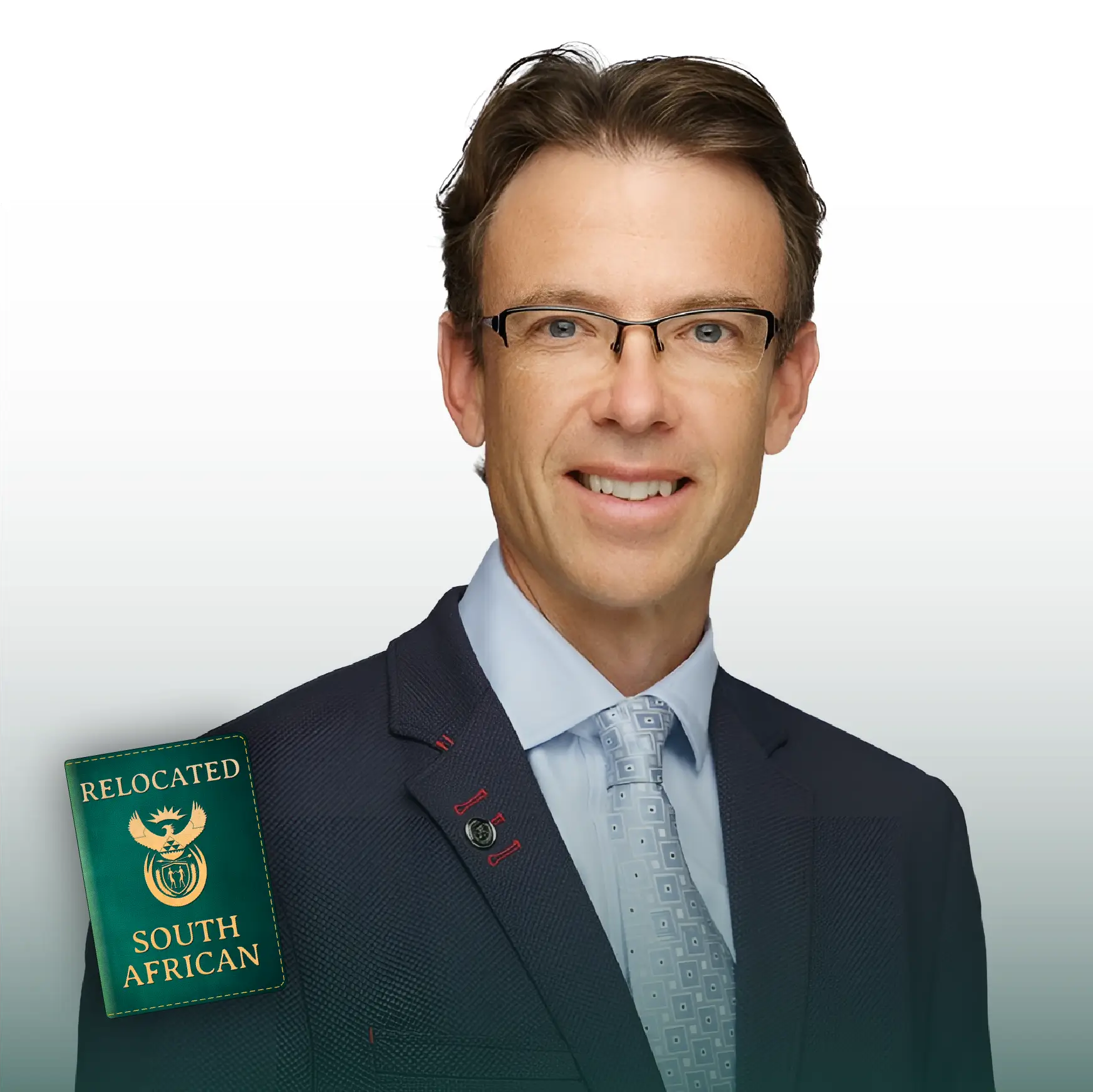
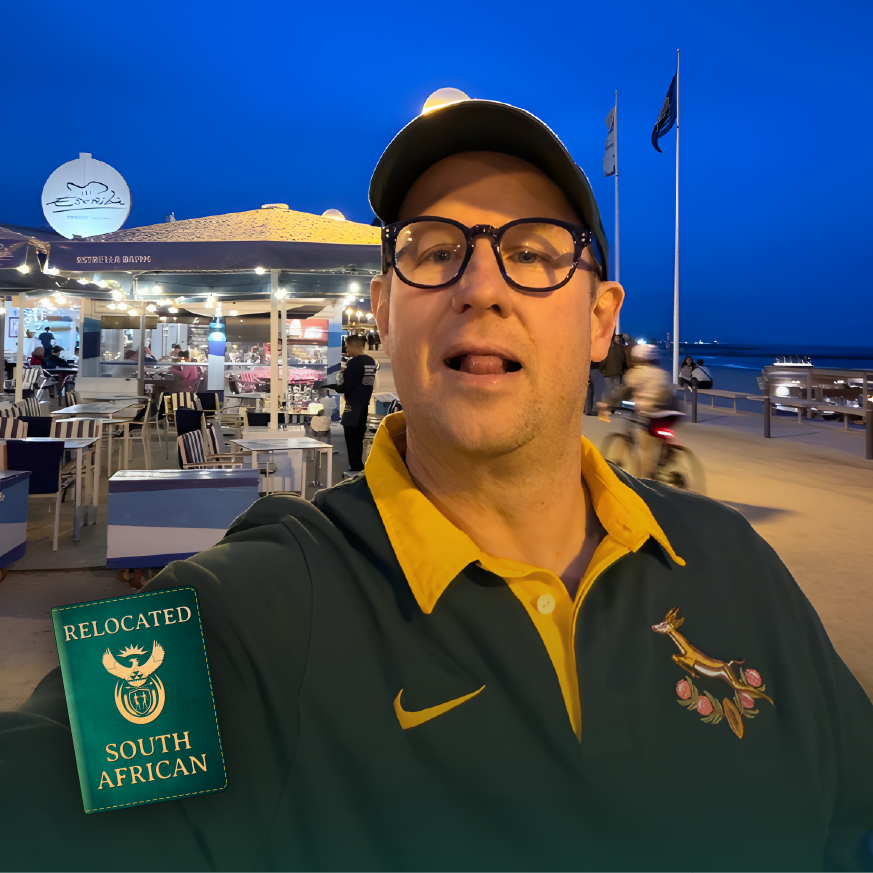
Jan Hugo:
Welcome to The Relocated South African, the podcast that explores the journeys of South Africans building lives and careers around the world. I’m your host, Jan Hugo, speaking to you as always from Lagos in Portugal.
Today is a really interesting episode. Of course, it’s not just about leaving South Africa, it’s also about returning. So, our guest today is Monty Stephenson, now living in Cape Town. Welcome, Monty, it’s great to have you on the show.
Monty Stephenson:
Yeah, thank you, Jan. Really, really appreciate the opportunity to share my story. Actually, our story. It’s my family’s story.
Jan Hugo:
Lekker. Absolutely. So, Monty, I always start the episode with just a question, like where you’re from, where do you study, and how did you get to leave South Africa?
Monty Stephenson:
Yeah, good question. I’m going to start by going in reverse order in terms of where I was born. So it’s currently called Makhanda. I grew up knowing the isiXhosa name as Rhini. And it’s actually Grahamstown sitting on my ID document. Yeah, I grew up in the Eastern Cape. Unfortunately, I was in the Eastern Cape for about five years.
My grandmother on my mother’s side, my maternal grandmother, sadly got killed in a car accident. And so my mom said to my dad, who had been a farmer all his life, unfortunately, we’ve got to move back, or not move back, but move to Plettenberg Bay, where my grandmother and my mom had grown up. So…
Yeah, hell of a fortunate to grow up in Plettenberg Bay, actually outside of Plett on a small farm. My dad became a small farmer, if I could use that term. Grew up in Plett, Knysna, spent a year in Cape Town after my dad passed on and…
That year I thought it was going to be at least three years at Rondebosch Boys’ High, and then my stepdad said, no, he’d like us to move back to Plett. So we moved back to Plett and then from Plett it was up to Johannesburg. I had to go and see the concrete jungle. So I was at university at Wits. Absolutely loved it. BCom, BCom honours and…
That my articles became a chartered accountant. My initial vocation was actually to become a sports broadcaster. But my stepdad at the time said, you know, you’re very good in accounting and maths. And at that point in time, sadly, South Africa was still under apartheid. And he said, look, your opportunities within sports broadcasting are going to be fairly limited, whereas within the accounting profession, you can at least earn a living.
So I took his sage advice. I’ve never given up on the sports broadcasting side. I mean, I’m an avid sports guy. But having said that, to get back to your original question, it’s out of being with Deloitte in Johannesburg, got married two years earlier to my wife, Cathy, and she’s an occupational therapist.
And you know, being young South Africans back in the day, in the 90s, young South Africans were keen to go and travel and work overseas. Unfortunately, I was at a senior level with Deloitte already and they weren’t keen to promote or sponsor me going overseas. So instead I had to do my own thing. I contacted Deloitte in Canada and that’s a long story as well. But literally a night later, Friday night, I got a call from them. They said, we’ve got an opportunity for you in Canada. And Cathy and I hopped on a plane in March 1996 and arrived in…
The very cold Prince George, a northern winter city in British Columbia in Canada, to shock and horror. I remember us phoning her parents that evening from a very dark looking motel, not dark because of the winter conditions, just dark and dingy inside, and just said to them, we’re on the next plane home. All our dreams are being shattered.
And yet we stayed there well beyond the two years. So there was something more to it. Yeah.
Jan Hugo:
Wow, that’s awesome. No, we’re going to delve a little deeper. And your wife, was she able to work as an occupational therapist?
Monty Stephenson:
Yeah, interesting story. In preparing to go overseas, we’d been offered the, or I’d been offered my contract, I think around July 1995. So that’s about seven months to get over to Canada. Part of it was the whole process of having to get the medicals. I think it’s, my understanding is still very similar, it’s done out of Nairobi, Kenya.
Not that we had a flight there, some doctor in Johannesburg was designated, did all the requirements and then sent it off. And I think we were informed around November that we could get a visa. And then the challenge was, because I was a senior manager with Deloitte…
I had a fairly large portfolio and I needed to hand that portfolio over to the manager who was going to take over from me. So there was a bit of process there. I think we were meant to go a little bit earlier if I recollect. We had a look at Cathy’s situation and it was outstanding. I mean, Deloitte in Canada said, yeah, occupational therapy, it’s the number one requirement in Canada. Your wife will get a job, no problem. So did Deloitte in Prince George. They made the same comment. We arrived in Prince George with the expectation that she’d be able to get a job almost immediately.
Every week, every day, every week, every month went by and she couldn’t get a job. And it was hell of a challenging, because she was now sitting at home in a foreign country. I was at work. It was initially winter conditions.
We needed to get used to driving in snow, on icy roads, on the wrong side of the road. So far away from family, Prince George to Cape Town is probably the longest route you can fly. I mean, you could probably fly from Anchorage to Cape Town and it’s longer, but it’s possibly one of the longest routes that a South African or expatriate would have to fly to get home.
And so we even went down to Vancouver in the summer, first time we were down in Vancouver since when we arrived, we landed there and then flew up to Prince George. But the first time to go and explore Vancouver, I think it was around June, July. She was required to do a conversion exam, so to become a Canadian OT. In my case, I didn’t have to do it initially. And so she did the exam. I remember…
Trying conditions, we ended up staying at a campsite in a tent at Vancouver Airport of all places, or next to Vancouver Airport. You just got these planes taking off over you, making, you know, absolute loud noise and you can’t sleep. Anyway, she went and wrote the exam, successfully passed that. And we just got to a point where we started looking around and there was an opportunity for her in…
Saskatoon in Saskatchewan, in the Midlands of Canada. And I had a look at, there was a Deloitte office there and I went to my bosses at Deloitte in Prince George and said, look, sorry guys, when we signed up, both of us signed up to come and gain work experience in Canada and enjoy what Canada has to offer and explore it.
Do you mind us moving to Saskatoon? There’s an opportunity for Cathy and, you know, what are your thoughts? Well, the next day she had a job in Prince George. I found out subsequently and she relates the story differently. We had already met her boss beforehand. She had got to know many of the occupational therapists in town. We’d actually become very good friends with two of them and their husbands and…
And the one couple today are still our best friends, Ken and Sherry Mitchell. So she knew everyone within the OT space, but just didn’t have a job. And she survived that time period through volunteerism. And that’s one of the strengths of Canada. It’s known for its volunteerism. You actually, even if you got a job, you’re still required to volunteer. And I think it’s a brilliant thing. I mean, it’s…
When I say you’re required, it’s by choice. It’s not forced, but it’s a culture. And the reason she got that job, this is my take on it. If she was sitting next to me, she would give you a very different reason. My boss was known as Mr Deloitte in Prince George, very charismatic, Brent Campbell, very charismatic person. I learned a lot from him.
And he was close to completing his tenure at Deloitte. He was a few years away from retirement. So you can picture the age. And Cathy’s boss, I’m trying to remember her name now, but Brent literally lived two doors away. So he was the neighbour of his neighbour. And my understanding is Brent, who was, I mean, he was persuasive as anything.
He walked two doors down and he said to her, he said, you will hire this lady, because we’d like to retain this guy. That’s the story I got told by Brent, but Cathy maintains it’s different. And I mean, that just showed me the strength of Canadians as well. They’re some of the most caring people and…
Jan Hugo:
That’s a beautiful story. Awesome.
Monty Stephenson:
Probably further on in our discussion, I’ll share more around Canadians, because we really came to appreciate them a lot. Initially, when we arrived, you have that expectation as South Africans. I mean, for example, Jan, if you came back to Cape Town, you and I will connect and we’ll go for a coffee, a lunch, or whatever, dinner. That’s the way we are. We love kuier en saam. In Canada, when we arrived, it’s like…
Oh, okay, South Africa. You know, there’s no sort of big thing about you. Sure, you’re from South Africa, so what? But what they really appreciate of individuals is who you are, what you represent in life. And as soon as they connect with that, you’re a friend forever. Yeah.
Jan Hugo:
That’s, I think that’s amazing. I think probably in 96, when you got there, they didn’t have all the Facebook groups and all the, you know, these days there’s South Africans connecting with South Africans in every town. So for a lot of people, it’s a soft landing, you guys went across just for work experience for a two year period. When did that become 10?
Monty Stephenson:
Yeah, good question. So the initial year and a half for me was tough. I mean, I come from a senior manager role. In Canada, there was nothing at the time called senior manager at Deloitte. It was manager. And the manager role really felt like junior manager. And when I arrived, a fellow South African, and it was actually through him, Wayne Pullman, the opportunity arose.
Wayne and I were, if you remember, in Joburg, it’s still there, the Bella Vita Hotel, still in the middle of the street, and we were there for a goodbye. It might’ve even been his. He had just finished articles. He had worked on one of my jobs. And so we were having a typical South African thing back in the day, or CA thing, you know, from 12 o’clock and it just carries on. And he said he’s off to Canada. So I said…
Where in Canada? He said, yeah, it’s a place called Prince George. And I actually got the details of the Canadian HR leader, Deloitte’s leader, from him, contacted her in Toronto, and as I said, I got a response a night later to say, we’ve got the job for you. So Wayne arrived a month before us.
My initial starting point with Deloitte in Prince George was to work under Wayne. So I was about four or five years the senior of Wayne and there, the first job I was doing, I was actually working for him. And it was hell of a funny because…
Wayne, and I’m sure Wayne won’t mind me saying this, but Wayne back in Deloitte Johannesburg, I mean, it’s highly competitive, it’s made up of a lot of top performers, and he certainly wasn’t one of those. The interesting aspect: he had an 18 month contract, if I recollect, and when he finished his 18 months, they absolutely loved him, and I saw it, him and I worked together quite a bit, he was a top performer. That’s the one great thing about South Africans: you take us out of the country and we are hard workers, we’re committed, intelligent, et cetera.
People, and I remember back in the day, they wanted South Africans to come and work for them in Canada. Yeah, the first 15 months, 15 to 18 months, were difficult. They wouldn’t…
Provide me with a senior manager or director role. And they said, look, we can see you at that level, but we hired a manager, and unfortunately we mistook your experience, and they thought so with Wayne as well. But if you commit to us, then things will change. And Cathy and I, towards the end of that contract, decided that…
We’d already decided, before we went over to Canada, that we were going to start a family once we came back. And that was going to be like five years into our marriage. And so we just looked at each other, Cathy and I, and said, you know, Canada is the ideal place to bring up kids. And especially where we lived in Prince George. Let’s commit longer. Let our kids be born here and let’s…
Consider getting a Canadian passport ourselves, not for convenience, but for long term. So once we had committed to Canada, I got promoted to senior manager. I started fulfilling the role of almost a partner or director. The opportunities were significant. I then, a year or two later, committed to actually doing the…
CA conversion. So I’m a Canadian chartered accountant as well. But yeah, that commitment became quite easy. We never left South Africa to immigrate. We left to go and experience a different culture. And you spoke earlier about South Africans…
Jan Hugo:
But if I… Okay, sorry.
Monty Stephenson:
Connecting with South Africans overseas. We came across so many South Africans. Again, I’ve got a few funny stories. You hear the accent, the Afrikaans accent, even the English accent, or Indian, or isiXhosa accent. You can hear these accents. So we connected with South Africans, and two of our best friends are still ex-South Africans from Bloemfontein and our husbands.
Ex-UK, born in the UK, but also from Bloemfontein and Pietermaritzburg. And we see them every year, they come out to Cape Town. We tried to connect with Canadians. We wanted to, we were there to experience a different culture, not to do the ‘reach out and experience South Africa’ thing. We had always had in mind to come back after two years. So we tried to be in Canada when we got back. So…
Jan Hugo:
Huh? But that’s a very interesting way of looking at it, because a lot of my guests are: you decide you’re going to go for an opportunity, or kids leave like us and we decide to go. But in your case, it’s kind of mid-story that you decided you’re going to now stay. And I mean, that just raises questions like, what about family back home?
Monty Stephenson:
Yeah.
Jan Hugo:
How did they react to that? People were thinking you were coming back. When you left, did you sell up? Did you completely leave initially? Or how did that process work? Because I think a lot of people struggle sometimes with those questions.
Monty Stephenson:
Yeah, it’s quite important questions that you’re raising. So initially when we left, we had a townhouse in Johannesburg. We initially were going to retain that. My youngest sister, who’s older than me, I’m the youngest of five kids in my family. My youngest sister, we had in mind for her to…
Actually look after the place for us over the two year period. But just before, I think, we left for Canada, she decided to make a move to Cape Town. So that option was no longer there. We had two cats at the time and we thought, and then I think one of them got killed. So we had a cat and we thought, you know, she could look after the cat by the time we come home.
At least our cat would still have the townhouse. I think what made it easier to stay in Canada is, with my sister moving to Cape Town, we made a very last minute decision to actually sell the townhouse. I was quite nervous that I was going to be left with still something owing on the mortgage, because we had owned that townhouse for about two years, most…
Sold it and actually made some money from that, which helped us in our move to Canada. The cat. So initially, I budgeted to pay for everything for us to travel to Canada. So the whole move.
We took all our goods and stored them with my one brother, my youngest brother, also in Johannesburg. So they were going to be, the goods would be there for two years, later when we get, you know, all our furniture, et cetera. And the cats, because all our other costs, our flights, et cetera, were paid for by Deloitte, we had some extra cash. So we decided to actually take the cats…
Over to Canada. It’s one of the few countries at the time that you could take a cat without it having to be in quarantine. So actually it was two cats, not one cat, because we had replaced the cat that had been killed. So the two cats got to travel to Canada via a cat hotel in Amsterdam.
Arrived in Vancouver, must have sat there in the cold as well for a while, and then the flight up to Prince George. And we think by the time that flight took place, the sedatives had worn off. And, you know, they keep the cats sort of in a lower area close to the engines. And that impacted those cats for the rest of their lives. Just that experience. It was…
You could see they were traumatised by it. But anyway, so to sell up, we had sold up. That made it easier to then make the decision to stay in Canada. And once we made the decision, I gave my boet a shout in Joburg, and I said, can you please get our stuff in a container, which was, if I recollect, paid for by Lloyds, they were happy to pay for that.
In a container, and it was sent across to us. So all our stuff from Joburg ended up in Prince George. Yeah, that decision became quite easy to make. The family, I must be honest, I’ve never asked them how they felt. My mom, because my dad had long passed on and my stepdad had passed on as well, I think my mom was a little bit hit up by us living so far away.
Jan Hugo:
Well.
Monty Stephenson:
But before we made the decision to stay, she actually came across to Canada, her first major overseas trip. And I think her having seen where we lived, and the tranquility and the peace, and just the absolute beauty of that area and the friends we had made, must have given her a level of peace. The rest of my siblings, I’ve actually never asked them. It’s a good question and I will.
Jan Hugo:
Now, it’s, you know, this family thing, Monty, comes out in every conversation, is that, you know, leaving parents behind, it’s very difficult. And people don’t realise how parents suffer, because they don’t want to tell you, they don’t want to tell the kids how bad it is for them.
Monty Stephenson:
Maybe tied to that, Jan, I mean, Cathy and I have now gone through that same experience. Our eldest daughter has spent three stints overseas. And the initial time was a gap year straight out of school in London. And initially it was difficult. And I remember Cathy and I saying to each other, we now know what it feels like, what it felt like for her parents, more so.
Her parents by then had passed on. My mom was still alive at the time. She only passed on two years ago. And so we just said to each other, we now fully understand the pain that we created for our parents. When you’re young, it is pretty much about you. It’s about exploring adventurism. But as a parent, I still sit here, I’m close to 60 now.
My three daughters are in their early to late 20s. And I still worry about each of them. That worry never goes away. So I can imagine for Cathy’s parents, that was the worry. For my mom…
Jan Hugo:
Mm.
Monty Stephenson:
She stayed with my youngest brother and his wife. So there was more connection to a family member. For Cathy’s parents, their eldest son, and he’s still in the UK, Andy. So Andy and his wife and daughter had immigrated to the UK, and their middle son, Lawrence, and his wife, Marilyn, and their two kids were in Johannesburg, and they were down in Mossel Bay.
So for them, it must be lonely. And you’re probably going to come to the question, but that’s what led us back to South Africa: our kids are still very young. They were between the age of three. They were three, five and eight. But we thought it’s time to bring them back because, you know, granny and grandpa and Ouma are close to possibly passing on. And we need to give the kids and the grandparents an opportunity to really connect.
Jan Hugo:
Okay, well, yeah. Okay, because that’s, okay, I’m going to get to that, because I was going to ask you, with your kids being born in Canada, obviously their early recollection would be Canadian, and they saw themselves probably as Canadian. How gradual did it change that they became South African after you came back? And you’ve kind of answered the question why you came back, for the family, but…
Monty Stephenson:
But I’ll share more on that story. Yeah.
Jan Hugo:
But for them, how did they identify today? They’re now 20.
Monty Stephenson:
Yeah, they’re South African. Very interesting aspect: when we became Canadian, Cathy and I became Canadian citizens, very proud occasion. I’m still proudly Canadian. That’s, or South African Canadian, or Canadian South African, I don’t know what I have.
Jan Hugo:
Okay, with Canadian passports.
Monty Stephenson:
When we became Canadian, our South African citizenship was stripped from us. We applied a year before we got Canadian citizenship to apply for a second citizenship. And the South African authorities at the time took their time. We got our citizenship, and literally a few days later, we finally got a letter from the consulate in Ottawa to say…
That’s it, your citizenship has been stripped from you. Sorry, a request to fill out another form. And on it it said, have you got citizenship of another country?
And Cathy and I are deeply committed Christians, and the last thing I’m going to do is not say what’s the truth. So we actually noted, you know, we’re Canadian citizens. And literally a few days later, I mean, it took them a year to respond, a few days later we got a letter to say, you’re officially no longer South African citizens. Your passport’s taken away. We had to, if I remember, send it to them.
And so that was it. We were Canadians going forward. Our kids, when we came back in 2006, we had registered our eldest daughter Tessa’s birth with the South African authorities, because that happened before we became Canadian citizens. And I think we had registered the middle one as well, or we possibly hadn’t. And we had quite urgently registered one of them, possibly the youngest one, or possibly both of them.
Literally a few months before coming back to South Africa, because that’s another story, why we came back and the urgency of that. And there was a very kind lady at the Ottawa consulate who got it through. I still don’t know how she did it, and I trust it was all above board. And so our kids returned as South African passport holders and Canadians. So they were South African citizens and Canadian citizens.
Cathy and I were Canadian citizens, yet we were born in South Africa and had no South African citizenship. Literally, we got our South African citizenship back about two months ago, through the whole process: one of the political parties here took the government to court and said, this is illegal. And the courts actually confirmed that. And can I tell you, getting my South African citizenship back…
Jan Hugo:
I…
Monty Stephenson:
A few months ago, the process to get it back took half an hour. It’s the most efficient process through Home Affairs I’ve ever seen, ever, ever seen. Kudos to them. Electronic biometrics, picture of myself in the avocado shape. And the process was simple.
Jan Hugo:
Wow.
Monty Stephenson:
Literally two weeks later, your citizenship has been reinstated. Same for Cathy. So we proudly now are South African citizens again. We can vote, which I think is an honour. When we’re in Canada, I voted in every election. It’s a privilege to vote. The last 20 years we’ve been back in South Africa, it’s been difficult to sit here and not vote. Not that my vote would make a huge difference, but it will. That’s the way I see it.
Jan Hugo:
Absolutely.
Monty Stephenson:
So, yeah.
Jan Hugo:
That’s awesome. Well, congratulations. You know, thinking back to this decision, obviously you must have had a conflict, because on the one hand, by then you must have been close to partner, if you’d stayed with Deloitte for the 10 years, or maybe you were partner and high up in a career. Giving that up and making that call to go back, how difficult was that?
Monty Stephenson:
Yeah. Very difficult. I was meant to be a partner literally six months after we left. So in Prince George, it was a small office when I arrived, seven partners. In today’s world of big four audit firms, that partnership has now become a local Canadian partnership, so no longer Deloitte, but by the time I left, it was down to a two partner practice. And…
The partner I worked closely with was retiring six months after I left. And so, a very difficult decision. When I went to go and first mention to him that we were returning to South Africa, I mean, I just broke down in tears, because it was difficult to tell people who I considered some of my best friends. I mean…
And it was a 50 person practice. By that time, I think we were down to four partners. I just, you know, I felt I was letting the team down. They were amazing. They initially said, look, we understand your wish to go back to South Africa, but we want to keep you.
And so, and because you mentioned that the reason you’re going back is because of the elderly parents, we’ll pay for them to come to Canada and we’ll cover their medical costs. Because those were two requirements: if you bring your parents over, you’ve got to cover the medical costs.
So we spoke to our parents, and my mom was keen to come, and then one of Cathy’s parents didn’t like the cold, even though over the 10 years we were there, they had visited about five or six times, and my mom had been over three times.
They were in a very nice retirement village in Mossel Bay and they had friends. Moving at their age, which was late 60s, would have been difficult for them. Late 60s, maybe, yeah, late 60s, close to 70. So the next thing, so they said, unfortunately, parents won’t come over. They then offered, yeah…
It’s an amazing offer. Whenever I share the story, I find it hard to believe that this was the reality. They said, Monty, you and your family, five of you, can go to South Africa every year in December for four weeks. We’ll pay for the whole trip until you tell us you no longer want to go. And I mean, I’ve never heard a story similar.
Don’t ask, well, I know why we didn’t accept it, but we look back over the last 20 years because we’ve been extremely happy in Cape Town. It was bittersweet to come back to Cape Town. I mean, we didn’t leave South Africa angry. We actually left to go and explore the world. Fell in love with the country and an area that we absolutely loved. But we still loved South Africa. We’re committed South Africans. Obviously when we became Canadian citizens, we became committed Canadians as well.
You know, but we do look back and we say, why didn’t we take that up? Because we could have had the best of both worlds. But yeah, there was a reason we didn’t take it up. And even then, post that expectation, I’d said to them, I do believe we’ll be back in two years’ time. And over the next…
Jan Hugo:
Cool.
Monty Stephenson:
Two years, I got asked several times: hop on the plane, direct partner entry, can you be here to replace John, John Patterson, I’d worked closely with. He’s retired now and we need you to come and take over. And then, up until five years after we had left, the managing partner, Ron Fechner…
He was the one who had contacted me. He said, Monty, I’m finally retiring and we need you back. Can you hop on a plane to Toronto? Direct partner entry. And the objective always was that I’d become a partner, I’d obviously grow in that, but there’d be two of us left, and the other partner had said they didn’t want to be the managing partner, and I’ve always enjoyed leadership. So that was also the objective for me, to lead that practice, which…
You give that up, it’s a lot. But can I tell you, we gained a lot coming back to South Africa. The family aspect, sure, life has treated us in strange ways here. And in Canada, life was pretty easy. My stress levels were 0.5%. But I have no regrets, absolutely no regrets.
Jan Hugo:
But yeah.
Monty Stephenson:
And you asked something about my kids being Canadian. The accents are still very, the two elder ones, they’ve still got a very Canadian link to it. I mean, they get asked often, my eldest daughter, where are you from? And she says, I’m South African. And they say, no, no, you’ve got some other accent. She says, well, I’m Canadian born. But…
Jan Hugo:
Okay, yeah.
Monty Stephenson:
They identify themselves more as South African. They’ve been here way longer. The youngest one can’t remember Canada, and the two middle ones remember events with their friends in Prince George. So, yeah.
Jan Hugo:
I mean, and again, just thinking of the return, when you came back, did you have work in South Africa, or how did that process work?
Monty Stephenson:
Yes. So that’s part of the story why we came back, because we had no plans to come back. What? Because we were angry at South Africa. Every three years we’d come out to South Africa on holiday, and we came out in December 2005. And we were in Johannesburg before coming down to Cape Town for a few days to see my younger sister, and then on to Mossel Bay to spend time with Cathy’s parents, and Plettenberg Bay with my mom.
Jan Hugo:
Okay.
Monty Stephenson:
And so I was up in Joburg with all our others, Cathy’s one sibling and my three siblings who lived up there and their families. And on the last day of our trip in Johannesburg, my brother-in-law, Pete, who I really get on well with, organised an interview, unbeknownst to me, with Ernst & Young in Johannesburg.
And so he phoned me, said, Monty, I’ve got an interview for you tomorrow, I’d like you to go and take it. He, yeah, but Pete, we’re not planning on coming back here. No, I’d like you to go, and I have a deep respect for Pete, and so I decided, now I’ll take it in, even though I’d prefer to be on holiday.
And I took the interview, and you can imagine I was so relaxed, because I had no plans. I didn’t put in a CV or anything. I mean, they knew nothing about me. And the fortuitous thing is that Ernst & Young were on overseas recruitment. They were trying to recruit South Africans back to South Africa. They were the number four business at that time, size-wise, big four business. And they had ambitions to become number three, and possibly number two.
Jan Hugo:
It…
Monty Stephenson:
And so they were on this drive to bring back mostly ex-Ernst & Young individuals who were working overseas. So when I went for the interview, an hour later I had a job in Johannesburg. And I said to the interviewers, the partners I was interviewed by, I said, I just want to be honest, we have no plans coming back. This is my brother-in-law, who they knew well.
It was his audit partner who he had contacted and said, please interview my brother-in-law. And I said, if we do come back, it’s Cape Town. And so I said, well, we can organise an interview in Cape Town. So when are you in Cape Town? We said, we’re in Cape Town tomorrow.
So the next day I had another interview. I remember parking at the Waterfront. I didn’t know where the Ernst & Young office was. It was actually in Lower Burg Street. And I parked at the Waterfront thinking, you know, we didn’t have cell phones in those days, Canada, back in 2006, there was no purpose for a cell phone.
So I didn’t know how far the walk was. It felt like it took me an hour to get to the Ernst & Young offices. And by that time it was piping hot. I mean, it was December. I arrived there, I was probably as sweaty as anything. And I met with the managing partner, James Newlands, and his HR partner. And an hour later, I had a job in Cape Town. So now I’m like, cool.
Jan Hugo:
Thank…
Monty Stephenson:
Then I said to them, actually, if we do come back, again, I said the same thing, we’re not planning on coming back. If we do, it’s going to be George. Now, Prince George to George made sense to us. And so he said, I’ll organise an interview for you in George. So when we arrived in Mossel Bay, we were just tired of this thing. We said we want two weeks of holiday, they need more interviews. I disrespectfully didn’t take the interview in Port Elizabeth.
Jan Hugo:
You…
Monty Stephenson:
Later, so I’ll come back to the Ernst & Young story, because it’s one I enjoy sharing. But later, once we’d returned to South Africa and I was with Ernst & Young, I was expecting to become a partner within a short time period. And unfortunately, situations happened that just, you know, I went for partner assessment, the managing partner changed, and he had different objectives. But he said to me, he said, Monty…
I can position you in Port Elizabeth or Kwebarche, they’ve got an opportunity, Ernst & Young, they’re looking for someone and I think you’re the ideal person. And Cathy and I flew to Port Elizabeth or Kwebarche, and I went to meet with, his surname is Biggs, hell of a nice guy.
I thought, man, Port Elizabeth is the ideal place to end up in. And interestingly, the other person I interviewed with was the George partner. So I did eventually have that interview, and they both wanted me to join Port Elizabeth. And my wife and I looked at each other and said, you know, when we came back, we came back to Cape Town.
So as much as I would have loved to move back to the Eastern Cape, we just said, timing’s not right, young kids. But to come back to the Ernst & Young story, James…
Newlands, the managing partner in Cape Town, said, we’ll give you three months to make a decision, which, as you and I know, you never give someone more than a day to make a decision. If you want them, you say, you’ve got a day. And if he had done that, we probably would have said yes. He gave us three months, and Cathy and I returned to Prince George.
We were mulling over this, because we had never planned to come back, and we prayed about it, and we literally took up until the week before our time was meant to run out, and James gave me a call, and he said to me, he said, Monty, sorry, I know there’s still a week left but we’re in the process of hiring someone else if you can’t make it. We have someone who can replace you.
And I said to him, you won’t believe this, James, but half an hour ago, Cathy and I just felt a God given passage, and it was exactly the same one. And it said, whether you’re this side of the seas or that side of the seas, I’ll be with you wherever you are. And we said, we just felt in our spirit that this was the right thing for us. And…
You won’t believe it, we’ve made a decision, we are coming back. And that’s how we ended up back in Cape Town. So yeah, absolutely fortunate. As I said, I’ve never regretted it.
Jan Hugo:
Fantastic, beautiful. That’s amazing. And Monty, when you came back, was it hard to reintegrate in South Africa, or did you not find it hard at all?
Monty Stephenson:
No, no, we did. So we went from an environment where safety was a given. You can leave your front door open. You can leave your car door open. Yes, there was petty crime around Prince George. I mean, Prince George at the time was about 90,000 people. There was the odd murder from…
You know, was gangsters or druggies taking each other out. Just from an environment, ideal for kids. I mean, yeah, I’m sure you experienced the same in Portugal. There’s no fences around the front yard. It’s just lawn after lawn after lawn. You walk across to your neighbour, I mean, his lawn is your lawn. There’s no division. Sure, the back is divided, and that’s purely because you just want a little bit of privacy.
And you get to know your neighbours well. I mean, when we left Prince George, they had a street party for us. I’ve never experienced something like that. I know Joburg has street parties. So we went from an environment very safe, and we came into South Africa, Cape Town, where we got put up, very fortunate, it’s one of the better experiences I’ve had in Cape Town.
We got put up in Victoria Road, you know Cape Town, well, it’s in Camps Bay, it’s probably one of the most beautiful areas for sunsets, the most stunning sunsets you can have. So we were put up there for six weeks, and I drove over from Camps Bay, over Clifton Neck, into the office in the CBD in Cape Town and…
There were still street vendors, newspaper vendors holding up the headlines. And every morning I’d read, X, Y, Z murdered, X murdered, Y murdered. And it just knocked me. And Cathy, again, no job, came back to no job. And the three girls, three young girls sitting in an apartment, and you suddenly think, why are you doing this? This is just, this is crazy. Why am I wanting to live in that environment?
But can I tell you, it’s similar to when we moved to Canada. It took us literally three months to reintegrate. So Canada taught us how to integrate into a new society. That hairy experience of arriving in that dark, dingy motel.
A month later we had our own apartment or house we’d organised ourselves, set ourselves up in this rental. You know, I really love gardening, I said to my landlord, I want to fix your garden up. I mean, you could see it used to be something special. His wife used to own the house before they married and…
Redid the garden and really became part of that community. And similarly in Cape Town, once we had got a house, which is actually where we’re doing this podcast from, we’ve been here 20 years, once we’d got the house, man, we reintegrated quickly. We called a, I said to Cathy, we’ve got to have a street party. We still haven’t, but we’ve got to know our neighbours very well. And reintegrated, and you get used to the fact that…
Jan Hugo:
Now let’s…
Monty Stephenson:
You’ve got to be different here. You’ve got to lock the house. I don’t want to share too much, but I mean, we’ve got burglar bars, but it’s the bare minimum. We still try and live very much the way we lived in Canada. And one thing I want to say, and I preach it often to friends and whoever I can, the one criminal in Cape Town…
Jan Hugo:
Yeah, it’s… in Canada.
Monty Stephenson:
There’s one criminal in our community and 99 of us are sitting in our houses whilst we allow that criminal to take ownership of our street.
Let the 99 of us, this is my learning from Canada, go and be on the street, and be friendly and committed and connected. And that one person won’t want to be in our community. They’ll go somewhere else. I don’t wish that they go somewhere else, because something else I’m very passionate about is transforming the economy in South Africa. We’ve transformed the…
We now are democratic, so we’ve transformed the political thing, but it hasn’t changed life for the majority of South Africans. And I want to try, I know I can’t do it on my own, but I’m part of an organisation which, in a very small way, is starting to transform the economy. And that for me is so key, because as soon as we get to a very strong middle class society, then democracy will truly take hold. We’ll truly see the fruits of the labour of…
Not only the people from the past who were brave enough, which included you and I, to actually say, let’s become democratic, but the fruits of those over the last 30 years who have tried to make South Africa something better. I know we’ve got challenges here, but I can tell you the majority are trying to make it better. And we will get there.
Jan Hugo:
I think that’s very true. You obviously know about the Lekker Network.
Monty Stephenson:
Yes, I’ve been wanting to be part of it and I see you are. Well, I’m connected with all the key guys. I’ve been waiting. I mean, they invite me to events or whatever.
Jan Hugo:
I am, you should really join. I mean, there’s a, didn’t, yeah. But…
I did an interview with Nic Latouf, who is the founder. In December, you can listen to that. It’s just the one thing that comes through in every discussion with those guys: they are so positive about South Africa. And they live all over the world. But they’re trying to make a difference. And I think that’s a very positive thing. So you’ll do well to join them. I think it’s very good.
Monty Stephenson:
Yes, yeah, yeah. No, as I said, I’ve connected with a few of them. And for me, life is about relationships. And if you’ve got similarities, I mean, we’re all different, but if you’ve got similar values, and I’ve seen that John Watson connected with them, who’s the local coordinator in the Western Cape, Renier, I’ve met with John from time to time, Renier, but I haven’t…
Met in person, but I’ve met online several times, or engaged several times. I’ve seen Nic’s network events. We’re actually in the process, through what I’m trying to do, I’m part of a foundation called the Silulo Ulutho Technologies Foundation. So the business, Silulo Ulutho Technologies, started in the townships by a very good friend of mine from the Eastern Cape as well, Komani, formerly Queenstown.
And he has built this highly successful business. He’s received accolades across the world, World Economic Forum, the Schwab Foundation, Africa Focus, leading now. He started a business with his brother and another friend 20 years ago called Silulo Ulutho Technologies. And then three years ago, I decided to start a foundation.
And you know, the foundation, I had the honour and privilege of being invited to be a director of the foundation. It’s a great board, so diverse, age, colour, male, female, just one of the best boards or directors or boards I’ve been on.
But our whole purpose is to support township and rural entrepreneurs to get them to succeed. And they’re going to grow the economy for us. They’re going to transform it for us. And so I actually said at our most recent network, the Lekker Network, the 500 plus, and 30,000 followers, are sitting in countries where I know what it means. If I earn…
You know, X amount of dollars, to give away ten dollars a month, which is 200 grand, is not a much, but can I tell you, if all 500 Lekker Network members, and, or the 30,000 followers, but just the 500, each gave ten dollars or ten pounds a month, the impact it will have is huge. And I know the Lekker Network is looking to have impact back in South Africa.
Jan Hugo:
That’s it. Big time.
Monty Stephenson:
And money is not always the solution, but if you funnel that into the right organisations, like the Silulo Foundation, then the potential is huge. So we’ve reached out, not to Renier or John yet, although my plan is to reach out to John, but we’ve reached out to one of my other colleagues, or…
Jan Hugo:
This.
Monty Stephenson:
I’m an advisory board member to Silulo Ulutho Technologies. So one of my fellow advisory members, we’ve reached out to her. She’s part of the Lekker Network and we’ve asked her to actually engage Renier. So, yeah. Yeah.
Jan Hugo:
Okay, there’s a good plan. Anyway, amazing how time flies when you’re having fun. Just getting to the end and maybe asking you, on reflection, if you think back on your career, you used the word bittersweet, in terms of how things have panned out for you, would you have done it differently?
Monty Stephenson:
Not at all, not at all. You know, people talk about regrets in life. I have no regrets. I possibly do have one, but I have no major regrets. Life is about experience, and it’s about experiencing experiences. That’s why, when you said, Monty, would you like to be part of the podcast?
Whenever I get asked, you know, for a meeting or engagement, I’m always keen, even if my time’s limited, and the reason I say that is because you never know, I never know what comes out of this, Jan, not the podcast, but just meeting you. I mean, you and I could become the best of mates out of this. And that for me is what life is about. It’s about sitting down, sharing experiences. It’s about…
Jan Hugo:
Absolutely.
Monty Stephenson:
Seeing how we can help each other. I mean, the Lekker Network, one of the guys, du Plessis, who you might know, Pierre, came and met with me. I mean, he contacted me and said, Monty, I need to meet with you. And then when we met…
There’s the Lekker Network thing, how can I help you? And he said to me, at the end, how can I help you? And I wasn’t expecting help. I just wanted to connect with someone, and I thought that’s why he’s connecting with me. He said, how can I help you? And I didn’t know how to answer him. It was like, this was lekker, just getting to know you and know what you’re up to. And so…
But life is about helping each other, hey? It is. That’s what I love about the Lekker Network. You’re right, I should become a member. I’m just so committed to different things, like the Silulo Foundation, I’m part of a Christian Business Leaders Forum, you know, all of these. And I feel that I’m in the right place.
Jan Hugo:
Absolutely.
Monty Stephenson:
And I feel the people who are in the Lekker Network are there for a good reason. But I love the Lekker Network. So I will become part of it sometime, at some point in time. I definitely want to.
Jan Hugo:
That’s awesome. That’s awesome.
Monty Stephenson:
Enjoy the journey, and sometimes the journey, instead of going through Kimberley, goes Pofadder way, and sometimes it goes through some of the strangest places. But can I tell you, when you arrive in Pofadder, there’s something exciting to do there, something you didn’t expect. So yeah.
Jan Hugo:
Exactly. But last question, you’ve already said your daughter’s gone to London. What would you advise them, the younger ones now, if they come to you and they say, Dad, I want to go, what would you say to them?
Monty Stephenson:
Well, that’s my elder daughter who went for the gap year. She then went back to Bordeaux of all places. So I was quite chuffed, because I said, now, you know, something, when the 2023 World Cup is on, I’ve got a game in Bordeaux, yeah, I want to go and stay with it. Unfortunately, we didn’t make it over, the cost was way, way too much.
But so she was there for about six weeks. So you could argue that’s short. And then her and her boyfriend, she was still on her CommServe when he, he’s a CA as well, and he moved over to the UK to go and work there. And she then followed just over a year later.
And so Cathy and I saw the same thing unfolding. My eldest daughter is an occupational therapist. So a CA and an occupational therapist going overseas, we knew where this was potentially going. Yeah, but you should maybe interview Reese and Tessa. They were there for, Reese was there for two and a half years.
Jan Hugo:
I’ve seen the movie.
Monty Stephenson:
Tessa was there for a year and a half, so she stayed a little bit longer than him. He came back in May last year, and he just said, you know, London has changed. It’s not what they experienced, you know, after leaving school and doing university and, you know, holidays here. His brother is still in the UK with his wife. They’re happily living there.
But Reese said, look, I need to get back to South Africa. Tessa still had a contract, about a six month contract, to go in London. So she stayed a little bit longer, but still left a little bit earlier than planned.
They’re both happily back in South Africa, loving it back here, love Cape Town, loved their time in London, but they said London has changed. If they could have lived outside of London, it would have been a different story. They possibly would have stayed. Now, the interesting aspect is a lot of friends, parents in general would say, why are your kids coming back?
Jan Hugo:
It comes.
Monty Stephenson:
I think we as parents do have a responsibility to equip our children to make a decision where they want to live. Our kids all got Canadian passports. It’s opened up the opportunities for the rest of their lives.
My eldest daughter travelled on a Canadian passport overseas and it cost her nothing to go into most European countries. Unfortunately, her boyfriend couldn’t, because he’d have to get a visa to get into those on a South African passport. So, you know, she’s an adventurous child. The other two would like to go overseas.
They’re both still studying, but they’d love to do a master’s or a PhD overseas. They’ve looked into it. The opportunities have arisen. We’re supportive of it, because, having lived overseas, it’s scary, but you can do it. This is a very small world. And when you have a look at…
The four people, including a proud Canadian, who were part of the trip to Mars. I think they might have landed today or they’re landing tomorrow, back on Earth. I mean, when you look at what they saw, this world is even smaller. Kids must go and enjoy themselves. And if they live overseas, that’s fine. I fully support them, because it’s each individual’s choice. Some of us have come back to South Africa.
Jan Hugo:
Smaller. This video.
Monty Stephenson:
My brother sent me something the other day to say that a lot of South Africans are immigrating, coming back, from Canada, Australia, and the UK, more than you can ever believe. And that’s great. I think it’s good. This world’s open to live wherever you like. So enjoy it.
Jan Hugo:
Absolutely, absolutely. It’s not for me to judge. Every person does what’s right for him at that point, and I think that’s the way to look at it, you know.
Monty Stephenson:
Yeah. Yeah.
Well, all I ask is, those South Africans leaving South Africa after a bad experience, I really feel for you. But can I ask, please don’t bash us overseas. We all have bad incidents. The only time our house has ever been broken into was in Canada. It was a horrible experience. Not because of Canada.
It was a horrible experience when people have walked through your property and taken stuff. But you know what? Canada has got great memories for me. I mean, and I realise a lot of South Africans have experienced bad things, and that’s caused them to be, but I do encourage them to remember that there were good things, and there still are good things happening in South Africa. And please just…
Make sure that when you’re out there, wear that proud South African flag for us. We need it.
Jan Hugo:
Exactly, exactly. Stay positive. I must say I can still talk to you for hours, but thank you so much for sharing. I mean, it’s just such a wonderful perspective, and it’s so good to hear that you’re happily back in Cape Town. It’s funny though, that not many South Africans return from overseas to Johannesburg.
Monty Stephenson:
Yeah, I… we must catch up again.
Jan Hugo:
Everyone that I’ve spoken to that’s looking at coming back is coming back to Cape Town. So that says something about Cape Town too. But yeah, thank you so much. And to our listeners, if this episode resonated with you, please consider sharing it with someone who might enjoy the conversation. You can find more episodes of the podcast on your favourite platform or visit our website,
Monty Stephenson:
Yeah. Yeah, yeah.
Jan Hugo:
therelocatedsouthafrican.com. Thank you for listening, and I’ll see you next time.
Monty Stephenson:
Thank you.
This transcript was generated with the assistance of AI and checked for accuracy.