Jan Hugo: Welcome to The Relocated South African, the show for navigating immigration from South Africa for a better future. I’m your host, Jan Hugo, from Lagos in Portugal. And just to let you know, we’ve recently launched our brand new website, www.therelocatedsouthafrican.com. If you want to interact with us or comment on our discussions or even participate in an interview, please contact me on relocatedsouthafrican@gmail.com or jan@therelocatedsouthafrican.com. Also, if you like our content, why not subscribe on your favourite platform.
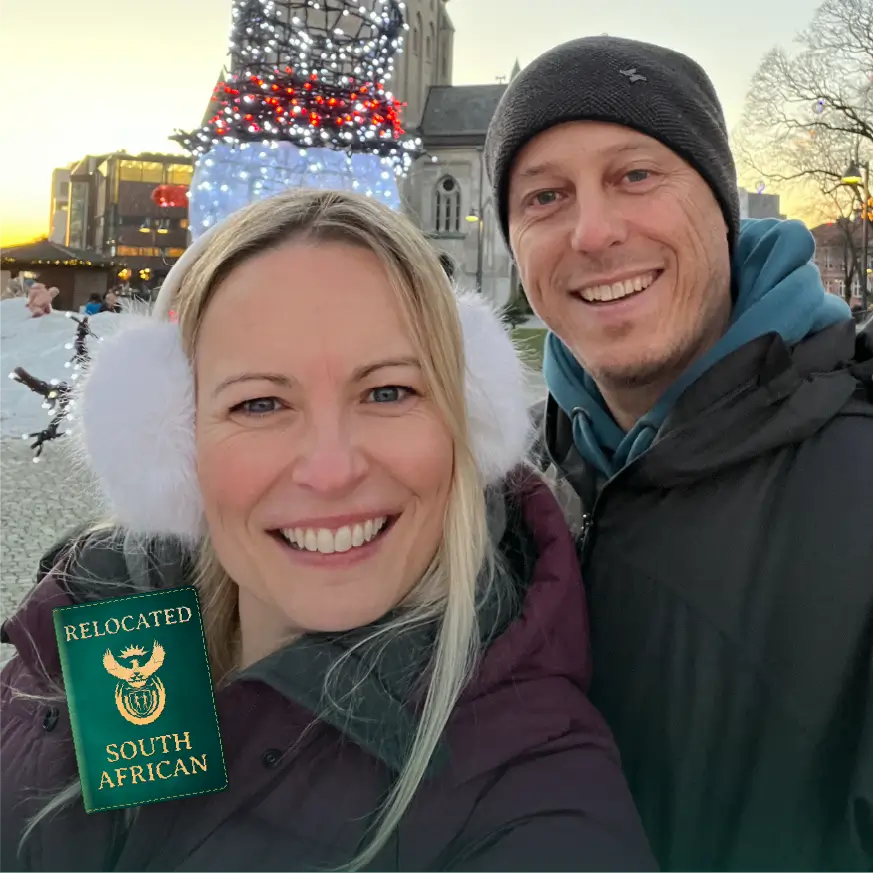
So tonight I have Norman and Chantal van Wyk. They’re the first couple that I’ve spoken to from Norway. So welcome to the van Wyks from Norway. It sounds like the Van Wyk’s van Soetmelksvlei play. You have to do it in Norman from Norway. Well, welcome guys. It’s great to have you and I really look forward to the chat.
So just a brief introduction. So Chantal describes herself as a lady who respects her husband and family. She’s a biker, a gamer, an explorer and most importantly, a legal immigrant. She also says that dragons are her favourite animal, so that’s quite interesting. So Norman, what about you? Does that describe you as well?
Norman van Wyk: Yeah, pretty much except the dragon. Yeah, I know, pretty much. I also all of those things – mountain biking and motorcycling, you know, so love nature, love hiking and these kind of things. And yeah, pretty much the same.
Jan Hugo: Wonderful. It’s nice to have you guys and you’re the first people from Norway on the show. So thank you for being here.
Chantal van Wyk: Thanks for inviting us. This is really an awesome podcast. Love listening to all your stories and everyone’s. There’s a red thread – we were speaking a little bit earlier about how everyone seems to have roughly the same things going on. So they’ve got, you know, like you say, missing family, will need to go through the same stuff, the jobs, the bank accounts, and then finding… I think what we do is we find a lot of South Africans. That’s probably the first thing that we do when we arrive. Even before we come, we just look for the South Africans. Where are they?
Jan Hugo: Absolutely. We’ll get to that. So just, I mean, I normally ask my guests just for a short history – where you guys grew up, went to school, university. And most importantly, how did you get to Norway?
Norman van Wyk: We moved from Cape Town. We’ve been in Cape Town about 10 years. Originally, we both, funny enough, from Vereeniging.
Jan Hugo: Oh my word, okay.
Norman van Wyk: I’ll try and go, yeah. So I spent quite a few of my school days in Krugersdorp.
Jan Hugo: Oh, don’t say that, because my wife went to Hoërskool Krugersdorp.
Norman van Wyk: I spent my sort of primary school time there mostly, but I know back then when I was in Krugersdorp, it was a small, small little school. But then I ended up in Johannesburg and kind of we came together. We’re not going to go into that, but we met on the highway actually one day. We never met each other before, we’ve known each other before. And then we moved to Johannesburg, lived and worked there a little bit and then moved to Cape Town. So we were there for the last 10 years.
Jan Hugo: We have to explore this highway story because you’re the second couple in two weeks that met under strange circumstances. The guy that’s on next week from New Zealand – he sat next to his wife on an airplane. Can you believe that? They connected, exchanged numbers. He went back to Pretoria. She went back to Potch. And later on, he became a lecturer at Potch University. And then they connected and got married. There you go. So maybe the highways… Maybe there’s something there.
Chantal van Wyk: I was also born and raised in Vereeniging. When I started studying, I went to a travel college in Florida in Roodepoort. From there I just kind of stayed there and then I met Norman on the highway on the way home and then we moved a couple of years later. Well, we moved in together and we lived in Joburg for a while and then we moved to Cape Town and then we moved here.
Jan Hugo: Wow, and how long have you been in Norway now?
Norman van Wyk: Just over six years now. We moved in 2019 in July, the hottest… You don’t think of Norway as hot because when we left South Africa, everybody was like, you know that’s everything everybody says. The first thing Norway and then isn’t it cold? It’s like literally that rhymes like Norway. Then everything is cold. So yeah, we came in July. We basically had, I had one pair of shorts and one T-shirt. The rest was cold clothes.
Chantal van Wyk: I had no shorts. I had no dresses. I left everything in South Africa and I just came in with my jeans and my jersey.
Norman van Wyk: And it was so hot. We were so… we had to go buy clothes, but yeah. When we left South Africa, it was a push-pull thing, but we basically said we’re not saving energy for going back. We’re going forward and we’re never coming back. So that was our mindset, you know, so a lot of people, you know, maybe they keep one foot in South Africa a little bit and sometimes, but we didn’t save any energy for the way back. And we just thought if it comes to that, and if it doesn’t work out in Norway, then it’ll be somewhere else. And funny enough, Portugal was one of those countries we thought of, but so we’re very happy. It’s been amazing.
Jan Hugo: Well, let’s just go back to July 2019. It was six, seven months before COVID, obviously. But when you say push pull, you were pulled by a job opportunity. Is that why you ended up in Norway?
Chantal van Wyk: We really wanted to leave the country, I hate to say. We had quite a lot of bad experiences there. I’ve had so many guns pointed at me, I’m surprised that I’m still standing. And we had a couple of people try and get into our house and we lived in beautiful Blouberg and there was nothing wrong with anywhere the place we lived or anything like that. I think I just kept finding myself in these weird situations – I mean in my office and on the road and walking down the street in town. Yeah so the push was a lot for us and we just really wanted to… and I always say, I always say people always ask why did you move and I always say because my husband would take a bullet for me and I really don’t want him to.
Jan Hugo: Yeah, exactly. That’s such a thing that also comes out in a lot of conversations. I’ve had conversations with people who said they’ve never had a crime experience, but they very few and far between. And then there are others like, a lady I spoke to early on in Spain, you know, they were at home invasion in Bryanston. And she said, I’ll never go back. It doesn’t matter how hard it is. And they were battling in Spain with the language and all of that. So I think the one thing we cannot do is judge. Because everyone, as we discussed, the people who live abroad don’t understand physical safety unless you live in Lagos in Nigeria or a crazy place.
Chantal van Wyk: You mean the Europeans and the Americans, not the South Africans abroad?
Jan Hugo: No, exactly. But we all understand what it’s like to feel threatened. We were cyclists. I rode my bike with a taser, you know, and Stellenbosch was a terrible place. It’s become a terrible place for cycling. So the bottom line is, yes, that issue is not going to go away unfortunately for a long time. And I said the other day, I did a little episode by myself and I just said, we have so many days on earth, you know, you might as well make the best of it. And if you have to constantly look over your shoulder because you feel threatened, that doesn’t make you happy. And then you must go somewhere else. And I think that’s basically what you guys are saying.
Chantal van Wyk: Jan, what we’ve learned is that you don’t have to live that way. You don’t have to live in fear. You don’t have to look over your shoulder. You can walk around with your cell phone in your back pocket. I did that when my mom came to visit me and she’s just like, why do you keep walking around with your cell phone in your pocket? And Norman’s uncle was here at the same time and they were walking behind me, chatting about me with my cell phone in my pocket.
Jan Hugo: It’s crazy. I mean, when I go out and do a long ride, I just do road biking now, but I go out in the countryside and you see ladies on their own running, walking, and there’s nobody nearby anyway. It’s farmland and it is just the concept of physical fear just doesn’t exist. And sleeping like that at night and not feeling threatened in any way. And I’m not saying it’s all safe. Yes, there’s crime and there’s petty crime and so on, but the bottom line is it’s just a very different environment from that perspective. So yeah, I understand that.
Norman van Wyk: Your chances are less. And I think it can happen anywhere, you know, but the thing is, and we’re not fearful people, you know, we’re not people that was scared, but we, you don’t, it’s kind of like we, we both people that learn from other people’s mistakes a lot. And then a few times now it’s happened and we were lucky enough or, you know, fortunate enough or whatever. And that’s the rhyme that everybody says, you know, at least they didn’t do this, at least they didn’t. And I just thought to myself, you know, I don’t want to be the person who says at least…
Jan Hugo: Yeah, we’ve had a knife against the neck in your house. You don’t recover from that. It’s a massive invasion. So yeah, let’s not get into that detail, but we fully understand where you’re from and the job opportunities. I’m just questioning how Norway came up because it wouldn’t be the first place on people’s list.
Chantal van Wyk: Firstly, it was never on my radar whatsoever, you know, we were always looking at the usual Australia, Canada, New Zealand. And the problem with them is that they had points and we grew up quite poor, both of us, and we didn’t have education, you know, and so we needed to educate ourselves as we were working. And as we were doing that, we were getting older and the points were getting higher, you know, higher, lower, whatever – the more points we needed every year. So as we were getting older, so it’s just sort of getting too stressful.
And I was working from home already. I was working for a British company from home. I’d already convinced them we had an office in Cape Town. And I managed to convince them that it was a good idea for me to work from home. So I’d already been working from home for two years. And then one morning, we were having coffee and we just said, let’s go live somewhere else and we can be remote workers. And then Norman…
Norman van Wyk: Yeah, digital nomads. So it was kind of like that thing is like, I’ve actually been through like these retrenchment or recalibration, which they called it at that time twice. And every year or so, it kind of happens. And then you go through it. And then, you know, I was very lucky. You know, I keep on saying I’m lucky. And truly, I feel lucky because every time something like that happened, for some reason I got promoted. It’s just the opposite that you expect, but that’s anxiety. Yeah, it’s like this monkey on your back the whole time. It’s this threat if you want to call it that. And I was just sick of it.
So, yeah, we were sitting having coffee and we said, let’s just do digital nomad. We had some friends that was doing it. They were travelling the world and they were saying they’re loving it. And for us, it was a bit… They were quite a bit younger than us and we were like, okay, maybe it would work out. So I went online, you would not believe it, and I got a forum in this old post, three months old, and I thought, wow, this is a cool company, Norway. I’ve always liked these Scandinavian countries, fascinated by them, but it was unobtainium. You can’t go to Scandinavia because it’s the language, it’s like all those things.
And anyway, I took a chance. I sent my CV and I said, the job, you know, it’s old and I’m not replying for the actual job. But if you ever have a company, your company looks interesting. You know, they contacted me. I came out of a meeting. I went to work. I came out of a meeting. I had an email. And I looked at the email saying, can you go for an interview tomorrow? Anyway, long story short, went for the interview. They asked me to start the next day. And I said, yeah, so we were like, what the hell? This must be a scam.
But something about the interview that was really nice. I spoke to people. They were Norwegian. They, you know, we did it over Teams. I then said, okay, what I’ll do is I will give you guys four to five hours in the evenings for three or four months. Let’s just check it out. So I thought, okay, let me check it out. So that was very tough because I worked during the day, went home, started my other job. And then after my job, I’d be doing my master’s degree and stuff. So I would get to bed at like two o’clock, woke up at six, and that was my life for basically four months. Yes, then I really liked the company and they were really good to us and everything. And I resigned.
But that was still just working from South Africa. So then we sold the house… and we put our house on the market. And as it happened to have it, the company invites us to come over to come and visit the different campuses, branches. We just knew we were going to do this. We didn’t know. So you can talk about the house selling. So we get to Norway, and we meet the company, the people we’ve been working with, and Chantal gets a call.
Chantal van Wyk: Yeah. So it’s from this lady. She says, I want to buy your house. And I think we just put it on the market just before we went. So we came to Norway to do a little bit of a scout. And yeah, she says, I want to buy your house. And I don’t want any other house. I want this house because this house is the only house that allowed dogs in a smaller complex. So she was very happy with that. And so I said, well, we’re in Norway at the moment. Can you wait a little bit? She says, of course, I’ll wait for you. And so when we got back, she bought it.
Norman van Wyk: So then what happened is like two weeks later, I get a call from one of the managers to say, we’ve been looking for this person for a while. We can’t find people with that skill set and it’s in cybersecurity and forensics. Also with e-learning and content development knowledge, we want to start up this new team. Would you be interested in moving to Norway? So obviously for us, it was like, what the hell? That’s amazing. That’s literally everything we could have wished for and better.
Chantal van Wyk: I’m going to tell you that I’m quite a lucky person as well. So everything that I plan sort of happens. I mean, I’m not airy fairy or anything, but I like the power of positivity, you know, like I like to believe things are going to happen for the good. And so, and I feel like I’m quite lucky that way.
Norman van Wyk: So yeah, then we long story short, we kind of planned a date and then for various reasons we brought three cats with and it was more difficult to get the cats here than us. That’s a whole other story, a very interesting story. We had to leave our cats here. No, we brought them. Yeah, we got here and it’s in Kristiansand, which is in the south of Norway. And then, yeah, here we are.
Chantal van Wyk: You know what? When we arrived here, I must give a shout out to my friend Carla. So when we’d already been speaking…
Norman van Wyk: They’re South African.
Chantal van Wyk: Yeah, she was one of the wives of the guys that Norman was working with. She’s South African. And so when we got to Norway, they helped us find a place to stay, like a little house.
Norman van Wyk: A townhouse, yeah.
Chantal van Wyk: A townhouse. And then when we got there, the beds were made. She made sure that our beds, we had new sheets. We had cheese and ham and sausages and hot dogs in the fridge. She made sure that we had coffee and toilet paper and towels and typical South African. It’s just such a beautiful thing.
Jan Hugo: That’s fantastic. Isn’t it wonderful?
Chantal van Wyk: Yeah, amazing. Yeah. So I really like I’m grateful to her for ever for that. And yeah, so when we got here as well, we also we of course found the community, the South Africans.
Jan Hugo: I was going to say that I mean, I’ve sort of got a lot of questions here. The first question. What about the weather? You knew I was going to ask.
Chantal van Wyk: We love it. Oh, really? No. So let me tell you, on the first of May, the summer is turned on.
Norman van Wyk: Does someone flick the switch?
Chantal van Wyk: Just switched on and then that’s on the 1st of May and then on the 24th of September, the day that we’re all having a nice braai in the afternoon. So the morning it’s nice and calm in the afternoon. Someone switches the summer off and the winter on. So it’s just like this big switch. So the 1st of May to the 24th of September, you’ve got good weather and then the rest of it is a little bit crazy.
Norman van Wyk: But you know, Jan, they say in Norway there’s no such thing as bad weather, only bad clothing. No, but I mean, I’m someone who’s I can adapt very easily to circumstances, whether all kinds of things. So I’m lucky. And I think she’ll tell you as well. Because for me, we’ve had negative 27, you know, and we were out on dog sleds in the snow. And it was amazing.
Chantal van Wyk: And that was funny.
Norman van Wyk: That was funny. Yeah. And we’re not really cold because the houses are built for heat. Your clothes here is different. We love it. And it’s that cutoff from very distinct seasons, summer and autumn and winter and spring. So we honestly don’t mind the weather.
Chantal van Wyk: So the snow, of course, is a novelty for us every year because it’s only happened to us six times now. So I’m very excited about it. We’re learning, we’re learning that when the Norwegians do something, if we start seeing them around the neighbourhood trimming hedges or cutting down trees or snow blowing, then we know, oh, then I shove Norman out the bed, get out of bed and go and snow blow.
Jan Hugo: So yeah, but I mean, I think that’s just amazing to hear that you’ve got the right attitude. Obviously, you’re on the same page. That’s another thing that comes through in a lot of discussions – if a husband and wife on different pages it’s tough and very often I think the couple in America talked about it where she was saying you know the husband’s working she doesn’t have a visa it’s quite difficult to you know and she was here to high-powered job but so it is critically important to be on the same page and it sounds to me like you guys have always just been on the same page and that already is a win.
And I think the other thing that you’ve said that I’ve been advocating from day one is if you look over your shoulder to say, if it doesn’t work, I’m going back, you will go back because you will find a reason why it doesn’t work. And I mean, there’s no greater adaptation than, you know, adapting to what you’re doing in terms of weather coming from Cape Town.
Norman van Wyk: And language.
Jan Hugo: I was going to ask about that. Where we live, it’s like Cape Town. It’s no different. Blowing the living daylights out of us now, but it’s northwest instead of southeastern, but it’s the same story, you know, on the Atlantic Ocean. But yeah, so fantastic. So yeah, tell me about the language because can we just say you’ve just become citizens? Is that correct?
Norman van Wyk: Yes.
Jan Hugo: Well, congratulations. I think that is a massive thing. But did you require a language test in order to become a citizen?
Norman van Wyk: Yes, language test, citizen test. There’s quite a few things that you have to do. You need to make a minimum amount of money every year, so you need to be paying tax, which we mentioned last that Chantal was working for a company. She got a transfer, but subsequently got a job as well, because she got a transfer for a British company.
Chantal van Wyk: That is a very big thing. To have a job in your new country is such a massive thing. And here it was very important to have a two salary income in the house because the people that came here thinking that they were going to have huge salaries where the one was not working, those were quite strained. Those families were quite strained. But they eventually got jobs and…
Norman van Wyk: Yeah. For me, it’s also getting like, if one of the partners, whether it’s the husband or the wife is not out there working and stuff and have to stay home with the kids and these kind of things, I think it’s a very different experience maybe for the one to the other one, you know?
Jan Hugo: Yeah. And it can probably be quite depressing. Correct. If the husband’s working, comes home is tired and wife sits at home all day waiting for him to come home. You can’t really air. So I can just imagine it must be a nightmare.
Chantal van Wyk: There’s a thing with us South Africans that it takes us a very long time to figure out that it’s okay to go outside in the dark.
Jan Hugo: Yeah, true.
Chantal van Wyk: No, we were like always, it just became like a thing when we were in SA, we just like, you know, it’s six o’clock dark, we need to be inside now.
Jan Hugo: Yeah, and obviously Cape Town, driving from Stellenbosch to the airport, I see now it’s become a big problem again with rocks and stuff, but you were scared. We used to go to concerts. I remember we went to see Ed Sheeran in Cape Town. But we booked a hotel room. We stayed. We didn’t drive back to Stellenbosch because it was too dangerous. So it’s exactly that mindset of driving to the airport at 10 at night to follow. You don’t even think about it anymore. And people don’t understand that.
Chantal van Wyk: But if there’s a, if there’s a wife at home that she’s, and you just got to Norway and then it’s like, it’s winter because the days here sometimes in Christmas months it’s a little bit better because the sun starts to shine around about quarter to nine. And then it goes down at about 3:45. So put it to four in the darkest. So, you know, then you feel like, okay, now husband’s at home. He’s not come home, but now the house is everything is so pitch dark outside. You don’t want to go anywhere. So you’ve spent like five hours of the day kind of looking at the snow from the inside and then by yourself. And then the husband comes home and then, you know, then you all feel like you need to go to sleep now.
Norman van Wyk: And that’s one of these things that you got to learn to kind of put yourself out there. And it’s one of the things that, you know, I’m sure, Jan, you know, and your listeners as well, when this is a very humbling experience to move countries. Now, I think being able to come into a country that is so foreign, you know, that the language is different, the weather, the, you know, everything you experience is different. The side of the road, did you drive? And that’s another thing we can’t do like other places in Europe swap your licence, your driver’s licence. You’ve got to retake your driver’s licence.
Now I like motorbikes, I had to do it twice. You pay about between 50 and 60,000 rand if you convert it to do your licence because you’re doing these tests that takes about three to six months to do. You do skid pan driving, you do lessons, safety, you know, to be able to help someone on the side of the road and things like that. So while he’s getting to grips with work and all these other things, your shopping, your housing, buying a house, we bought a house as well, eventually after we moved from the other place, you know, then you’re learning the language and you’re trying to sort of integrate with your friends because that’s something I was kind of staunch onto. We need to make Norwegian friends or, you know, we can’t just stay in this South African bubble, although we’d be very appreciative of them. But in the language, yes.
So we had to start learning language classes.
Chantal van Wyk: We have got such amazing neighbours. We’ve got really good neighbours all around us. And they all helped us learn Norwegian. And we went to the office. And we’ve got friends at the office that also just refused it. Two weeks before I had to do my exam, nobody in my office would speak to me in English. They refused to help us. So I really am so grateful for them being so hard ass.
Jan Hugo: We have a East Swedish and his wife is Norwegian. It sounds like this very similar language. You can understand, yeah. When I listen to, there’s a lot of Swedish in Portugal at our golf club and so on. It’s a very strange sounding. It’s a bit like German, but it makes absolutely no sense. So it must be very difficult to learn or not.
Norman van Wyk: Yeah, but there’s a little bit of Afrikaans in it. You know, it’s actually like the word like stark is exactly the same in Norwegian. And then there’s a word called forsiktig.
Chantal van Wyk: It’s just the way that they pronounce stark here is stark.
Jan Hugo: All I know is when they hit a really bad shot on the golf course, they go, nee, nee, nee. But I think that’s more Swedish.
Norman van Wyk: Yeah. And the problem with this is that they’ve got in Norway, I’m not sure about Sweden actually, I think it is, but they’ve got a lot of dialects. They’ve got like a thousand four hundred or something dialects. So the one, you speak the same language, but…
Chantal van Wyk: So they barely understand each other. In some places, their joke is that they’d rather speak to each other in English than in Norwegian because they couldn’t understand each other’s dialect.
Jan Hugo: You obviously will have learned this in your history classes or becoming a citizen. How many people live in Norway? Just a matter of interest.
Norman van Wyk: 5.5 million.
Jan Hugo: Oh, wow. So it’s about half of Portugal.
Norman van Wyk: Yes. And the thing is, it’s also a very long country. It’s not that big. So the amount of what land per square metre is quite vast. It’s just Oslo. I think Oslo has got like a million people. I mean, if you think about Cape Town and surrounds, it’s like four million.
Jan Hugo: And from south to north?
Chantal van Wyk: It will take us driving, the speed limit is 50, 80, 110 is the max, but most places it’s around about 80. Yeah, so it would take us about 32 to 36 hours to drive from south to north.
Jan Hugo: That’s crazy. I mean, just again, Portugal is six, seven hours from south to north. For us to drive to Porto is about six hours and the Spanish border is not far from there. So we took a train the other day and it was just over five hours from Lagos to Porto. So it’s about six, seven hundred kilometres north to south, and about 300 wide. So it’s a relatively small country, land-wise, with 10 million people.
Norman van Wyk: They say if you pin on the south where we stay, if you pin it and you can swing Norway, it’ll go to Italy. It’ll sort of be as long as Italy.
Jan Hugo: So it’s a vast country. A long country, yeah. It’s really interesting. Anyway, so you did the language test, just the whole citizenship, because that’s the other thing a lot of people underestimate is red tape. You know, in every country, it’s different. We’ve dealt with it in France, and we’ve dealt with it here, and it’s just red tape is red tape. It’s just maybe you have a friendlier person. Was there a lot of red tape involved in getting settled there and…
Chantal van Wyk: No, if you follow the structure of everything, it works out very well. So we came here and did everything by the book. So Norman came on a skilled worker’s visa, I came on a family visa. I was allowed to work from, I didn’t need to wait for any permits or anything like that. I can just work and I had my job. You need to earn a certain amount of money so that you can pay your taxes. You need to do a language test. You need to get your permanent residency. You need to do another language test. Then you can get your citizenship test in Norwegian. And then you have to be here for six years and then you can become a citizen.
Norman van Wyk: So if you’re on a skilled workers visa it’s six years with paying taxes and not having claimed anything or any of that type of stuff. Seven years if you come in on a study visa family and like if you’re a refugee or something like that it’s like eight years and they want to make that not 10 years. So it’s got more like to do with the language and the tax thing. Because Norway is an expensive country. It’s a really expensive country. Some things are actually really cheap. You know, you’ve got health care is free and it’s very good. Water is an abundance. Can you imagine? Yeah, but alcohol and sweets and sugar taxes and these kind of things are expensive, very expensive.
Jan Hugo: We spoke about the expensive booze. They said that people drink mostly on company account. They don’t drink at home. So just when you came and you started your process, you weren’t familiar with the language yet because you didn’t start the language before. So was it difficult then to deal with a red tape or are people generally able to speak English?
Chantal van Wyk: Absolutely. Some people speak like American.
Norman van Wyk: Yeah, they’ve got like American accents in a way.
Chantal van Wyk: They’re trying to struggle here with struggling saying, can’t you speak English? And then they come out with this perfect American accent.
Norman van Wyk: And everything is extremely efficient. So you’ve got an appointment, for example, and let’s say the appointment is quarter past eight or quarter past nine you get there you get a ticket your appointment opens the door it’s quarter past and it says it’s going to last 10 minutes and it’s eight minutes so they’ve got enough time for the next person there’s no queues there’s no and everything works like that the the licences we had to do all these kind of things the licences we had to do in Norwegian so that was tough because you know, you’d sit there and not really understand, but I spoke to one of the guys and they said, okay, if the stuff I don’t understand, they’ll cover with me after hours.
So it took me extra long because I did it as soon as I could because you need, we believe that you really need a car, especially in this place. The public transportation is great, but to be able to explore and these kind of things, you’re really… This country is amazing.
Chantal van Wyk: It is an incredibly beautiful country. You can drive for 20 minutes and you will find adventures along the way. My mom came and she’s a little bit disabled, so I couldn’t really take her for walks and hikes and things like that, but we just drove for 20 minutes, 30 minutes. And we just, there’s so many little things along the way. And she was so gobsmacked with everything. She kept going, wow, I’ll never forget her eyes. She was so excited about everything that she saw. So, and you don’t, you can’t really do that on the bus. You can’t just get off and say, and then you’ve got to wait another half an hour to another hour, maybe if the next bus comes.
Jan Hugo: I would agree that that’s important. Just thinking of going through this licence process, we’re very fortunate in that we were able to swap our licences. It was a bit of a rigmarole with the admin and getting an appointment and submitting the right documents and so on. But eventually, because we went from South African to Monaco to this and the Monaco is not part of the EU. So it had a separate process. But anyway, I’m proud to say that I have a Portuguese driver’s licence. So now, before we move on. Just say in Norwegian, we are Norwegian citizens. Let me hear what it sounds like.
Norman van Wyk: We are Norwegian citizens.
Jan Hugo: So it’s not so very different. We could have sung that, actually, yes. Oh, well, congratulations. That’s awesome. That’s so weird. Thank you very much. And did you keep South African citizenship?
Norman van Wyk: I’m in the process of actually relinquishing it. Because it used to be up until 2022, I think you had to. And then afterwards, you know, you kind of keep it. But there’s something going on with some court case that was won.
Jan Hugo: Yeah, there was that court case. Yeah, because we had to, you know, you have to get letters to say that, you know, you want to retain it. But I think that’s gone now. You don’t have to. But I mean, if you’re not going back, why keep it?
Chantal van Wyk: We didn’t speak to the consulates in Oslo and they said that we needed to send in some forms and get some confirmation back before we become citizens. But you know, life happened and then suddenly it was suddenly we were citizens, which is great. But apparently we just get to be residents in South Africa forever or something like that. So I’m not sure.
Norman van Wyk: Yeah, well, there’s a thing that goes on that they say that you need to kind of for any South African, obviously that listens to what what happened is I sent a mail in and they spoke to us in the consulate and you have to confirm that you’re a citizen, a dual citizen, that you’re still a citizen in South Africa because of that law. So it’s weird and they’re busy building a new website or something where you can kind of keep your citizen, anyone that it has happened before that they lost it can kind of apply again. Then obviously it’s fine if you want to keep it and if you don’t want to keep it then you could actually there’s a form that you follow and you put your passport and you send it and the the nice thing is the Norwegian passport has got so such you can go to South Africa three months visa-free you know the best passport in the world so it’s one of the best yeah it’s definitely yeah.
Jan Hugo: It makes no sense to keep it. My kids in America, they’ve just become American citizens. And so they’ve also, they said they’ve just been to South Africa on their first trip was on the American passport. So. So yeah, you must forgive me. I have to say that I thought you were in America when I first made contact with you. I was completely deaf. I didn’t realise you were Norway. But thinking back, when I contacted you on X, there was no mention of Norway.
Chantal van Wyk: Yeah, I think so, yeah.
Jan Hugo: Anyway, so yeah, I must have sounded really daft, but for me. Where’s Portugal? Are you in?
Jan Hugo: Yeah, exactly. Lagos, Nigeria. You mentioned how big is the South African community in Norway?
Chantal van Wyk: Not very big. There’s a, I would guesstimate about 60 to 80 in Oslo, including kids. But here we’ve got about, in Kristiansand, I think I counted about maybe 30 people here that we all, and we have this huge braai every year.
Norman van Wyk: On Freedom Day.
Chantal van Wyk: Yeah, beautiful friends that just, yeah, we really, we, so we really lucked out with our friends here.
Jan Hugo: And with the local friends as well so yeah yeah yeah the Norwegians yeah that’s awesome were they welcoming to you guys the the Norwegian so welcoming
Chantal van Wyk: I love them so much. They’re so welcoming. They never feel, they never say, if we ever say anything like we feel bad or we’ve got any anxiety or anything like that about South Africa, then they say, this is your home now. They’re just so welcoming. As soon as we arrived here, we were just, we just felt so at home.
Norman van Wyk: For any Norwegian listener, I mean this in a best possible way. But they’re a little bit strange, you know? Because what they have is that they’re cold on the outside. But then they extreme you. Once you have a Norwegian friend, I’ve got a few really good Norwegian friends as well. And they are amazing, like seriously good, good, good friends.
Chantal van Wyk: But you know how you get through that hard shell? You just have to say hello. Amazing. You just have to say hello and then they just like open up and then they realize oh you’re foreign and then they start to realize you know I kind of like I don’t know I was a little bit like shy to say I was from South Africa because people just they cogs turn you know they just stare at me for a little bit and you can just see oh there’s something happening behind their eyes but then they really actually start thinking you know where they’re where they’re exotic friends. We have the one friend from Africa you know with a…
Norman van Wyk: Yeah, when we met the one friend, we started meeting them and stuff. And then they like, I said, no, no, you got to meet my exotic friends from South Africa. So, you know, they’ve been amazing. And they honestly, we expected to have a lot of difficulty, but it was mostly with language and these kind of things. And still, I mean, we can speak, but we’re not like fluent, you know, but they’re amazing.
Chantal van Wyk: Yeah, the best thing is that they live next to my favourite ones. I love all of them, but my besties live next door to me. So I’ve got one on that side and one behind me. And we’re like sisters. You know, we have Christmases together. We enjoy New Year’s together. And it’s just the best.
Jan Hugo: That’s fantastic. So good to hear that you guys are happy. I’m very, very glad. I don’t even know how long we’ve been going, but there’s so many questions. Do you still obviously have family you mentioned, your mother in SA?
Chantal van Wyk: Yeah, so my mom lives in South Africa. Where does your mom live Norman?
Norman van Wyk: My mom has a flatlet at the bottom of our house. Oh, no. We brought her in on family immigration because I am the only child. So it was my, my stepfather died. There’s no one to look after, you know, as some older people have, there’s a long story. They had a very difficult time. So she had nothing. So we supported her and so on from Norway. And so we could documents, obviously we’re supporting her and there’s no one else there and it’s me and we repatriate.
Chantal van Wyk: So to bring your parents in, the parent needs to be single with no parents, no spouse, no children in the country and we would have had to be like supporting, proof that we’ve been supporting her financially and we had all of that stuff. So we brought her over and now she goes downstairs.
Norman van Wyk: Yeah, almost two years now.
Chantal van Wyk: Yeah, like a year and a half I think. She’s so great. We’ve got this magic laundry room. I have a magic dishwasher.
Jan Hugo: It’s amazing. I think that one of the couples said, oh, it was Chanel, the girl in America. I said, if you could ship anything from South Africa, what would it be? And she said, my mother, you know, and, and I think the couple in America said they would send the ship their servant. But I think we’ve all learned to do our own stuff. Yeah. But I mean, that’s true. Yeah. There’s so many questions. I think we need to kind of get back. Is there anything? What would you miss the most from South Africa, if you have to say?
Chantal van Wyk: The wine. Oh, yeah. I’m not an alcoholic. I’m just saying, yeah, it’s like if I had to buy a bottle of wine, just like a cheapy one, it’s the cheapest one is about, I think 130 kroner, which is about 200 rand.
Jan Hugo: Oh, well, okay. Well, we lucky. Then you must come to Portugal. Yeah, I know. I always joke of how cheap the wine is, you know, because we drink this green wine vinho verde, which is like 9% alcohol. And we say, bring us a bottle and two straws because, you know, it’s so light and so cheap.
Norman van Wyk: Yeah, we learn how to make our own. So I’ve, those friends I talked about, they’ve got me into local IPA beer brewing and cider, these other things. So it’s quite interesting. But for me, it will be the sand dunes. That’s the one thing. I don’t know, obviously friends, but my family is not very big.
Chantal van Wyk: Yeah, you had a Land Rover. Norman had a Land Rover. One of these old Land Rovers.
Norman van Wyk: Defender, yeah.
Chantal van Wyk: Defender. We used to go on a Sunday and watch the sunset and just fly through the dunes. It was so fun.
Norman van Wyk: They are Atlantis dunes there in the Cape. But that’s the one thing I miss sometimes, just be able to do that. You’ve got mountains here and you’ve got forests and all the things, but you don’t have dunes.
Jan Hugo: Do you make biltong yet?
Norman van Wyk: We make boerewors. But this year is the boerewors.
Chantal van Wyk: Yeah, it’s funny how many things you learn how to make. It was so easy. I used to just go to Spar and spend 20 bucks and get a milk tart.
Norman van Wyk: But what did we discover? We went to Trondheim on holiday and we found there things called aidsmold and it’s literally biltong-sized dried elk. Moose dried elk.
Jan Hugo: Oh wow.
Norman van Wyk: Yeah they own it tastes a bit different but it’s it’s really spicy it’s really nice yeah so that’s a benefit.
Jan Hugo: That’s awesome. So, I mean, as I say, I couldn’t talk to you guys for a long time. Maybe I must do another interview. Maybe last question. If you two questions, would you have done anything differently? Is there anything that you’ve done in the last six years in the process of getting there that you would have done differently? And sort of coupled with that, if you have friends, your age, people in South Africa thinking, what would you advise me?
Chantal van Wyk: I think we did it by the book and so well. I think what we did do and the things that, I don’t know, I hate to brag, but I really think that we did a good job moving here and we’re so happy. And I think the best thing for me while I was working from home was bringing my cats over. I’m not a cat lady. I’m not crazy.
Jan Hugo: You can be. I forgive you because I’m a cat person in a big way.
Chantal van Wyk: Any pets if you just bring your pets over they just bring along that sense of home with them so I didn’t feel homesick ever I wasn’t living with my mom or anything like that I did miss being able to go and have a nice cup of coffee with her and help her with a couple of things but yeah my cats were just… It was just so lovely because they would just come and lie on my lap and I’d just work because I worked very hard. Very, very hard. While my neighbours were all swimming, I was inside working hard.
Norman van Wyk: I can tell you what you have done differently is lock the cat’s cage better. So they didn’t escape on the plane. Oh, no. Yeah, that’s all the story. They X-rayed the plane. We were in the news on the first day in South Africa, in Netherlands and in Norway. That’s a long story.
Jan Hugo: That sounds very interesting. Maybe we can tell you offline. So the cat escaped on the plane.
Chantal van Wyk: Yeah, man, we can make it a short story. So yeah, my white fluffy cat, his name is Limpet. He became very famous very quickly. So he just, we were in Amsterdam already with our cats and everything was on and we got to Amsterdam. And then when we went to the next flight to get to Oslo, they said, can the van Wyk family please come to the front? So we went to the front and they said, did you mean to bring three boxes and only two cats? And I was like, why would I bring one cat box that’s empty? There’s a picture of a white cat on it. So I was like, oh, that’s the worst one. Of course, all of them would be worse. But he’s the most. But it actually would have been awful if any of them actually escaped. But you just think, oh, how he would have reacted. Anyway, so long story short, he went missing at Schiphol for five days. There was a cat whisperer in there somewhere.
Norman van Wyk: Don’t even go with that. I’m a scientist guy. This is crazy. But the point is they didn’t know where the cat was. And then they had to X-ray the plane. We only found this out later. And eventually it was KLM. They were really good. They found it. Eventually they were. Then they kind of like the main customer service guy… We got the cat. He flew all the way to Norway, brought the cat himself, personally.
Jan Hugo: Awesome. The cabin crew, the pilots, everybody came up. Oh, is this the cat? Because it was on the news everywhere. Wow, that’s an awesome story. So where did they find the cat?
Chantal van Wyk: He was in a warehouse. It was where the cat whisperer lady. She saw that he was in a warehouse and they found him in a warehouse.
Norman van Wyk: I’m not even joking. With chalk on the floor and she said there’s chalk on the floor and pipes and they found him with chalk on the floor and pipes. I don’t believe.
Chantal van Wyk: I’m still thinking it’s some sort of scam where they took the cat and she’s like, I told him to go to a man with a yellow vest.
Jan Hugo: It’s absolutely crazy. Oh my soul. That sounds wonderful.
Norman van Wyk: But I would, what I would do sooner for advice for everybody like that is what I would do is come do this sooner. I think if I knew what I know, I would have jumped at the opportunity and made it happen way sooner. Don’t be afraid. Do it. You know, it’s a humbling experience, but you learn so much about yourself, about your partner, what life is. People think the grass is not greener, but it can be. It really is. And we should have just done it earlier. That’s the only thing I would do different.
Chantal van Wyk: And definitely come with a job. I know it’s difficult to get a job, but the security of that is just so freeing as well. Because you feel like you can actually do some stuff and you can enjoy your country, your new country.
Jan Hugo: Awesome. I must say it’s just been such a nice refreshing and honest discussion. I really, really enjoyed having you guys on the show. Thank you so much. And thanks. I’d love to speak some more.
Chantal van Wyk: If you need us again, just give us a call.
Jan Hugo: Thank you so much.
Chantal van Wyk: Thank you so much. We love this podcast.
Jan Hugo: Well, so if you enjoyed my discussion with Norman and Chantal and would like to hear more about South Africans and their experiences once they’ve left South Africa, why not subscribe on your favourite platform. If you’d like to share your own story, contact us on jan@therelocatedsouthafrican.com or relocatedsouthafrican@gmail.com. Until next time.