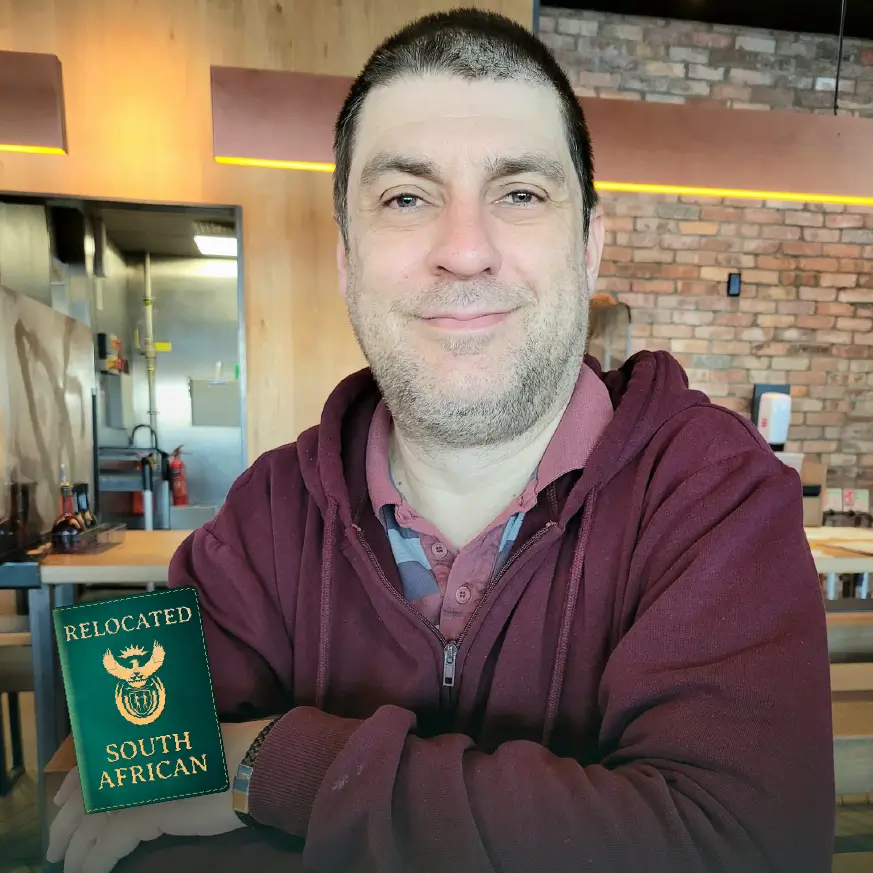
Jan Hugo: Welcome to the Relocated South African, the show for navigating immigration from South Africa for a better future. I’m your host, Jan Hugo, from Lagos, Portugal. Today, I’m joined by Martin Labuschagne from the UK. Martin recently published an article in Beeld newspaper in South Africa about immigrating from South Africa. Welcome, Martin. It’s great to have you on the show.
Martin Labuschagne: Thank you. It’s nice being here.
Jan Hugo: Perfect. A lot of interviews that I’ve done to date has been with younger people who’ve left South Africa for a better future for their kids like us and gauging from your article, we fall into a category of all the immigrants. So tell us a bit about yourself, where do you grow up, education and just the background.
Martin Labuschagne: Okay, I grew up in Pretoria. My whole life I lived in Pretoria. I never moved out of Pretoria. Well, I was a short time in Rustenburg for about four months when I came back to, went back to Pretoria. I grew up in Pretoria in Meyerspark, which is a little suburb on the eastern side of Pretoria. I went to university, the University of South Africa. I first studied a bachelor’s degree in German and I had a second subject, psychology. Then I changed to law. I did my bachelor’s degree in law and subsequently I went into practice. I practiced mostly in the areas of labour law. And also I worked with regulatory law for professions and so on. And that is where I’m at. And then we came into the UK in 2019.
Jan Hugo: Okay, so you’ve been there since 2019. And what kind of made you decide to leave South Africa? It was before COVID, even.
Martin Labuschagne: These basically the same reasons most people leave, for instance, crime, corruption. Yeah, it’s just that we didn’t foresee a future for our son. My wife and I had a son very late in our lives. And we just thought that we would like to move to a place where I would always say that we will have at least a sporting chance in life, you know, a meritocratic society where it’s really about him. And if he really works hard, then he should, you know, be able to put it this. But then long and short, Africa broke my heart and everything at that.
Jan Hugo: I can imagine. So if I recall in the article you were 48 when you left in 2019. That’s right, yeah. That’s quite, I mean, as I said, we left also but I was retired so I wasn’t working at the time. So from your point of view, getting to the UK? Did you leave with a job? Did you have a job signed up when you left South Africa?
Martin Labuschagne: If I can just take a step back. We went to immigration consultants in about May 2019. And we thought we would just find out what do we require if we would like to go to the UK or any other country. We just wanted to know some facts and then afterwards discuss it. And my wife has a Portuguese passport. She grew up in South Africa with her parents are Portuguese. So then the UK was part of the European Union. And when we got there, the consultant said, no, you must make a plan. Like we say, when Brexit is completed, no person from the European Union will be able to go and live and work in the United Kingdom. So we literally had since May to October to organize everything. That was a lot of rain. I know it might sound, oh, it’s a long time. It’s a few months. It’s not. We had to sell our house. We had to sell our cars. We had to get my pension money. I had to resign from work. We had to jump through all the hoops. But eventually we got to the UK. And yes, that’s where our story began.
Jan Hugo: Wow, that’s amazing. And I think you’ve just touched on something that I’ve come across in every discussion and I think my impression is that a lot of people underestimate the red tape that’s involved in making a move like this. It’s serious red tape.
Martin Labuschagne: Yeah, definitely. We had some absurd requirements because we went with my wife’s passport. and I went as a taggle, I went as her spouse, and of course my son is her son, well as our son, and then what happens is, or what happened is we want, we needed to show that we were in a relationship and Her Majesty’s government wasn’t just satisfied with showing a marital or marriage certificate. We had to do a lot of things. I had to produce love letters. I had to produce pictures of us together and almost intimately. We couldn’t just stand across each other in a room. And yes, you’re right, there’s a lot of red tape and a lot of people don’t realise how much effort goes into it. We, for instance, had to have money to be able to go, I, to be frank, I took all my pension money, which was released to me.
Jan Hugo: And, you know, we needed that to make it happen. Very, very true. I must say, this is the first time I’ve heard about proving that you married, but you have to prove that you have a real relationship because I guess there’s a lot of these marriages of convenience where people marry for a possible reason. Did you, on that basis, because I know there’s a lot of people in Portugal that friends of ours, the wife is a Portuguese passport holder, like your wife grew up in South Africa, but as a Portuguese passport holder. And the husband is now trying to get a Portuguese passport, and it’s quite a nightmare. It’s going to take a long time. Did you get a Portuguese passport or were you still on your South Africa?
Martin Labuschagne: Now, I’m still in my South African and I can testify or attest to it that it is very difficult in Portugal to get the passport. My wife did say the same thing. Yeah, that was something that put us off about Portugal is the red tape is even longer and more complex than in the United Kingdom. But no, we didn’t. One of the reasons why we took the United Kingdom, we decided and the United Kingdom is the language. I work as a, when we can talk about that a bit later on in the legal field. So, and I need to be able to communicate properly. I need to speak properly and be able to convey an idea because the law I always say is 90% talking. and then present anything else. So yes, it wasn’t for us a possibility, but we’re working there too, that she can register our marriage in Portugal.
Jan Hugo: And having been in the UK for more than five years now, don’t you qualify for that resettlement, or what do they call it, settlement status where you, after a while, can get a British passport?
Martin Labuschagne: Yes, we indeed have the indefinite leave. But we need one more year. You need about six years. And then we can apply for a British passport. Okay, okay, awesome.
Jan Hugo: Now, that sounds wonderful. Now, again, the big thing about this decision to leave with couples is, you know, that’s, and you may again mention that in your earlier bit of discussion, that you sold up everything, you took your money, you took your pension, you took everything. But it’s very important that both people in a relationship, in a marriage, must be on the same page. And I guess you guys were?
Martin Labuschagne: In the beginning, my wife was a bird. I’ll say, but skeptical. And then when we had our son and we realized the schooling was going to be downwards, and we couldn’t afford sending him to a very expensive private school. she got them all she said yes there’s no for us no real future or alternatively rather there’s no future for my son for our son if we didn’t have a son or two children we might have stayed there in South Africa and beg the punch but not for our son.
Jan Hugo: have responsibility towards him. Just again, question in terms of you in your article, which for people who haven’t seen it, you say that, you know, you start, you decided, and I guess the thread of the article is that when you, if you want to go, go earlier. So you left at 48, was this decision ever in your mind earlier than that?
Martin Labuschagne: It was. I was playing with ideas since I was younger, since my 20s. But you know, life works different. And then I, we had our son when I was 30 or 40 and my wife was 38 or 37. So then we really started considering immigration. But yes, I think it’s just how it worked out. But I agree with you and I, if you can go, go in your 20s or in your 30s, go as soon as you can. So you can start making a life there early on. I mean, you also might understand that or agree that, you know, the older you go, the more more difficult it becomes, or at least for me, to fully integrate and, you know, to be part of the community. It’s because it’s just different.
Jan Hugo: There’s certain things that are just different. Yeah, I think that is, it’s very difficult and a lot of people revert back to a South African community abroad and people tend to stick together and they are together and South Africans are generally very welcoming and helpful to other South Africans. But it’s quite a difficult one to integrate with the community. I think you made an interesting comment in your article that you tend to relate more to other people from Africa and other expats as opposed to English people.
Martin Labuschagne: Yes, no, absolutely. That, for instance, where I work, the people that I are the closest to, as my colleagues are, in fact, people from Kenya and Ghana. And it’s just, if there’s something, and I, some people think you’re crazy, but it’s just, without being lyrical about it, it’s just something special about Africa that is in us. And non-Western people, if I can say that, we also have good Indian people, we’re friends. And it’s just our values are a bit, or strangely, they are a bit more with each other than with the other Brittons because I think one thing is and Britton people are more individualistic and more rights oriented. I’m not saying it’s bad it’s it’s to each his own and we’re more community centered you know and people are getting to help each other more which also has its downsides, but that’s why I experience it obviously, but the experts might experience it differently.
Jan Hugo: Again, I can relate and I think there is a special bond in Africa that people speak in a way not the same actual language, but there is an Africa, an understanding of Africa that people here don’t have enough. I mean the other question about living in the UK, certainly what we’re finding is we have a lot of UK friends who live in Portugal and we sometimes are completely lost when they start talking football. I mean I sit there and I look really stupid because they know everything. They talk about players and how much they paid for him and I guess it’s even worse when you when you live there because they’re exceptionally passionate about their football.
Martin Labuschagne: Oh yes, definitely. It’s like a religion here. Everybody plays football. I think my son sometimes also finds a little bit difficult to relate to that because he doesn’t replace dinners and things like that. And the football culture, if I can say it’s never really gotten hold of me. I can relate to what you say. If there’s just a strange world, it’s not something that we’re part of.
Jan Hugo: Yeah. Yeah. And, you know, but one learns to adapt. I think, you know, the, The other thing that you just mentioned was the issue of money. I mean, the sooner you leave, the sooner you can start building your nest egg abroad. I’ve heard that in other interviews as well where people say they cashed in their pension, but they have nothing on the other side. They have to use their pension money and whatever they’ve saved up to start a new life. But then you have to start building for your retirement again. So another reason why it is better to leave earlier rather than later.
Martin Labuschagne: No, I absolutely agree with you. The earlier you leave, as you say, you can start creating an estate. I mean, our situation is in such a way I’ll have to work until I die. Which I don’t have a problem with. I think it’s good to keep your mind busy. Yeah, it’s it’s the money that all used up coming here. Yeah, it’s really an expensive exercise to come to the UK if you want to do it right and be sure that you are here legally, that you can become a citizen because that’s what we aim for eventually. is to become a citizen or to become citizens.
Jan Hugo: What is the stolen way to go? I hear you and it is very expensive and again something that I can gather from your discussion is that you did your homework. I think a lot of people get on the plane without having done their homework and they become very disillusioned and I’ve spoken to people as well who have gone back to South Africa who We arrived and were kind of almost conned into stuff that didn’t exist. So there is a, again, if we’re talking about advising other people, it would be make sure you’ve got your ducks in a row. And, you know, it sounds like you spoke to a reputable immigration agent, which is quite important because other people, you know, you hear a lot of stuff from people, but it’s not necessarily It doesn’t necessarily relate to your circumstances. So I think that’s great. Is there something you would have done differently other than leaving younger?
Martin Labuschagne: Yes. I think a lot of the things we would have done differently was affected by the fact that we had to leave so quickly. I would have, if I could leave now, I would have tried getting qualified in the United Kingdom as a solicitor. It’s now too expensive because you have to pay to write the exams. You don’t always pass the exams. You have to rewrite them. So I would have wished that could have happened earlier, because it would put us in a better financial position as well. When I came here, my first job was in a call center. a couple of jobs and call centers. And as you know, this causes a problem because the experience I have now for the last six years, which is what a company looks at, they’re not so concerned what you did 10 years ago. it’s all causing to work and it becomes a sort of a trap. So that is what I think I’ll definitely would have liked happen differently that I couldn’t continue with my career in the United Kingdom.
Jan Hugo: Okay and is your wife working?
Martin Labuschagne: Oh, yes, she’s actually in a beta position. She’s a purchase major clerk. She’s in bookkeeping in that area. And in South Africa, that’s not very well paid, but here they actually pay people well for that kind of work.
Jan Hugo: Oh, well, that’s awesome. And I mean, obviously, having backed up and lived with everything, do you think you would ever go back to South Africa?
Martin Labuschagne: not for this or that reason. I think the most important reason is our son. To leave, go back, now back up everything, go back would be so disruptive to him. And he started to, he’s starting to find these roots here. He’s got his friends here, he’s got his interests here. In fact, we’ve asked him directly, and the Jannie would you like to go back to Seisman? There was a time in the beginning when we came here, you would have said, yeah, maybe but now he doesn’t want to.
Jan Hugo: Okay. Now, well, I think that’s great that you know, because it’s very important to have a focus on your goal and why you’re there. In the same breath, I mean, you don’t have any regrets other than, as you say, you didn’t qualify before and had more time. But other than that, do you still have family in South Africa?
Martin Labuschagne: Oh, yes, all my family. We basically have no family here, which is another thing. We came, we never, neither my wife nor I have ever been in the UK before we came here. I’ve been to Germany, she lives in Portugal. We came here, we lived everything right. So I have most of my friends there, my family, my mother, my elderly mother stays there, my brother. my nieces, my nephews, and my in-laws, they’re all still in South Africa.
Jan Hugo: Well, and have you been back in the six years?
Martin Labuschagne: No, not for the sort of that reason, but I don’t want to go or close the door behind me or something. It’s just financially as well. It might sound strange because we’re paying pounds. But the thing is, it does get expensive and you have to take days off, leave from work and that’s always possible.
Jan Hugo: I often have this conversation with our UK friends who live here in Portugal and most of them are retired, but for them it’s a short commute. Sometimes they pay, you know, 50 euros for a flight to London from Faro and they they’re able to go for a weekend to go and see their grandchildren and family and elderly parents and so on. Which I would say, you know, as a South African, it’s a much bigger decision to leave than to say, oh, well, I’m going to retire in Portugal from London. It’s just a very different ball game. So I think we all All very aware of that. I guess as a family, you and your wife and your son, this process has probably brought you much closer than you would have been in South Africa, because you’re reliant on each other.
Martin Labuschagne: Yes, we are basically now, we are each other’s best friends. We are each other’s tribe. We are each other’s country to some extent. You’re right. We are each other’s everything at the moment.
Jan Hugo: Okay, I think that’s also something that comes out of any discussion. If there’s something you could ship from South Africa now, what would it be if you could get something theoretically tomorrow from South Africa?
Martin Labuschagne: What would it be? Well, my books. I had a large library. I love reading. I had to give away a lot of books, sell a lot of books. And that’s a pity because I had really had classics and great books. But unfortunately, I just couldn’t bring everything. In fact, I’m a book shelf is here next to me.
Jan Hugo: And yeah, that I would have loved to ship. Okay, that’s very interesting. I mean, and this brings back to this, how big a decision it is to leave. It’s not just for, okay, we’re gonna go now, you know, we’ve had enough and we go. There are so many things to consider in this process. And you’re saying as a couple, you are now best friends and you have to be best friends because that’s the way it is. A lot of people talk about support. When something goes wrong, a kid gets sick or your elderly parents get sick and you can’t be with them. That’s hard. It’s a very, very hard decision. I sometimes feel some anger about it, but I try and contain that. But that’s the way it is in our case. Our children have left, so we kind of followed our children. So it is a slightly different situation. Can I ask you this article? I find that quite interesting. How did you come about? Did you know the people it built?
Martin Labuschagne: How did you write the article? No, it’s funny enough. Funny enough, I didn’t really know anybody years ago like 20 years ago I wrote something for to them and never again, and I should write two or three pictures to them I was thinking why I wrote the pictures I was. pitch something about my experience, my first-hand experience living here. Instead of a theoretical story and telling everybody the statistics, what about something emotional, something that touches the heart? So I pitch that in. And they looked at it and they were very impressed with it. They said, yes, that sounds like a good article. And I wrote it really without being romantic or lyrical or anything. I really wrote it from my heart, you know, all the things that we’ve experienced. And I plan to write more of that because I think it helps people emotionally like what you’re doing here. You can easily lose yourself in all the rate type, and so on. You don’t think of the human factor. And one thing that I found, and it’s amazing, I’ve always written on Afrikaans, and I mean, I had really, really success in it. And, okay, that published me and made sense of being here. My Afrikaans, poetry and stories and everything that’s just blossom and it publicizes me or why that has happened. Maybe because you have more distance as a person, I’m just perplexed.
Jan Hugo: I don’t know. Well that’s fantastic that you can hang on to the culture and cultivate it and have an outlet like the biggest newspaper, Afrikaans newspaper in South Africa to take your story. I think that’s absolutely fantastic and I think it’s, as you say, it helps people. There’s a lot of people that are looking at this. This is so topical with all the stuff in America and the The things that are happening in South Africa and people are more and more considering leaving. Somebody said the other day that they’ve made the decision for their children and they will never go back. But their children can’t now see their grandparents who live in South Africa, but at least they will be able to see their grandchildren in the same country one day. And that’s what’s important. Somebody had to break that chain, you know? And I guess that’s important, but it’s tough. Was it a very emotional thing for you guys to get on the plane?
Martin Labuschagne: You know, I was excited. And look at this very theory. I become a cowboy and then cry. So for me, I felt a bit numb. It was so unreal. It was surreal. It didn’t really strike me what I was doing in the scenes, the emotions and things. But when I got in South Africa, it started to become more emotional. We’ve got a moment, there are times when you think, I feel like just backing up and leaving. And it’s not because of this or that reason. It’s just emotions. You know, this whole thing about emigrating, these are very strong emotional side to it. And I don’t think people understand it.
Jan Hugo: People have no idea. Honestly, I have no idea. I agree with you. It’s an exceptionally difficult thing to do. and it’s not for sessies and I think that’s why I asked the question earlier about you and your wife and being closer together and being each other’s support because it’s very difficult to find support elsewhere and But there are groups in the UK, I guess, like anywhere else. There’s lots of Facebook groups and people where you can connect with people. But you have to be out there. It’s not going to come to you. You have to actually put yourself out there. So now I take my hat off to you. I really can relate to what you’re saying. And I think two more questions. Are there any funny stories about your move?
Martin Labuschagne: Maybe not the story, but the practice here that I felt very strange. Now I know what it’s about. But sometimes you would go in a shop and you don’t know the person and they would say, how can I help you love? How can I help you darling? I barely know you, my wife. And then I realised, no, this is how people talk.
Jan Hugo: It’s like we’re saying, my China in South Africa. Yes, exactly. That is true. That’s very funny. I could just imagine it’s all these little things that one has to get used to. If you have one word of advice to anybody thinking of emigrating, what would you say to them?
Martin Labuschagne: You must be determined. You must decide we’re going to leave and not leave. You know, we’re going on, we’re going to go this year when you’re younger, but it’s more than just making the decision. It’s once you’ve made the decision is to go because a lot of people, I think, become unsure. And that really ruins it because then you start not being happy when you are and you can’t go back. And so, and I’ve got some fellows of Africans who are like that. They are here, but no, they really want to be back in South Africa, but they can’t go. And it’s a whole complex in between this side and that side. So I think you must go in with your lot, make a decision and do it and follow through with it.
Jan Hugo: and stay with your decision. Don’t question it. Now, I think that’s been such a good discussion. Thank you so much for sharing your journey and your life in the UK. It really is interesting to meet people of different age groups who have decided to make this move. I think for all the people, it can be a lot more challenging. And I think you guys have risen to it and well done. And thank you so much, Martin. Thank you very much for joining me on this show. And if you enjoyed my discussion with Martin and would like to hear more about experiences of South Africans who have left for a better future, why not subscribe on your favourite platform. If you would like to share your own story, why not contact us on jan@therelocatedsouthafrican.com. Until next time.