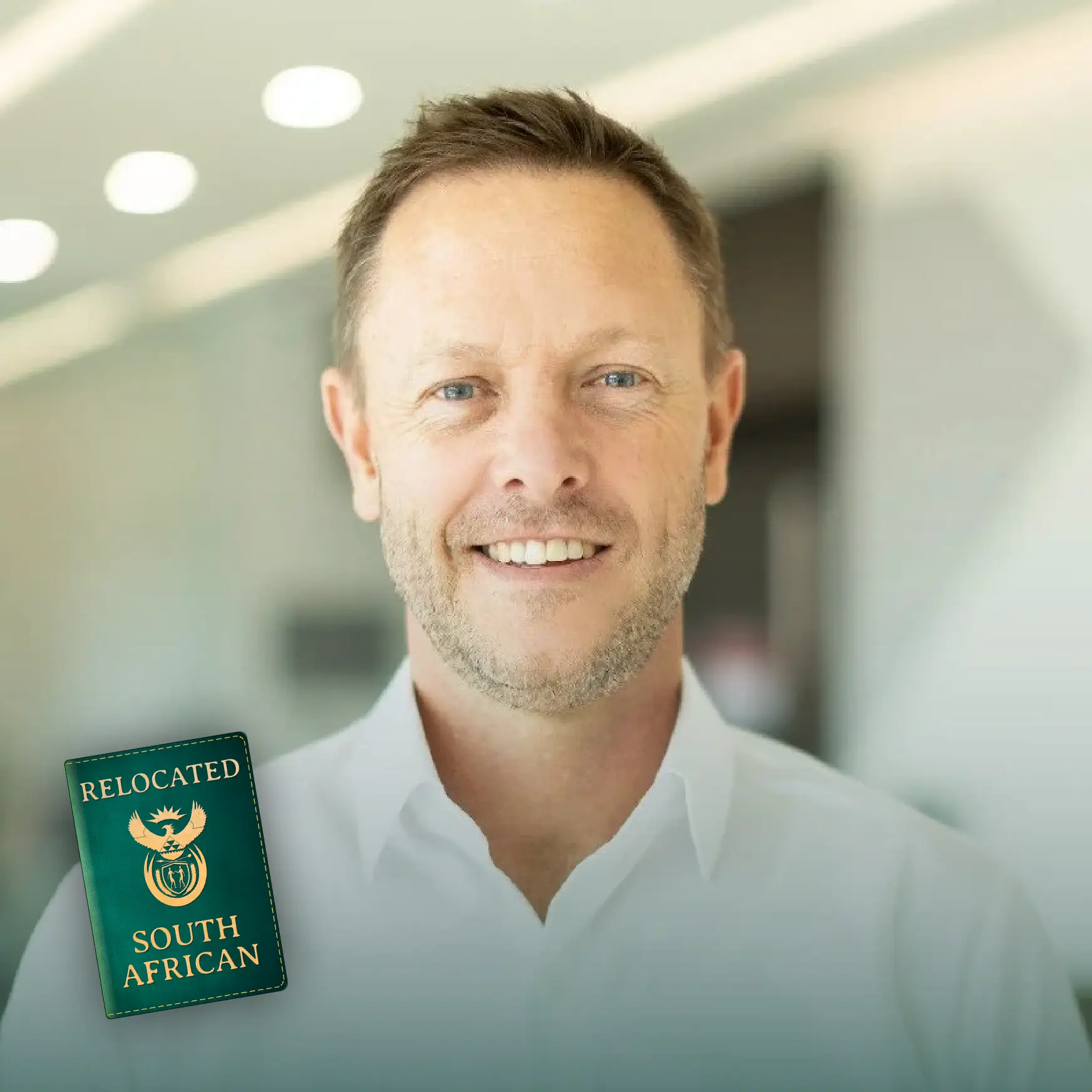
Janlo Van Den Heever:
For me, it’s about making sure that you have skills that you can take, almost like a tortoise on your back, anywhere you go, so that you’re not reliant on a lifeline to South Africa to produce an income. Because the reality is, South Africa is not growing as fast as most of these other markets.
Jan Hugo:
Welcome back to The Relocated South African. Today I’m speaking with someone who has left Cape Town not once, but twice: first for Brazil, and now Southeast Asia. He’s a father, a strategic thinker, he’s future-focused, and he’s not shy to say what he thinks. Thanks for joining me, Janlo Van Den Heever.
Janlo Van Den Heever:
Thanks for having me, Jan. Yeah, I mean, I’m looking forward to the conversation, and looking forward to hearing the feedback from the audience as well.
Jan Hugo:
Lekker to have you. Just, where are you talking to us from?
Janlo Van Den Heever:
Currently in Bali. We’ve been in Bali, Indonesia, now for just over two months, and I’m in the process of actually applying for my residence here to stay long term.
Jan Hugo:
Okay, okay. So let’s just go back to the start. Where did you grow up, study, and how did you first leave South Africa?
Janlo Van Den Heever:
Well, I was born and raised very Afrikaans in Pretoria, went to school there in the north of Pretoria, and then also studied there, at Tuks. So I went straight out of school to varsity. I didn’t do the gap year or the opportunity travel that many of my mates and family members did. I don’t know what it was, I think something in me always told me that I’ll have the opportunity to travel in the future and I didn’t need to rush it. I didn’t need to mortgage the predictable path of going to university, getting into the workforce, and take a risk at that point. My mom had actually worked really, really hard to make sure that I get into university, and she really was the one who made all that happen. So I wanted to honour that to a degree as well. So I stuck with that.
I originally started studying law, but it took me about three months to realise I wasn’t going to cut it academically. Then I switched, six months in, into BCom Marketing, or business management as it was called at the time, to finish that in the allotted three years. I got out of there because I’m a bit of an anti-academic, Jan: it’s a tough one for me to sit still and listen to other people talk for three years straight.
Yeah, it was really, I guess, the start. It did give me a foothold. I mean, we’re talking about very long ago now, about 20 years ago that I finished varsity. It did give me some opportunities to get into the world of work, and it didn’t take me long to get into multinational companies. Basically, with my first big multinational company, I worked with them in the Johannesburg office, commuting the lovely N1 commute every day from Pretoria to Johannesburg: actually from the north of Pretoria to the south of Joburg.
Jan Hugo:
My god.
Janlo Van Den Heever:
So the ultimate, I think it was 75km’s one way, but you know, when you’re young and you’re starting out, you have to pay your dues and you have to do this stuff, right? So I did it for about three years or so, three and a half years, until I was around 26 or 27, and I was pushing for an opportunity to either move abroad with them or move to Cape Town, where they had an office. So I ended up there, and then, about a year and a half after landing in Cape Town, one of my clients from that company actually approached me. This was Red Bull, the energy drink company. And then, after another five years in Cape Town with Red Bull, during which I travelled a fair amount and really got into the idea of travelling and maybe leaving the country to see what’s out there for me, they were the ones who moved me to Brazil, after I was actually…
Jan Hugo:
Okay.
Janlo Van Den Heever:
…scoping out and about to be moved with them to Austria, to the head office. I decided to go to Brazil instead, and that was the first time that we left Cape Town. But I had just gotten married. My wife and I had been married for about a year at that point, and both of us really felt like we wanted to go and explore. No kids at that stage yet, so it was much easier than it is now.
Jan Hugo:
Yeah, I can imagine. Well, Red Bull, I remember one of the highlights of a visit to Austria was that museum at the airport in Salzburg. If you’re a motor car and aeroplane fanatic, that’s the place to go. It was amazing.
Janlo Van Den Heever:
Yes, Hangar-7. That’s actually the only place I ever met the original founder, Mr Dietrich Mateschitz, was at Hangar-7. And yes, I was fortunate enough to travel quite frequently to Salzburg in Austria for business planning and all sorts of different things with Red Bull. I actually went to, in the end, something like 23 or 24 countries on Red Bull business. So it was a really great springboard for seeing the world, and also for learning how to be entrepreneurial.
Jan Hugo:
And were you in the marketing, branding side, or what role did you have?
Janlo Van Den Heever:
No, I wasn’t allowed to have that much fun, unfortunately. I was on the boring side, I guess. I was in trade marketing, so that’s part of the sales function. I was working more closely with the retailers on strategic initiatives, working with the Walmarts and the Spars, and in South Africa, with the Pick n Pays and these guys.
Jan Hugo:
Okay, last question about Red Bull. Did they allow you to go to the Grand Prix?
Janlo Van Den Heever:
This is a sore one, Jan, because I…
Jan Hugo:
Ha ha ha!
Janlo Van Den Heever:
…actually did negotiate it into one of my year-end bonuses. And then, I don’t know why I did this, I guess at the time I was really just set on being a good leader and a good team manager because I was starting to build up a small team there, I had five or six people at this point. At one point, there was a really good shopper marketing conference on in New York, and I couldn’t get budget to go, but then I kind of traded in my single ticket to go to Monaco for three of us going to this conference in New York instead. So it was very altruistic at the time, but I…
Jan Hugo:
Ugh.
Janlo Van Den Heever:
…definitely sort of regret it now.
Jan Hugo:
Taking one for the team. I have to say, that’s the one thing we realised: we were at one of the Grand Prix in 2022, living in Monaco, and we were looking out over the sea. We had a view, and they were bringing this barge in. You could see it from miles away, and we were watching this barge coming in, and that ended up being their party barge, which they anchored there.
Janlo Van Den Heever:
The energy zone.
Jan Hugo:
That’s amazing. That shows you what they can do. Interesting. So, and then after Brazil, what made you leave?
Janlo Van Den Heever:
I did get the chance to meet the drivers. They came through when I was in the São Paulo office; they obviously came for the race at least once a year. So I did get to meet Max and Danny at the peak of their rivalry. They were literally having a bit of a dispute in the office there while we were all playing PlayStation. So it was, yeah, I did get to touch on the world and live in the world, but no, I still haven’t made it to a race, I’m still holding thumbs here.
Jan Hugo:
Yeah, it was interesting. I had a quick geography lesson after I spoke to a guy the other day who lives in Brazil, but he’s in the south. I didn’t realise Brazil was so big, 220 million people. I mean, I was flabbergasted. And were you in São Paulo?
Janlo Van Den Heever:
Yes, we were based in São Paulo. São Paulo can be a bit of a minefield: if you’re in the wrong area, you’ll notice pretty quickly, but we were fortunate to stay, I think, in one of the better areas in the centre of São Paulo. We had a very, very safe, very fun life. The people are wonderful and friendly and accommodating, and always interested to speak to people that are not from there. So, no, we really loved it. We ended up being there for two years, and having our first daughter there, who’s also Brazilian.
Jan Hugo:
I hope so too.
Jan Hugo:
Oh, wow. And just lifestyle and food, we don’t have to spend much time on it, but the lifestyle and the food in Brazil, it looks attractive to us living in Portugal, I guess, some similarity.
Janlo Van Den Heever:
I must say I had a very cool experience living there because of the area that we lived and the fact that I could walk to the office, or sometimes take my bicycle to the office. That was a nice change from sitting in the car for two hours or whatever at a time. It was almost like a European way of living, thanks to where we lived and where the office was. I mean, if I had to drive my car, Red Bull gave me a car, I don’t know why, but if I had to drive my car in peak traffic to get to the office or back, that would take probably an hour to do three or four kilometres. So you may as well walk that, right? And then you’re walking through really interesting little areas, you can stop for a beer, you can pop into the grocery store on the way home, pick up some flowers for the wife, do whatever. I never really had that experience because everything is so car-based in South Africa. You have to be quite intentional: I’m going here, and then here, and then here, and everyone kind of lives like that. So it was my first opportunity to live a little bit differently, and I loved how it felt, to be honest.
Jan Hugo:
That’s excellent.
Janlo Van Den Heever:
As for the food, I didn’t get into the food, to be honest. Açaí, sure, açaí bowls are great and amazing, but that’s also only because there’s so much sugar in them. And then the national dish, the pork and beans and rice, the feijoada, it wasn’t really for me, to be honest. So I don’t think back to the food, but I always think back to the people and the kindness of the people and the friends that I made there.
Jan Hugo:
Excellent. Let’s just quickly touch on it: you mentioned that your wife had your first, your daughter, there. Just from a healthcare perspective, for people who are thinking about immigrating, how was that, and how does that compare to South Africa?
Janlo Van Den Heever:
It was actually great. The reason we ended up going to Brazil, not Austria, I mean, there’s a couple of reasons, but one of the biggest driving factors was that the commercial director who was going to be my new boss in Brazil had recently actually moved from Cape Town to São Paulo himself, and had some kids there. So they had found some English-speaking doctors and gynaecologists and all these people that are really difficult to find, they had basically a playbook for us to follow. And with Red Bull, I had really top-tier expat medical care, so that was far superior to anything I’d experienced in South Africa. When I tell people that, they generally look at me like I’m having them on, but actually there was no doubt about it. The dental care, the general care, especially for my wife when she was pregnant, the process was almost a little bit too arduous, they were almost a little bit too all in on frequent checkups and thorough checkups. In South Africa you can kind of pace it yourself, but there, once you are enrolled as a patient, they really have a strong system that ensures you’re healthy and well throughout the whole process. I don’t know, I was quite surprised, it was significantly better than the private care that I was also getting in South Africa.
Jan Hugo:
Okay, yeah, I must say, apparently the dentistry is very good, there’s a bunch of Brazilian dentists here in our town that practise, and they’re very good, the training apparently is excellent. So, Janlo, then you went back to Cape Town, what prompted that?
Janlo Van Den Heever:
So, unfortunately, while we were in Brazil, my wife’s father got ill, and we decided, with the small baby with us, our kid was a year and a half old, that it would be better if we were closer to home. I didn’t want her to have any regrets about being away from her dad while he was ailing, just because we wanted to be out and live this international lifestyle. So we decided to go back. Initially we didn’t go back to Cape Town because they were all based up in the Gauteng and North West area. So we settled in Pretoria for a year. We then got stuck in Johannesburg over COVID for another two years, as life happens, and had our second child there, during COVID. It was only about 2022, I think, that we made it back to Cape Town, and then we were in the Somerset West area. I could never go back to the southern suburbs, or the centre of Cape Town, with two kids, it’s not very kid-friendly. So we were out there in Somerset West. That was a really great life, really enjoyed this new experience of it, because when I was a student and travelling down or going to the wine farms, that’s one experience, but how much they cater…
Jan Hugo:
You…
Janlo Van Den Heever:
…for kids, and the fact that there’s open lawn and playgrounds, and they’re very open to having kids’ parties and all these things, all the kids’ parties happen at the wine farms anyway. So that was a great experience, and we loved it, for three or three and a half years, we were down there.
Jan Hugo:
And you were still working for Red Bull at the time?
Janlo Van Den Heever:
No, so when I left Brazil, I also left Red Bull. There was really no path forward that made sense to me. They wanted me to go back and forth for a month at a time, fly in, fly out, and transition across to the local team where there wasn’t an immediate gap for me. I kind of realised, in those years that I was in Latin America, that I was an absolute dinosaur. Probably by South African standards I was quite clued up and experienced and well-skilled, but by global standards I started measuring myself a bit differently when I was in Brazil. LATAM for me, in terms of tech and development and business in general, people used to say the UK is five years ahead, or the US is ten years ahead, of South Africa. LATAM is interesting because it’s just three years or so ahead of South Africa, three or four years ahead, so the gap is a bit smaller, but at the same time, it’s very visible.
For innovation at Red Bull, I was dealing a lot with these on-demand start-ups that you can order on the app right now and they deliver in fifteen minutes. The guy sometimes comes with a bicycle and still does it in fifteen minutes and brings you a lot of stuff, and I always marvelled at that, to be honest. I was working with the biggest one in LATAM, called Rappi, headquartered in Bogotá. So every time I would go to Bogotá, I would see these guys and I would really, really sit there and feel like a total dinosaur.
There were also some of the team that were working with Amazon and these guys for more traditional e-commerce, but that didn’t excite me as much as this. I just realised I don’t know anything about tech, I’m like a retail marketing dinosaur and I needed to pivot. So I took the opportunity, when we went back, when we were in Pretoria and in Johannesburg, to start trying to learn more about start-ups, to learn more about coding and tech and all this kind of stuff, and to try and see if I could build something of my own.
Jan Hugo:
Okay, excellent. And then another move, was this a push or a pull this time, to go to Southeast Asia?
Janlo Van Den Heever:
So the interesting thing is, in that gap between going back to South Africa and leaving, I developed a completely new skill set and also a very different worldview. I had gone from being this very corporate employee type, punch in, punch out, nine-to-five type person, to thinking very non-linearly about my time and what I do. I was becoming a lot more intentional about what I was learning and upskilling myself. For most of my time in Cape Town, I was actually working in start-ups. I was working in a big edtech start-up that had been blowing up in the UK, working with the UK’s Department for Education, working remotely with this team. Then I also worked with one of the biggest YouTube channels in crypto. For me, that was interesting because, during COVID, a lot of people got into crypto. I didn’t have a job at one point, I was just focused on my own start-up, but I was leaning into this a lot because, actually, when I was in Brazil originally, I had travelled a lot to Argentina, and this was quite interesting. In South Africa, I was, among the many things I was in charge of, in charge of pricing, and because of the affordability issues in South Africa, especially for a brand trying to break into the mainstream market, I had, for four to five years, to try and keep the price for Red Bull stable, in terms of how we managed pricing through the retailers and back to the head office, because everything is imported, of course, nothing is made in South Africa. That did allow Red Bull in South Africa to really increase in penetration and grow a lot, and I was very proud of that. Every year I needed to fight off these guys who just want us to increase price, and, you know, I’m going to be the man of the people and make sure we can put a can in everyone’s hand and keep it affordable.
I think I travelled to Argentina, in those two years, I think I travelled twelve times to Buenos Aires in those two years. I landed there and they were like, listen, we have a couple of problems, but one of your first priorities is going to be pricing in Argentina, because they’re running at 115% inflation. I was like, what does that mean? I understood inflation based on what the government tells you about CPI, but I didn’t really understand how it happened, or what the major events are that can occur that can create such hyperinflation. So when I started digging into it, the first thing I realised was that all of these guys are obviously not saving their money in pesos or anything, they’re all buying gold, and some of them were starting to buy Bitcoin. It was cool for me because, in that time when I was in LATAM, I think a lot of the big crypto and Bitcoin scams went down in South Africa, but I got the clean version. I got very much like, this is hard, programmable money. This is not, it was not that programmable, hard digital money, similar to digital gold. I decided to buy some, and then I kind of forgot about it, forgot about the fact that I had this account, and I actually thought that, because I had registered with my Brazilian ID, I wouldn’t be able to get it back when I was in South Africa.
Long story short, I basically got all that back in 2021, saw that it had gone up sevenfold since I had bought it, and started really deep-diving this crypto thing a lot more. I guess in a way that a lot of guys do, and they speak to the wife and the wife just glazes over, my wife was that for sure, but we just kept going because we believed there was maybe something here, there’s an opportunity here.
The channel I was watching most of the time while I was in Johannesburg was called Crypto Banter. They had just kind of started taking off, and when I got to Cape Town I really, really wanted to work with these guys. As a matter of fact, I was very set on just taking them up on this offer, I had to come work in their offices, even if you’re working obviously on something else or for someone else, just come work in our offices. I never did that, but I did actually end up getting an interview there and landing the job. So I did work there for a year and a half with the guys, some of the best traders in the world, honestly, some really inspiring people from places like Boksburg who had $400.00 to their name and turned it into literally an empire, and I learned a lot in that phase. From then, I really didn’t want to work in any other field, I really didn’t want to move away from Web3 or crypto. So even after that role ended, I decided, okay, I’m going to start taking on clients who work in this space, and I’m going to bring together the tech, the start-up tech side, and, call it, the traditional brand and marketing side, because a lot of these businesses are trying to go mainstream. There’s a lot of what we learned at Red Bull that you can apply. The other cool thing is you get to basically create all new stuff. So when I basically figured out that I was going to be remote indefinitely, I, it was a very long way to get to the point, but I think the context is important: when I basically figured out I was set on being remote indefinitely, and never going back into the office, I decided, okay, cool, but then is Cape Town still the best option? I’ve got two young girls, is this really the best place to raise them? I mean, stuff goes down even in Cape Town, I think a lot of Joburg is moving down to Cape Town and they’re taking a lot of the issues with them, to be honest. Even in the sleepy areas of Somerset West and Strand, we started having issues like, the house cleaner couldn’t come today because there was shooting at her local taxi rank, or we had to fetch the kids from school early because there was a shooting at the mall, and this kind of stuff. It came much closer to us than I had expected. You leave Joburg and you think, okay, cool, I’m leaving all that behind, but it had started following us. A lot of people had been through a lot worse, my wife’s family had been through much worse, but I just didn’t want to have my kids in the firing line of any of this, or myself for that matter, or my wife, of course.
So we were looking at options, we were actually looking at coming to Portugal at one point, but I have a couple of opinions about how Europe runs and how Portugal is affected by that, so we decided to…
Jan Hugo:
Big time.
Janlo Van Den Heever:
…look at Asia. I’d been travelling for crypto work a lot more to Asia, more to, I would say, the privileged cities like Hong Kong and Singapore, for major conferences and big meetings, and there was something about it that just resonated with me. It was probably the more traditional values, maybe the more conservative values, there’s still really strong family values here, and we didn’t feel like going back to Brazil. So we decided, okay, we’re going to pack up, we’re going to put all our stuff in storage, and we’re going to go and check it out. We’re going to go see Thailand, we’re going to go see Vietnam, and we’re going to go see Bali and Indonesia, and then decide where we want to settle. So, at the end of last year, that’s what we did: went to Bangkok for a few weeks, went to two different spots in Vietnam, and then after that came here to Bali, Indonesia. I think it was three days in that we looked at each other and said, this is a really special, very different kind of life, and we could see ourselves staying here long-term. So yeah, now it’s two and a half months and counting.
Jan Hugo:
Excellent. I think, just to the point that you made about living in bubbles, I think the problem, even in Cape Town, we lived in the Cape Winelands, in Stellenbosch, and you have to leave your bubble to go to the store, and we were cyclists and you have to go out to cycle, our friends got attacked, and so on. So it is, unfortunately, one of the things in South Africa. I think you made the point in our conversation that you don’t want your kids exposed to DEI-based initiatives, and that you thought the political situation is retarded. Do you see that changing in any way?
Janlo Van Den Heever:
Not in the medium term, not in the short or medium term, right. In the long term, I must say, the new generation is very switched on, and I think the fact that we all have a lot more data, a lot more information, is useful, because, if you’ve raised the rainbow nation on propaganda, then they’re going to level off, that preload, for quite a while. It’ll take like half a generation for things to change. You get to make the choice whether you want to sit and wait it out, or do your part to fight for it, or whether that energy is potentially better used elsewhere. That’s the choice that I made. It’s not that I love South Africa, my parents are there, our friends and family are all there, and we miss them daily, that part doesn’t change, and I definitely didn’t leave with any hate or anything like that in my heart. But yeah, there’s a couple of different dynamics that you can now see quite clearly again. I think about your typical Metro Police roadblock, right, how antagonistic and aggressive that is, and here, I don’t see the police unless something goes wrong. They have a completely different agenda, a completely different modus operandi. We accept all that as normal in South Africa, and it actually, if you travel enough, you realise, no, it’s actually not the norm, it’s the exception. Staying there is an active choice to submit to all that, and I don’t know, if you have options, which every person needs to create for themselves, then I don’t really see why you would subject yourself to that for long periods of time. And the bubble piece that you mentioned is super true, we were in Paardevlei, right, Paardevlei is also very nice, a locked-up estate. I was able to walk around the vlei every morning, that was beautiful, that’s Africa at its best, and it’s very safe in the estate and around the estate, but even there, just when they started developing around it, things really started to change quite quickly. I don’t know, it’s just, again, if you’ve already got that perspective of what life is like in other places, and you’ve travelled enough, it doesn’t become such a, I’m going to give up everything I have here to be able to go and experience something different. It’s very much not goodbye, just see you later.
Jan Hugo:
And I think, you know, there’s a perception, I think maybe wrongly, but in South Africa, that people who leave are disloyal to the country, and I think that’s absolutely wrong. I think it’s wrong to judge people who want to go elsewhere to go and experience other countries, and may go back, you may decide to stay, but I just think it’s very bad to judge people. You also made a point which I, you know, we communicated, you said there’s no kindness on the streets. Was there anything specific that made you think that way, and, added to that, where you are now, do you get a different sense of the kindness of people on the streets?
Janlo Van Den Heever:
Yeah, I mean, you only need to get on the highway for five minutes to understand…
Jan Hugo:
You…
Janlo Van Den Heever:
…what I’m talking about. You don’t need to have a run-in with anyone, but the whole place is highly charged. I have a very, very good friend, Jacques, or Jakkals, he’ll probably watch this, who recently moved as well. They’re in Australia, north of Sydney, and they had just recently completed a visit back for the first time. His feedback was, you know, it’s lovely, it was amazing seeing everyone, really missed the place, but everyone seems so on edge, you know. It’s that edge that I’m talking about, the fact that everyone seems like they could snap at any given moment if you put a foot wrong, or if you say the wrong thing, and tensions are so high that you end up being very tense and you end up being very controlled by all of that. I’ll give you a good example, right: in Brazil, in São Paulo, okay, big city, 22 million people, complete chaos, gridlock and everything, the road that I used to take to work has, I think, five or six lanes in each direction. If you are a person who decided, goodness, I’m in the far right lane and I need to turn left here, and you put your indicator on, people will kind of go like, my gosh, okay, and then they’ll make space for you, and no one’s going to hoot at you, they won’t even hoot at you, let alone swear at you or pull out a baseball bat…
Jan Hugo:
You…
Janlo Van Den Heever:
…or anything like that. Everyone is very much aware, like, okay cool, they must have miscalculated, and it’s okay. There’s that grace that you have for people. But in South Africa, you put one foot wrong, you move one inch too close to me, you go out your lane by this much, there’s aggression, there’s always an aggressive response back. Here in Bali it’s like the ultimate, the absolute opposite. Many people might not know, because Indonesia is a Muslim country, but Bali is actually the exception, it is very much a Hindu island, and the Balinese people are, for that reason, majority Hindu and very peace-loving, and actually just incredibly generous and kind, even though they don’t have that much to offer, it’s not like this is a very rich place. People think about Bali and they think about the luxury resorts and the supermodels and the beautiful people that are all here, and they are all here, I can tell you, they definitely are all here. But more than that, the local people are very humble, and something that’s quite beautiful, put out according to their customs and religion, they put out little offerings on the street corners, and they do this in many parts of Asia, we saw this in Vietnam as well. They put out these little offerings on street corners and outside houses and all sorts of things, on a daily basis. The women prepare these, it’s like a little folded, is it a palm leaf or banana leaf, I never know, with some flowers and crackers, there’s like a whole little setup in there. The reason they do this is actually to promote harmony and to make sure that area has peace and harmony. I’ve even heard that if you’re in your villa and you’re shouting at your kids or shouting at your family, you can expect one of those suckers outside your door the next day, so…
Jan Hugo:
Okay.
Janlo Van Den Heever:
…someone will hear you and actually come the next day and put an offering down on your behalf, to bring peace and harmony to your home. So, no, they’re the extreme opposite, and that’s one of the things that we absolutely love about being here, and we are doing our bit a little bit to learn the language, it’s not so simple, but there’s some formative Dutch in there which is helpful, because this used to be a Dutch colony also. But more than anything, you can see it, people are smiling, people are still poor, they’re not necessarily wealthy, but they are smiling. I love how the expats that are here generally work really well with that, and reward that. So it’s been great for us.
Jan Hugo:
That’s, and cost of living wise, I mean, I always ask, what’s the price of a cappuccino? I don’t know if you get a cappuccino there, but in a place where there’s lots of resorts, that’s not the cost of living, if you go to a resort, but outside of that, is life relatively cheap?
Janlo Van Den Heever:
Yeah, so I would say we have a similar setup to what we had being in Somerset West, to what we have here. We are about, call it, 45 minutes outside the big city, which is Denpasar, so we’re out in the rice fields, similar to me being out in the vlei…
Jan Hugo:
Hmm.
Janlo Van Den Heever:
…in Somerset West. I would say, if you’re talking about a cappuccino, it depends on where you go, there are some very fancy places here, I used to think Cape Town cafés are very much on par with the best cafés in the world, and they are. You go to Sea Point, you find really pretty cafés and they’ll charge you R 60.00 now for a cappuccino. Here, at probably the nicest place, you might pay the equivalent of R 40.00 to R 45.00. So it’s probably about 40 to 50% cheaper in general, and at…
Jan Hugo:
Wow, I could…
Janlo Van Den Heever:
…my local, I would pay R 30.00.
In some places you would pay half, the food is generally about half, unless you’re going for steak or something like that, but the meat isn’t that expensive because you actually have Australia right next door shipping quite a lot of meat here. There are a couple of guys even selling biltong on the island, but that comes at a premium.
Jan Hugo:
Premium, obviously. Things like rent and accommodation, again, compared maybe to Cape Town?
Janlo Van Den Heever:
I would say it’s still slightly cheaper, probably 20% cheaper than Cape Town, and you have a couple of different options here. You can’t buy and own freehold, so everything is rent, or owning leasehold, which is between a 25- or 35-year lease, at the end of which you completely return the property back to the owner, so any improvements or anything you make to the land revert back to the owner when the lease ends. The only way to own land here is to do it through a company, and setting that up can be quite expensive, and a little bit, I would say, covered in red tape. So the majority of people would rent here, and the option that you have here is to pay your rent upfront and get something like a 30 to 40% discount off the annual rent also, that’s actually a pretty good deal. If you do that, you can have a comparable three- or four-bedroom place here for half the price of what you would pay in Cape Town, but then you’d need to pay your rent in advance for the year to secure that kind of rent.
Jan Hugo:
And taxes, I mean, would you now be taxed in Indonesia as a taxpayer?
Janlo Van Den Heever:
Yes, once we have spent obviously enough time here for that to materialise, we would be Indonesian tax residents, but there are a couple of favourable things. I run my consultancy through a company structure as well, and I have multiple clients, so that’s already better than just being an employee and paying the full rate. The other thing that’s interesting is, on trading, I have a very low tax as well, it’s not taxed as per your personal income tax rate, they have a very strange mechanic whereby you just pay basically a closing fee on all transactions. So, for traders, this is actually a very, very good place to base yourself.
Jan Hugo:
Excellent. And you mentioned that you’re looking at residence there, is that quite difficult? What’s the red tape like for that?
Janlo Van Den Heever:
It’s not bad, you effectively have to just have some money, if you can prove some funds and you can prove your intention. In my case, I have enough remote work to prove that I’m working remotely for clients that are not Indonesian-based, so it’s a pretty clear-cut case, very easy to get their remote worker visa. There are also other visa options, like investor visas and entrepreneur visas. Once I’ve been here for a year, I’ll probably switch to a different visa type, but for now it’s easy to settle down with the family using what they call their KITAS remote worker visa.
Jan Hugo:
Okay, excellent. And with kids, I don’t know what age your kids are, but would they be starting to look at schooling, international schooling, what would happen on that front?
Janlo Van Den Heever:
So part of what drove us to go and explore was the fact that we wanted to have more time with our kids. We had our kids in private schools in South Africa, they’re now five and nine, and we didn’t really like how that felt. I don’t know what it was, if it was the clickiness, if it was comparison being the thief of joy, it could be that one.
Jan Hugo:
Mm-hmm.
Janlo Van Den Heever:
But, especially down there in the Cape Winelands, it can get very snooty and snobby, and it wasn’t really for me. We made some really great friends there, so there are definitely some exceptions to that, but in general, my experience with private school wasn’t that great. Same with the actual level of education that the kids got. I’m pretty set on separating education and schooling because they are, for me, two separate things, and I wanted to be more involved in my kids’ education, which for them still involves some fundamental schooling. So what we decided to do is homeschool the kids, and bring on a nanny, which kind of acts like a tutor for the younger one, who was in Montessori primary for most of her time, and creates a little bit of a buffer for us in the afternoons when my wife and I need to work on the business and a couple of different things. But effectively, we are not thinking of putting them back in schools now that they’ve had a taste of freedom. I think the five-year-old, maybe she would love to still go to school, and I think she would benefit from going to school, so for her I’m actually thinking of it. But my nine-year-old is dead set on doing her own thing, she loves her freedom, she doesn’t want to be back in the cage, as she calls it. So I think she’ll probably want to explore her options and opportunity. I do all the maths and stuff with her, I love doing that with her, I actually can’t imagine going back to a life where I don’t have that hour, or maybe even hour and a half, with her. The cool thing is, because of the time zone and where my clients are, my mornings are quite open, and I’m able to do that.
Jan Hugo:
Okay, that makes a lot of sense. Just, have you guys been exposed to any healthcare issues there, do you know how it works?
Janlo Van Den Heever:
So I have pretty good remote, call it like full remote work health insurance, which we’ve brought on for the rest of the family, and we haven’t had too many issues to deal with. Luckily, we had a couple of issues on my wife’s side when she was in Vietnam, but she was able to get most of that sorted. It’s a bit difficult to get some of the medication here that we’re used to, but, at the same time, not really, a lot of people talk about planning immediately and getting Bali belly, we haven’t had that. But yeah, you do have to be careful with the water here because it definitely doesn’t go through the same treatment process as it does in South Africa. I’m still not sure if it’s a good or a bad thing, but the water is very hard, so you need filters on all the taps and showers to ensure you don’t go completely bald. I’ve actually had a number done on me since coming here…
Jan Hugo:
You…
Janlo Van Den Heever:
…and then realising I need these filters. It wasn’t too bad of an investment, but at the same time, if you’re in the pool, or you can’t ask for tap water at a restaurant, it’s not an option.
Jan Hugo:
Yeah. And, in terms of friends, are you friends with a lot of expats, a lot of South Africans there, or how are you adapting to that?
Janlo Van Den Heever:
Yeah, so we’ve made a couple of friends quite quickly. The nice thing is, when we came, we weren’t alone. Actually, one of my colleagues from Red Bull, in my Latin American days, who I worked with in São Paulo, is settled here and runs businesses this side and works in real estate, which is also why we felt like we could come here and have some connection. He’s been great, introducing us to other families who have kids. But at the same time, there are a lot of opportunities for kids to mingle and socialise, and that’s why I’m not too concerned about them not socialising if they’re homeschooling. A lot of the kids are either homeschooling in the morning or going to school in the morning, and then they all have play dates in the afternoon. So, I don’t know, my kids have made friends with other kids and families from Russia, from France. I actually have a South African living right next door to me who’s also from Somerset West, living with an Australian guy. On the other side, we have a Brazilian family. It’s pretty international where we are, but at the same time, we haven’t had a chance really, besides your typical barbershop interactions and these kinds of things, to connect with the locals.
Jan Hugo:
But it sounds like you guys are very well settled. You talked about Bali belly, do you like the food, are you adapted to the food, or do you eat pretty much Western-style food?
Janlo Van Den Heever:
We eat more Western food, I’ll be honest. There’s a wonderful local dish called Nasi Goreng, which I can definitely eat any day of the week, it’s basically just noodles, rice, and eggs, so for me that’s not a problem at all, with some chicken or with some mince in it. The local food is good, but it also is varied, they do curry here because it’s not a fully Muslim population, both the Muslims and the Hindus. Yeah, I love eating curry, right, so…
Jan Hugo:
You…
Janlo Van Den Heever:
…I would eat more if it wasn’t so hot most of the time. But…
Jan Hugo:
You…
Janlo Van Den Heever:
…yeah, the local food is really good, and I think we have yet to really scratch the surface of what we can enjoy in those terms. But because the kids are pretty fussy, it’s really difficult to order something like that, and then they also eat from that, so for the sake of everyone eating, it could quite often end up being just like beef stir-fry, or pizzas even, from down the road. Yeah, I think as we stay here longer, and as we travel also more…
Jan Hugo:
To.
Janlo Van Den Heever:
…of Bali, outside of this bubble area that we’re in, clearly, we’ll definitely get into it.
Jan Hugo:
Absolutely. I mean, it’s not long that you’ve been there, but what do you miss most, apart from family, about South Africa?
Janlo Van Den Heever:
I was missing the biltong until one of our new South African friends showed up with a big bag the other day, so that was great, that was great. As I mentioned, she was able to buy it from someone on the island, but I think it was R 800.00 a kilogram, so it’s a bit of a premium on what you would pay back home at your Checkers or your local butcher. But everyone says biltong and droëwors, it’s a bit cheesy. I guess affordable wine is another one, having lived in the Winelands and being used to unwinding with a glass of wine, the wine here isn’t that great, there are great wines here but they’re all imported, and as we know, South African wine offers exceptional value.
Jan Hugo:
Yeah.
Janlo Van Den Heever:
I mean, it’s really sometimes the vibes, sometimes it’s more than the vibes, the friends, as you mentioned, the friends and family, but I don’t know, I’m the kind of person that likes to look forward and not look back too much. I keep in touch with my good mates all the time, we share a lot of new music and we’ve stayed actively in contact around our interests. So we do connect, and actually, it’s almost like a bit of a revolving door there in Cape Town: I’m in Brazil, and then I’m back, and then when I’m back, someone’s in the Isle of Man, and then the guy from the Isle of Man comes back, and then I leave again, and then this guy’s moved to Australia. So we’ve all kind of settled into a rhythm that we’re not going to constantly be together, but we will always stay in touch, and we’ll always remain friends, and we’ll always have each other’s backs. I think just that reassurance, for me, is enough.
Jan Hugo:
Yeah, I think that’s awesome. Getting to the end: so a lot of people can’t just back up and leave. What would you say to somebody who’s sort of on the fringe of wanting to leave, should I leave, should I stay, what’s your view?
Janlo Van Den Heever:
My personal take is that the biggest thing standing in the way of South Africans being successful all over the world is staying in South Africa, because it does put a ceiling on what you believe is possible, and the way that you approach your work and your life and even just your daily routine, because it very much, and it’s the same for anyone from anywhere, to be honest, like for a Brazilian who grew up in Brazilian culture where kids stay up until 11pm and where they do X and Y like this, they will also challenge their own norms by moving abroad. So there’s no perfect combination on this lock, it’s not that, it’s very much just what’s ideal for your next chapter. The chapter I’m in right now is very much a building chapter, where I’m building businesses and I’m building up my profile and a whole bunch of different things, and I actually can’t afford to not focus more fully on that. It’s almost like I wanted to remove myself from the usual distractions and allow myself the space to focus. So I think if someone’s in that space, they should definitely consider it. The main thing, though, is to make sure that you future-proof your skills, because a lot of people in South Africa have skills that are not relevant for 2026, so it’s quite important that you make sure that, if you’re going to do something like this, that you are well set in a new path, and that you are in demand and well-skilled for the future world of work. The future world of work is going to be much less corporate, much less in the office, I think there will still be offices, but instead of a thousand people in one office, there’s going to be ten different companies with a hundred people each. The companies will all get smaller…
Jan Hugo:
Hmm.
Janlo Van Den Heever:
…and there’s a lot more room for people to do their own thing. A lot of South Africans are very comfortable working in corporate, having a salary, getting their pension fund paid for them, but at the same time, what you’re giving up for that is a real compromise in most cases, so annual tax rates are just way higher, and then, I mean, I’ve been in legal disputes in South Africa with employers, right, they really do own you. So it’s a really tricky one. But, yeah, for me, it’s about making sure that you have skills that you can take, almost like a tortoise on your back, anywhere you go, so that you’re not reliant on a lifeline to South Africa to produce an income. Because the reality is South Africa is not growing as fast as most of these other markets are, and so if you want to grow, then you should go and tether yourself to other things that are growing, otherwise you’re going to be swimming against the stream, and it’s going to be so much more difficult for you to accomplish what you want to do. So if you can release yourself from that and free yourself from that, and tether yourself to something that’s growing faster, that’s why so many people decided to learn Mandarin and move to China, right, because they saw the…
Jan Hugo:
Mm-hmm.
Janlo Van Den Heever:
…GDP growth, and in Asia in general, they see the GDP growth, they realise, wow, okay, if I just go there, then I’m average, then everything I have is going to grow by at least that rate. That’s true, it’s exactly how it works. In a lot of these countries, not Indonesia, but a lot of these countries, inflation is actually very, very low, and there’s much better monetary and fiscal policy. So if you are saving money, you’re actually saving it, the government isn’t debasing it faster than you can put it in your bank account. Everyone needs to think about their own financial situation, their appetite for risk, because there are some risks, there are some things that can go wrong, but I feel like if you are skilled enough and in demand enough, you can overcome all those things.
Jan Hugo:
Awesome, man, that was such a good conversation. If people want to know more about you, where’s the best place to find you, on LinkedIn or your website?
Janlo Van Den Heever:
Yeah, I guess both of those, you can find me on LinkedIn or my website is janlo.xyz. And yeah, always happy to have a chat, or drop me an email, and happy to catch up with any fellow South Africans who’ve relocated abroad.
Jan Hugo:
Excellent, Janlo, thank you so much for sharing your journey, your perspective on living in Brazil and Southeast Asia. Really enjoyed that. Thank you.
Janlo Van Den Heever:
Thank you, Jan, thanks for having me. It’s been great.
Jan Hugo:
And to our listeners, if this episode resonated with you, please share it with someone who might enjoy the conversation. You can find more episodes of The Relocated South African on your favourite podcast platform, or visit therelocatedsouthafrican.com. Thank you for listening. See you next time.
This transcript was generated with the assistance of AI and checked for accuracy.