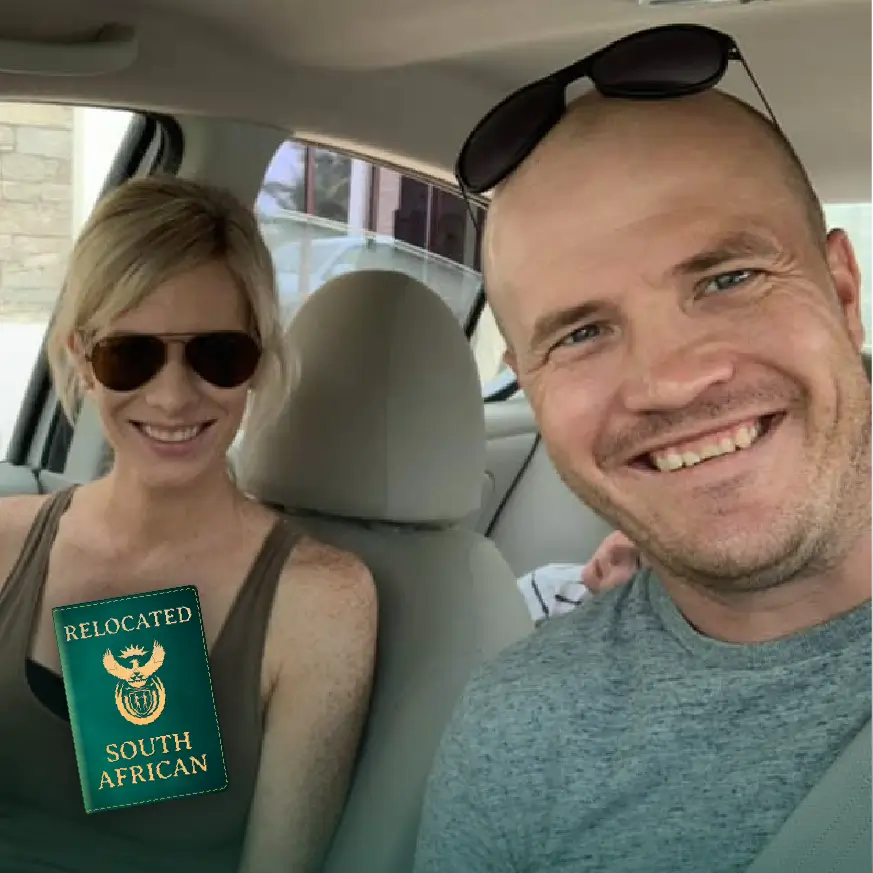
Jan Hugo: Welcome to the Relocated South African, a show for navigating immigration from South Africa for a better future. Today we are joined by Wade Loehmer living in Dubai and maybe his wife a bit later on. Welcome, Wade. It’s lovely to have you on the show.
Wade Loehmer: Thanks. I appreciate it.
Jan Hugo: You guys are celebrating your 10th anniversary in Dubai. That’s a long time, isn’t it?
Wade Loehmer: It is. And when you reflect on the initial decision to move, I think you didn’t quite expect 10 years, but yes, it’s gone by quickly.
Jan Hugo: OK, because that was my first question, was Dubai driven by work opportunity?
Wade Loehmer: I think at the time when we were deciding, Estelle’s older two sisters had both already relocated to the UAE, both in Abu Dhabi at that time. And we had come across to visit them on one occasion and I told Estelle, it seems like they’re building quite a lot of things out here. And I was in the construction industry in South Africa. And I said, I wonder if I should try and push my CV forward. And that was the start of the sea that was planted.
Jan Hugo: Okay, that’s very interesting. And you have three kids, is that right?
Wade Loehmer: Yes, all born, yeah. We moved across when Estelle was six months pregnant with Luca. So we know Dubai as Dubai with kids, which is different to many other expats that come out at a younger age.
Jan Hugo: I can absolutely imagine that. And I mean, one of the first questions that people ask you when you look at relocating in different countries, different stories, but from a medical perspective, has it been a good experience having three kids there?
Wade Loehmer: Yes, it has been something that we only realized much later how spoiled we are with the medical conditions that family members in South Africa picked up. And then you reflect on the hotel room that you’re offered during your stay with birth. So yeah, the medical system is quite well advanced and fortunate to have had all babies here in good conditions.
Jan Hugo: Okay and just, I mean an admin question in a lot of countries, if you’re born in that country, like my grandson was born in Ireland and he’s become an Irish citizen, does that apply in Dubai?
Wade Loehmer: No, not yet. You still have to apply for your passport from your home country, whichever that may be. So there’s no citizenship through birth in the UAE yet.
Jan Hugo: Okay, and you guys have been living there for 10 years. Does that mean you get a permanent residence now or do you still have to apply on a regular basis for visas to stay?
Wade Loehmer: Our visas are renewed every three years through the work and the UAE has recently brought out a golden visa campaign where through qualification you can apply for a 10-year visa that then takes you off your employer’s sponsorship, and you can go on your own. And that is through qualification or investment. But it’s a 10-year golden visa. It’s not a citizenship or passport.
Jan Hugo: Yeah, because I’ve heard that it’s very difficult to get actual citizenship in the UAE. I think it’s a bit like Monaco. You have to be born to Monarch parents, otherwise you won’t get citizenship. Unless, I think there, the prince can give you citizenship if you’re really good to him.
Wade Loehmer: I believe it’s very similar. On the sporting front, I think some individuals who have not been born to Emirati parents sometimes get offered that because they represent the UAE at Olympics or other international sporting events. So those are the instances that I have heard of people not born to Emirati parents that have been offered citizenship.
Jan Hugo: Okay, that’s actually very interesting. And currently you’re working for a big UAE construction company.
Wade Loehmer: Yes, the company originally started out of South Africa. It’s called Mirage Leisure & Development. And 25 years ago, if not mistaken, I think we’ve just crossed the 25 year, six South Africans came across to the UAE and the company was birthed. And in 2015, EMAAR, which is a large developer, they bought majority shareholding within Mirage. And three years later, they called the shares, in essence, took over the full ownership of the company. And at that point, there were some changes in the executive body. So we’re now owned by EMAAR, but still an entity on our own have to be profitable and do work outside of EMAAR as well.
Jan Hugo: Okay, and EMAAR is owned by the Maktoum family, etc.
Wade Loehmer: Mohamed Alabbar is the founder and CEO that there is a link to the government as well. So it’s a government, semi-government company they refer to. So you have some limitations where a private company will not have it. Yes, not fully government, they refer to us as semi-government.
Jan Hugo: Okay, and the construction is continuing unabated in that place?
Wade Loehmer: Interesting enough, yes. And your eye is drawn to what used to be the desert landscape that is fully developed and continues to be developed. A lot of the areas that were considered as a desert area have now been changed to villas, some very high-end villas with waterfronts, you call it waterfront lakes, if you want to refer to it as that. And then on the smaller remaining plots around the ocean or Gulf, development continues to thrive as well. And very recently, a lot of projects launched on the extreme luxury criteria. So quite a vast spread from villas all the way through to extreme luxury. And if I’m not mistaken, the sales are still outweighing the the demon is outweighing the supply at the moment.
Jan Hugo: Yeah, that’s unbelievable. Just off the cuff question, I know for instance in Monaco where they were developing land out of the sea and they were constructing an ultra luxury apartments and they were going in euro off plan. They were selling for 70,000 euro a square meter. They were fully sold off plan. And then I read that if you were wanting to buy in the secondary market, they were going at 100,000 euros a square. Is that kind of similar to the numbers in Dubai?
Wade Loehmer: Not those that are involved, but there are some real high-end stuff. And what you mentioned is very similar to, I suppose, the investors’ mindset. Yeah, some are bought to be turned around just before the hotel or, sorry, with a service department or apartments get completed, they then roll them over to get their percentage on their investment. So some are long-term investors that pick up multiple properties and others buy off plan to then sell just before completion. I think they absorb the risk of a delay in completion and that is why they buy from a premium knowing there’s no one that has lived in it but you can pick it up just before completion which means you’re a bit more certain of the completion date and when you’re moving in. So that seems to be the trend here.
And then there’s a big current trend in the market with the rental prices that are very high. and many families have chosen to now purchase property and that’s then in the resale market. So second hand, is it second hand owners? They’ve bought it from someone that has owned it before. The value has been occupied and then buy it, often having to give the tenants notice, which as per the UAE government is one year notice from the courts of Dubai and at that point then they can move into the property.
Jan Hugo: Oh well that’s really, really interesting. So just thinking back to 10 years ago, nine and a bit years when you left South Africa, obviously with your wife’s family already living in the UAE, so that made the decision easier. Was it a difficult decision in the end to leave?
Wade Loehmer: I think there was a lot of excitement being, I call young. We still, I suppose, young factors considering, but we didn’t have kids that were in a schooling system. So it was pretty much, I believe, an easier decision than a decision that had to be made now if the kiddies were really in school established, had their friends. So for us, what deemed to be an easy decision is reality kicked in the night that we started saying goodbye and you realize you are leaving.
The comforting factor was the time zone, which I think works for the UAE. It’s only two hours time difference to South Africa. So with the family being there, at least you keep communication going. One of the difficult things at that time was the UAE were on a Sunday to Thursday work week. So then your your rest day would be a Friday and you would, the construction industry would pick up on the Saturday again. So we would get Fridays and Saturdays off and Sunday you start working. So there’s a bit of a difficulty there keeping full relationships going or while you’re watching sport on a Saturday night, bit of a mismatch. But I’m trying to recall it was post COVID, I believe, then they changed it to Monday to Friday work week.
Jan Hugo: Oh so you guys, I didn’t realise I was there in 2008 for a few months and that was quite irritating doing any kind of work on a Sunday. Body didn’t react well to this.
Wade Loehmer: The other thing that was a bit more challenging, I suppose at that time, is yes, although we had family once you settle, and because we were close in that family in South Africa, then the reality does kick in. It’s not just driving on the road to see the parents or see the friends that I believe with technology and the WhatsApp groups. It was probably easier than people many years ago. But that’s when the reality starts kicking in. Once you’ve moved and what they call the honeymoon period has lapsed, I think then the challenges start becoming real.
Jan Hugo: I can imagine that. That’s absolutely right. And as you say, especially when you have a close knit family, but all your siblings are still in South Africa.
Wade Loehmer: Yes. My youngest brother has just moved to Austria in August with his wife, but my oldest brother and parents are in South Africa.
Jan Hugo: Yes. Okay. Now, I think that’s, you know, from listening to other people and discussions, that’s probably the hardest thing is, is what you leave. What we finding here, particularly, we have a very big expat community of English, lots of English, lots of Swedish, and they’re a lot closer to home, but they tend to keep family relations on a different basis to us because it’s a short flight for them. It’s two or three hours and they back home with family and they’re going for a weekend, which we can’t do with South Africa. And I think when you leave South Africa, one has to appreciate that it’s quite a big call to make. And I think the other thing that we found, and maybe you have other friends and expats that are around you, but the one thing that I’ve realised is if you leave while looking over your shoulder with a mindset of, well, if it doesn’t work out, I’ll go back. If you think that way, you will go back. That certainly is my view. Otherwise, you don’t give it your full attention to make it work.
Wade Loehmer: Yeah, I suppose I don’t know what the other people you’ve chatted to, but I think with the UAE, because you don’t get permanent residency, we all know we have to leave at some point. And I think that’s the difficulty in the UAE and also alludes to one of the challenging items is you actually make friends and we’ve made very close friends who then left to Australia. So that’s always the question of when is the next person going to leave because as it stands, everyone has to leave the UAE. There’s no real retirement facilities available to an expat. So in that light, yes, you have to make a plan, what they call your departure plan. Where do you go to next? Is it back to South Africa or is it somewhere else? And that’s a decision that I think hangs on a lot of us in the UAE. But the timeline is dependent on your timeline or work dependent. So yes, many people have been here for 20 plus years and others is a pit stop two or three years, save a bit of money and then they’re off again.
Jan Hugo: Okay, that’s a very interesting perspective. I didn’t think about it like that. I mean, that’s one of the questions that obviously comes up in all of these discussions is, you know, would you go back? I know we’re at a different in a different age group and all my kids or three of our four kids live overseas, so it’s quite difficult for us to go back, not that I want to go back. But I think once you get used to life here and the safety and the security and the things that work, it becomes a really hard decision. And I guess for you guys, just financially, it must be a nightmare to go back and go and earn Rand again, unless you become the CEO of a company.
Wade Loehmer: Yeah I think the heart belongs to South Africa and even our kids just to bring some perspective is the kids believe they are and they are because they’ve got a South African passport but they are full on South African walk around our shoes often commented on where’s the kids shoes where’s the kids shoes for example. And I think the heart is still South African and maybe it’s because the UAE is very open to having international days where all the nationalities within the schools, countries are celebrated and you are reminded that you originate from this country. However, as you said, I believe in the construction industry as it stands, it’s a challenging environment in South Africa and many friends are there in the construction industry and actually doing very well. Yes, and our heart longs for it. But I also see a lot of the positives that we have available to us here. And then you realize, yes, what are the pros and the cons of being back in South Africa? But as you said, even amongst the people, what is your departure plan as I stated? And we don’t have one, strange enough. We feel we we call to be on the UAE and making this home as best we can and see what happens in the future. But yeah, I think the benefit is that we do get an opportunity to go back once every year or 18 months to South Africa to get a bit of of that taste of what we used to, and then you come back to this environment again. And there’s a lot of South Africans in the UAE, so you’re not too lonely.
Jan Hugo: I believe so. I believe this. So you do have a big expat community. And I’m finding that, you know, people come and visit here as well, which is absolutely lucky to see people from South Africa and hear all the stories. And the one thing we know is that we laugh at different jokes to some of these other experts. So we have a lot of contact with Swedes and some of them have no sense of humor.
Wade Loehmer: They don’t pick up on your dry sense of humour, do they?
Jan Hugo: No, absolutely. Very difficult. So your kids go to international schools, is that right?
Wade Loehmer: Yes, so in the UAE, most schools are what we would refer to in South Africa as private schools. But there are local schools that are for Emirati, and I don’t have enough knowledge to know whether they are open to other nationalities, but they are referred to as local schools. and then we’ve got many different curriculums at offer. We’ve got the international curriculum, Indian, Australian, British and American curriculum. Those are the main ones that are on offer in the UAE. So your decision For us, we followed the British curriculum. We felt that’s easiest for us to relate to, I suppose. So our kids are in a British curriculum school.
Jan Hugo: Okay. And is there any requirement to learn Arabic for kids?
Wade Loehmer: Yes. As part of their school rating, they get rated by the KHDA, which is the Education Department. And having Arabic as an option is one of the criteria. And it would be similar to my reference as a kid, you would have a first and second language. So Arabic for some kids will go as a first language. And for example, our kids do it as a secondary language.
Jan Hugo: Okay, okay, so it is. And just talking about language, is it an issue there at all?
Wade Loehmer: Not at all. No. No, interesting enough, I believe, especially in the UAE, that English is understood by most people we would interact with. But no, the road signs, everything is in both English and Arabic.
Jan Hugo: Okay, so you don’t end on working with construction and so on. That’s not an issue.
Wade Loehmer: No, I think you’d be better off if you could speak Urdu or Hindi, which is the Pakistani and Indian. Yeah. Um, one of my friends who, who’s been here for 15 years, I believe he’s South African from the farmlands and he speaks full on Urdu, which is he picked up on site. And that takes him a far way because from the taxi drivers to construction, you’re able to then have a proper dialogue.
Jan Hugo: Oh, I guess that’s true. I mean, we’re finding the same in Portugal, especially south on the Algarve. Most people speak English. Every now and then you’ll find a guy who does a delivery or something. You can’t really speak English, but and some of the construction guys, they use a lot of Brazilians here because they’re battling with with finding people to work on construction. It’s a real issue with all the development. But then we use Google Translate and you show the guy what you want to say to him. I’ve given up trying to learn Portuguese. My wife goes to school twice a week. I speak French, I can get along in French, but I’m too old to learn another language. And in terms of kids, they’ve all made luck of friends and they like the lifestyle.
Wade Loehmer: Yeah, I think they have nothing to compare it to. But what they do have available to us here and what the kids have is, I believe, safety that allows them to ride with their bikes in these communities and The only reason why we call it the expat community is because there’s a lot of expats. It’s not a compound like in Saudi. It is open to anyone. We don’t have similar restrictions that Saudi Arabia have. But being able to say, I’m clearly going to my friend’s house and we know it’s within our community and they go up and later on we call the parents, they send the kids home and they come home again. So I believe that is something that they might not have had in South Africa. I don’t think that is available to everyone. Where, yeah, it’s more the norm than not the norm, the way things are set up. And many South African friends and also different nationalities. And I think it’s the benefit of the UAE having a lot of expats and people are open to mingling with different nationalities. But as you said previously with all the understanding of jokes and reference to things that happen in South Africa, there is still, for us, we are still attached to a lot of predominantly more South African friends than other nationalities. But we have other nationality friends as well.
Jan Hugo: Yeah, I mean that’s touched on the safety issue. I guess, you know, we both cyclists, I still cycle after the dishes to accidents. She’s no longer cycles, but it’s not uncommon to see a lady on a bike out in the sticks on her own, you know, and nobody near and for us in South Africa that would just be unthinkable. We, I used to ride with my my taser, every time I went out on the bike in South Africa. And so the safety thing is a massive thing for all of us that do live overseas.
Wade Loehmer: I think on the UAE with, for example, the sport and cycling. Cycling I think has always been quite big and large. And there’s dedicated cycle tracks, 180 kilometers worth of track that’s off next to the main road, but it’s got its own cycle track. And as you said, any time of the day, you’ll be out there three o’clock in the morning, people in the desert riding and not to worry about safety. It’s more. And then with the running very similar with the Stalina that run, she will go out to learn. And as you see in South Africa, you never even consider that. You won’t do the lady run. So, yes, those elements are fantastic. And just on the kids, sorry, with the sport, I think that’s the big things. The African sport, I believe, is a lot more competitive than what it is here, but it’s picking up. When I recall what Estelle’s sister’s kids were doing and what our kids are doing, it has become a lot more competitive and I think our kids are getting the best exposure that they could get now, even within the schooling system, which is good.
Jan Hugo: That’s fantastic. Yeah. That was another question that came up in my mind was the climate. I mean, the summers are exception. I remember days in the environments, 45, 48 degrees, and you can’t get out of your car. How do you guys deal with that in the summer with the kids as well?
Wade Loehmer: I don’t think one ever gets used to it. When we count the years, we actually count the summers. How many summers have you survived? I suppose we have got the vehicles that have got the right air conditioning systems and the buildings are air conditioned, but the kitties are the ones who I suppose they affected the most because the Congo play outside is what they usually would and then a bit more confined to indoors and We’ve got the big malls and big soft play areas and that keeps the kids busy. But yes, it is a challenge that we work through each year.
Jan Hugo: Okay. No, I think that’s something that one has to get used to. We’ve had three weeks of just hostile weather. It’s just been raining. Today we had between 35 and 50 kilometer winds on the Gulf coast. But it’s a funny depression that’s been hanging around Portugal that’s caused this weather. But three weeks of bad weather for us is terrible. We hear how it’s like Cape Town. The summers are quite warm but it’s not… You can live here and the winters are very mild. So that’s very important is the weather. Just a question on, in 10 years have you seen a decline in South Africa? Do you have a bit of a sense of dread when you go back there?
Wade Loehmer: I think initially we were following a lot of what’s going on in the news and I still let my news 24 app and at a stage I decided to stop following it just not because I’m not interested but I think there’s a lot of news that is spread that is it propaganda? Is it the truth? How bad is it? And then I think the best information has come through the friends and then knowing what the family is saying and I believe there’s hope. There’s hoping that there’s been a change of government just so that it is different. And sometimes that is what is necessary to initiate, I suppose, better governance of the finances which drives a lot of, I think, South Africa struggles. I think once that is sorted out, a lot of positive things will come to light. But the friends who are there, many have remained, almost all of them, and speak very positively of their circumstances. But yes, they have set themselves up within a state, so within compounds or safety areas. So I suppose you take yourself out of sometimes the reality that many others face within South Africa. But I haven’t followed enough to know too much detail.
Jan Hugo: Yeah, I think that’s very valid. When we left in 2020, Letitia said if you put that news 24 on one more time. So she took it off my phone, so I don’t have access. I mean, I have two more questions before we finished. The one was religious freedom living in an Arab country. My impression is that one is free to practice your religion. Is that true if you’re a Christian?
Wade Loehmer: Yeah, and they’re very open to it, especially the UAE. And as interesting as it may sound, there’s a new development that’s just opened and it is a Jewish synagogue a mosque and a Hindu temple all on one premises to demonstrate that they are for religions, if that’s the right word. In our or the church community that we attend, yes, we’ve got a warehouse and it is well supported and very thankful for that. And the talk that goes around is that The royal family believed that they would rather accept someone who believes in something, when I call it that, than someone who believes in nothing. And apparently that is why they’re open to it. But yes, we’ve got the freedom to continue going to church as well as those that are or Hindu, which is also not Muslim, they’re able to go to their temples as well. So they’re open to all religions. Okay, that’s fantastic. But it does come with a little caveat is that you’re not allowed to publicly try and evangelize. Yeah, convert people. Yes. And so you’re able to, yes, they’re open to churches, but don’t go on the streets and make too big of a scene. So that’s the line, apparently, of the draw.
Jan Hugo: OK. Well, at least you can practice it. So last question. Is there something you would have done differently moving there? And what advice if you have somebody your age, 10 years ago, was thinking about leaving, what would you say to them?
Wade Loehmer: Yes, I think we learned a valuable lesson and a thankful lesson in a sense is that you are all of a sudden in an environment where you’re earning something that with the exchange rate in Rand means a lot. And we got caught up in the simple thing of moving out of our budget, even though we had prepared a budget, a well-defined budget, because we knew what the costs of living were because of consulting with my brothers in law. But we moved out of that comparing our life to theirs. But they had already been here for eight years. So all of a sudden you’re into a villa and pushing your budget from the onset. And I think that perhaps comes with the conversion rate of your rand. And because many currencies are stronger than the rand, I think we fall into that trap. And we’re also victim of it. All of a sudden you’re earning dirhams. It took us a few years to recover after the lessons learned of year one. And I would think if someone can start off small, find your feet, and then move forward, I believe it would not put you in a position which many South Africans face, unfortunately, is that they get into a lot of debt. And the UAE system doesn’t see that lightly. It’s not anything you want in your name. Yes, I would say being wise with that.
From a practical point of view, I think we left our life insurance active in South Africa, which I believe is still a good choice because there’s a continuation of life insurance and on the conversion rate, it’s not quite a big monthly expense to keep it going. We kept the bank account going because of when you visit South Africa, how do you move money around? And a cell phone, our SIM card, we left it at the lowest. I think it’s 50 Rand a month. It just keeps the number alive. So when you arrive, you’ve got a number. You don’t have to figure that went well. And then, you know, the only struggle we face here is with passport renewals. And when you renew your passport, it takes anything from six to eight months to get your passport back. So that’s a bit of a damper that we face this side. So make sure before you fly out, you get your passport renewed. So you’ve got 10 years before you have to worry about it.
Jan Hugo: Many thanks for a very interesting conversation Wade. It was great to hear about your life in Dubai and thanks for sharing some really good advice for making the move from South Africa. If you enjoyed my conversation with Wade and would like to hear more from people who have made the move, why not subscribe to the show? Thanks and until next time.